

“Your Daily Dose” is a quick two minute read packed with bite-sized wisdom from all the great teachers. But you could also choose to turn it into something more… a powerful daily practice for personal growth. Give it a try!
A message from today’s meditation:
The human condition so often finds itself gripping on tightly to what it perceives as a sense of safety, while violently resisting the things that scare it.
Stretched thin – between clinging to what is fleeting, and resisting what is inevitable – leaves us with no energy to take action where we are actually effective.
We cling to possessions, relationships, and even our identities with a white-knuckle grip, terrified of relinquishing control. Yet, in this relentless pursuit of security, we often overlook a profound truth: it is in letting go that we free up the energy to be at our best!
We are so accustomed to believing that our grip on life’s reins is a measure of our power. But what if the opposite were true? What if relinquishing control allowed us to access a deeper well of strength and resilience?
“Some of us think holding on makes us strong; but sometimes it is letting go.” – Hermann Hesse
“No permanence is ours, we are a wave that flows to fit whatever form it finds.” – Hermann Hesse
“You say yes to the sunlight and pure fantasies, so you have to say yes to the filth and the nausea. Everything is within you, gold and mud, happiness and pain, the laughter of childhood and the apprehension of death. Say yes to everything, shirk nothing.” – Hermann Hesse
To break free from our own exhausting grip on control, we must embrace the concept of surrender, and have acceptance for both the light and the darkness of life’s complexity. We cannot experience joy without sorrow, or growth without challenges. By surrendering to all aspects of our experience, we open ourselves to a deeper understanding of ourselves and the world around us. It doesn’t mean giving up or becoming passive; rather, it signifies a willingness to trust in a higher power, or simply in the natural flow of life itself.
Surrender is not about weakness, but about strength. It’s about recognizing that we are part of something greater than ourselves and that our resistance to life’s currents is futile. In the quiet space of surrender, the mind clears, and a sense of peace emerges. It’s in this clarity that we can truly see our path forward and take inspired action.
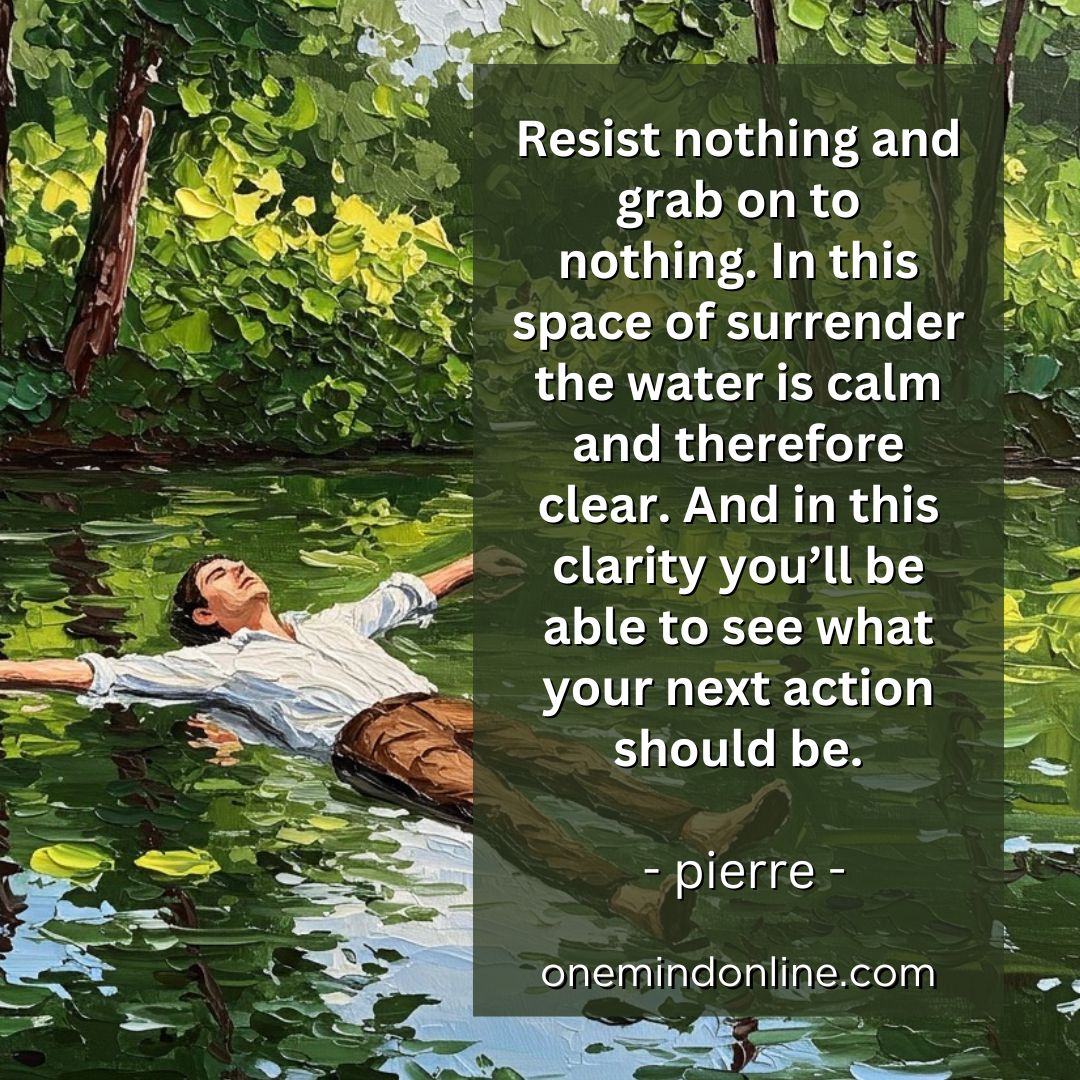
Resist nothing and grab on to nothing. In this space of surrender the water is calm and therefore clear. And in this clarity you’ll be able to see what your next action should be.
A few thoughts to consider as you open yourself to surrender:
- Let go of what you can’t control. Trying to control just wastes your energy.
- Embrace the unknown with curiosity. In the unknown you will create the new.
- Trust that clarity will follow surrender. When you stop splashing, the water always becomes clear.
- Find an abundance of energy in surrender. All the energy you wasted in trying to control, now becomes available to you.
- Promise yourself that you will always act on clarity. When you can see the next baby step, take it, even if you feel scared.
Our personal growth is always accelerated when we stop wasting energy on what is not ours to control, and place all of our focus only on the next step to take. Today’s meditation journey is a very practical exercise in surrender. Join us to find your own way to clarity.
– pierre –
Today’s LIVE meditation is: Surrender
Today’s LIVE meditation
https://youtu.be/nmUGH6ynkfM 2026
https://youtu.be/Gq3vKEgDk-0 2024
https://youtu.be/HYzewszghHY 2023
https://youtu.be/oepUyKR4r64 2022
Practice the “Daily Dose”
Let’s put it into practice! Choose what works for you – daily, once a week or whenever inspiration strikes. Putting pen to paper wires the neural pathways that will create your new habits.
1 – Affirmation
Not quote affirmations today, but a few important thoughts to consider in your relationship with surrender. Write down your favourite one on a sticky note and place it somewhere that you’ll be able to see it the whole day.
- Let go of what you can’t control. Trying to control just wastes your energy.
- Embrace the unknown with curiosity. In the unknown you will create the new.
- Trust that clarity will follow surrender. When you stop splashing, the water always becomes clear.
- Find an abundance of energy in surrender. All the energy you wasted in trying to control, now becomes available to you.
- Promise yourself that you will always act on clarity. When you can see the next baby step, take it, even if you feel scared.
2 – A moment of reflection
Use today’s question as a journal prompt. If you don’t have the time to sit down and write, just take a moment to reflect on your response.
“In this space of surrender the water is calm and therefore clear. And in this clarity you’ll be able to see what your next action should be.”: Picture the water in your life right now – is it swirling with silt, or beginning to settle? Bring to mind one decision or situation that currently feels murky, one where you don’t know your next step. Instead of asking “What should I do?”, try asking “What am I still stirring up?” – the anxious rehearsing, the endless researching, the reaching for certainty before it’s ready to arrive. Write about what it would feel like to set all of that down, even just for the length of this entry, and let the sediment sink on its own. When the stirring finally stops, what rises into view? Trust that your next action doesn’t need to be forced into focus – it only needs enough stillness to be seen.
3 – Quotes to share
Send a quote to someone who needs it, or share them all on social media to spread the good vibes!
4 – Q&A for deeper learning
Read through the questions and answers and write down at least one “aha moment” that clicked for you.
Q1: Doesn’t surrendering mean giving up on my goals and dreams?
Not at all – surrender isn’t about giving up, it’s about refusing to give up, while also refusing to thrash about in fear. There’s a world of difference between someone grabbing and clawing at the water trying to stay afloat, and a swimmer who surrenders to the water, trusting that the water will hold them, and swimming with a measured rhythm towards their goal.
Q2: How do I know what I can and can’t control?
A simple test: ask yourself, “Can I directly influence this outcome through my actions right now?” You can control your responses, choices, effort, and attitude. You cannot control other people’s decisions, external circumstances, timing, or final outcomes. Focus your energy on your actions and responses, and surrender the rest. This distinction becomes clearer with practice and honest self-reflection.
Q3: Won’t people take advantage of me if I stop trying to control situations?
Surrender doesn’t mean becoming passive or allowing others to walk over you. It means responding from wisdom rather than reactivity. When you’re not wasting energy on futile control attempts, you actually become more aware and can set clearer boundaries. True strength comes from knowing when to act and when to let go, not from trying to control everything around you.
Q4: How do I “say yes” to painful experiences without becoming overwhelmed?
Saying yes to pain doesn’t mean seeking it out or wallowing in it. It means accepting that difficult emotions and experiences are part of life’s natural rhythm. Practice acknowledging painful feelings without immediately trying to fix or escape them. You might say, “I see you, sadness” or “I accept this anxiety as part of my current experience, and I’ll focus on what action I can take.” This acceptance often allows difficult emotions to move through you more naturally.
Q5: What’s the difference between surrender and resignation?
Resignation is passive and often bitter – it’s giving up with a sense of defeat. Surrender is active and conscious – it’s a choice to release control while remaining fully engaged with life. Resignation says, “Nothing matters, so why try?” Surrender says, “I don’t control outcomes, but I can give my best effort and trust the process.” Surrender actually increases your capacity for meaningful action.
Q6: How can I practice surrender in daily life when everything feels urgent?
Start small. When you feel overwhelmed, pause and ask: “What’s the very next step I can take?” Focus only on that one action, releasing worry about the ten steps after it. Practice the “calm water” technique – when you notice yourself “splashing” mentally, take three deep breaths and remind yourself that clarity comes from calm, not from frantic activity. Build this muscle gradually throughout your day.
Q7: How do I trust that clarity will come when I surrender?
Trust builds through experience. Start by noticing times when you’ve been overthinking a problem, then stepped away and suddenly the solution became obvious. This is surrender in action. Begin with low-stakes situations – surrender your need to control how a conversation goes or the outcome of a minor decision. As you experience the clarity and peace that follow, your trust in this process will naturally grow. Remember, you’re not trusting an external force – you’re trusting your own innate wisdom to emerge when you stop forcing it.