
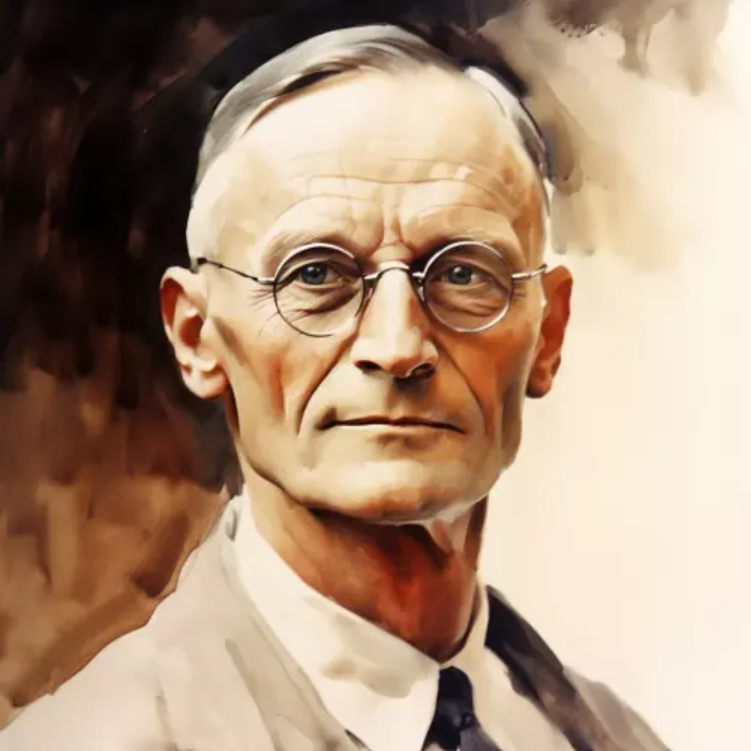
Long before modern mindfulness entered the mainstream cultural lexicon, Hermann Hesse was mapping the quiet, turbulent contours of the human soul. Born in Calw, Germany, in 1877 into a German and Russian family steeped in missionary work, Hesse grew up amidst profound tragedy and personal turmoil – losing three siblings in infancy and exhibiting severe depressive tendencies from a young age. In May of 1892, following a suicide attempt at just fourteen, he began a grueling journey through institutions in Bad Boll, a mental facility, and later a boy’s home in Basel. Yet this early exposure to deep darkness, institutional constraint, and inner anguish did not break his spirit; instead, it forged a rare, unvarnished empathy for the wounded seeker and laid the groundwork for his lifelong exploration of identity and the human condition.
Rather than breaking under the weight of his struggles, Hesse transformed his suffering into visionary literature. Drawing deeply from Eastern philosophy and Western thought – from Buddha and St. Francis of Assisi to Nietzsche and Dostoevsky – he crafted timeless literary mirrors for anyone searching for authenticity, spirituality, and inner balance. His unique perspective earned him the 1946 Nobel Prize in Literature, awarded during the turbulent aftermath of World War II and the fall of the Nazi regime. In a world fractured by dogma and war, it was particularly the younger generation who rallied around his work, finding solace in masterpieces like Siddhartha, Steppenwolf – which brilliantly dissects the conflict between primal instinct and spiritual ideal – and The Glass Bead Game.
To read Hermann Hesse today is to enter a sacred dialogue with a celebrated master who knew firsthand the darkest depths of the human psyche, yet still pointed toward light, wholeness, and self-mastery. He never positioned himself as a rigid guru offering simple answers, but as a fellow traveler reminding us that wisdom cannot be taught; it must be directly lived. As we explore his life and teachings, we are invited to pause, step away from collective noise, and remember the central truth echoing through all his work: that the ultimate destination of any true spiritual journey is the courageous return to oneself.
Click on the image for more context.
“I have always believed, and I still believe, that whatever good or bad fortune may come our way we can always give it meaning and transform it into something of value.” – Hermann Hesse
Click on the image for more context.

“Every experience has its element of magic.” – Hermann Hesse
Click on the image for more context.
“Learn what is to be taken seriously, and laugh at the rest.” – Hermann Hesse
Click on the image for more context.
“Some of us think holding on makes us strong; but sometimes it is letting go.” – Hermann Hesse
Click on the image for more context.
“No permanence is ours, we are a wave that flows to fit whatever form it finds.” – Hermann Hesse
Click on the image for more context.

“You say yes to the sunlight and pure fantasies, so you have to say yes to the filth and the nausea. Everything is within you, gold and mud, happiness and pain, the laughter of childhood and the apprehension of death. Say yes to everything, shirk nothing.” – Hermann Hesse
Click on the image for more context.
“As a body everyone is single, as a soul never.” – Hermann Hesse
Click on the image for more context.
“Slowly blossomed, slowly ripened in Siddhartha the realization, the knowledge, what wisdom actually was, what the goal of his long search was. It was nothing but a readiness of the soul, an ability, a secret art, to think every moment, while living his life, the thought of oneness, to be able to feel and inhale the oneness.” – Hermann Hesse
Click on the image for more context.
“To hold our tongues when everyone is gossiping, to smile without hostility at people and institutions, to compensate for the shortage of love in the world with more love in small, private matters; to be more faithful in our work, to show greater patience, to forgo the cheap revenge obtainable from mockery and criticism: all these are things we can do.” – Hermann Hesse
Click on the image for more context.

“I wanted only to live in accord with the promptings which came from my true self. Why was that so very difficult?” – Hermann Hesse
Click on the image for more context.
“You know quite well, deep within you, that there is only a single magic, a single power, a single salvation… and that is called loving. Well, then, love your suffering. Do not resist it, do not flee from it. It is your aversion that hurts, nothing else.” – Hermann Hesse
Click on the image for more context.

“You are only afraid if you are not in harmony with yourself. People are afraid because they have never owned up to themselves. A whole society composed of people afraid of the unknown within them!” – Hermann Hesse
Click on the image for more context.
“The true profession of a man is to find his way to himself.” – Hermann Hesse
Click on the image for more context.
“It may be important to great thinkers to examine the world, to explain and despise it. But I think it is only important to love the world, not to despise it, not for us to hate each other, but to be able to regard the world and ourselves and all beings with love, admiration and respect.” – Hermann Hesse
Click on the image for more context.
“Happiness IS love, nothing else. A human who is capable of love is happy.” – Hermann Hesse
Click on the image for more context.
“… gentleness is stronger than severity, water is stronger than rock, love is stronger than force.” – Hermann Hesse
Click on the image for more context.
“Have you also learned that secret from the river; that there is no such thing as time?” That the river is everywhere at the same time, at the source and at the mouth, at the waterfall, at the ferry, at the current, in the ocean and in the mountains, everywhere and that only the present exists for it, not the shadow of the past nor the shadow of the future.” – Hermann Hesse
Click on the image for more context.
“He saw that the water continually flowed and flowed and yet it was always there; it was always the same and yet, every moment it was new.” – Hermann Hesse
Click on the image for more context.
“This day will never come again and anyone who fails to eat and drink and taste and smell it will never have it offered to him again in all eternity. The sun will never shine as it does today… but you must play your part and sing a song, one of your best.” – Hermann Hesse
Click on the image for more context.
“During deep meditation it is possible to dispel time, to see simultaneously all the past, present, and future, and then everything is good, everything is perfect.” – Hermann Hesse
Click on the image for more context.

“A tree has something to say to us: Be still! Be still! Look at me!… Home is within you, or home is nowhere at all.” – Hermann Hesse
Click on the image for more context.

“We must become so alone, so utterly alone, that we withdraw into our innermost self… Then our solitude is overcome, we are no longer alone, for we find that our innermost self is the spirit, that it is God, the indivisible. And suddenly we find ourselves in the midst of the world, yet undisturbed by its multiplicity, for our innermost soul we know ourselves to be one with all being.” – Hermann Hesse
Click on the image for more context.
“Within you there is a stillness and sanctuary to which you can retreat at any time and be yourself.” – Hermann Hesse
Click on the image for more context.