

“Your Daily Dose” is a quick two minute read packed with bite-sized wisdom from all the great teachers. But you could also choose to turn it into something more… a powerful daily practice for personal growth. Give it a try!
A message from today’s meditation:
I love to really dig into the science of how we are put together. I feel like I’ve been given the “operators manual” to this vehicle that I’m driving around here on planet Earth, and slowly I’m understanding more of what all the buttons and switches do.
Today’s meditation is the journey of the chemistry that happens in our bodies while we meditate. Do yourself a favour and make some time for this one in order to understand your body better. But even if you don’t find the time to meditate today, become open to the idea that your mind holds the key to everything that happens inside your body.
The perception in your mind is reflected in the chemistry of your body. From one thought to the next, the chemistry in every cell of your body is adjusted. This means that you can literally change the fate of your cells by changing your thinking.
I’ll leave you with this quote from Dr. Bruce Lipton’s book “The Biology of Belief”
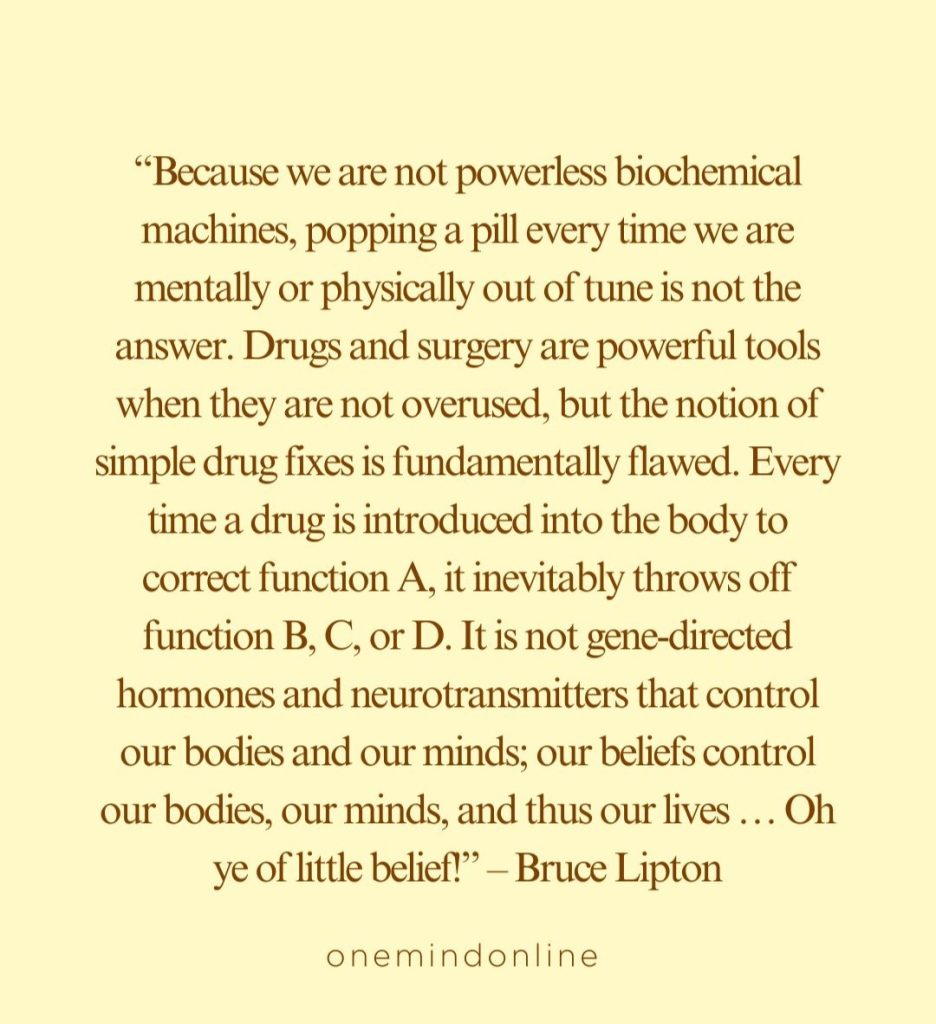
“Because we are not powerless biochemical machines, popping a pill every time we are mentally or physically out of tune is not the answer. Drugs and surgery are powerful tools when they are not overused, but the notion of simple drug fixes is fundamentally flawed. Every time a drug is introduced into the body to correct function A, it inevitably throws off function B, C, or D. It is not gene-directed hormones and neurotransmitters that control our bodies and our minds; our beliefs control our bodies, our minds, and thus our lives … Oh ye of little belief!” – Bruce Lipton
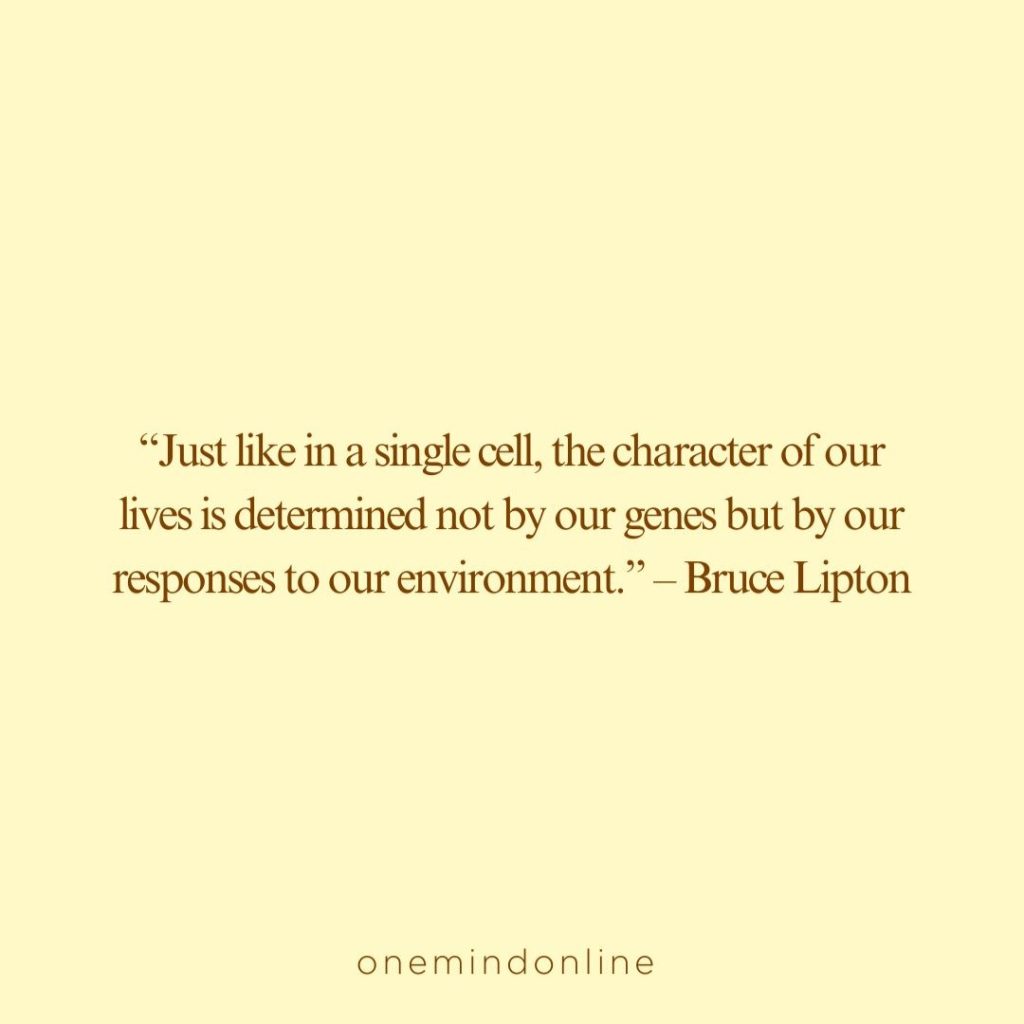
“Just like in a single cell, the character of our lives is determined not by our genes but by our responses to our environment.” – Bruce Lipton
The more regularly you meditate, the clearer you start to see yourself interacting with your environment. It gives you the perspective of “the observer” and then your experience shifts from “I am drowning in this storm!” to… “oh I can see that I feel like I am drowning in a storm.”
Just this simple shift of awareness brings about a completely different chemical environment in your body, creating the space for both mental and physical health. Every shift in mindset – from worry to wonder – sends ripples through your cells, altering your biochemistry in real-time.
A few guiding mantras:
- “My thoughts are the conductors of my body’s chemistry.”
- “I can choose to play a soothing symphony in my body, or a chaotic cacophony.”
- “Every breath is a chance to rewrite my internal script.”
- “I am the composer of my health and happiness.”
Give today’s meditation a try, you won’t be sorry.
– pierre –
Today’s LIVE meditation is: The science of meditation.
Today’s LIVE meditation
https://youtu.be/TIK1Ws3qYTQ 2024
Practice the “Daily Dose”
Let’s put it into practice! Choose what works for you – daily, once a week or whenever inspiration strikes. Putting pen to paper wires the neural pathways that will create your new habits.
1 – Affirmation
Write down your favourite affirmation on a sticky note and place it somewhere that you’ll be able to see it the whole day.
- “My thoughts are the conductors of my body’s chemistry.”
- “I can choose to play a soothing symphony in my body, or a chaotic cacophony.”
- “Every breath is a chance to rewrite my internal script.”
- “I am the composer of my health and happiness.”
2 – A moment of reflection
Use today’s question as a journal prompt. If you don’t have the time to sit down and write, just take a moment to reflect on your response.
The Operator’s Manual: If your body came with an instruction manual, what chapter do you wish you understood better? What “buttons and switches” in your physical or emotional system remain mysterious to you, and what would you like to learn about how to operate them more skillfully? If you write down the things you want to learn more of, then you’re telling your brain what you want it to pay attention to, and you will indeed see more helpful content on this subject.
3 – Quotes to share
Send a quote to someone who needs it, or share them all on social media to spread the good vibes!



4 – Q&A for deeper learning
Read through the questions and answers and write down at least one “aha moment” that clicked for you.
Q1: What does it mean that “the perception in your mind is reflected in the chemistry of your body”?
A: This means that your thoughts and beliefs directly influence your body’s biochemistry. When you think a stressful thought, your body releases cortisol and adrenaline. When you feel gratitude or peace, your body produces different chemicals like oxytocin and serotonin. Your mental state isn’t separate from your physical state—they’re constantly communicating and influencing each other in real-time.
Q2: Can I really change the fate of my cells by changing my thinking?
A: Yes, according to the science of epigenetics. While you can’t change your genetic code, you can influence how your genes express themselves through your environment, beliefs, and behaviors. Your thoughts create chemical signals that can turn genes on or off, affecting everything from inflammation to immune response. This doesn’t mean positive thinking cures all diseases, but it does mean your mental state plays a significant role in your physical health.
Q3: Why does Dr. Lipton say we’re not “powerless biochemical machines”?
A: This challenges the traditional view that we’re simply victims of our biology and genes, with medication being the only solution. Lipton argues that while drugs have their place, they often create side effects by disrupting other systems. Instead, he emphasizes that our beliefs and perceptions actively shape our biology, giving us much more agency over our health than we’ve been taught to believe.
Q4: What’s the difference between “I am drowning in this storm” and “I can see that I feel like I’m drowning in a storm”?
A: The first statement is total identification with the emotion—you become the overwhelm. The second creates a small space between you (the observer) and your experience. This shift activates different neural pathways and creates a calmer biochemical environment in your body. When you observe your feelings rather than become them, you engage your prefrontal cortex (reasoning brain) rather than just your amygdala (fear center), which literally changes your body’s stress response.
Q5: How does meditation give you the perspective of “the observer”?
A: Meditation trains you to notice your thoughts, feelings, and sensations without immediately reacting to them. Through regular practice, you develop the ability to step back and watch your mental and emotional processes as if from a slight distance. This observational stance becomes available to you throughout your day, not just while meditating, allowing you to respond thoughtfully rather than react automatically to life’s challenges.