

“Your Daily Dose” is a quick two minute read packed with bite-sized wisdom from all the great teachers. But you could also choose to turn it into something more… a powerful daily practice for personal growth. Give it a try!
A message from today’s meditation:
We are human, and therefore we all succumb to the most basic human trait – the need to survive. Add to this the fact that we are social animals who for most of our history lived in tribes because we wouldn’t survive solo, then it’s real easy to see that our first survival mechanism is to be acceptable to the tribe.
We have a very deep programme that finds rejection traumatic, and it responds from instinct, trying to make ourselves acceptable to the humans around us. Even if it means that we completely reject ourselves in the process. All in the name of survival.
This isn’t wrong, it’s just human. It’s not something we should judge in ourselves or others, but it is something we can free ourselves from when we take a step backwards and become an observer.
Mooji says:
“Step into the fire of self-discovery, this fire won’t burn you but it will burn everything that you are not.” – Mooji
As we grew up we’ve had to make so many adaptations in order to feel like we could survive, or cope. Even in our adult lives we’ve had to put on a mask or wear some kind of armour in order to feel like we could make it through the day.
Stepping into the fire of self-discovery as Mooji says is the process of realizing that: “what I have always thought of as me, is really the collection masks and armour that I’m wearing. And that the real me might be buried so deep under all of this that I might have forgotten who I really am.”
In today’s meditation we dust off the masks, not with shame, but with curiosity. We examine their patterns, the stories they whisper of childhood fears and societal pressures. This isn’t a witch-hunt, but a treasure hunt, unearthing the gold of our authentic selves.
Mooji warns that change is a stubborn beast though and that old habits tend to cling like barnacles, so please be kind to yourself when you find yourself slipping back into old patterns. Change takes time.
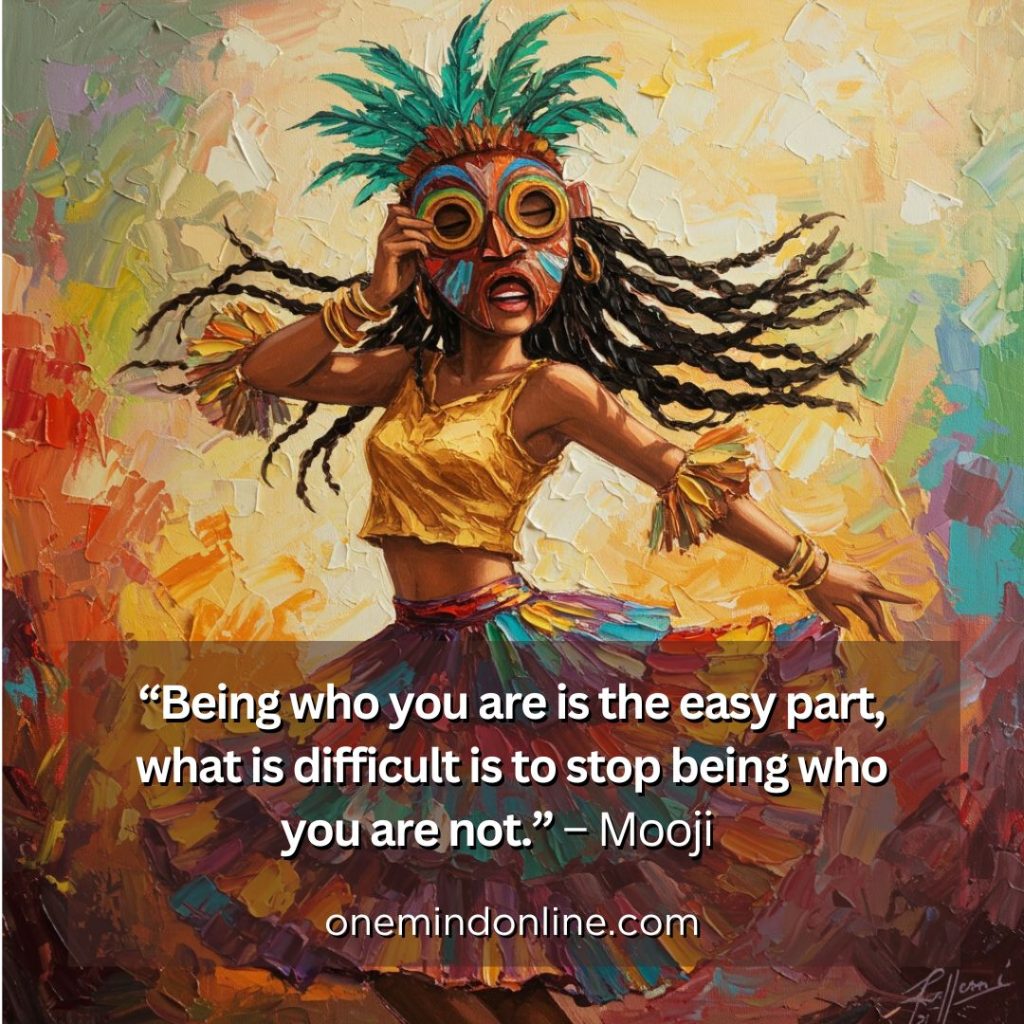
“Being who you are is the easy part, what is difficult is to stop being who you are not.” – Mooji
Inside of you, under all the layers of armour and masks is a beautiful being of pure love. Trust that this is what you are. Trust that your work is not to fight against all your “bad” habits, but simply to keep leaning into your light.
“Whenever we attain a higher vision, the lower vision disappears of itself.” – Swami Vivekananda
Don’t fight against your own low vibrations, but make it your job to reach for the higher vibrations again and again, the masks and the armour and bad habits will disappear of themselves when it becomes clear that you don’t need them to survive anymore.
Mantras for your unmasking:
- “I choose acceptance, of myself and others, knowing that we are all doing our best to survive and thrive.”
- “I shed masks and embrace vulnerability, trusting that my authentic self is worthy of love.”
- “Being me is enough – I don’t need to perform or pretend to deserve belonging.
- “With kindness and patience, I evolve, releasing one mask at a time without judgment.”
- “I shine brightest when I let go of the need to fit in and allow myself to stand out as my true self.”
Join me for today’s LIVE meditation. Let’s shed the masks together and reveal the radiant souls within!
– pierre –
Today’s LIVE meditation is: The masks we wear.
Today’s LIVE meditation
https://youtu.be/d4xu8UrFUl0 2024
https://youtu.be/WF2nK-M9YEw 2023
Practice the “Daily Dose”
Let’s put it into practice! Choose what works for you – daily, once a week or whenever inspiration strikes. Putting pen to paper wires the neural pathways that will create your new habits.
1 – Affirmation
Write down your favourite affirmation on a sticky note and place it somewhere that you’ll be able to see it the whole day.
- “I choose acceptance, of myself and others, knowing that we are all doing our best to survive and thrive.”
- “I shed masks and embrace vulnerability, trusting that my authentic self is worthy of love.”
- “Being me is enough – I don’t need to perform or pretend to deserve belonging.
- “With kindness and patience, I evolve, releasing one mask at a time without judgment.”
- “I shine brightest when I let go of the need to fit in and allow myself to stand out as my true self.”
2 – A moment of reflection
Use today’s question as a journal prompt. If you don’t have the time to sit down and write, just take a moment to reflect on your response.
Underneath the Armor: If you could peel away all the protective layers, masks, and survival strategies, who do you imagine you’d find underneath? What qualities, desires, or expressions have you been hiding? Write a letter from your authentic self to your current self, expressing what it wants you to know.
3 – Quotes to share
Send a quote to someone who needs it, or share them all on social media to spread the good vibes!



4 – Q&A for deeper learning
Read through the questions and answers and write down at least one “aha moment” that clicked for you.
Q1: Why do we develop masks in the first place?
We develop masks as a survival mechanism rooted in our evolutionary history as social animals. For most of human existence, belonging to the tribe meant survival – being rejected could literally mean death. This created a deep psychological program that experiences rejection as traumatic. As children and even adults, we unconsciously develop masks and armor as coping strategies to feel acceptable, loved, and safe within our social groups, even if it means suppressing our authentic selves.
Q2: Is wearing masks always a bad thing?
No, wearing masks isn’t inherently wrong or bad – it’s simply human. These protective strategies helped us survive difficult circumstances and navigate complex social situations. The key is awareness. Problems arise when we’ve worn these masks for so long that we’ve forgotten our true selves underneath, or when the masks prevent us from experiencing genuine connection and self-acceptance. The goal isn’t to judge ourselves for having masks, but to become conscious observers of them.
Q3: How do I know which parts of me are authentic and which are masks?
This is where the “fire of self-discovery” comes in. Authentic aspects of yourself typically feel expansive, energizing, and aligned with your values, even when they’re challenging. Masks often feel performative, draining, or accompanied by anxiety about being “found out.” Ask yourself: “Am I doing this because it genuinely reflects who I am, or because I’m afraid of what will happen if I don’t?” Your body often knows the difference – authentic expression usually feels like relief, while masks feel like tension.
Q4: What does it mean to “reach for higher vibrations” instead of fighting low ones?
Rather than battling against your perceived negative traits, habits, or thought patterns (which often strengthens them through resistance), this approach suggests focusing your energy on cultivating positive states. This might mean choosing gratitude over complaint, compassion over judgment, or presence over anxiety. As Swami Vivekananda taught, when you consistently elevate your consciousness to a higher perspective, the lower patterns naturally fall away because you’ve outgrown the need for them.
Q5: How long does it take to shed these masks and find my authentic self?
This is a lifelong journey rather than a destination. Change takes time, and old habits cling stubbornly because they once served important purposes. The process isn’t linear – you’ll likely find yourself slipping back into old patterns, and that’s completely normal. The key is approaching this journey with kindness and patience rather than urgency or self-criticism. Each moment of awareness is progress, even if outward change seems slow.
Q6: What if my authentic self isn’t acceptable to the people around me?
This is one of the deepest fears that keeps us trapped in our masks – and it’s a valid concern. The truth is, as you become more authentic, some relationships may shift or end, which can be painful. However, you’ll also attract people who appreciate and love the real you, creating deeper and more genuine connections. Additionally, you may find that people respond more positively to your authenticity than you feared. Remember: you survived needing the tribe’s acceptance, but as an adult, you have more choices and resources than you did as a child.
Q7: How can I be kind to myself when I keep falling back into old patterns?
Recognize that those patterns are habits carved deep by years of repetition and genuine need. When you notice yourself slipping back into a mask, treat it as valuable information rather than failure. Observe with curiosity: “What triggered this? What am I afraid of right now?” Then gently redirect yourself without judgment. Think of it like learning any new skill – you wouldn’t berate yourself for not being perfect immediately. Celebrate the moments of awareness as victories, because consciousness itself is the first step toward transformation.