
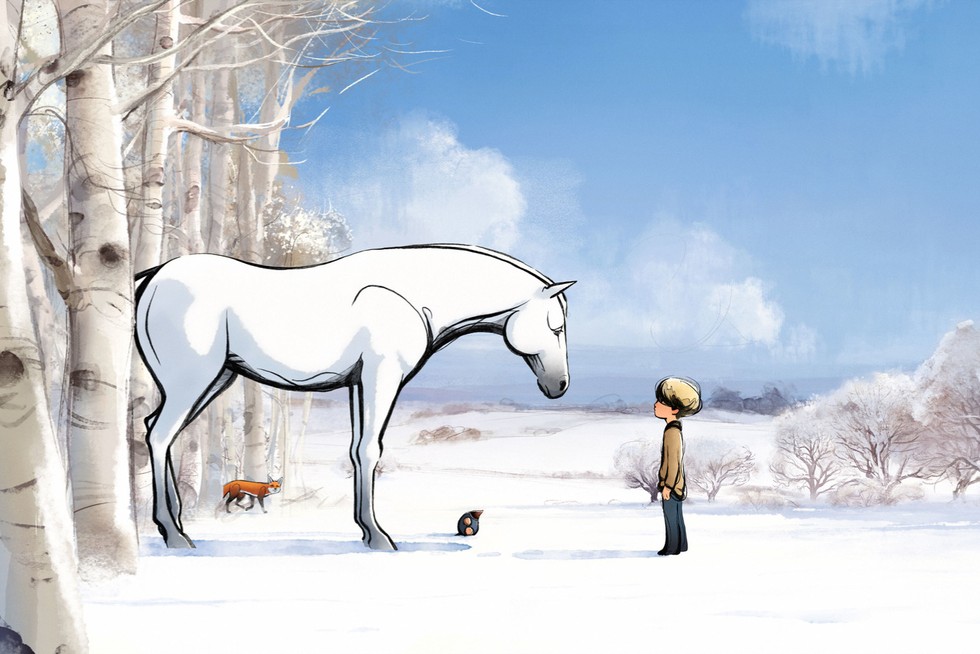
“Your Daily Dose” is a quick two minute read packed with bite-sized wisdom from all the great teachers. But you could also choose to turn it into something more… a powerful daily practice for personal growth. Give it a try!
A message from today’s meditation:
Your ability to choose your response is a superpower. It’s the key to unlocking a life far less stressful and far more fulfilling.
It’s easy to underestimate the power you have to choose your response, or even choose not to respond at all. Instead, you get caught in a trap – your emotions and actions hijacked by external events. You become like a programmed robot, reacting on autopilot whenever a button is pushed.
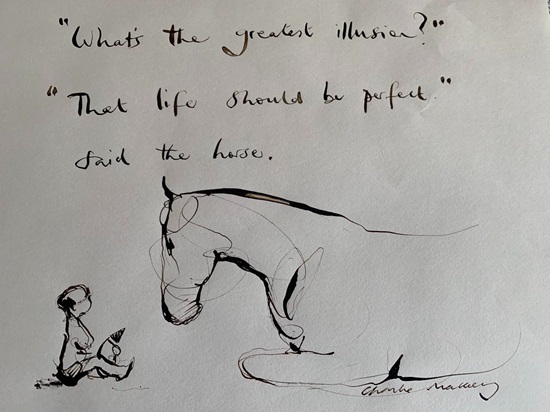
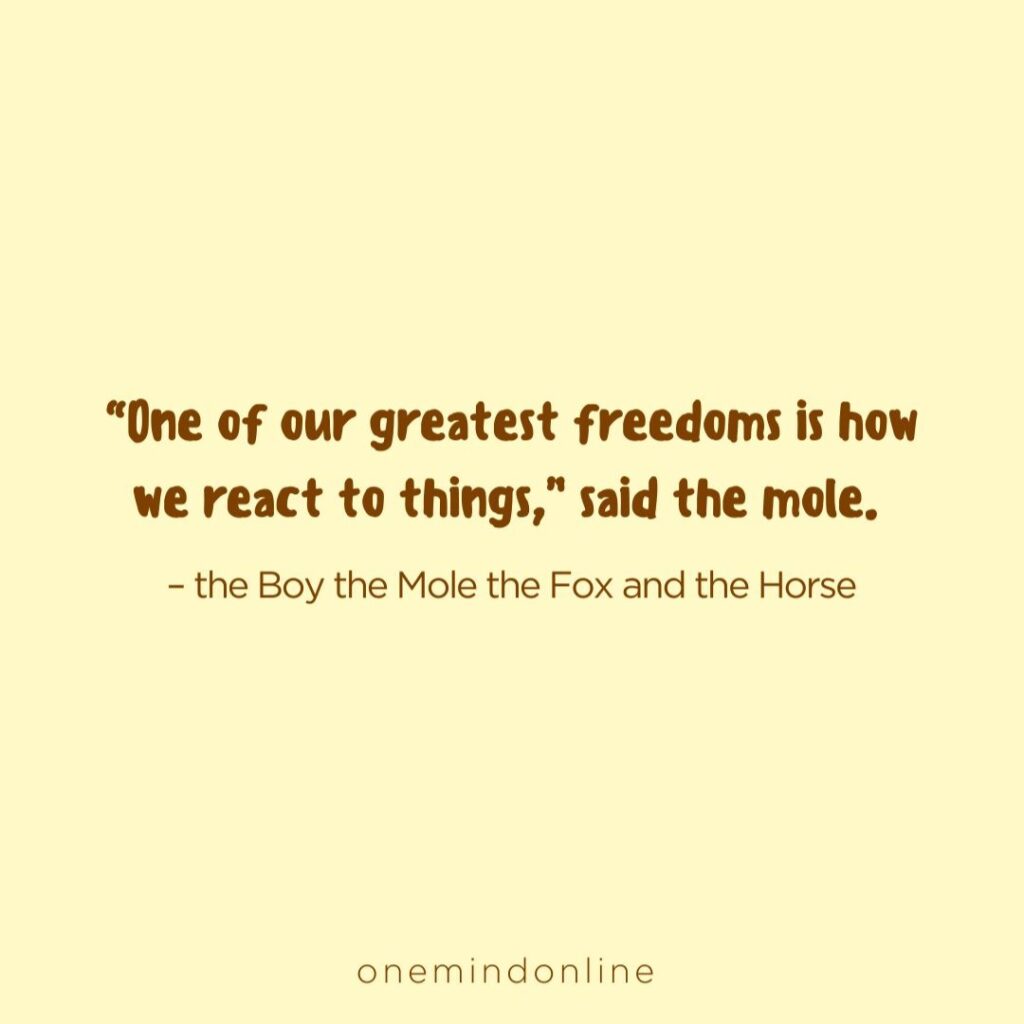
“One of our greatest freedoms is how we react to things,” said the mole. – the Boy the Mole the Fox and the Horse
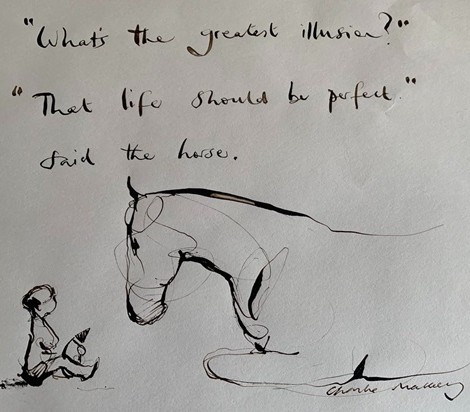
“The greatest illusion,” said the horse, “is that life should be perfect.” – the Boy the Mole the Fox and the Horse
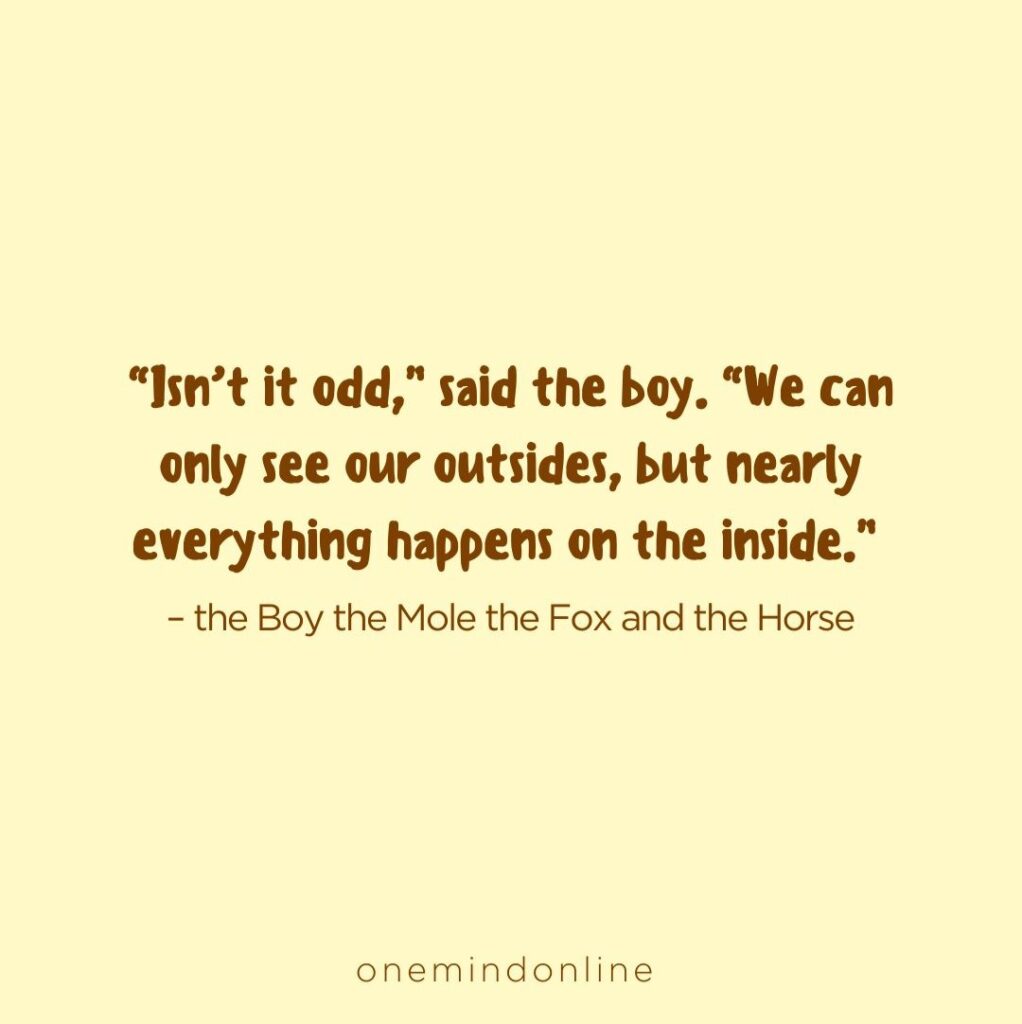
“Isn’t it odd,” said the boy. “We can only see our outsides, but nearly everything happens on the inside.” – the Boy the Mole the Fox and the Horse
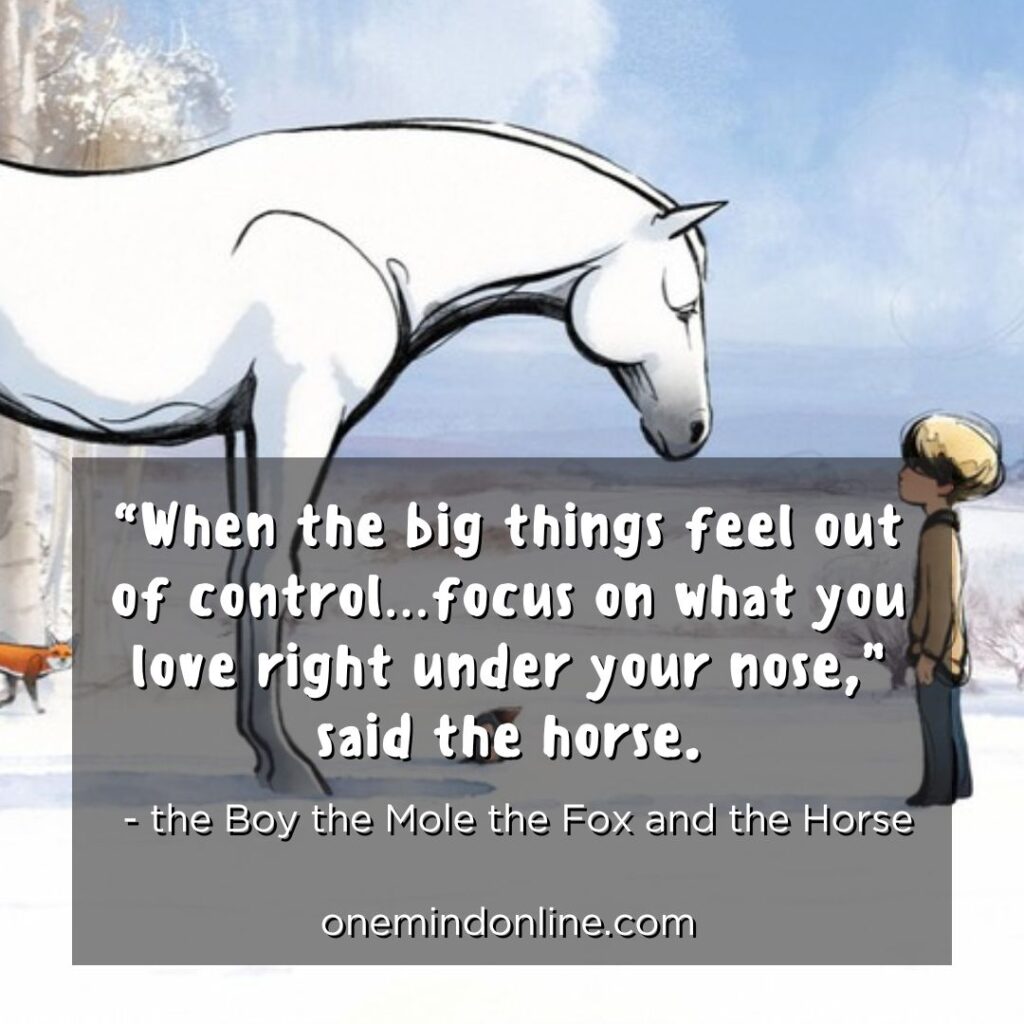
“When the big things feel out of control… focus on what you love right under your nose,” said the horse. – the Boy the Mole the Fox and the Horse
Focus on what’s right under your nose, says the horse. Which is exactly what our meditation today is about. Take a moment to experience your 5 physical senses…
Take a few deep breaths, sit back and soak up the experience that they are giving you:
… what do you see…
… what do you hear…
… what do you smell…
… what do you taste…
… what does your skin feel…
The first quote mentions that one of our greatest freedoms is “how we react to things”. It means that we can choose what our response should be, or to not get involved at all – freedom from being triggered into reacting.
To make the meaning even more clear, let me approach it from the other side – “one of our biggest traps is our compulsion to react to things.” Having our emotions and our actions hijacked by events around us turns us into nothing more than slaves, whenever the button is pressed, the monkey dances…
Bring your awareness again to your senses and notice how you are able to hold a space for the experience provided to you by your outer senses. No judgement, no criticism, no reactivity, just allowing the experience to unfold. Almost as if you’re just an observer.
With enough practice you can develop the same skill toward all the inner experiences you have as well. Sit, breathe, and notice the information that your inner senses are providing you, how your emotions are stirred into life in response to what is happening in your world. Now, can you also learn to feel your inner senses without being triggered into a reaction?
What happens when you’re able to sit and allow the experience of:
… hurt…
… grief…
… anger…
… shame…
… jealousy…
When you are able to allow the feeling to be felt – like allowing a smell to linger even if it’s not something you enjoy – you are setting yourself free from the illusion that life should somehow be “perfect” in order for you to be happy.
Everything you experience is felt within you. Even when it’s a human being in front of you that’s pushing your buttons, it’s the emotions inside of you that you’re struggling to deal with. When you can allow the experience inside of you to unfold without resistance, you will find yourself stepping into a more spacious place, the space of the observer… surrender… clarity… developing the ability to see where to take action and where to just back off.
Freedom is only available to you when you are no longer enslaved by the compulsion to react.
Here are a few thoughts to guide you towards true freedom:
- Pause before you react. “I have the power to choose my response in every moment.”
- Observe your emotions. “My emotions are temporary visitors, not permanent residents.”
- Choose your response. “I can feel my emotions without letting them control my actions.”
- Focus on what’s yours to control. “I focus on what is mine to control… MY responses.”
- Practice self-compassion. “I will me patient with ME, as I learn and grow.”
By cultivating the ability to observe and allow your inner world to unfold without resistance, you break free from the illusion of a perfect life. You discover a deep well of peace and freedom that resides within you, no matter what is happening around you. Join us today as we explore this journey further.
Join us for today’s journey and put freedom into practice.
Hope you’re having a really beautiful weekend fam!
– pierre –
Today’s LIVE meditation is: Come to your senses.
(Image credit: “The boy, the mole, the fox and the horse” by Charlie Mackesy)
Today’s LIVE meditation
https://youtu.be/DmNfszU8kU0 2026
https://youtu.be/cLdx_JEthIk 2025
https://youtu.be/4UGP1caNzHc 2024
https://youtu.be/l4IoQP2uKVQ 2021
Practice the “Daily Dose”
Let’s put it into practice! Choose what works for you – daily, once a week or whenever inspiration strikes. Putting pen to paper wires the neural pathways that will create your new habits.
1 – Affirmation
Write down your favourite affirmation on a sticky note and place it somewhere that you’ll be able to see it the whole day.
- Pause before you react. “I have the power to choose my response in every moment.”
- Observe your emotions. “My emotions are temporary visitors, not permanent residents.”
- Choose your response. “I can feel my emotions without letting them control my actions.”
- Focus on what’s yours to control. “I focus on what is mine to control… MY responses.”
- Practice self-compassion. “I will me patient with ME, as I learn and grow.”
2 – A moment of reflection
Use today’s question as a journal prompt. If you don’t have the time to sit down and write, just take a moment to reflect on your response.
The Autopilot Assessment: Think about a recent situation where you reacted automatically – perhaps someone said something that immediately triggered anger, frustration, or hurt. Write about this experience in detail: What happened externally? What emotions arose within you? How did you respond? Now, reimagine that same scenario: If you had paused and chosen your response instead of reacting on autopilot, what might you have done differently? What would that have felt like? Explore what “buttons” you have that others seem to push easily, and consider why these particular triggers have such power over you.
3 – Quotes to share
Send a quote to someone who needs it, or share them all on social media to spread the good vibes!


4 – Q&A for deeper learning
Read through the questions and answers and write down at least one “aha moment” that clicked for you.
Q1. What does it mean to “choose your response” when emotions feel so automatic?
Choosing your response doesn’t mean suppressing or controlling your emotions – it means creating a pause between what you feel and how you act. When something triggers you, your emotions will naturally arise, but you have the power to pause, breathe, and decide how to respond rather than reacting on autopilot. This pause allows you to observe what’s happening inside you and choose actions that align with your values rather than being driven purely by emotional impulse.
Q2. How can I practice “sitting with” difficult emotions without being overwhelmed by them?
Start by treating emotions like you would physical sensations from your five senses – observe them without immediately trying to change them. When you feel anger, sadness, or fear, notice where you feel it in your body, what thoughts arise, and what urges you have to react. Breathe deeply and remind yourself that emotions are temporary, like clouds passing through the sky. The goal isn’t to enjoy difficult emotions, but to develop the capacity to experience them without being controlled by them.
Q3. What’s the difference between being an “observer” of my emotions versus being detached or disconnected?
Being an observer means staying present and aware of your emotional experience without being swept away by it. You’re fully engaged and feeling everything, but you’re not identifying completely with the emotion (“I am angry” versus “I notice anger arising in me”). Detachment, on the other hand, involves disconnecting or numbing yourself from feelings entirely. The observer stance allows you to feel fully while maintaining the space to choose your response wisely.
Q4. How do I know when to take action versus when to “back off” in challenging situations?
This wisdom comes from developing your observer capacity. When you’re reactive and controlled by emotions, your actions often make situations worse. When you can pause and observe what’s happening internally, you gain clarity about what actually needs to be addressed versus what’s just your emotional reaction. Ask yourself: “Is this action coming from wisdom and care, or from my triggered emotional state?” Actions taken from a place of centered awareness tend to be more effective and less harmful.
Q5. Why does focusing on “what’s right under your nose” help when big things feel overwhelming?
When we’re overwhelmed by large, complex problems, our nervous system goes into fight-or-flight mode, which actually reduces our ability to think clearly and take effective action. By intentionally focusing on immediate, tangible things you can appreciate or control, you help regulate your nervous system and return to a state where you can think more clearly. This doesn’t mean ignoring serious issues – it means grounding yourself so you can address them from a place of strength rather than panic.
Q6. How can I stop taking things personally when others seem to “push my buttons”?
Remember that your emotional reaction is something that happens inside of you. The emotion that you’re experiencing is not something that someone else handed you. When someone “pushes your buttons,” something gets activated within in your internal landscape that already existed there – perhaps old wounds, insecurities, or unmet needs. Instead of focusing on changing the other person, focus on understanding why certain behaviors trigger such strong reactions in you. As you develop the ability to observe and allow these reactions without immediately acting on them, you’ll find that others have less power to disturb your inner peace.
Q7. Is it realistic to expect that I’ll never react emotionally again once I master this practice?
Absolutely not – and that’s not the goal. Being human means having emotional reactions, and trying to eliminate them entirely would be both impossible and unhealthy. The practice is about developing the capacity to pause more often, to observe your emotions with compassion, and to choose your responses more consciously. Even masters of this practice still have emotional reactions; they’re just less likely to be completely controlled by them. Progress is measured not by perfect emotional control, but by the increasing space between stimulus and response, and the growing wisdom in how you choose to act.