
“Your Daily Dose” is a quick two minute read packed with bite-sized wisdom from all the great teachers. But you could also choose to turn it into something more… a powerful daily practice for personal growth. Give it a try!
A message from today’s meditation:
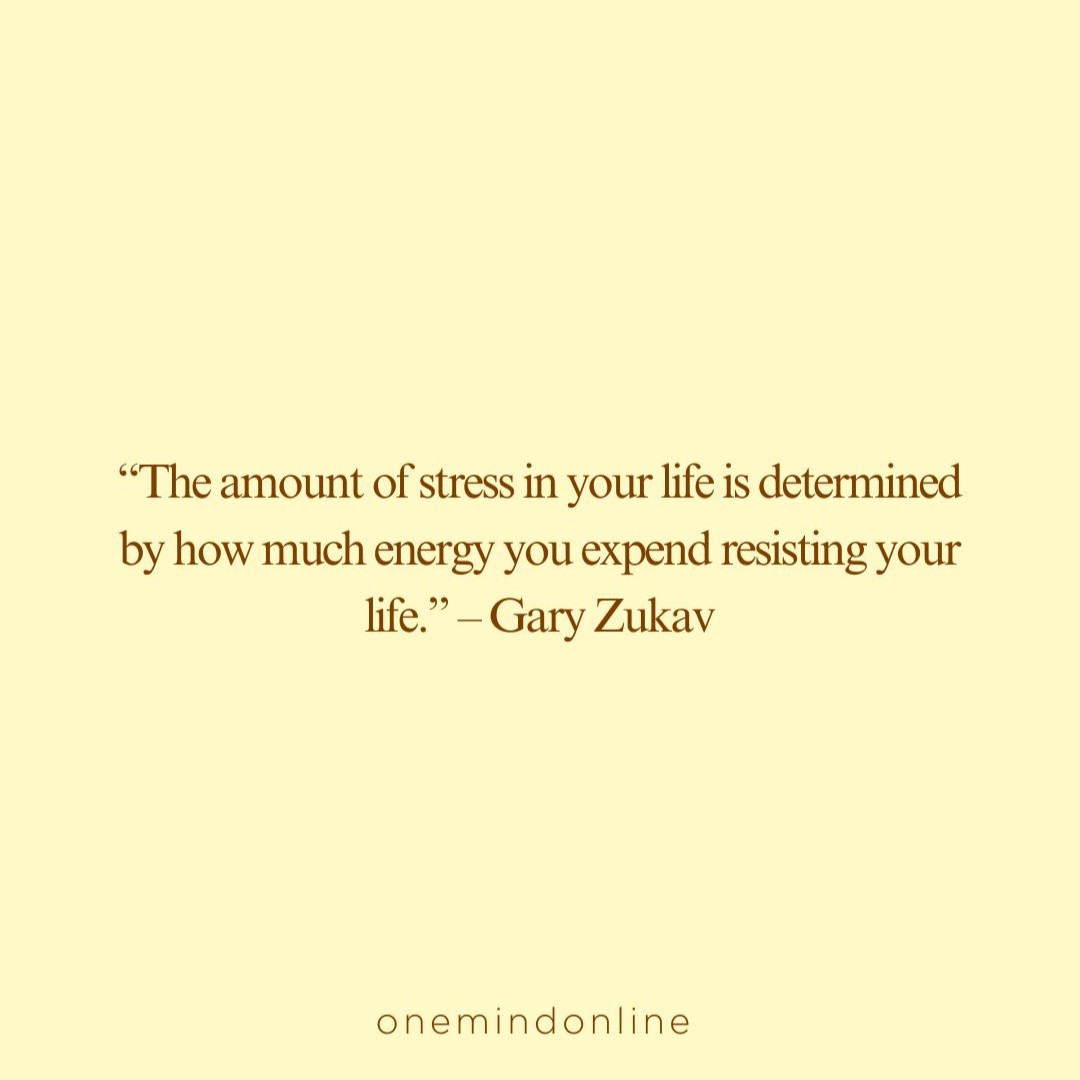
“The amount of stress in your life is determined by how much energy you expend resisting your life.” – Gary Zukav
In spiritual teachings “resistance” is a regular topic, and to understand the effects of what resistance creates within our bodies, it may be helpful to look at what resistance means in physics.
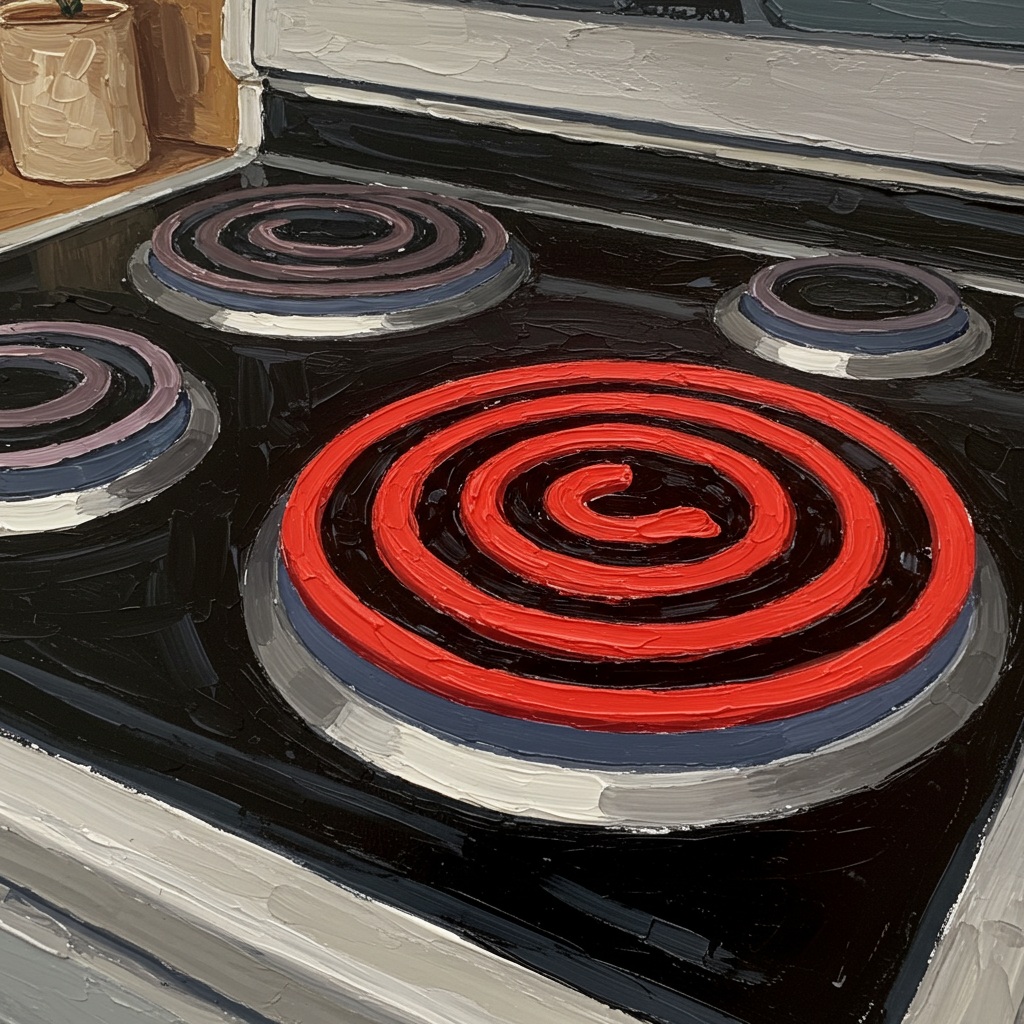
In an electrical system, resistance is created by a component (usually called a resistor) that is designed to resist the flow of electricity. Some simple examples of resistors are the tungsten filament in an incandescent light bulb, and the nichrome spiral of an electrical stove top.
These metals are not good conductors of electrical current, in fact they resist the flow of electricity so much that they heat up and start to glow enough to either light up a darkened room or even bring a pot of water to boiling point.
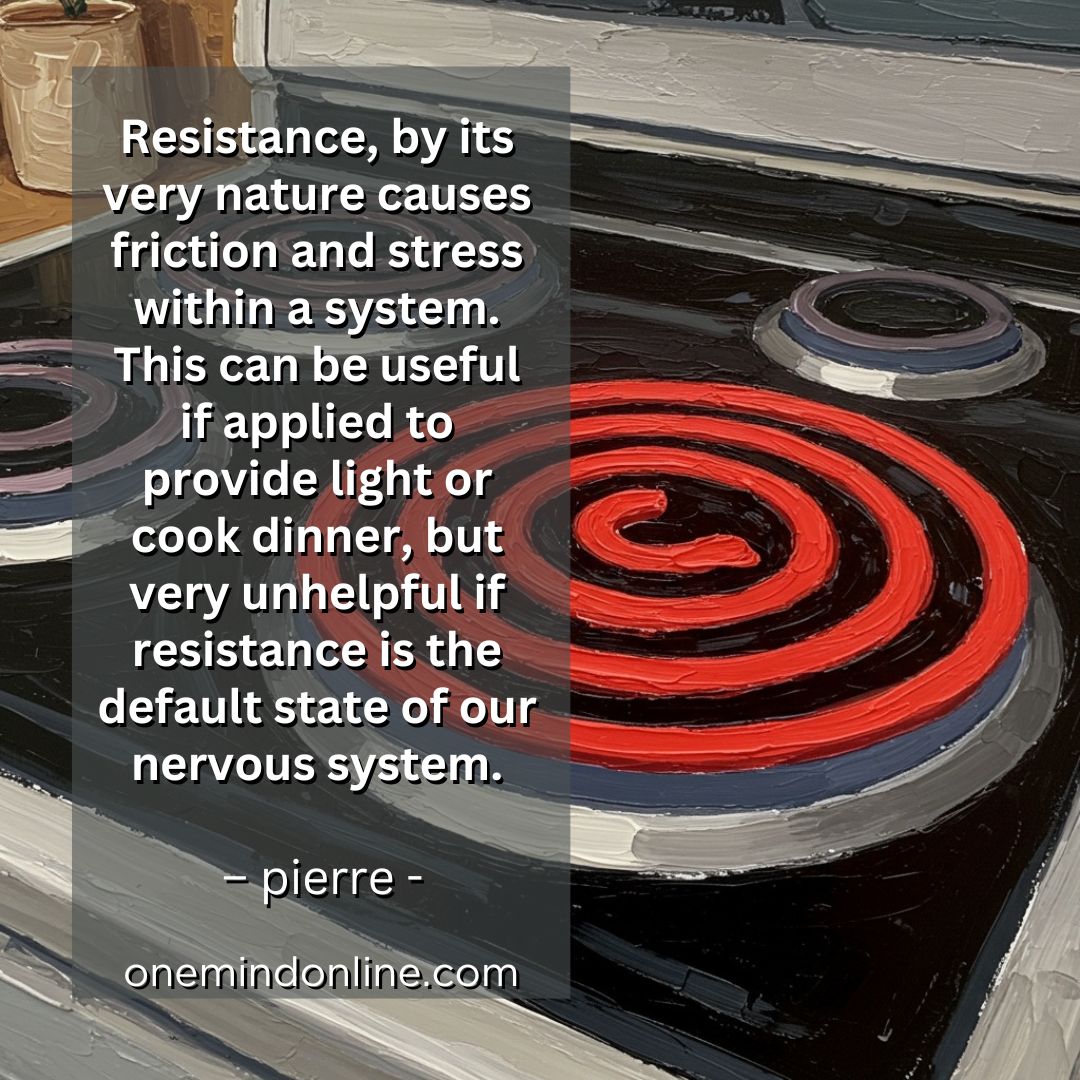
Resistance, by its very nature causes friction and stress within a system. This can be useful if applied to provide light or cook dinner, but very unhelpful if resistance is the default state of our nervous system.
Similar to resistance in an electrical system, a nervous system that is in resistance also restricts the flow of information. In an electrical system if the wiring heats up, the heat causes the plastic insulation to become brittle and break, creating short circuits and miss-firing. So too does a nervous system in constant resistance cause the myelin sheath around neurons to wear thin and break, creating miss-firing and miss communication within the system.
Are you perhaps frying your wiring?
What are you in constant resistance to?
This might not be easy to answer. It might not be obvious at all, so to try and form a clearer understanding of the concept of resistance we’ll look at it through the eyes of multiple different teachers:
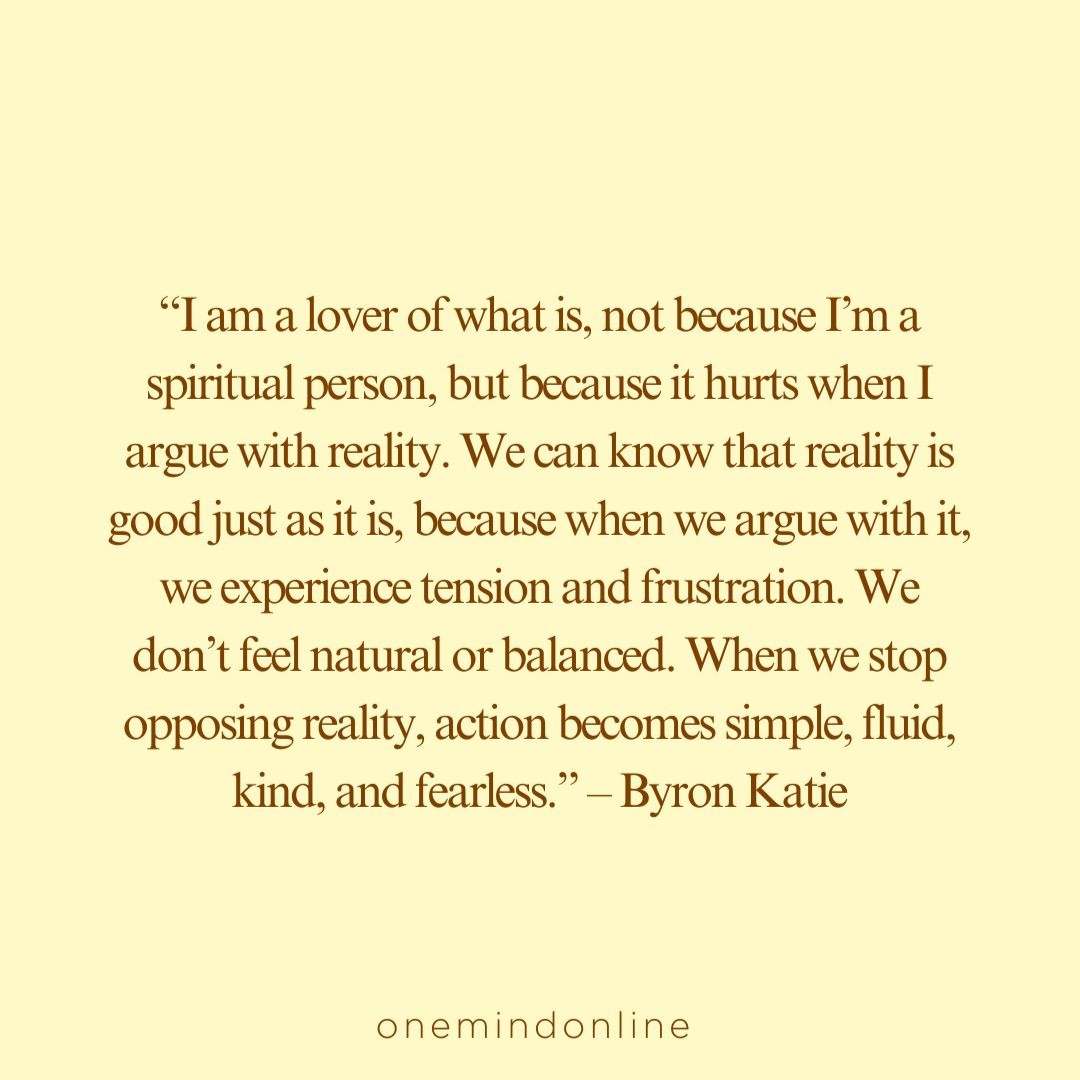
“I am a lover of what is, not because I’m a spiritual person, but because it hurts when I argue with reality. We can know that reality is good just as it is, because when we argue with it, we experience tension and frustration. We don’t feel natural or balanced. When we stop opposing reality, action becomes simple, fluid, kind, and fearless.” – Byron Katie
“To offer no resistance to life is to be in a state of grace, ease, and lightness. This state is then no longer dependent upon things being in a certain way, good or bad. It seems almost paradoxical, yet when your inner dependency on form is gone, the general conditions of your life, the outer forms, tend to improve greatly” – Eckhart Tolle
“The greater part of human pain is unnecessary. It is self-created as long as the unobserved mind runs your life. The pain that you create now is always some form of nonacceptance, some form of unconscious resistance to what is.” – Eckhart Tolle
“Whatever you resist you become. If you resist anger, you are always angry. If you resist sadness, you are always sad. If you resist suffering, you are always suffering. If you resist confusion, you are always confused. We think that we resist certain states because they are there, but actually they are there because we resist them.” – Adyashanti
“Change is never painful, it’s the resistance to change that is painful.” – Gautama Buddha
The conversation about letting go of resistance and softening into surrender always leaves the question about action: “Does surrender mean that I never take action?
Surrender becomes available to us once we realize that our latest set of actions have been mostly unhelpful. That in our resistance to reality we’ve been doing nothing but splashing up a storm in our pond, and that the only route back to clarity is to take a step back and for the moment do nothing but wait for the water to settle. Surrender doesn’t mean the absence of action but it does mean the absence of splashing, and being committed to only act once we’ve returned to calm clarity.
Eckhart beautifully illustrates acceptance first, and then action:
“Accept the present moment as if you had chosen it. Accept, then act.” – Eckhart Tolle
It may sometimes seem really difficult to have acceptance for everything that life brings, but what is a lot harder, is living in constant resistance to what life brings… a life full of tension, anxiety and eventually completely frying your wiring.
A few affirmations to help you release resistance and embrace life:
- “I release my fear of the unknown.”
- “I am open to change and growth.”
- “I can find peace in reality just as it is.”
- “I trust the process of life, even when I cannot see the outcome.”
By cultivating a mindset of acceptance and non-resistance, we can reduce stress, improve our mental and physical health, and unlock our true potential. It’s time to unplug from the constant struggle and reconnect with the flow of life.
– pierre –
Today’s LIVE meditation is: Surrender
Today’s LIVE meditation
https://youtu.be/AmMaHh8LDLA 2025
https://youtu.be/Giw54o6Q6SU 2024
https://youtu.be/MuQbcPhdSXg 2023
https://youtu.be/G0B9MZJMjr0 2022
Practice the “Daily Dose”
Let’s put it into practice! Choose what works for you – daily, once a week or whenever inspiration strikes. Putting pen to paper wires the neural pathways that will create your new habits.
1 – Affirmation
Write down your favourite affirmation on a sticky note and place it somewhere that you’ll be able to see it the whole day.
- “I release my fear of the unknown.”
- “I am open to change and growth.”
- “I can find peace in reality just as it is.”
- “I trust the process of life, even when I cannot see the outcome.”
2 – A moment of reflection
Use today’s question as a journal prompt. If you don’t have the time to sit down and write, just take a moment to reflect on your response.
Identifying Your Resistance Patterns: Think about your daily life and recent experiences. What situations, people, or circumstances do you find yourself consistently fighting against or wishing were different? Write about a specific example where you noticed yourself “arguing with reality.” How did this resistance feel in your body? What thoughts kept cycling through your mind? Explore how this resistance might be “frying your wiring” and creating unnecessary stress in your life.
3 – Quotes to share
Send a quote to someone who needs it, or share them all on social media to spread the good vibes!
4 – Q&A for deeper learning
Read through the questions and answers and write down at least one “aha moment” that clicked for you.
Q1. What exactly is “resistance” in a spiritual or psychological context?
The seeds of resistance begin the moment we have the thought that a situation, or the way someone is behaving, should be different than what we’re actually experiencing – that subtle mental “no” to what’s in front of us. From there, if we habitually latch onto that thought and pour our mental and emotional energy into fighting the way things are, resistance becomes a pattern rather than a passing moment. When this becomes our default response to life, our nervous system never gets the signal to stand down; it stays locked in a state of high alert, as if constantly bracing for a threat. Over time, this chronic activation doesn’t just stay in the mind, it shows up physically, wearing down our bodies through tension, fatigue, and the kind of deterioration that comes from a system that never gets to rest. This is what resistance truly means: not just disagreeing with reality, but the ongoing physiological toll of refusing to let it be as it is.
Q2. How does resistance actually affect my nervous system?
When you’re in constant resistance, your nervous system becomes overloaded and stressed, similar to how electrical resistance causes wiring to overheat. This chronic stress can wear down the myelin sheath around your neurons (the protective coating around nerve fibers), leading to miscommunication within your nervous system. The result is mental fog, emotional reactivity, poor decision-making, and eventual burnout.
Q3. Does accepting reality mean I should never try to change anything?
Not at all – the entire point of this practice is to help you create the life you actually want to live. But sustainable change starts with accepting your current reality as the starting point, not as an obstacle to escape. When you truly accept this moment, you can see clearly what action is actually needed to make a difference; clarity and acceptance go hand in hand. Unhappiness and resistance, on the other hand, make you want to escape – even just mentally – checking out of the present moment in search of somewhere else to be. And if part of you is trying not to be here, you can’t possibly take effective action from here. Acceptance isn’t the opposite of change; it’s the ground you stand on to make change real.
Q4. How can I tell if I’m acting from a place of resistance or taking healthy action?
Resistance-driven action feels frantic, forced, and exhausting. It’s like “splashing up a storm” in muddy water. You’ll notice tension in your body, racing thoughts, and a sense of urgency that doesn’t match the situation. Healthy action flows from a place of acceptance and clarity. It feels natural, purposeful, and sustainable. You’re able to see more clearly where to place your next step rather than thrashing about blindly.
Q5. Why do I keep resisting things I know I should accept?
This is often unconscious conditioning. You may have been taught that caring means worrying, that love means controlling, and that responsibility means constant vigilance. Also, if your childhood consisted of never being allowed to say no to the people around you, then that inner child may have subconsciously decided that it will say NO to everything as an adult. Additionally, the ego mind believes it needs to be in control to keep us safe. Recognizing these patterns is the first step. Remember that resistance often keeps feeding more energy to the very things we’re trying to avoid.
Q6. What’s the difference between surrender and giving up?
Surrender and giving up can look similar on the surface, but they come from entirely different places. Giving up means quitting on the life you want to lead, it’s a retreat from your commitment, often driven by exhaustion or despair, where you stop caring about the outcome altogether. Surrender, by contrast, means staying fully committed to the life you want, while releasing your grip on how or when it has to unfold. You haven’t abandoned the goal, you’ve simply stopped fighting the present moment as the path toward it. That’s what makes surrender an act of strength rather than defeat: it holds the commitment steady while letting go of the struggle around it.
Q7. How can I practice non-resistance in daily life?
A powerful place to start is by asking yourself, “Is fighting this situation the way that I want to live my life? When I envisioned the picture of my beautiful life, is the picture I saw one of me fighting?” For most of us, the answer is no, our vision of a good life was never one spent in constant battle. Once you see that, ask the next question: “How do I walk towards what I do want, rather than fighting against what I don’t want?” This shifts your energy from resistance to direction. The answers won’t always show up right away, and that’s okay. Stay committed to asking these questions again and again, even when clarity doesn’t come immediately, and over time you’ll start to see the next step forming a little more clearly.