

“Your Daily Dose” is a quick two minute read packed with bite-sized wisdom from all the great teachers. But you could also choose to turn it into something more… a powerful daily practice for personal growth. Give it a try!
A message from today’s meditation:
The journey of personal growth sometimes feels like a delicate dance between creating and surrendering. We pour our energy into creating the lives we want, and then find ourselves trapped by our own expectations, desperately clinging to the outcomes that we’ve envisioned.
Spiritual teacher Gary Zukav, author of “The Seat of the Soul,” offers profound wisdom for navigating this paradox. His teachings reveal a transformative truth: we can be seriously committed to doing our best while releasing our grip on outcomes. This delicate balance, though it may take a lifetime to master, holds the key to authentic freedom.
We take two thoughts from his work for our week ahead.
“You create your reality with your intentions.” – Gary Zukav
“Allow yourself to experience what it is to learn the freedom that comes from being unattached to the outcome.” – Gary Zukav
Let’s dive into these two messages from Gary Zukav:
1. You create with your intentions.
Your intentions are not just wishful thinking, they’re the driving force behind every thought and action that shapes your world.
The real work however, is not just setting intentions; it’s maintaining awareness of your internal state throughout the day. You might begin each morning with crystal-clear intentions, but life has a way of triggering our survival responses. Fear creeps in silently, transforming panic into anxiety, frustration into anger. Before you know it, your beautiful intentions become clouded by emotional reactivity.
Your primary responsibility is developing the awareness to notice when fear enters your body. This awareness creates space – space to pause, breathe, and soften back into your creative potential.
Fear hijacks even our best intentions. And unless we develop our awareness, fear will slip in under the radar and we won’t realize that we’ve strayed far away from our original intentions again.
2. Unattached to the outcome.
The second pillar of Zukav’s teaching challenges us to become unattached to the outcome. This can be a difficult lesson to learn because it sounds a bit like not caring at all, but it is in fact just the opposite – it’s caring so deeply that you’re willing to trust the process completely. Being unattached doesn’t mean being passive. It means being committed to pouring your energy into what you can control – your thoughts, your actions, your responses – while accepting that outcomes are also shaped by events and circumstances that are out of our hands.
Here’s a really simple example:
Can you get up in the morning, set a clear intention for your day, do your very best to create at your highest potential and then also… at the end of the day can you surrender your attachment to any outcome? Can you trust that you need only pour your energy into taking action on the things that you CAN control, and accept that however things turn out is perfect?
Gary Zukav calls this FREEDOM!
Try this three step practice for more freedom.
Zukav’s wisdom translates into a simple yet powerful daily practice that we are all invited to try out this week, and if this feels helpful, perhaps we can adopt it for the long term:
- Set your intention: Get up in the morning and be deliberate about setting a good intention for your day. Ground yourself in what you want to create and how you want to show up in the world.
- Re-commit to your intention: Move through your day committed to doing your best, staying aware of when fear tries to hijack your intentions. When you notice the shift, pause, breathe, and return to the intention you started your day with.
- Surrender the outcome: However the day turns out, put yourself to bed at night by telling yourself, “Today I did my best. And tomorrow I will try again.”
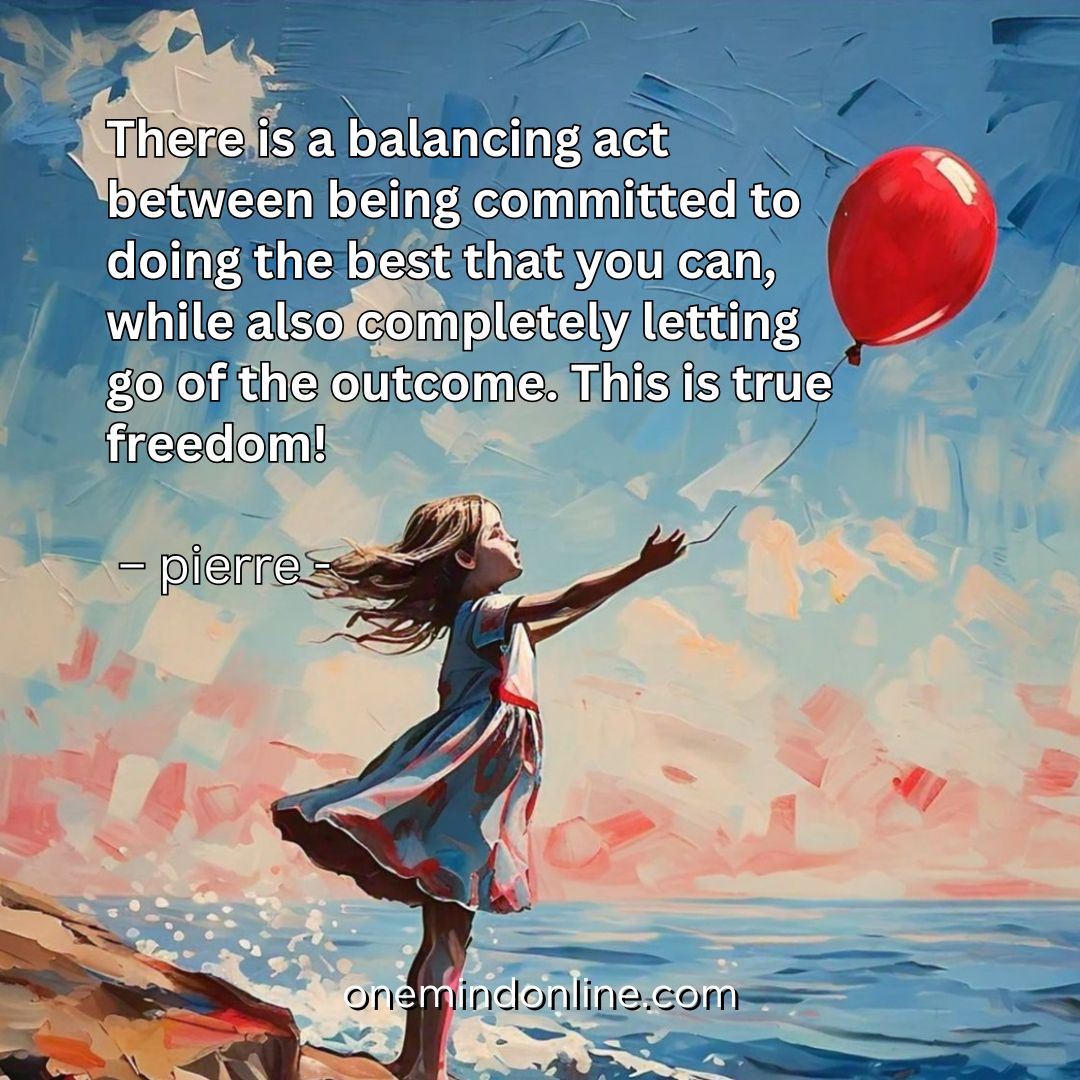
There is a balancing act between being committed to doing the best that you can, while also completely letting go of the outcome. This is true freedom!
A few affirmations that lead to freedom:
- “I trust my intentions to guide my actions while releasing my need to control outcomes.”
- “I have the awareness to notice when fear enters my body and the wisdom to return to my clear intention.”
- “I am committed to doing my best while accepting that the results are not entirely in my hands.”
This freedom, as Gary Zukav calls it, is a balancing act. It requires both seriousness of purpose and a willingness to let go. By cultivating awareness, embracing your intentions, and surrendering to the unknown, you can unlock the true power of your being and experience the liberating freedom that comes from living in alignment with your authentic self.
My wish for you this week is to be able to experience this freedom.
– pierre –
Today’s LIVE meditation is: Jumpstart the week!
Today’s LIVE meditation
https://youtu.be/bi906_PSohQ 2026
https://youtu.be/KbEYMd-S-YM 2025
https://youtu.be/0B3T4MJqXrE 2024
https://youtu.be/f9VxRXBJ0as 2023
https://youtu.be/zRvnFeUIqLA 2022
Practice the “Daily Dose”
Let’s put it into practice! Choose what works for you – daily, once a week or whenever inspiration strikes. Putting pen to paper wires the neural pathways that will create your new habits.
1 – Affirmation
Write down your favourite affirmation on a sticky note and place it somewhere that you’ll be able to see it the whole day.
- “I trust my intentions to guide my actions while releasing my need to control outcomes.”
- “I have the awareness to notice when fear enters my body and the wisdom to return to my clear intention.”
- “I am committed to doing my best while accepting that the results are not entirely in my hands.”
2 – A moment of reflection
Use today’s question as a journal prompt. If you don’t have the time to sit down and write, just take a moment to reflect on your response.
The Control Paradox: Think about an area of your life where you’re struggling to balance doing your best with letting go of the outcome. What specifically are you trying to control that might be outside your influence? How does this attachment to control affect your daily peace and effectiveness? What would it look like to pour your energy fully into what you can control while trusting the process for everything else?
3 – Quotes to share
Send a quote to someone who needs it, or share them all on social media to spread the good vibes!
4 – Q&A for deeper learning
Read through the questions and answers and write down at least one “aha moment” that clicked for you.
Q1: How is being “unattached to outcomes” different from not caring or being lazy?
This can be a difficult lesson to learn because it sounds a bit like not caring at all, but it is in fact just the opposite – it’s caring so deeply that you’re willing to trust the process completely. Being unattached to outcomes actually requires more courage and commitment than attachment does, because it means you’re willing to show up and give everything you’ve got even while you know that the outcome is not within your control. Laziness, by contrast, is disengagement from effort altogether – a withdrawal of care rather than a redirection of it. True non-attachment asks you to pour everything you have into the moment and then release your grip on what comes next, which takes far more strength than simply not trying at all.
Q2: What does it mean to “notice when fear enters your body”?
Our bodies react to fear physically, often before our minds even register what’s happening – a tightening in the chest, a clenched jaw, shallow breathing, or a sudden knot in the stomach. Learning to notice these physical signals is like developing an early warning system for when you’ve drifted from your original intention into fear-based reactivity. Rather than getting swept into the anxiety, anger, or panic that fear brings, this awareness becomes your cue to pause. Once you recognize the signal in your body, you can stop, take a breath, and consciously redirect your attention back to the intention you set at the start of your day, rather than letting fear silently hijack your actions without your realizing it.
Q3: How can I set clear intentions if I’m not sure what I really want?
This is quite common actually, and it doesn’t have to stand in your way. Instead of tying your intention to a specific outcome you’re unsure about, you can set an intention for how you want to show up, how you want to be, regardless of what the day brings. You might intend to stay emotionally regulated, to be patient with yourself and others, or to catch yourself when you’re triggered rather than getting swept away by the reaction. These kinds of intentions don’t require you to know exactly what you want from life – they simply ask you to choose the quality of presence you bring to whatever unfolds, which is something you can commit to with clarity even when the bigger picture still feels uncertain.
Q4: What if I do my best but still feel like I failed at the end of the day?
It can be tempting to punish or criticize ourselves when we feel we didn’t do our best, or when we perceive failure – it might feel like judgment will move us to try harder next time. But the neuroscience is clear: the harder we attack ourselves, the more we trigger our fight-or-flight response, creating more stress and anxiety and actually leading to worse outcomes, not better ones. Self-criticism keeps your nervous system in survival mode, which is the very state that pulls you away from your intentions in the first place. So instead of berating yourself for not living up to your intentions, simply acknowledge that you’re not perfect, extend yourself some compassion, and commit to trying your best again the next day. This gentler approach keeps you out of the fear response and back in the empowered state where real growth happens.
Q5: How long does it take to master this balance between creating and letting go?
Finding balance is never something with a static ending – in fact, balance itself will always consist of constant movement, like a tightrope walker who stays upright not by locking into one fixed position but by continuously making small adjustments. In the same way, the balancing act between creating and letting go will never be finally reached as an ultimate goal you check off and move past. Instead, it’s a consistent practice for the rest of your life, one you return to again and again as circumstances shift and new challenges arise. This isn’t a discouraging truth – it means there’s no finish line to fall short of, only an ongoing relationship with the practice itself, where each day offers a fresh chance to find that moving point of balance between commitment and surrender.
Q6: Can this approach work in high-pressure situations or competitive environments?
Actually, this approach often works better in high-pressure situations because it eliminates the additional stress of trying to control outcomes. When you’re fully committed to excellence while remaining unattached to results, you perform with less anxiety and more flow. Athletes often describe this state as “being in the zone.” In competitive environments, focusing on what you can control (your preparation, effort, and response) while releasing what you can’t control (others’ performance, external circumstances) often leads to better results and greater satisfaction.