

“Your Daily Dose” is a quick two minute read packed with bite-sized wisdom from all the great teachers. But you could also choose to turn it into something more… a powerful daily practice for personal growth. Give it a try!
A message from today’s meditation:
Walt Whitman once wrote,
“Do I contradict myself? Very well then I contradict myself, I am large, I contain multitudes.”
Whitman poetically describes a truth of being human. Each of us is a universe unto ourselves, containing a multitude of thoughts, emotions, and beliefs that often contradict each other in harmonious dissonance. We can feel confident and insecure simultaneously, love deeply while also harboring resentment, or desire change while clinging to familiar patterns. This internal complexity isn’t chaos – it’s the rich tapestry of human experience.
Over time, some of our thoughts and feelings become grouped together as repeated inner narratives, each associated with the same emotional response playing out over and over again. These patterns become hardwired elements of our personality, creating what feels like automatic responses to life’s situations. We all tend to have several of these narrative patterns that play out old stories like recordings from the past.
The challenge lies in how these different parts of our personality can become triggered before we realize it. We might be completely unaware of how we’re at the mercy of different narratives and emotions from moment to moment, reacting from unconscious patterns rather than conscious choice.
Our “work” is to build an awareness of how our inner state shifts so that we create for ourselves the space in which we are able to say, “I choose a new response to these old thoughts and feelings.”
“The journey to wholeness requires that you look honestly, openly, and with courage into yourself, into the dynamics that lie behind what you feel, what you perceive, what you value, and how you act.” – Gary Zukav
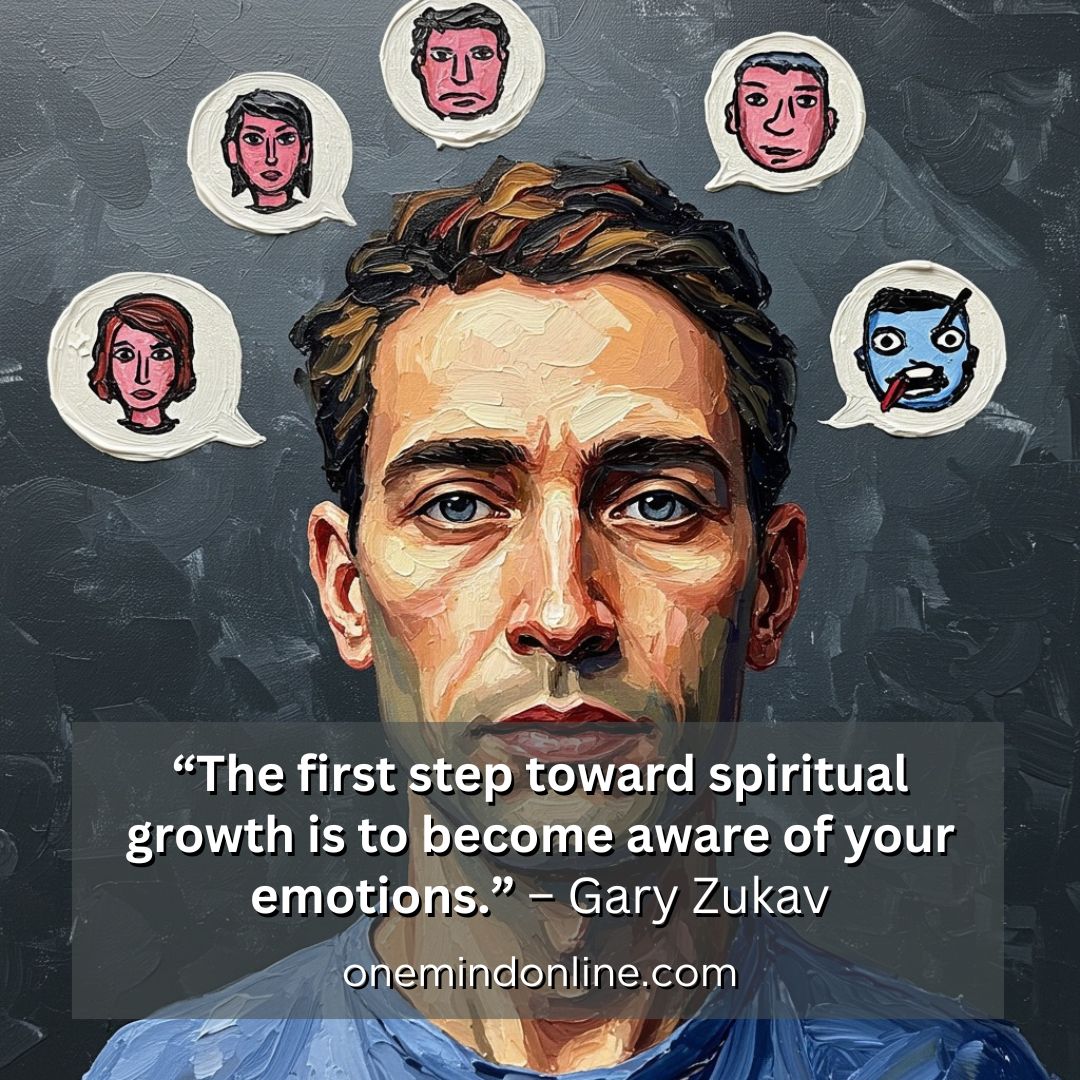
“The first step toward spiritual growth is to become aware of your emotions.” – Gary Zukav
“When you welcome your emotions as messengers, every emotion brings good news, even the ones that are painful.” – Gary Zukav
“Choosing to act from a loving part of your personality, while you are feeling the painful sensations of a frightened part of your personality, is the moment of traction on the spiritual path.” – Gary Zukav
The first step on our journey of personal growth is to become aware of our emotions. By welcoming our emotions, even the painful ones, we can learn to extract wisdom from how our emotions move.
When we embrace our emotions as messengers, we begin to see beyond the surface reactivity into the deeper narratives that drive our behaviour. This awareness empowers us to make conscious choices, to act from a loving part of ourselves, even when we are experiencing pain.
This is transformative because it means we’re no longer prisoners of our emotional states. Instead of being controlled by our feelings, we can create a new relationship with everything we think and feel. We can acknowledge our contradictions, honor our complexity, and still choose to respond from our highest self.
A few affirmations to expand your sense of self:
- “I choose to embrace my emotions as messengers.”
- “I am capable of choosing a new response to old narratives.”
- “I choose to observe my thoughts and feelings without judgement.”
- “I am a multifaceted being, capable of holding contradictory thoughts and feelings.”
Today’s meditation journey is an opportunity to – in a very practical way – create an awareness of what may lie behind some of what you think and feel. Please join us.
– pierre –
Today’s LIVE meditation is: A sense of self.
Today’s LIVE meditation
https://youtu.be/qRt5wPWw1pM 2026
https://youtu.be/4CGO9n0c144 2025
https://youtu.be/E2JsRui9AY4 2024
https://youtu.be/UPnpxF_QLjY 2023
https://youtu.be/IhpBgD35Evc 2022
Practice the “Daily Dose”
Let’s put it into practice! Choose what works for you – daily, once a week or whenever inspiration strikes. Putting pen to paper wires the neural pathways that will create your new habits.
1 – Affirmation
Write down your favourite affirmation on a sticky note and place it somewhere that you’ll be able to see it the whole day.
- “I choose to embrace my emotions as messengers.”
- “I am capable of choosing a new response to old narratives.”
- “I choose to observe my thoughts and feelings without judgement.”
- “I am a multifaceted being, capable of holding contradictory thoughts and feelings.”
2 – A moment of reflection
Use today’s question as a journal prompt. If you don’t have the time to sit down and write, just take a moment to reflect on your response.
Mapping Your Contradictions: Walt Whitman wrote, “I contain multitudes”, describing the inherent complexities of being human – confident and insecure, love and resentment, or the desire for change while still clinging to the familiar. What contradictory aspects of yourself can you identify? Write about two opposing qualities, beliefs, or desires that coexist within you. How do these contradictions show up in your daily life? Instead of seeing them as problems to solve, explore how they might actually contribute to your complexity and depth as a human being.
3 – Quotes to share
Send a quote to someone who needs it, or share them all on social media to spread the good vibes!
4 – Q&A for deeper learning
Read through the questions and answers and write down at least one “aha moment” that clicked for you.
Q1. What does it mean to “contain multitudes”?
To contain multitudes means recognizing that you are a complex being with many different aspects, thoughts, emotions, and even contradictory beliefs coexisting within you. This concept, borrowed from Walt Whitman’s poetry, suggests that internal contradictions aren’t flaws but rather evidence of your depth and humanity. You might simultaneously feel confident and insecure, loving and frustrated, or hopeful and afraid – and all of these feelings are valid parts of your complete self.
Q2. How do I identify my recurring narrative patterns?
Start by paying attention to situations where you have strong emotional reactions or where you feel like you’re “reacting automatically.” Notice what story you tell yourself in these moments. Common patterns might include thoughts like “I’m not good enough,” “People always leave me,” or “I have to be perfect.” These narratives often repeat with the same emotional charge and can be traced back to earlier experiences. Journaling about your reactions and the thoughts that accompany them can help you recognize these patterns.
Q3. Is it healthy to have contradictory feelings and thoughts?
The issue is not whether contradictory feelings and thoughts are “healthy” – they’re simply a normal, unavoidable part of being human. Everyone carries competing thoughts, emotions, and desires at once; that’s intrinsic to our complexity, not a sign that something is wrong with us. That said, these inner contradictions can absolutely have unhealthy consequences when left unexamined – they can leave us feeling confused, anxious, or stuck in loops of self-doubt, or drive us toward impulsive reactions we later regret. So the more useful question isn’t whether contradiction itself is healthy, but how we relate to it: what’s a healthy way to hold our own paradoxes? The answer lies in building awareness – learning to notice when competing parts of ourselves are activated, meeting each part with curiosity rather than judgment, and creating enough inner space to let our wisdom surface, instead of being swept along by whichever narrative happens to be loudest in the moment.
Q4. How can painful emotions actually be teachers?
Painful emotions often contain valuable information about our needs, boundaries, and values. For example, anger might be teaching you about a boundary that’s been crossed, sadness might be showing you what you value and have lost, and fear might be highlighting something important that needs protection. When you welcome these emotions with curiosity rather than resistance, you can extract the wisdom they contain and use it to make better choices about your life.
Q5. What does it mean to “act from a loving part of your personality”?
Acting from a loving part of your personality means choosing to respond from your highest self – the part of you that is compassionate, wise, and connected to your values – even when you’re experiencing difficult emotions. This doesn’t mean ignoring or suppressing painful feelings, but rather acknowledging them while still choosing to respond with kindness, understanding, and wisdom. It’s about creating space between your emotions and your actions.
Q6. How do I create space between my emotions and my reactions?
Creating space requires developing awareness of your internal state as it shifts. This can be cultivated through practices like meditation, mindfulness, or simply pausing before reacting. When you notice a strong emotion arising, try to observe it without immediately acting on it. Ask yourself: “What am I feeling right now? What story am I telling myself? How do I want to respond?” This pause creates the space needed for conscious choice rather than automatic reaction.
Q7. Can I really change my automatic responses to old narratives?
Yes, but it takes practice and patience. While you can’t completely eliminate old patterns overnight, you can develop the ability to recognize them more quickly and choose different responses. Each time you notice an old narrative re-playing and consciously choose a different response, you’re literally rewiring your brain. The key is consistent awareness and gentle persistence rather than expecting immediate perfection. Remember that change is a process, not a destination.