

“Your Daily Dose” is a quick two minute read packed with bite-sized wisdom from all the great teachers. But you could also choose to turn it into something more… a powerful daily practice for personal growth. Give it a try!
A message from today’s meditation:
Do you sometimes feel – or – have you ever felt like your self-worth fluctuates with the approval (or disapproval) of others? This is a common experience, but one that can leave us feeling insecure and unfulfilled, on a teeter-totter that hinges on the whims of the world around us.
This little book, “the Boy the Mole the Fox and the Horse” offers a path towards self-discovery where your inherent worth shines through, independent of external validation. Helping you shed the masks you wear to seek approval, and embrace the authentic YOU whose worth is undeniable.
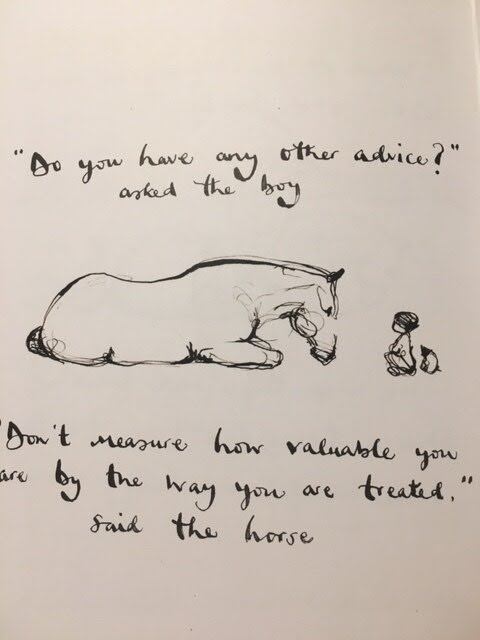
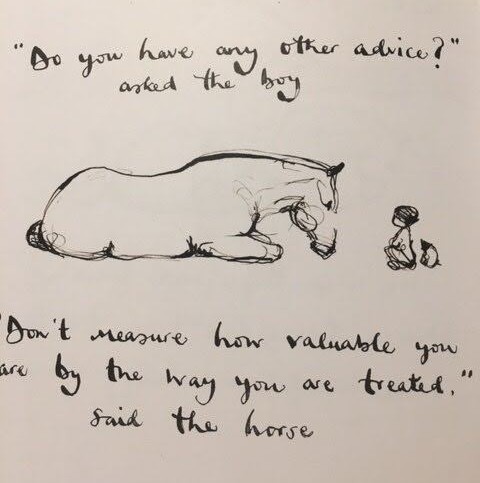
“Do you have any other advice?” asked the boy. “Don’t measure how valuable you are by the way you are treated,” said the horse.” – the Boy the Mole the Fox and the Horse
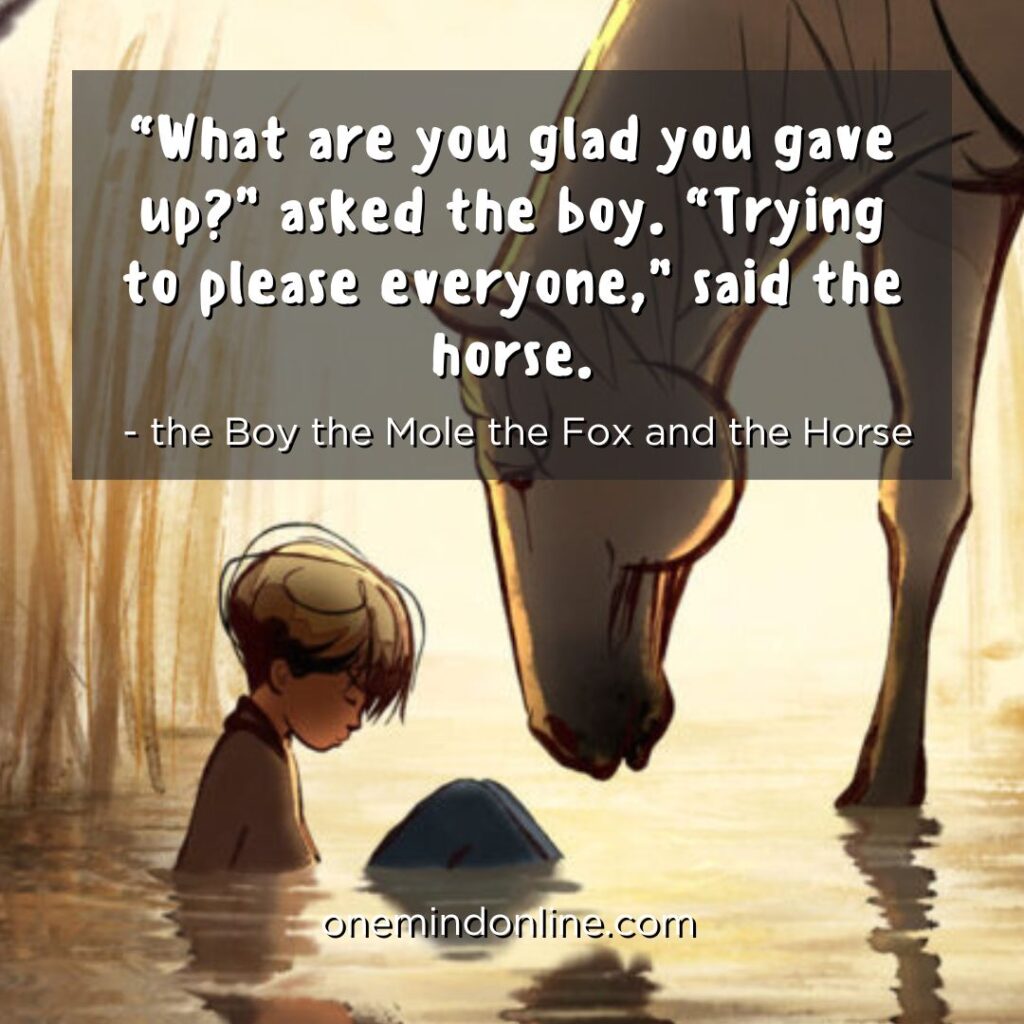
“What are you glad you gave up?” asked the boy. “Trying to please everyone,” said the horse. – the Boy the Mole the Fox and the Horse
A reflected sense of self… this is the term used to describe how children first learn who they are, the process of building an identity from what gets reflected back to them. Very literally, the world around us repeated our names to us until we adopted the belief that “this is who I am”.
Might there be any other beliefs that we perhaps picked up and made a part of our “self” because of what was reflected back to us from the people around us? How much of other people’s opinions about us shaped who we think we are today?
Today’s meditation is a journey of the masks we wear in order to make ourselves acceptable to “the world”, looking at each one, and reminding ourselves that we’re getting better at shedding our need for these masks. It is well worth repeating this process again and again because as Mooji so beautifully reminds us: “The easy part is being who you are. What is hard, is to stop being who you are not.” Masks can be sticky in this way. Even once we can clearly see how we’re modulating our behaviour in order to please others, it can still feel so unsafe to step into the world without that old form of protection. It can be a long process before we’re finally ready to put our masks down for good.
As a part of the “identity” we create from the opinions of others, we also record and adopt the voices around us in childhood, and this often becomes the way we speak to ourselves as adults – the ways in which we were spoken to as kids.
“Sometimes your mind plays tricks on you. It can tell you ‘you’re no good, that it’s all hopeless.’ But remember this – You are loved, and important and you bring to this world things no one else can. So hold on.” – the Boy the Mole the Fox and the Horse
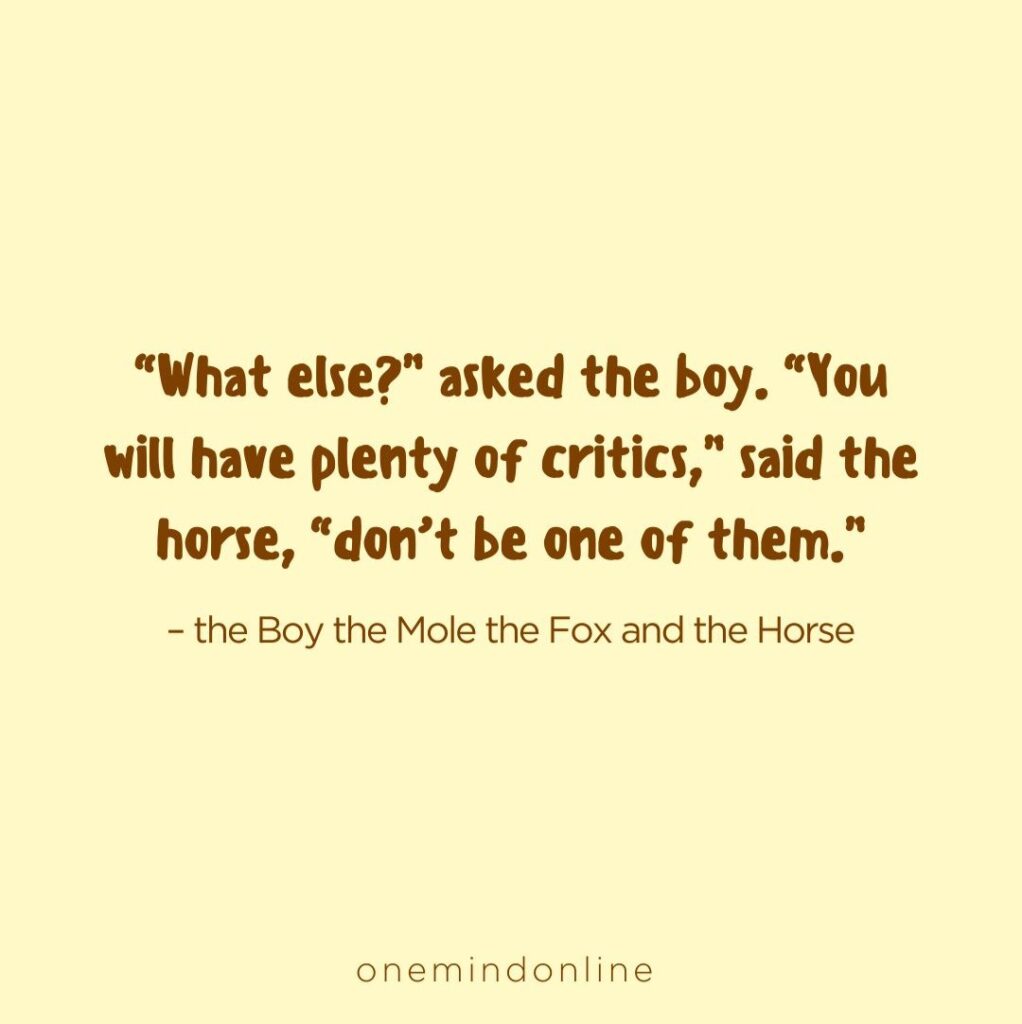
“What else?” asked the boy. “You will have plenty of critics,” said the horse, “don’t be one of them.” – the Boy the Mole the Fox and the Horse
Our old patterns of survival cause us to unconsciously pick up and wear those old masks, and speak to ourselves in the same old dis-empowering ways again. But over time, if we are kind to ourselves through this process, it becomes easier to stop and recognize that: “This is not me” – when we put on that mask and, “this is not how I want to speak to myself” – when you hear that same old accusing narrative again.
The journey to self-discovery isn’t about becoming someone new, but rather rediscovering who you were before the world told you who you should be.
Here are some mantras to guide your introspection:
- Challenge your inner critic. Is that voice truly yours, or an echo from the past?
- Practice self-compassion. Be kind to yourself as you unveil your authentic self.
- Embrace your uniqueness. Your quirks and flaws are what make you, you.
- Let go of the need for approval. Your worth is not defined by what others think.
- Be true to yourself. Authenticity is liberating and empowering.
Remember, the journey towards your authentic self is a continuous process. As you shed the masks, embrace the part of you who needed those old masks to feel safe, and know that your own acceptance of yourself will provide you with more safety than you’ve ever known.
Thank you for joining me on this journey, and well done on doing your inner work!
– pierre –
Today’s LIVE meditation is: The masks we wear.
(Image credit: “The boy, the mole, the fox and the horse” by Charlie Mackesy)
Today’s LIVE meditation
https://youtu.be/s7pfPh6RIU4 2026
https://youtu.be/-qMinPPlPqM 2025
https://youtu.be/-xvzepxT-GE 2024
https://youtu.be/Rgi3gA4lxTg 2023
https://youtu.be/dJukXfIdaNo 2021
Practice the “Daily Dose”
Let’s put it into practice! Choose what works for you – daily, once a week or whenever inspiration strikes. Putting pen to paper wires the neural pathways that will create your new habits.
1 – Affirmation
Write down your favourite affirmation on a sticky note and place it somewhere that you’ll be able to see it the whole day.
- Challenge your inner critic. Is that voice truly yours, or an echo from the past?
- Practice self-compassion. Be kind to yourself as you unveil your authentic self.
- Embrace your uniqueness. Your quirks and flaws are what make you, you.
- Let go of the need for approval. Your worth is not defined by what others think.
- Be true to yourself. Authenticity is liberating and empowering.
2 – A moment of reflection
Use today’s question as a journal prompt. If you don’t have the time to sit down and write, just take a moment to reflect on your response.
Tracing Your Inner Critic: Write down three critical things you often say to yourself. For each one, explore: Where did this voice originate? Whose voice might it really be? How would you respond if a friend spoke to themselves this way? Now, rewrite these statements with the compassion you’d offer a loved one.
3 – Quotes to share
Send a quote to someone who needs it, or share them all on social media to spread the good vibes!


4 – Q&A for deeper learning
Read through the questions and answers and write down at least one “aha moment” that clicked for you.
Q1: How can I tell when I’m wearing a “mask” versus being my authentic self?
Pay attention to how you feel in different situations. When you’re wearing a mask, you might notice tension in your body, mental exhaustion, or a subtle feeling that you’re performing rather than being. Your authentic self feels more relaxed, energized, and aligned – there’s a sense of ease even when facing challenges. Ask yourself: “Would I still behave this way if no one were watching or judging?”
Q2: Is seeking approval always harmful?
No, it’s natural to want connection and acceptance. The problem arises when your sense of self-worth becomes dependent on others’ approval. Healthy relationships involve mutual respect and validation, but your core value shouldn’t fluctuate based on others’ opinions. The goal is to value others’ perspectives while maintaining your internal anchor of self-worth.
Q3: My inner critic seems to protect me from making mistakes. Won’t silencing it lead to poor decisions?
There’s a difference between constructive self-reflection and harsh self-criticism. Your inner critic often exaggerates threats and underestimates your capabilities. Replace criticism with curious self-inquiry: instead of “I’m terrible at this,” try “How can I approach this differently?” This shift promotes growth without the unnecessary suffering of self-judgment.
Q4: How do I maintain authenticity in environments that seem to require conformity?
Start by identifying your non-negotiable values and boundaries. You can strategically adapt to different contexts while keeping your core authentic. Seek environments that allow more authentic expression, build support networks of like-minded individuals, and make small, gradual moves toward authenticity in challenging settings. Remember that authenticity doesn’t mean sharing everything with everyone – it means being true to yourself.
Q5: What if my authentic self disappoints people who matter to me?
This fear is common and valid. As you become more authentic, some relationships may change – this is often unavoidable. However, most important relationships have more flexibility than we assume. Start with small expressions of authenticity and notice how people respond. Many will appreciate the genuine you, even if adjustment is needed. Those who truly love you want the real you, not a performance.
Q6: How long does it take to overcome approval-seeking patterns?
This is a lifelong journey rather than a destination. Long-established patterns don’t disappear overnight, but many people notice significant shifts within months of consistent practice. The key is persistence and self-compassion. Celebrate small moments of authenticity, be gentle when you slip into old patterns, and remember that each authentic choice strengthens your genuine self-expression.
Q7: What practical steps can I take today to begin living more authentically?
Start small: practice saying “no” when you mean no, share a genuine opinion on a low-stakes topic, spend time identifying your true preferences separate from what others expect. Develop a daily check-in practice to notice when you’re acting from authenticity versus seeking approval. Journal about your authentic desires. Find role models who exemplify authentic living. Most importantly, practice self-compassion throughout this process – the goal isn’t perfect authenticity but greater alignment with your true self.