
“Your Daily Dose” is a quick two minute read packed with bite-sized wisdom from all the great teachers. But you could also choose to turn it into something more… a powerful daily practice for personal growth. Give it a try!
A message from today’s meditation:
Anita Moorjani’s spiritual transformation starts while she’s looking at her dying body on a hospital bed, while doctors are battling with her organs that are shutting down one after the other.
She realises that she’s never really loved this human who she see’s lying on the hospital bed and that in her lack of compassion for this body, she’s allowed more and more pressure to be piled on, with the expectation that she should take control of and be responsible for everything in her world. She’s given the choice of either stepping away from this tumour riddled body, or returning in a new way than before.The understanding that she comes to is that what this body needs to heal is to be loved, and to surrender her iron grip on control…
… within weeks the tumours were all gone, and tests couldn’t find any more traces of cancer.
Here are Anita’s thoughts on what facilitated this miraculous healing:
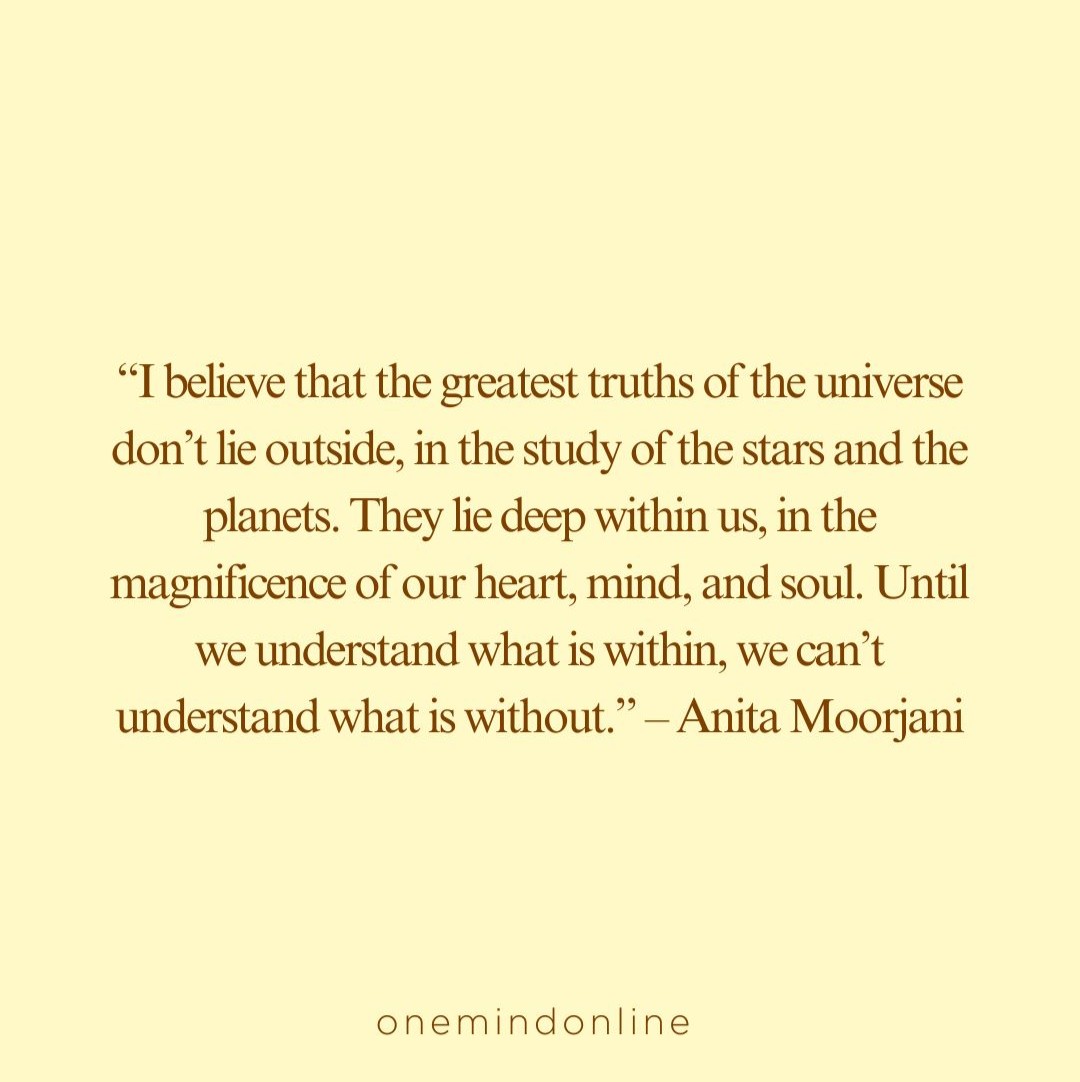
“I believe that the greatest truths of the universe don’t lie outside, in the study of the stars and the planets. They lie deep within us, in the magnificence of our heart, mind, and soul. Until we understand what is within, we can’t understand what is without.” – Anita Moorjani
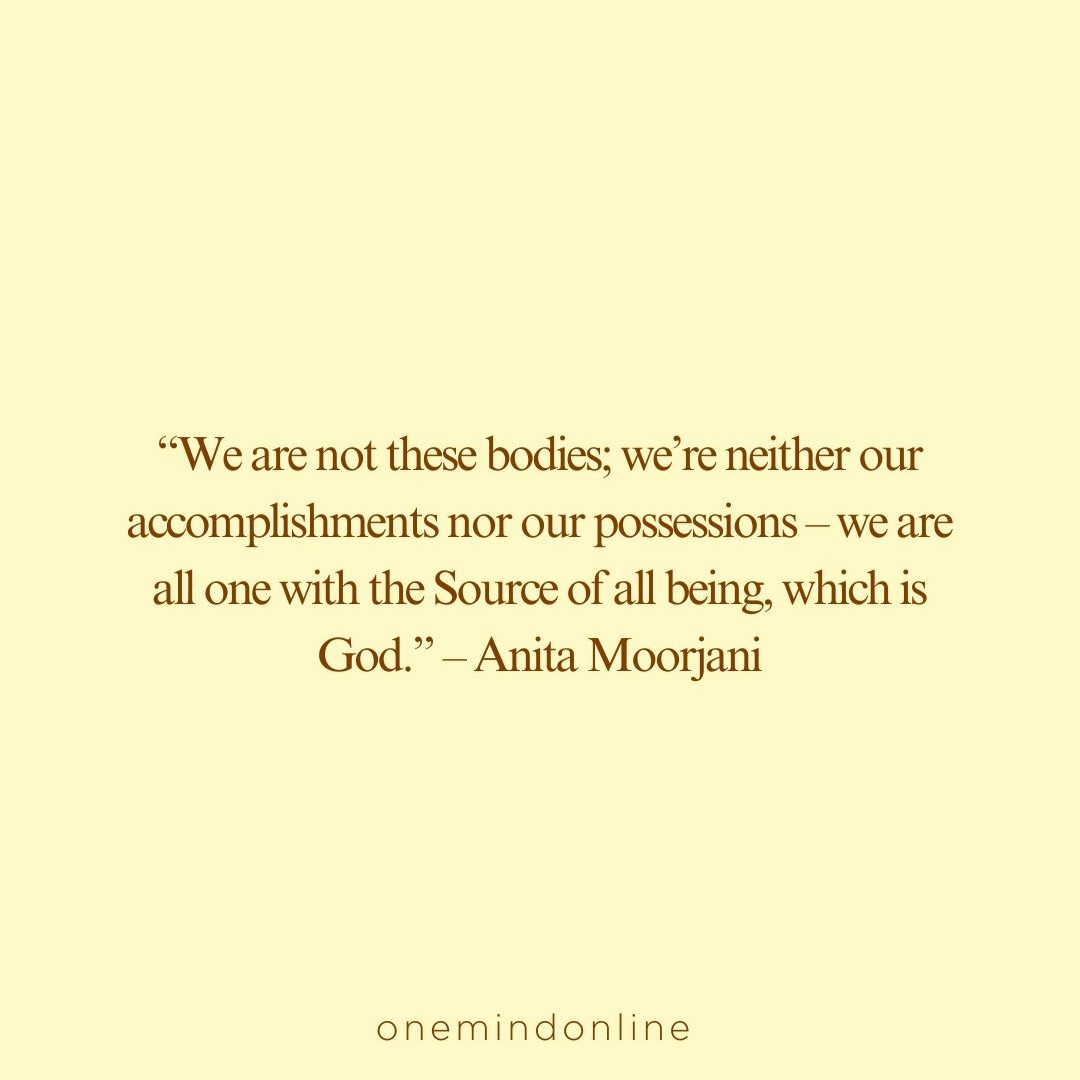
“We are not these bodies; we’re neither our accomplishments nor our possessions – we are all one with the Source of all being, which is God.” – Anita Moorjani
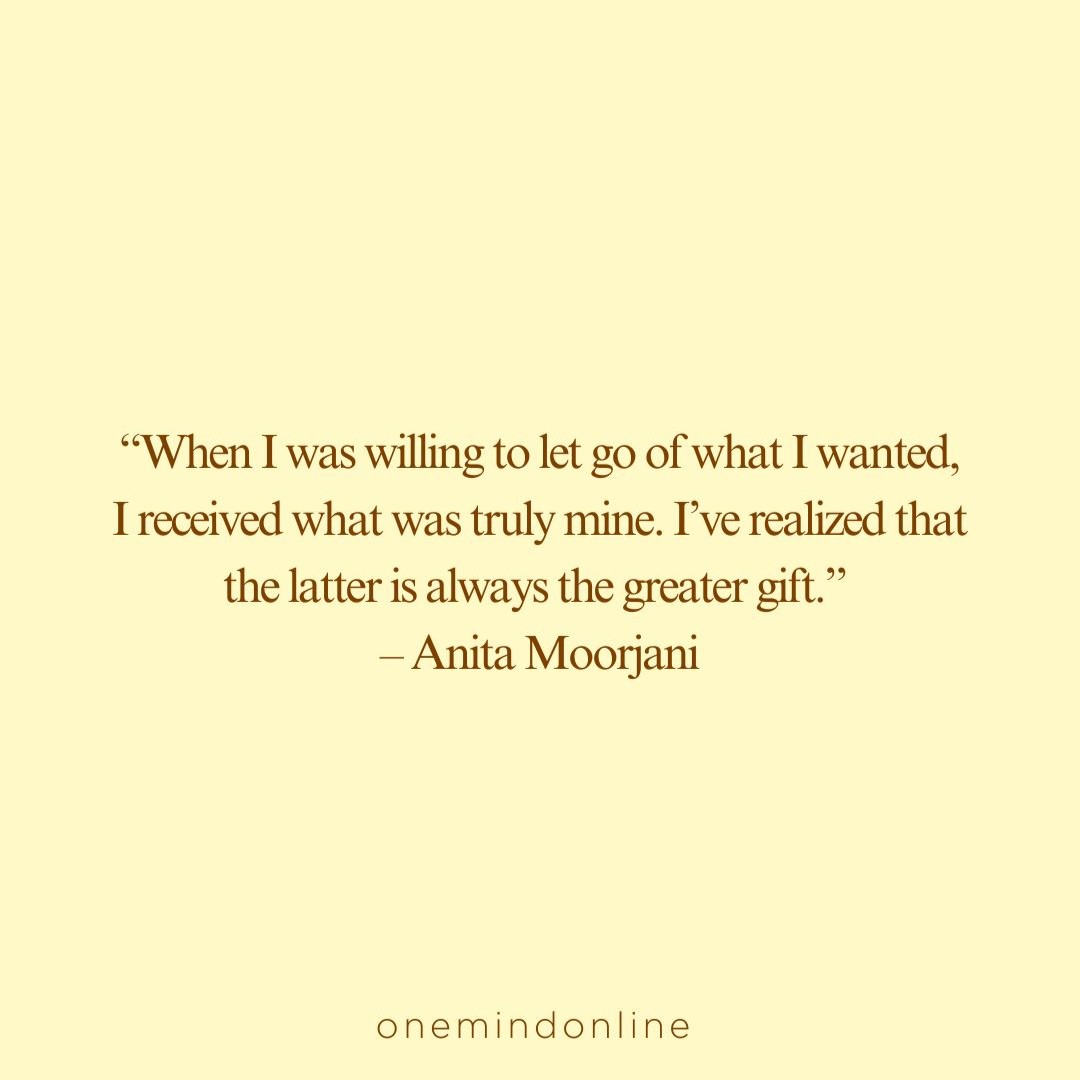
“When I was willing to let go of what I wanted, I received what was truly mine. I’ve realized that the latter is always the greater gift.” – Anita Moorjani
“…letting go of attachment to any way of believing or thinking has made me feel more expanded and almost transparent so that universal energy can just flow through me.” – Anita Moorjani
“I’m at my strongest when I’m able to let go, when I suspend my beliefs as well as disbeliefs, and leave myself open to all possibilities. That also seems to be when I’m able to experience the most internal clarity and synchronicities. My sense is that the very act of needing certainty is a hindrance to experiencing greater levels of awareness. In contrast, the process of letting go and releasing all attachment to any belief or outcome is cathartic and healing. The dichotomy is that for true healing to occur, I must let go of the need to be healed and just enjoy and trust in the ride that is life.” – Anita Moorjani
“I could feel my attachment to the scene receding as I began to realize that everything was perfect and going according to plan in the greater tapestry.” – Anita Moorjani
Surrender… It can be a rather difficult concept to grapple with because our very human bodies have a deep desperation to survive. To this body, surrender can feel extremely threatening. Anita describes surrender as a “letting go of our need for certainty.” That when we let go of certainty and just surrender, we are gifted with clarity.
Let’s reflect on these guiding mantras:
- “I love and honor my body as the sacred vessel that carries me through life.”
- “I release my need to control every outcome and trust in life’s natural flow.”
- “I listen deeply to my inner wisdom and follow the guidance of my heart.”
- “I surrender to life’s rhythm and allow myself to be guided by its intelligence.
- “I trust completely that everything is unfolding exactly as it should for my highest good.”
The path to surrender may be challenging, but the rewards are immense. As Moorjani shares, “I’m at my strongest when I’m able to let go.” By releasing our need for certainty and control, we can experience the transformative power of surrender and embark on a journey toward healing and enlightenment.
Join us on today’s journey for practical experience of how surrender leads to clarity.
Have a beautiful day peeps!
– pierre –
Today’s LIVE meditation is: Surrender.
Today’s LIVE meditation
https://youtu.be/CuWUtkUXzfk 2026
https://youtu.be/wuk-7LdLGic 2025
https://youtu.be/1jXAqYV9hlg 2024
https://youtu.be/Ah7s2yxqHd4 2023
Practice the “Daily Dose”
Let’s put it into practice! Choose what works for you – daily, once a week or whenever inspiration strikes. Putting pen to paper wires the neural pathways that will create your new habits.
1 – Affirmation
Write down your favourite affirmation on a sticky note and place it somewhere that you’ll be able to see it the whole day.
- “I love and honor my body as the sacred vessel that carries me through life.”
- “I release my need to control every outcome and trust in life’s natural flow.”
- “I listen deeply to my inner wisdom and follow the guidance of my heart.”
- “I surrender to life’s rhythm and allow myself to be guided by its intelligence.
- “I trust completely that everything is unfolding exactly as it should for my highest good.”
2 – A moment of reflection
Use today’s question as a journal prompt. If you don’t have the time to sit down and write, just take a moment to reflect on your response.
Exploring Your Relationship with Your Body: Reflect on Anita Moorjani’s realization that she had never truly loved her physical body. Write about your own relationship with your body. How do you speak to yourself? What patterns of self-criticism or self-compassion do you notice? How might loving your body more deeply change your daily experience and overall well-being?
3 – Quotes to share
Send a quote to someone who needs it, or share them all on social media to spread the good vibes!
4 – Q&A for deeper learning
Read through the questions and answers and write down at least one “aha moment” that clicked for you.
Q1. How can loving my body actually contribute to physical healing?
Self-love and body compassion create a supportive internal environment that reduces stress hormones and promotes healing. When we’re constantly criticizing or fighting our bodies, we generate chronic stress that can suppress immune function and create inflammation. Loving our bodies means treating them with kindness, listening to their needs, and providing proper care. This shift from internal warfare to internal peace allows our body’s natural healing mechanisms to function optimally.
Q2. Isn’t it dangerous to “let go of control” when dealing with serious health issues?
Surrender doesn’t mean stepping back from care, treatment, or responsible action; it means stepping back from acting out of fear. There’s a real difference between making a decision from clarity and making that same decision while gripped by panic. Fear narrows our thinking and floods the body with stress hormones, often pushing us toward frantic, reactive choices rather than wise ones. Surrender asks us to keep doing everything within our power – following medical advice, making healthy choices, showing up for treatment – but to do it from a place of trust rather than dread. You can take a medication because you’re terrified of dying, or take that same medication as an act of self-care and love; the action is identical, but the internal state is entirely different. And it’s that internal state, more than the action itself, that determines whether you’re fighting your body or working with it.
Q3. How do I know if I’m truly surrendering or just being passive?
Here again, surrender is not the absence of action – it’s the redirection of action. Think about how much of your daily energy goes toward trying to control things that were never actually yours to control: other people’s opinions, the exact timeline of your healing, outcomes that depend on a hundred variables outside your reach. That effort doesn’t create safety; it just creates exhaustion, because you’re pouring energy into a grip that was always going to slip. True surrender is the practice of noticing where that wasted energy is leaking out and consciously letting it go – not so you do less, but so what’s left is concentrated and clear. Passivity feels like giving up; surrender feels like finally having enough energy to act on the things that actually matter. So the real test isn’t how much or how little you’re doing, it’s whether your action is coming from a place of depletion and struggle, or from a place of abundance and ease.
Q4. Can anyone experience the kind of miraculous healing that Anita Moorjani had?
It’s worth pausing on this question, because there’s a hidden trap inside it – the moment we latch onto someone else’s miraculous healing with desperation, hoping to replicate it exactly, we’ve already stepped outside of surrender and back into fear. Anita herself points to this paradox when she says, “The dichotomy is that for true healing to occur, I must let go of the need to be healed and just enjoy and trust in the ride that is life.” When healing becomes the desperate goal, the journey fills up with stress, striving, and disappointment – none of which are fertile ground for the body to actually heal. But when the goal shifts to loving yourself right now, exactly as you are, even if healing never comes, something changes: the journey starts filling with small moments of joy instead of pressure. And it’s often in that state of wholeness – loving yourself in the present, without conditions – that healing has the space to follow, not because you chased it, but because you finally stopped needing it. It is not healing that makes you whole. It’s becoming whole that makes you heal.
Q5. How can I access my “inner wisdom” when I’m scared or confused?
This is a very real concern, and it’s important to understand why it happens: when we’re in survival mode, our brains default to shortcuts – the well-practiced coping mechanisms we’ve created in the past. That’s precisely why the practice can’t start the day the storm hits. On easy days, it’s tempting to skip meditation, journaling, or quiet reflection because in that moment we don’t feel like we need them – but that’s exactly when they need to be built, because without repetition they never become automatic enough to reach for under real pressure. You can’t grow strong roots only when the wind is already tearing at the branches; the roots have to go down long before the storm arrives. So if you want inner wisdom to be accessible when you’re scared or confused, the work is to practice tuning into it on the ordinary, uneventful days – not because you need it then, but so that it’s already familiar and well-worn by the time you do.
Q6. What’s the difference between spiritual surrender and medical treatment?
Spiritual surrender and medical treatment are not mutually exclusive, they can work beautifully together. Surrender means approaching medical treatment with trust and openness rather than fear and desperation. It means following your treatment plan while releasing anxiety about the outcome. Many people find that when they surrender their fear and trust the process, they make better decisions about their care, communicate more effectively with healthcare providers, and experience less stress during treatment, all of which can support better outcomes.