

“Your Daily Dose” is a quick two minute read packed with bite-sized wisdom from all the great teachers. But you could also choose to turn it into something more… a powerful daily practice for personal growth. Give it a try!
A message from today’s meditation:
What kind of energy do you want to carry around with you? This seemingly simple question holds the key to transforming not just how you interact with the world, but how you fundamentally experience life itself.
In our daily encounters with others, we face countless opportunities to choose our response. Someone cuts you off in traffic, a colleague makes a snide remark, or a stranger seems dismissive. In today’s meditation journey, Matt Kahn’s views on love focuses on what it is that we gain from doubling down on the giving of love.
“… He looked at me in a really surprised way, and I could tell he was thinking, “I didn’t mean it as a compliment!” Of course, I knew his words weren’t spoken with care and concern, but I chose to take it as a compliment and turn it into a gift that I offered in return. No matter the circumstance, love can withstand any type of judgement or ridicule and turn it into something more redeeming as a gift for every heart.” – Matt Kahn
This is not about taking the high road, not about being the bigger person but about realizing that how you choose to act, is you making a choice about who you ARE. The energy with which you show up and respond to the world will vibrate within your cells long after the interaction – so what is the energy that you want to carry around with you?
“You’re learning to be nourished by the love that you give, not by the validation offered in response to your giving.” – Matt Kahn
“You give to yourself, by giving of yourself.” – Matt Kahn
“When we are clear on the exact gifts we are open to sharing with others, the conviction of our generosity breaks the spell of energetically taking on other people’s experiences.” – Matt Kahn
Every cell in your body listens to the words you speak to others, which gives weight to the philosophy that, “you can’t do anything to another, without also doing it to yourself.”
Words can cut or they can heal, and if you are able to understand what it is that your body needs to hear in order to heal, why not make that the language in which you speak to all the humans around you?
“Empowerment is realizing you are the one who needs to say the things you’ve waited your entire life to hear.” – Matt Kahn
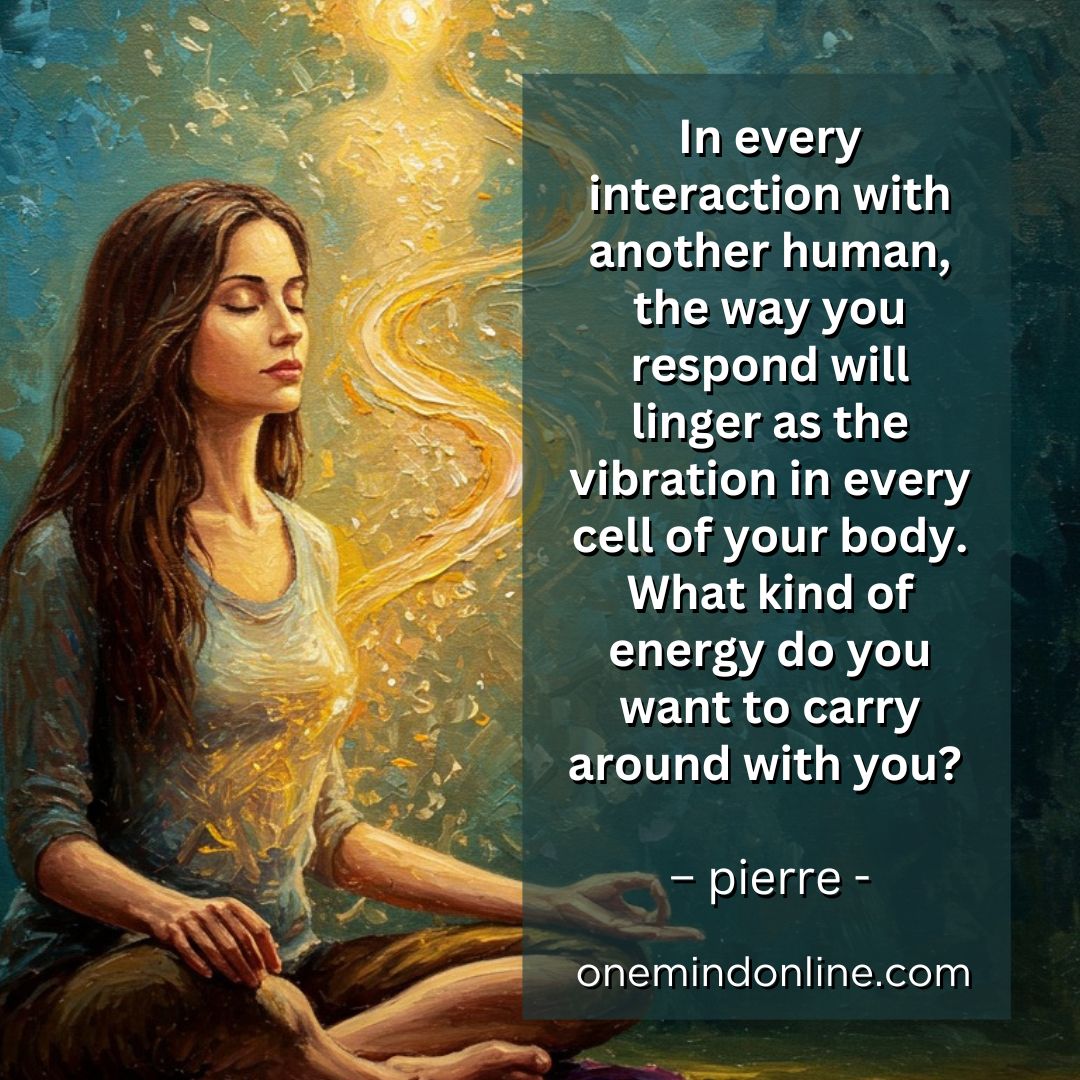
In every interaction with another human, the way you respond will linger as the vibration in every cell of your body. What kind of energy do you want to carry around with you?
“In a world of endless questions, love really is the only answer.” – Matt Kahn
Ultimately we really only have one option if we want to be sustainably healthy humans, and that is to show up as love. Always.
Affirmations to double down on love:
- “I nourish myself through the kindness I offer to others.”
- “I trust that love can transform any circumstance into a gift.”
- “I choose to carry the energy of love within every cell of my being.”
- “I am empowered to speak the healing words my body needs to hear.”
- “My words to others are also words to myself – I choose them with care.”
In a world filled with endless questions, love emerges as the ultimate answer. It is the guiding force that unites us, heals our wounds, and creates a more harmonious existence. As we navigate the complexities of life, let us choose to show up as love.
Have a beautiful Friday beautiful people.
– pierre –
Today’s LIVE meditation is: Sharing love.
Today’s LIVE meditation
https://youtu.be/Sd3lNRt1gUQ 2025
https://youtu.be/1LM80oNenwA 2023
Practice the “Daily Dose”
Let’s put it into practice! Choose what works for you – daily, once a week or whenever inspiration strikes. Putting pen to paper wires the neural pathways that will create your new habits.
1 – Affirmation
Write down your favourite affirmation on a sticky note and place it somewhere that you’ll be able to see it the whole day.
- “I nourish myself through the kindness I offer to others.”
- “I trust that love can transform any circumstance into a gift.”
- “I choose to carry the energy of love within every cell of my being.”
- “I am empowered to speak the healing words my body needs to hear.”
- “My words to others are also words to myself – I choose them with care.”
2 – A moment of reflection
Use today’s question as a journal prompt. If you don’t have the time to sit down and write, just take a moment to reflect on your response.
The Language of Self-Healing: The article suggests that every cell in your body listens to the words you speak to others. Think about the words and tone you’ve used recently when speaking to people who frustrated, disappointed, or challenged you. Now imagine your body as a sensitive listener to everything you say, what words does your body need to hear in order to heal? Write a conversation between yourself and someone difficult, but use only the language your body needs to hear for healing.
3 – Quotes to share
Send a quote to someone who needs it, or share them all on social media to spread the good vibes!
4 – Q&A for deeper learning
Read through the questions and answers and write down at least one “aha moment” that clicked for you.
Q1: Isn’t choosing love in difficult situations just being a pushover or doormat?
Not at all. Choosing love isn’t about accepting poor treatment or failing to set boundaries. It’s about responding from a place of strength rather than reactivity. When you choose love, you’re choosing the energy you want to carry within yourself, which often leads to clearer thinking and more effective responses. You can still say “no,” set limits, or address problems – but you do so from a centered place rather than from anger or fear. This approach actually empowers you because you’re not giving others control over your internal state.
Q2: How can I practically “turn judgment into a gift” when someone is being genuinely hurtful?
This doesn’t mean pretending hurtful words don’t sting or that harmful behaviour is acceptable. Instead, it means choosing how you internalize and respond to negativity. You might acknowledge the hurt while choosing not to absorb the negative energy as a truth about yourself. The “gift” you offer could be maintaining your own peace, responding with clarity instead of defensiveness, or simply not perpetuating the cycle of negativity. Sometimes the greatest gift is not allowing someone else’s pain to become your own.
Q3: What does it mean that “every cell in your body listens to your words”? Is this scientifically accurate?
It’s a poetic way of describing something your body demonstrates every day, and there is real science behind the idea. Imagine biting into a sharp, juicy lemon. Your mouth may start to water even though there is no lemon, because the thought alone triggered a chemical reaction in your salivary glands. This shows that your mind and body are in constant conversation, and the same principle applies to the thoughts behind your words and to the words themselves. Kind, joyful, or encouraging words are associated with the release of feel-good chemicals such as dopamine, serotonin, and oxytocin, while angry or hostile words tend to raise cortisol, adrenaline, and other stress hormones. These chemical messengers travel through your bloodstream to cells throughout your body, and they don’t switch off the moment a conversation ends. Long after you’ve walked away, your cells still reflect the tone of that interaction. “Every cell is listening” is metaphorical rather than a literal claim that cells understand language, but the underlying idea holds: the way you speak shapes your internal chemistry, so choosing loving words is also a way of caring for your own body.
Q4: How do I avoid taking on other people’s negative energy while still being compassionate?
The foundation lies in knowing who you are. When you have a clear, genuinely good opinion of yourself, you own yourself, and other people’s negativity has nowhere to land. If you don’t, other people’s opinions will own you: a sharp remark or a heavy mood slips in and starts to feel like truth about you, because there is no firm sense of self to measure it against. That’s why this isn’t about building walls or going cold. A person who is grounded in their own worth can stay open, listen, and offer real compassion without losing themselves in someone else’s storm. Self-knowledge lets you recognize the difference between “this is their pain” and “this is who I am.” You can strengthen it by speaking to yourself with the kindness you offer others, getting clear on your values, and noticing in a charged moment whose feelings you’re actually carrying. This echoes Matt Kahn’s point that being clear about the gifts you’re willing to share, such as presence, patience, or a listening ear, lets you give wholeheartedly without absorbing what isn’t yours. Compassion then becomes something you offer from a steady place, rather than something that costs you your own peace.
Q5: What if I don’t feel nourished by giving love? What if it just feels draining?
If giving feels draining, it’s worth looking honestly at what was actually being given. When love leaves you depleted, it usually wasn’t love in the first place. You were performing love as a transaction, in the hope of being validated, thanked, or loved back. Because the giving was tied to an outcome, your energy went out with a quiet invoice attached, and when the payment didn’t arrive, you felt empty. Real love works differently. It isn’t something you do for someone else’s benefit, but the truest expression of who you are, which is why experiencing yourself as love always brings nourishment, whatever the other person does with it. This is the heart of Matt Kahn’s teaching that you learn to be nourished by the love you give, not by the validation offered in response. A simple check is to ask yourself in the moment, “What am I hoping to receive from this?” If an answer comes, you can release the expectation and return to simply being the love you are, letting the other person’s response be theirs. Giving then stops being a trade and becomes an act of self-expression that fills you as it flows.
Q6: How can I become “the one who says what I’ve waited to hear” without it feeling fake or forced?
Pause for a moment and ask yourself: how can loving yourself possibly be fake? You are the one person you spend every hour of every day with for an entire lifetime, so shouldn’t caring for that person be the most authentic thing in your life? Of course, anything unfamiliar and unpracticed will feel uncomfortable at first, but that awkwardness doesn’t mean you’re being insincere, only that you’re new to it. Like any other skill, what you keep practicing you become better at. Begin with simple truths you already believe about yourself, such as “I showed up today” or “I’m doing the best I can,” and offer yourself gentle encouragement in the tone you’d use with a good friend. Over time, these small, repeated moments build a stronger, more supportive inner narrative, until the words you once waited a lifetime to hear from others become the inner-voice you can count on. This is the empowerment Matt Kahn points to: realizing you are the one who can say them.
Q7: Is it realistic to expect that love is “the only answer” to every situation? What about practical problems that require action?
Love as “the only answer” doesn’t mean love solves every practical problem, but rather that approaching challenges from a place of love creates the best foundation for effective action. When you’re centered in love rather than fear, anger, or desperation, you typically make clearer decisions, communicate more effectively, and maintain better relationships even during difficult times. Love includes wisdom, boundaries, and appropriate action – it’s not passive or naive. It’s about the internal foundation from which you operate, not about avoiding necessary practical steps.