

“Your Daily Dose” is a quick two minute read packed with bite-sized wisdom from all the great teachers. But you could also choose to turn it into something more… a powerful daily practice for personal growth. Give it a try!
A message from today’s meditation:
Have you ever felt a subtle nudge about a choice you needed to make, only to brush it aside and later wish you hadn’t? Or perhaps you’ve experienced an unexpected spark of insight that illuminated your path. These are all whispers from your inner wisdom, a powerful source of guidance often drowned out by the daily cacophony of thoughts. The good news? We can all learn how to better listen to this wise voice within, leading to a life of greater clarity, discernment, and fulfillment.
“Your inner wisdom will always guide you, if you listen and let it in. If you get quiet inside of your head, then your inner thoughts can come from your inner wisdom. When we are feeling judgmental, or self-conscious, or just plain uncomfortable inside, then usually it is just that noise in our head talking loudly. I call this noise your intellectual thinking which results from your opinions and beliefs. True wisdom holds pretty much no opinions or judgments. A lot of inner chatter is usually just going to mess you up with ideas that are not coming from your true inner wisdom.” – Jan Christenson
This distinction is everything. Intellectual thinking is reactive – it is built from fear, past conditioning, ego, and opinion. Inner wisdom, by contrast, is still. It doesn’t argue. It doesn’t compete. There is just a gentle knowing. The challenge is that the noise is so loud, so constant, so convincing, that we rarely make room for the quieter truth.
It’s our natural response to use our brain to try and ‘think’ up the answers, but have you tried finding answers by NOT thinking? The key to unlocking your inner wisdom lies in creating space for it to be heard. Embrace a practice of silence, and learn to discern that quiet voice from the noise of your thoughts.
Here is what I mean:
By now you know the formula of the meditation, and you know that you can do that deep dive to be connected to something deep inside you. This is where I like to take my questions, but… try to specifically not “search for” an answer. When we ask a question, naturally our mind wants to jump to attention and manufacture an answer but for this exercise, can you be like: “I’m not desperate for an answer, I’m just being curious.”
“Your vision will become clear only when you can look into your own heart. Who looks outside, dreams; who looks inside, awakens.” – Carl Jung
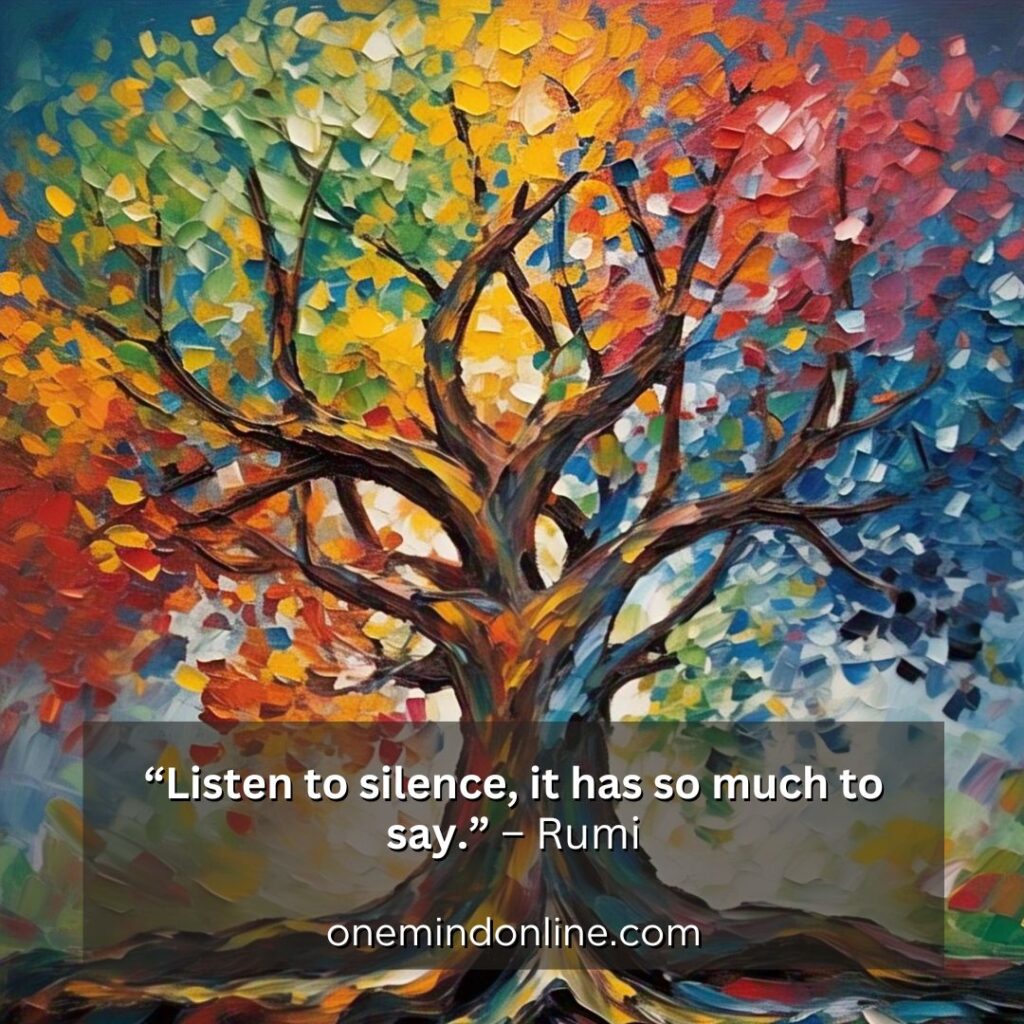
“Listen to silence, it has so much to say.” – Rumi
Our minds often try to force solutions, but inner wisdom speaks in a quieter language. To hear it, we need to create a calm inner environment, like stilling a pond to see the reflections clearly.
This journey of inner exploration doesn’t require complicated techniques. Here are a few thoughts to guide your self-reflection:
- Create space for Silence: “I do not need to force an answer. My inner wisdom speaks when I create space for it.”
- Listen Deeply: “I release the noise of judgment and opinion, and return to the clarity beneath.”
- Be Patient: “I let go of the need for immediate answers. I trust the quiet voice within me. It has always known the way.”
While our brains are powerful tools for analysis, they aren’t the only source of answers. Your inner wisdom offers a different kind of guidance, one that becomes accessible when you step out of the realm of constant thinking and into a space of quiet receptivity.
Have an awesome day peeps!
– pierre –
Today’s LIVE meditation is: Finding inner wisdom.
Today’s LIVE meditation
https://youtu.be/BORqfHSeTcI 2026
https://youtu.be/rkZGqQJyCKs 2024
https://youtu.be/84PX-3fRcTQ 2023
https://youtu.be/V1OSZi9RFKs 2022
https://youtu.be/GawO9AjORpI 2021
https://youtu.be/00XVeQdEPRM 2020
Practice the “Daily Dose”
Let’s put it into practice! Choose what works for you – daily, once a week or whenever inspiration strikes. Putting pen to paper wires the neural pathways that will create your new habits.
1 – Affirmation
Write down your favourite affirmation on a sticky note and place it somewhere that you’ll be able to see it the whole day.
- Create space for Silence: “I do not need to force an answer. My inner wisdom speaks when I create space for it.”
- Listen Deeply: “I release the noise of judgment and opinion, and return to the clarity beneath.”
- Be Patient: “I let go of the need for immediate answers. I trust the quiet voice within me. It has always known the way.”
2 – A moment of reflection
Use today’s question as a journal prompt. If you don’t have the time to sit down and write, just take a moment to reflect on your response.
Where Judgment Blocks Wisdom. Jan Christenson says true wisdom “holds pretty much no opinions or judgments.” Reflect on an area of your life where you feel a strong internal judgment — about yourself, a situation, or another person. How much mental noise does this judgment create? What might you hear or feel if you could set that judgment down, even briefly?
3 – Quotes to share
Send a quote to someone who needs it, or share them all on social media to spread the good vibes!




4 – Q&A for deeper learning
Read through the questions and answers and write down at least one “aha moment” that clicked for you.
Q1. What exactly is inner wisdom, and how is it different from regular thinking?
Inner wisdom is the deeper, quieter knowing that exists beneath the constant activity of the thinking mind. Regular thinking — what Jan Christenson calls “intellectual thinking” — is built from our opinions, beliefs, fears, and past experiences. It is reactive and often noisy. Inner wisdom carries no judgment and no agenda. It is not something you generate; it is something you uncover when you get still enough to hear it. Think of it as the signal beneath the static.
Q2. How do I know if what I’m hearing is genuine inner wisdom or just programming?
Our programmed thoughts are very often associated with survival and they tend to feel urgent, charged, or emotionally driven — they often tell you what you want to hear and involves attachment to a specific outcome. Inner wisdom, by contrast, tends to feel calm and clear, without the emotional heat. It rarely shouts; it whispers. It also tends to be consistent — if you return to silence on the same question over days or weeks, wisdom tends to repeat the same quiet knowing, while wishful thinking shifts with your mood.
Q3. I’ve tried to meditate but my mind won’t stop racing. Can I still access inner wisdom?
Absolutely. A racing mind is not a barrier to inner wisdom — it is simply the starting condition. You do not need a perfectly silent mind to access deeper knowing. The practice is not about stopping your thoughts, but about shifting your relationship to them: observing without being pulled in, noticing without judging. Even a few conscious breaths and a moment of intentional stillness can create just enough space for a quieter insight to arise. Start where you are, not where you think you should be.
Q4. Why suggest NOT trying to find an answer when sitting with a question?
Because forcing an answer activates the analytical mind — which will promptly generate one, whether or not it comes from a place of true knowing. When you approach a question with curiosity rather than urgency, you step out of problem-solving mode and into a state of receptive awareness. This is where inner wisdom operates. The instruction to “not be desperate for an answer” isn’t about being passive; it’s about creating the inner conditions in which a genuine, unforced insight can surface on its own.
Q5. Do I need a formal meditation practice, or are there simpler ways to access this?
No formal practice is required, though regular meditation deepens the capacity. Inner wisdom becomes accessible whenever you genuinely slow down and turn inward — during a walk in nature, while journaling without an agenda, in the quiet between waking and fully rising, or in any moment when you consciously choose stillness over stimulation. The key is not the method but the quality of attention: open, non-judgmental, unhurried. Any practice that cultivates that quality of presence can serve as a doorway.
Q6. What if I listen to my inner wisdom and it leads me to a difficult or uncomfortable truth?
This is the most courageous question of all. Inner wisdom does not always tell us what is comfortable; it tells us what is true. It may reveal that a relationship has run its course, that a path you’ve been on no longer serves you, or that a change you’ve been avoiding is necessary. The discomfort of that truth is not a sign that the wisdom is wrong — it is often a sign that it is right. Wisdom doesn’t demand immediate action; it asks for acknowledgment. Start by simply being honest with yourself, and trust that clarity precedes courage.