

“Your Daily Dose” is a quick two minute read packed with bite-sized wisdom from all the great teachers. But you could also choose to turn it into something more… a powerful daily practice for personal growth. Give it a try!
A message from today’s meditation:
We’ve all been there – that uncomfortable space where we know the old patterns no longer serve us, yet the path forward remains frustratingly unclear. This liminal space, the threshold between who we were and who we’re becoming, often feels like the purgatory that Dr. Suess described as the waiting place – a period in our life that feels like endless waiting, threatening to swallow our progress whole. But what if this in-between time isn’t a place of being stuck, but rather a sacred space of preparation?
Today’s thought from Iyanla Vanzant is my very favourite piece of her wisdom. Her message is about being in that space where I know that the old doesn’t serve me any longer, but I don’t quite have the clarity of what the next steps look like…
“You must be ready in mind, in body, and in spirit before you can make a change. People cannot convince you to do it. You cannot force you to do it. Everything you think, say, and do until that happens is just preparation. So love yourself right now. Honor yourself right now. Keep talking to yourself in encouraging ways. Keep thinking ready thoughts. In the meantime, try to remember you will not be ready until you are ready.” – Iyanla Vanzant
Our journey of “growth” doesn’t jump from A to Z but moves through layers, both inward and also outwardly.
The inward journey:
Our inner journey is a slow process of coming to an understanding of who/what we really are. And then from understanding, making our way to acceptance. Acceptance of the past that created our thought processes. Acceptance of our past need for certain coping mechanisms in order to feel safe. Accepting our past SELF for not knowing any better, and now – one step at a time without blaming our old self – making those new choices to create a future we want to be a part of.
But we only become ready for each of these steps one at a time.
The outward journey:
And so it is too, with the new that we want to draw into our lives. Making changes to our careers, to our relationships, and perhaps even relocating. Our journey outward also happens one layer at a time creating new habits, new routines, new patterns, new responses, taking steps forward.
And again, we become ready for these new layers, one at a time.
The problem is…
… how we deal with the in-between times when it feels like we are stuck. When it feels like, “yes there’s been some growth, but now I’ve become stagnant…?”
Sometimes we’re just not ready yet, and how we see ourselves during these liminal times is a huge factor in how we navigate the next steps.
This is where the above wisdom from Iyanla Vanzant can help support you… love yourself right now, honour yourself right now, understand that you are busy preparing, keep encouraging yourself and keep thinking ready thoughts. You will not be ready until you’re ready. But in the meantime you are getting ready to be ready.
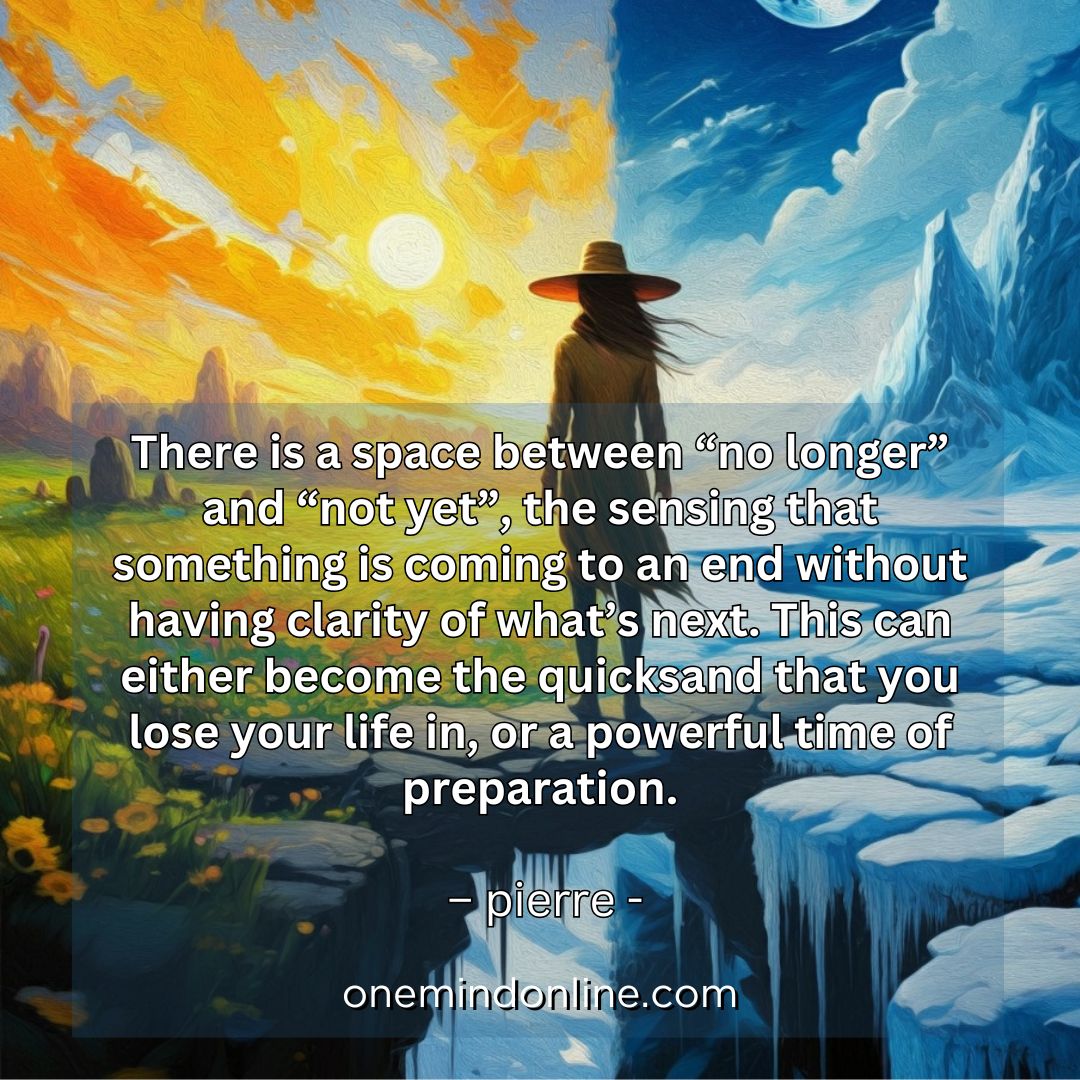
There is a space between “no longer” and “not yet”, the sensing that something is coming to an end without having clarity of what’s next. This can either become the quicksand that you lose your life in, or a powerful time of preparation.
For any change to take place what we need most is patience, and today’s meditation is a great tool for practicing patience. Learning how to BE with exactly where you find yourself right now, without losing hope if the progress feels slow.
Mantras for navigating the liminal space:
- “I am not stuck, I am preparing.”
- “I am getting ready to be ready.”
- “I trust the process, and I trust myself.”
- “Self-compassion and patience is my anchor.”
- “The in-between space holds the potential for profound change.”
By embracing the liminal space and approaching it with patience and self-compassion, you can transform this seemingly stagnant phase into a catalyst for positive change. Remember, even the most magnificent butterfly needed a period within its chrysalis before it could take flight. So, breathe deeply, be kind to yourself, and trust that your transformation is unfolding exactly as it should.
– pierre –
Today’s LIVE meditation is: Come to your senses.
Today’s LIVE meditation
https://youtu.be/YavPzv2etK4 2026
https://youtu.be/xSMsL6NWD68 2024
https://youtu.be/7FZOsWnfx2U 2023
Practice the “Daily Dose”
Let’s put it into practice! Choose what works for you – daily, once a week or whenever inspiration strikes. Putting pen to paper wires the neural pathways that will create your new habits.
1 – Affirmation
Write down your favourite affirmation on a sticky note and place it somewhere that you’ll be able to see it the whole day.
- “I am not stuck, I am preparing.”
- “I am getting ready to be ready.”
- “I trust the process, and I trust myself.”
- “Self-compassion and patience is my anchor.”
- “The in-between space holds the potential for profound change.”
2 – A moment of reflection
Use today’s question as a journal prompt. If you don’t have the time to sit down and write, just take a moment to reflect on your response.
Getting Ready to be Ready: Iyanla Vanzant reminds us that “everything you think, say, and do until you’re ready is just preparation… keep thinking ready thoughts.” Much of preparation happens beneath the surface – internal shifts in perspective, subtle changes in self-talk, quiet moments of building courage, private decisions to try again tomorrow. What invisible preparation work are you doing that no one else can see? Journal about the internal changes that don’t show up on the outside yet: the way you’re catching negative thoughts more quickly, the small boundaries you’re experimenting with, the kinder voice you’re cultivating toward yourself. Honour this unseen labor of getting ready.
3 – Quotes to share
Send a quote to someone who needs it, or share them all on social media to spread the good vibes!
4 – Q&A for deeper learning
Read through the questions and answers and write down at least one “aha moment” that clicked for you.
Q1: How do I know if I’m actually growing or just making excuses for being stuck?
The difference lies in what you’re doing with your time and what that time is doing for you. Preparation is active, even when it’s quiet: you’re reflecting, learning, experimenting with small shifts, and noticing your patterns with growing honesty, so each day leaves you slightly more aware, more capable, or more open than the last. Hiding looks similar from the outside, but it’s driven by avoidance. Instead of moving you toward readiness, it keeps you away from anything that might stir discomfort, and the days blur into one another without any new insight or movement. A helpful test is to ask yourself, “Am I using this time to get ready, or to avoid?” Preparation feels like gathering strength, even when it’s uncomfortable, while hiding feels like numbing or postponing, usually with a vague sense of dread underneath. If you find you’re hiding, there’s no need for shame. It’s simply information, and a gentle invitation to take one small, honest step toward what you’ve been avoiding. Remember Iyanla Vanzant’s words: everything you think, say, and do until you’re ready is preparation. That holds true when your thoughts, words, and actions are pointed toward growth, even slowly, and it’s worth checking that they are.
Q2: What does it mean to “keep thinking ready thoughts” as Iyanla Vanzant suggests?
Ready thoughts are the quiet, encouraging states of mind that keep you leaning toward growth while you wait for the next step to become clear. They don’t pretend you’ve arrived, and they don’t insist you should be further along. They simply keep you open and moving in the right direction. Thoughts like “I am becoming,” “I am learning,” and “I am open” are good examples. “I am becoming” reminds you that you’re a work in progress, not a finished product to be judged. “I am learning” turns confusion and missteps into useful information rather than proof of failure. “I am open” softens the resistance that can build when you’re desperate for answers, and it leaves room for clarity to arrive in its own time. You might add others, like “I am willing,” “I am getting ready,” or “I am doing the best I can today.” Each one speaks honestly about where you are right now, without forcing you to leap ahead. This is what separates ready thoughts from forced positivity. These thoughts aren’t pretending that everything is resolved, but they’re also not feeding the story that you’re stuck or behind. By repeating them, you lay the mental groundwork for the moment readiness arrives.
Q3: How long should I expect to stay in this in-between space?
There’s no universal timeline for liminal spaces because readiness is highly individual. What matters more than the length of the wait is where your attention goes while you’re in it. If your focus stays fixed on “when is this over?”, you spend each day scanning the horizon for an exit instead of paying attention to what’s in front of you. That keeps you closed to the lessons, insights, and small shifts that are available right now, which are the very things that build your readiness. The cruel irony is that you can wish the waiting away and still not benefit from it. When the time for change finally comes, you’ll arrive at the doorway without the preparation you were meant to gather on the way, and you won’t feel ready. So try replacing the question “when will this end?” with “what is this moment teaching me?” Let the days be days of learning rather than days to get through. Do that, and when the door opens, you’ll walk through it ready, as Iyanla Vanzant reminds us, because you’ve allowed yourself to use the time for preparation.
Q4: How can I practice patience when everyone around me seems to be moving forward while I feel stagnant?
Remember that external appearances rarely reflect internal realities. Others may appear to be making rapid progress, but you cannot see their struggles, setbacks, or their own periods of preparation. Your growth journey is uniquely yours and operates on its own timeline. Practice returning your attention to your own path by celebrating small internal shifts, honoring your courage to grow authentically rather than superficially, and reminding yourself that deep transformation requires different timing than surface-level changes. You can use the time to teach yourself to become really good at dealing with what is right in front of you, right now.
Q5: How do I handle friends and family who pressure me to make changes before I feel ready?
Set gentle but firm boundaries by acknowledging their care while maintaining your autonomy. You might say something like, “I appreciate your concern and support. I’m actively working on this area of my life, and I need to honour my own timing for making sustainable changes.” Remember that others’ urgency often reflects their own discomfort with uncertainty rather than what’s truly best for you. Share Vanzant’s wisdom if it feels appropriate: people cannot convince you or force you to change before you’re ready. Your readiness is an internal state that others cannot assess from the outside. Focus on surrounding yourself with people who can support your process without rushing it.
Q6: What practical steps can I take to make the most of this preparatory time?
Picture a sailing ship caught in the doldrums, those windless stretches of ocean where the sails hang limp and the water lies flat as glass. For weeks, nothing moves. The crew could shout at the sky, curse the stillness, or argue with a wind that isn’t listening, but none of it would stir a single breath of air. The sailors know what every sailor knows: the weather will change, because it always does. So the wise crew stops fighting the calm and gets to work. They mend the torn sails, varnish the weathered wood, and inspect and repair every rope, so that when the wind returns, the ship is ready to catch it. Your in-between season invites the same approach. Rather than raging at the pace of your life, use the stillness to tend what will carry you forward. Mend your self-talk by replacing harsh inner commentary with encouraging, ready thoughts. Varnish your foundations through rest, movement, good sleep, and nourishing food. Fix your ropes by strengthening your connections, whether that means a trusted friend, a counselor, or a quiet daily practice like meditation or journaling. Learn something that interests you, and try one small experiment that feels manageable. None of this forces the wind to arrive, but it means you’ll be ready when it does.
One thought on “The in-between spaces.”
Comments are closed.