
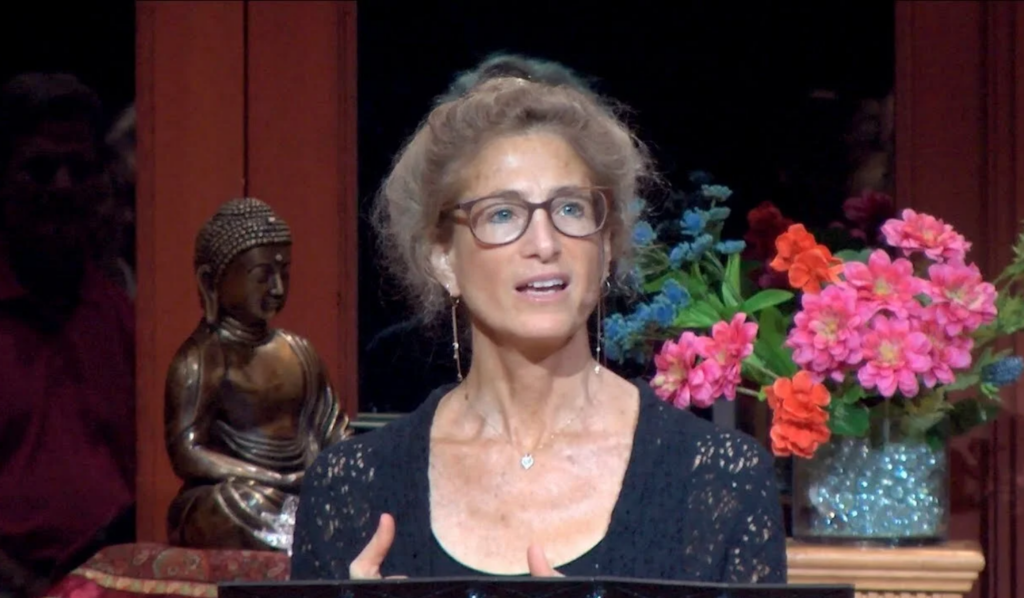
If you’ve ever sat down to meditate, only for your brain to immediately launch a full-scale investigation into that awkward thing you said in 2014, then Tara Brach is the spiritual teacher you’ve been waiting for. As both a clinical psychologist and a meditation powerhouse, Tara is essentially the master of teaching us how to be human without grading ourselves harshly for it. Instead of telling you to float away into a state of perfect, thoughtless bliss, she invites you to look at your messy, chaotic inner life and say, “Yeah, okay, let’s work with this.”
At the center of her teachings is a beautifully liberating concept called Radical Acceptance. Now, this doesn’t mean giving up or throwing your hands in the air; it’s the art of looking at your current reality – even the stressful, anxiety-inducing parts – and giving it permission to exist without picking a fight with it. She’s famous for introducing the RAIN acronym (Recognize, Allow, Investigate, Nurture), which is basically a brilliant four-step first-aid kit for when your emotions decide to hijack your day.
Ultimately, Tara’s wisdom feels less like a strict lecture from a mountaintop and more like a warm, reassuring cup of tea with a wise friend who totally gets it. She reminds us that our quirks, flaws, and stressful moments aren’t personal failures – they’re just part of the wild ride of being human. Adding a splash of her insight to your day is the perfect way to quiet the inner critic and bring a little more laugh-at-yourself kindness to your practice.
Click on the image for more context.

“There is something wonderfully bold and liberating about saying yes to our entire imperfect and messy life.” – Tara Brach
Click on the image for more context.

“There are some things we can’t choose, but in being present we can choose how we want to relate to them.” – Tara Brach
Click on the image for more context.

“Mindfulness is a pause – the space between stimulus and response: that’s where choice lies.” – Tara Brach
Click on the image for more context.

“To flourish and keep evolving, we need to know how to make peace with the truth of uncertainty.” – Tara Brach
Click on the image for more context.

“Imagine you are walking in the woods and you see a small dog sitting by a tree. As you approach it, it suddenly lunges at you, teeth bared. You are frightened and angry at the dog’s behaviour. But as the leaves move you notice that one of its legs is caught in a trap. Immediately your mood shifts from angry to being concerned. You see that the dog’s aggression is coming from a place of vulnerability and pain. This applies to all of us. When we behave in hurtful ways, it is because we are caught in some kind of trap. The more we look through the eyes of wisdom at ourselves and one another, the more we cultivate a compassionate heart.” – Tara Brach
Click on the image for more context.

“Extend an act of kindness each day. No one has to know. It can be a smile, reassuring words, a small favor – without expecting something in return.” – Tara Brach
Click on the image for more context.

“The spiritual path is not a solo endeavor. In fact, the very notion of a self who is trying to free her/himself is a delusion. We are in it together and the company of spiritual friends helps us realize our interconnectedness.” – Tara Brach
Click on the image for more context.

“Become a witness to your thoughts.” – Tara Brach
Click on the image for more context.

“Each time you meet an old emotional pattern with presence, your awakening to truth can deepen. There’s less identification with the self in the story and more ability to rest in the awareness that is witnessing what’s happening. You become more able to abide in compassion, to remember and trust your true home. Rather than cycling repetitively through old conditioning, you are now actually spiraling toward freedom.” – Tara Brach
Click on the image for more context.

“Feeling compassion for ourselves in no way releases us from responsibility for our actions. Rather, it releases us from the self-hatred that prevents us from responding to our life with clarity and balance.” – Tara Brach
Click on the image for more context.

“Clearly recognizing what is happening inside us, and regarding what we see with an open, kind and loving heart, is what I call Radical Acceptance. If we are holding back from any part of our experience, if our heart shuts out any part of who we are and what we feel, we are fueling the fears and feelings of separation that sustain the trance of unworthiness. Radical Acceptance directly dismantles the very foundations of this trance.” – Tara Brach
Click on the image for more context.

“You can think of spiritual practice as a kind of spiritual re-parenting… You’re offering yourself the two qualities that make up good parenting: understanding – seeing yourself for who you truly are – and relating to what you see with unconditional love.” – Tara Brach
Click on the image for more context.

“The most powerful healing arises from the simple intention to love the life within you, unconditionally, with as much tenderness and presence as possible.” – Tara Brach
Click on the image for more context.
“The intimacy that arises in listening and speaking in truth, is only possible if we can become open to the vulnerability of our own hearts. Breathing in, contacting the life that is right here, is our first step. Once we have held ourselves with kindness, we can touch others in a vital and healing way.” – Tara Brach
Click on the image for more context.
“In any moment, no matter how lost we feel, we can take refuge in presence and love. We need only pause, breathe, and open to the experience of aliveness within us. In that wakeful openness, we come home to the peace and freedom of our natural awareness.” – Tara Brach
Click on the image for more context.
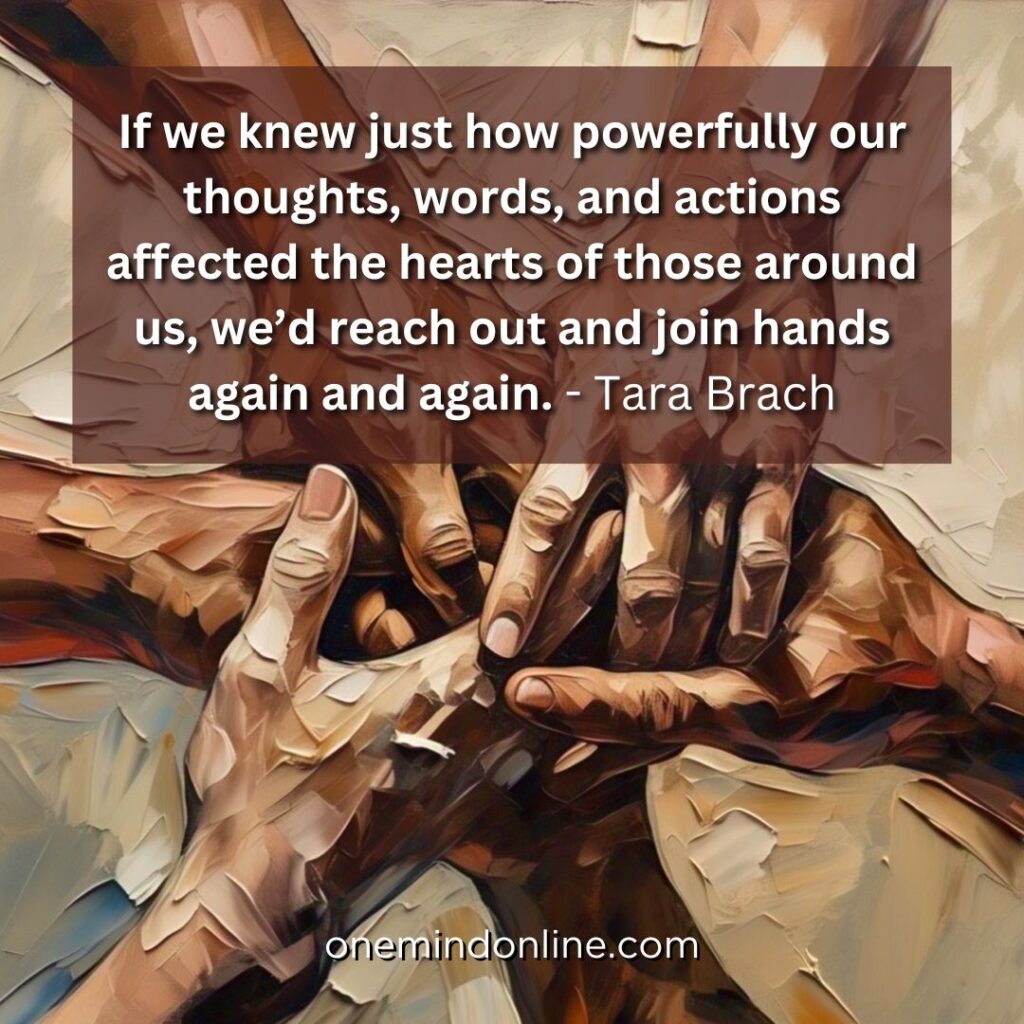
“Most of us need to be reminded that we are good, that we are lovable, that we belong. If we knew just how powerfully our thoughts, words, and actions affected the hearts of those around us, we’d reach out and join hands again and again. Our relationships have the potential to be a sacred refuge, a place of healing and awakening. With each person we meet, we can learn to look behind the mask and see the one who longs to love and be loved.” – Tara Brach
Click on the image for more context.

“Meditation helps us to get out of our thoughts about the future and really be in the present moment.” – Tara Brach
Click on the image for more context.

“We wait for things to be different in order to feel okay with life. As long as we keep attaching our happiness to the external events of our lives, which are ever changing, we’ll always be left waiting for it.” – Tara Brach
Click on the image for more context.

“Stopping the endless pursuit of getting somewhere else is perhaps the most beautiful offering we can make to our spirit.” – Tara Brach
Click on the image for more context.

“There are some things we can’t choose, but in being present we can choose how we want to relate to them.” – Tara Brach
Click on the image for more context.

“I decided to write ‘True Refuge’ during a major dive in my own health. Diagnosed with a genetic disease that affected my mobility, I faced tremendous fear and grief about losing the fitness and physical freedom I loved.” – Tara Brach
Click on the image for more context.

“The great gift of a spiritual path is coming to trust that you can find a way to true refuge. You realize that you can start right where you are, in the midst of your life, and find peace in any circumstance. Even at those moments when the ground shakes terribly beneath you—when there’s a loss that will alter your life forever—you can still trust that you will find your way home. This is possible because you’ve touched the timeless love and awareness that are intrinsic to who you are.” – Tara Brach
Click on the image for more context.

“You have a unique body and mind, with a particular history and conditioning. No one from the outside can offer you a formula for navigating all situations and all states of mind. Only by listening inwardly in a fresh and open way will you discern at any given time what most serves your healing and freedom.” – Tara Brach
Click on the image for more context.