

“Your Daily Dose” is a quick two minute read packed with bite-sized wisdom from all the great teachers. But you could also choose to turn it into something more… a powerful daily practice for personal growth. Give it a try!
A message from today’s meditation:
In search of some words of wisdom to share for this morning’s meditation, I came across this beautiful quote on self acceptance –
“There is something wonderfully bold and liberating about saying yes to our entire imperfect and messy life.” – Tara Brach
And seeing that the theme for Friday meditation is always love I wanted to share some more wisdom on finding love for your SELF.
Loving yourself despite your past choices is the foundation for making better decisions in the future. Embracing your imperfections, your quirks, and your vulnerabilities in a radical act of self-acceptance is what opens within you the ability to learn from past mistakes. After all – mistakes are lessons for us to learn from, not punishments for which we should pay forever.
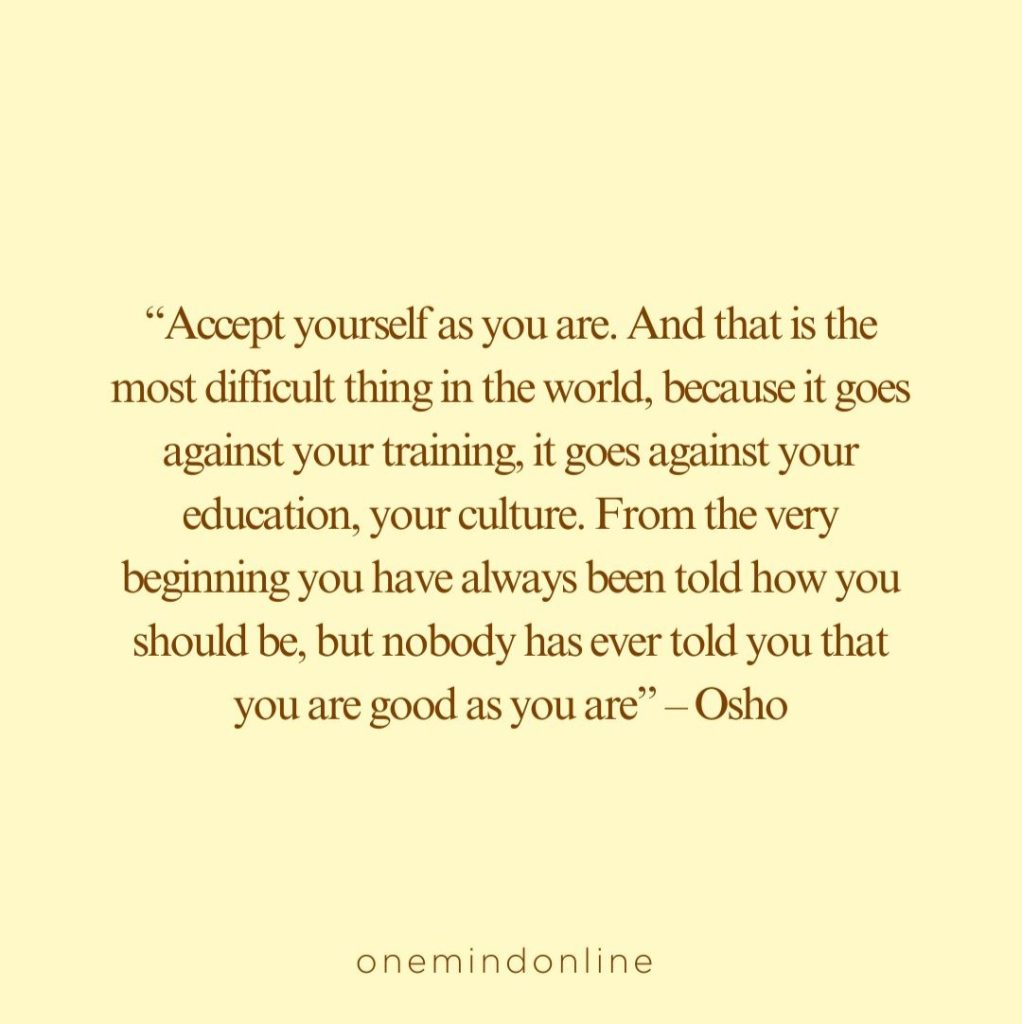
“Accept yourself as you are. And that is the most difficult thing in the world, because it goes against your training, it goes against your education, your culture. From the very beginning you have always been told how you should be, but nobody has ever told you that you are good as you are” – Osho
“You’ve been criticizing yourself for years now and the truth is that it hasn’t worked. Try approving of yourself and see what happens.” – Louise Hay
We’ve been taught to approach self-improvement like a battlefield, armed with judgment and harsh criticism, believing that if we just beat ourselves up enough, we’ll finally become the person we’re meant to be.
Think about this realistically. You’ve always wanted to improve, you’ve always tried to do things better and in an earnest attempt to try and “fix” yourself you’ve been a harsher judge of YOU than anyone else ever has. But the truth is that all of your past self-criticism has been ineffective because the mistakes have not stopped coming, in fact they’ve gotten worse.
Whenever you encounter FEAR about yourself, your shortcomings, your mistakes – the very next thing you do will either increase the fear or lower that fear.
I promise you that by judging and criticizing yourself you are only amplifying the fear and nothing will get better, only worse.
When you’re able to accept and love every messy part of you, you will experience SO much less fear, and when you’re not living in fear you’ll have the space to make better decisions.
Loving yourself despite your past choices is the foundation for making better decisions in the future.
As you reflect on your own journey, remember these guiding mantras:
- “I accept myself fully, just as I am, in this moment.”
- “I release the fear of judgment and embrace the power of love.”
- “Every part of my journey has value, even the messy parts.”
- “I trust that I will make better decisions when I come from a place of self-love and self-acceptance.”
So today, take a moment to reflect on your relationship with yourself. Are you your harshest critic, or your greatest ally? Remember, the journey to self-acceptance is not about becoming someone else; it’s about fully becoming yourself. And as you do, you’ll find that the path to personal growth becomes clearer and more joyful.
Have a happy Friday! And please be kind to your “self”.
– pierre –
Today’s LIVE meditation is: Sharing love.
Today’s LIVE meditation
https://youtu.be/M7KsqaX9kwY 2025
https://youtu.be/EiQEcQWEeVA 2024
https://youtu.be/u0YO56D5O4g 2023
https://youtu.be/TbTB35guUYs 2022
Practice the “Daily Dose”
Let’s put it into practice! Choose what works for you – daily, once a week or whenever inspiration strikes. Putting pen to paper wires the neural pathways that will create your new habits.
1 – Affirmation
Write down your favourite affirmation on a sticky note and place it somewhere that you’ll be able to see it the whole day.
- “I accept myself fully, just as I am, in this moment.”
- “I release the fear of judgment and embrace the power of love.”
- “Every part of my journey has value, even the messy parts.”
- “I trust that I will make better decisions when I come from a place of self-love and self-acceptance.”
2 – A moment of reflection
Use today’s question as a journal prompt. If you don’t have the time to sit down and write, just take a moment to reflect on your response.
Exploring Your Inner Critic: Reflect on a recent mistake or choice you regret. Write a conversation between your critical inner voice and a compassionate inner voice discussing this situation. What does each voice say? Which voice feels more true to who you want to become?
3 – Quotes to share
Send a quote to someone who needs it, or share them all on social media to spread the good vibes!




4 – Q&A for deeper learning
Read through the questions and answers and write down at least one “aha moment” that clicked for you.
Q: Isn’t self-acceptance just making excuses for bad behavior?
A: No. Self-acceptance is not about excusing harmful actions or abandoning accountability. It’s about separating your inherent worth as a person from the choices you’ve made. When you accept yourself, you actually become more capable of taking genuine responsibility because you’re not defending against shame. You can look honestly at your actions, learn from them, and choose differently without the paralysis that comes from self-hatred.
Q: How can I love myself when I keep making the same mistakes?
A: The pattern of repeated mistakes often persists because of self-criticism, not a lack of it. When you’re trapped in fear and judgment, your brain goes into survival mode, which limits access to your higher reasoning and decision-making capabilities. Self-love creates the psychological safety needed to interrupt old patterns. It’s not about perfection; it’s about creating the conditions where change becomes possible.
Q: Doesn’t self-criticism motivate us to improve?
A: Research in psychology suggests the opposite. While constructive feedback helps us grow, harsh self-criticism typically leads to anxiety, depression, and avoidance behaviors rather than positive change. Self-compassion, on the other hand, has been shown to increase motivation, resilience, and the ability to learn from mistakes. You can hold high standards for yourself while still treating yourself with kindness.
Q: What’s the difference between self-love and self-indulgence?
A: Self-love means caring for your long-term wellbeing and growth, even when it’s uncomfortable. Self-indulgence is avoiding discomfort at all costs. True self-love might mean having difficult conversations, setting boundaries, or making changes that feel hard in the moment but serve your deeper values. It’s about what genuinely serves you, not what merely feels good temporarily.
Q: How do I start practicing self-acceptance when I’ve been self-critical for years?
A: Start small and be patient with yourself (even in learning self-acceptance). Notice when you’re being self-critical and simply acknowledge it without judgment: “I’m criticizing myself right now.” Then practice asking, “What would I say to a friend in this situation?” This creates a small gap between automatic criticism and a more compassionate response. Over time, this gap widens and new patterns form.
Q: Can I accept myself and still want to change?
A: Absolutely. In fact, genuine acceptance makes change more sustainable. When you accept where you are right now, you’re working with reality rather than fighting it. You can acknowledge “I have this habit I want to change” without adding “and I’m terrible for having it.” This reduces resistance and shame, making it easier to take constructive action.
Q: What if my past choices hurt other people?
A: Self-acceptance doesn’t erase the impact of your actions on others. It means accepting that you are a flawed human who made mistakes, which then allows you to take full responsibility, make amends where possible, and commit to different choices going forward. Paradoxically, people who accept their imperfections are often better at genuine apologies and repair because they’re not defending against their own shame.