

“Your Daily Dose” is a quick two minute read packed with bite-sized wisdom from all the great teachers. But you could also choose to turn it into something more… a powerful daily practice for personal growth. Give it a try!
A message from today’s meditation:
Since humans first began to write, has there ever been a topic more written about than love? Trying to understand, explain, describe with words something that we all have some knowledge of, but still seems so elusive?
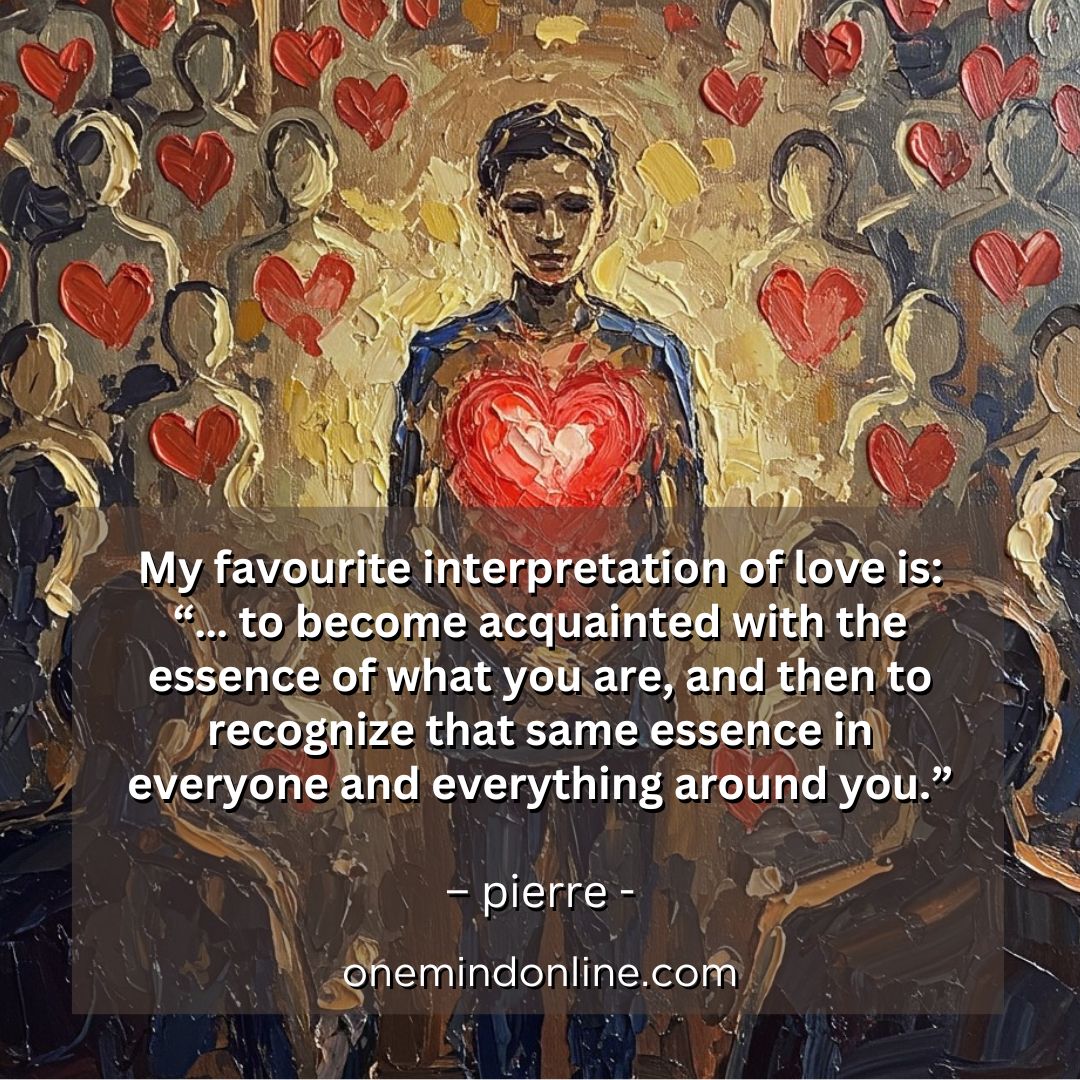
My favourite interpretation of love is: “… to become acquainted with the essence of what you are, and then to recognize that same essence in everyone and everything around you.”
When this recognition dawns, it becomes instantly clear that whatever you do to another, you do to yourself – not just the harmful actions, but genuinely the good ones too.
When you have unconditional love for the humans around you, YOU are the one who will benefit most from the love you generate, YOU are the one who will FEEL it the most.
And when you have unconditional love for yourself, that same love will obviously become available to the humans around you too!
“When you make genuine contact with your inner Spirit, there is an inner joy, an inner peace, that takes over.” – Michael Beckwith
“When we have an inner initiation into pure love, we are in contact with our true nature. Judgement of ourselves and others disappears. Compassionate, discerning wisdom then enters the equation in all of our relationships.” – Michael Beckwith
“We’ve gotten caught up in thinking we are what we look like, the physical, the exterior. We think we’re the lamp shade. We’ve forgotten that we are the light – the electricity and the luminosity that lights up every man, woman, and child. The light is who we truly are.” – Michael Beckwith
“Love: You’re not meant to wait for it. You’re not meant to search for it. You’re meant to generate it, be it.” – Michael Beckwith
We often find ourselves searching for love in all the wrong places, waiting for it to come to us, or even believing that we don’t deserve it. And the truth is that love is who you are, it’s what you’re made of and if you’re not experiencing love, it’s because you’re disconnected from your SELF, disconnected from the soul that you are.
Love is the recognition that we are all interconnected, that our essence is the same, that what I see in you, IS me. Love IS recognizing my own light, and then realizing that it’s the same light that I see in you.
Love is not something we wait for, love is the way that we choose to show up. It’s a choice we make every day, in every moment. By being the expression of our soul, we can unleash the power of love within ourselves and share it with the world.
In your quest to be the expression of love, here are a few thoughts to light your path.
- Love is unconditional: It extends to all beings without judgement.
- Love is healing: Love is wholeness, and wholeness brings healing.
- Love is transformative: It can change our lives and the world around us.
- Love is who we are: It’s not something we seek, but something we’re made of.
By understanding and embracing the power of love as the source of what we are, we become free to be ourselves, and to share our true selves with the world.
Have a beautiful Friday beautiful humans!
– pierre –
Today’s LIVE meditation is: Sharing love.
Today’s LIVE meditation
https://youtu.be/eF9r17ZgDek 2026
https://youtu.be/76Pk4UpuEL4 2025
https://youtu.be/GwXS6Q9oLEM 2024
https://youtu.be/74H1lEwygp8 2023
https://youtu.be/P17GjwnSl1s 2022
Practice the “Daily Dose”
Let’s put it into practice! Choose what works for you – daily, once a week or whenever inspiration strikes. Putting pen to paper wires the neural pathways that will create your new habits.
1 – Affirmation
Not quite affirmations today, but a few thoughts on being the expression of love. Write down your favourite one and place it somewhere that you’ll be able to see it the whole day.
- Love is unconditional: It extends to all beings without judgement.
- Love is healing: Love is wholeness, and wholeness brings healing.
- Love is transformative: It can change our lives and the world around us.
- Love is who we are: It’s not something we seek, but something we’re made of.
2 – A moment of reflection
Use today’s question as a journal prompt. If you don’t have the time to sit down and write, just take a moment to reflect on your response.
Beyond the Lamp Shade: Beckwith suggests that we’ve gotten caught up in thinking we are what we look like, the physical, the exterior. We think we’re “the lamp shade” when we’re actually “the light.” What aspects of your external projection (appearance, achievements, roles, qualifications, etc.) have you become overly identified with? Describe who you are when you strip away these external layers. What remains? Who is the part of you that is separate from what you look like and what roles you fulfil? How does this deeper understanding of yourself change how you show up in the world?
3 – Quotes to share
Send a quote to someone who needs it, or share them all on social media to spread the good vibes!
4 – Q&A for deeper learning
Read through the questions and answers and write down at least one “aha moment” that clicked for you.
Q1. What does it mean that “love is who we are” rather than something we seek?
This means that love isn’t an external resource to be found or earned – it’s your fundamental essence. Just as you don’t need to search for your ability to breathe, you don’t need to search for love because it’s already the core of what you are. When you feel disconnected from love, you’re actually disconnected from your authentic self. The work isn’t finding love “out there” but reconnecting with the love that already exists within you.
Q2. How can loving others benefit me more than them?
When you generate love toward others, you’re the one creating and experiencing that loving energy. You become the primary vessel through which love flows, which means you feel its warmth, peace, and joy most intensely. Think of it like lighting candles – when you light someone else’s candle with yours, your flame doesn’t diminish; instead, you’re surrounded by more light. The love you give creates the loving atmosphere you get to live in.
Q3. If we’re all the same essence, why do people seem so different and sometimes difficult to love?
The differences you see are like looking at different lamp shades while missing the fact that the same electricity powers them all. People express their personalities through the programming and learned behaviour that they picked up along the way, but underneath these surface variations lies the same fundamental nature. When someone is difficult to love, they’re often disconnected from their own essence. Your recognition of their true nature – even when they can’t see it themselves – can be a powerful catalyst for healing.
Q4. How do I practically “generate” love instead of waiting for it?
Begin with the mirror. Nobody who looks at themselves in the mirror and genuinely likes the human looking back ever feels disconnected from love, because that simple act of appreciation is love in motion, and it requires no one else’s participation. Generating love starts with how you treat yourself in ordinary moments: the tone of your inner voice when you make a mistake, the kindness you offer your body, the way you speak about yourself when no one is listening. Try looking into your own eyes each morning and saying something warm and true, even if it feels awkward at first. Judgment tends to soften when you practice this, because you can’t criticize someone you’re actively appreciating. From there, love naturally overflows into how you show up for others, through patience, a genuine compliment, or a few moments of full attention. Each small choice reconnects you with your own essence, and the more you generate love for yourself, the less you find yourself waiting for it from anyone else.
Q5. How does unconditional love work in practical relationships where boundaries are necessary?
Unconditional love doesn’t mean unconditionally accepting all actions. It means offering unconditional dignity to every human being, even when we have to say no to what they do. The two work together: the “no” protects your wellbeing, while the dignity ensures that your “no” comes without contempt, cruelty, or the withdrawal of basic respect. You can decline a request, walk away from a harmful pattern, or even end a relationship, and still hold the other person as a worthy human being who shares the same essence you do. In practice, this might sound like speaking calmly instead of attacking, addressing the behaviour rather than condemning the person, and acting from clarity rather than resentment. Boundaries are not the opposite of love; they are one of its clearest expressions, since they honour your own worth and allow your love to stay genuine instead of turning into quiet bitterness. When you say no from this place, you are loving both yourself and the other person at the same time.
Q6. What does it mean that judgment disappears when we operate from pure love?
When you see through the lens of love, you recognize that people’s actions come from one of two places: either from love, or from being disconnected from love. Someone who lashes out, deceives, or wounds is not revealing their true nature so much as showing how far they have drifted from it. Seeing this clearly changes your response, because treating them harshly will not move them any closer to reconnecting with love; contempt rarely heals anyone. What’s more, harshness comes at a cost to you, since meeting disconnection with condemnation only serves to disconnect yourself from love as well. In that moment, you have left your own center to join them in the very state you hoped they would leave. This is why, when you operate from pure love, judgment just doesn’t make any sense anymore. It isn’t that you approve of every action or pretend nothing was harmful, but that judgment no longer serves any purpose: it neither helps the other person nor protects your own peace. What remains is discernment and compassion, the ability to see what happened, respond wisely, and still hold the person as someone worthy of dignity.