
“Your Daily Dose” is a quick two minute read packed with bite-sized wisdom from all the great teachers. But you could also choose to turn it into something more… a powerful daily practice for personal growth. Give it a try!
A message from today’s meditation:
I want to start today’s message with this thought –
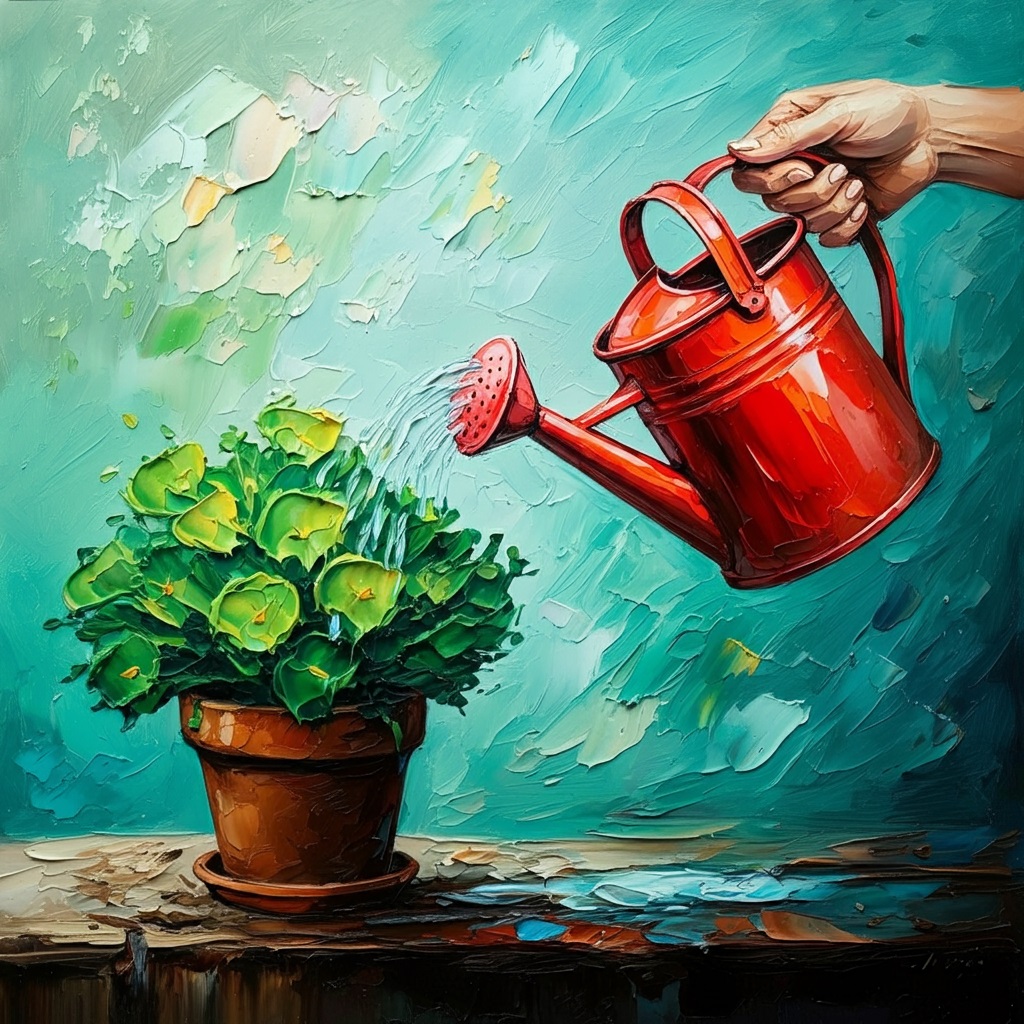
“Whatever you water will grow…”
… take a moment to let the thought marinade in your mind for a bit, and then we’ll get back to this thought in a moment. In the meantime, let’s get into Carl Jung’s message for us today.
“We don’t so much solve our problems as we outgrow them. We add capacities and experiences that eventually make us bigger than the problems.” – Carl Jung
No matter how much we learn or how good we may become at dealing with life, having problems or encountering difficulty will be ever present during our human experience. And as we develop the ability to allow the experience to be felt without the overwhelming need to run from it, or change it, or control it – so we grow our capacity to become bigger than the problem.
“People will do anything, no matter how absurd, in order to avoid facing their own souls. They will travel to India to practice yoga and all of its exercises, or observe a strict regimen of diet, even learn the literature of the whole world – all because they cannot get along with themselves.” – Carl Jung
“Somewhere, right at the bottom of one’s own being, one generally does know where one should go and what one should do. But there are times when the clown we call “I” behaves in such a distracting fashion that the inner voice of wisdom cannot make its presence felt.” – Carl Jung
“A man likes to believe that he is the master of his soul. But as long as he is unable to control his moods and emotions, or to be conscious of the myriad secret ways in which unconscious factors insinuate themselves into his arrangements and decisions, he is certainly not his own master.” – Carl Jung
Consider this example: when you drive to work in the morning (and you could insert many more examples in here), you naturally come under the influence of various different stimuli around you – the drivers on the road with you, the messages on billboards passing by and perhaps the radio.
By the time you reach your destination pay attention to your emotional state – if how you feel and the thoughts you think have become completely hijacked by the behaviour of other motorists, the messages on billboards or the news on the radio or social media, then understand what Carl Jung means when he says, “you are certainly not your own master.”
So whether we encounter an experience from the environment around us or an experience created within ourselves, when we are able to “be with” the experience – allowing the experience to be felt – without reacting to it, then we start to understand what Jung meant when he said, “problems don’t go away, but we gain the capacity to become bigger than the problems.”
Now we find ourselves inside that window of opportunity in which, “the inner voice of wisdom can make its presence felt,” as Jung suggests.
Let’s get back to the thought we started with: “What you water will grow.”
Whatever consistently holds your attention is what you are pouring your energy into. And anything that you consistently give your energy to WILL expand, and its presence will grow in your life.
Will you continue to let the world around you decide what captures your attention or will you grow bigger than the noise of the world, and as “the master of your soul” make a conscious choice about where you will pour the water of your attention?
… but first we need to become bigger than the problems around us by being able to have the experience, without the compulsion to react to it. And then take action only on what IS ours to change.
Today’s meditation is an exercise in sitting with the experience and finding that we are able to be ok with whatever the experience is.
A few thoughts to help you water only what you CHOOSE to grow:
- “I am becoming bigger than my problems when I am able to sit with discomfort.”
- “I consciously choose where to direct my attention and energy today.”
- “I can experience my emotions fully without needing to react immediately.”
- “I trust the inner wisdom that knows where to go and what to do.”
- “I am the master of my soul, consciously choosing my responses to life’s experiences.”
Either we take the responsibility of consciously choosing our actions, or the world around us will hijack our reactivity and determine every step we take.
Have a beautiful Saturday peeps!
– pierre –
Today’s LIVE meditation is: Come to your senses.
Today’s LIVE meditation
https://youtu.be/c15h4wem1CU 2025
https://youtu.be/Ap52NWdtCZ0 2023
https://youtu.be/IXt-DhO-x74 2022
Practice the “Daily Dose”
Let’s put it into practice! Choose what works for you – daily, once a week or whenever inspiration strikes. Putting pen to paper wires the neural pathways that will create your new habits.
1 – Affirmation
Write down your favourite affirmation on a sticky note and place it somewhere that you’ll be able to see it the whole day.
- “I am becoming bigger than my problems when I am able to sit with discomfort.”
- “I consciously choose where to direct my attention and energy today.”
- “I can experience my emotions fully without needing to react immediately.”
- “I trust the inner wisdom that knows where to go and what to do.”
- “I am the master of my soul, consciously choosing my responses to life’s experiences.”
2 – A moment of reflection
Use today’s question as a journal prompt. If you don’t have the time to sit down and write, just take a moment to reflect on your response.
The Growth Vision: Complete this sentence in as many ways as possible: “I want to grow more ___ in my life.” (Examples: peace, creativity, connection, courage, joy, purpose, etc.) Now, for each item you listed, ask yourself honestly: Am I watering this with my daily attention and choices? If not, what am I watering instead that’s choking out the growth of what I truly value?
We often water things unconsciously—feeding patterns we don’t actually want to grow. What are you watering by default or habit rather than by conscious choice? Perhaps it’s drama through constant news consumption, insecurity through comparison on social media, or stagnation through comfort-seeking. Identify one thing you’re unconsciously watering that you’re ready to stop feeding. What will you consciously water in its place?
3 – Quotes to share
Send a quote to someone who needs it, or share them all on social media to spread the good vibes!


4 – Q&A for deeper learning
Read through the questions and answers and write down at least one “aha moment” that clicked for you.
Q1: What does Jung mean by “we don’t solve our problems, we outgrow them”?
A: Jung suggests that many of life’s challenges aren’t meant to be eliminated but transcended. As a very simple example, consider driving your car in peak hour traffic, surrounded by an onslaught of frustrated motorists angrily trying to get to their own destinations. This is the kind of problem (like so many others) that we don’t have the power to “solve”. Instead of trying to fix or remove every difficulty, we develop new capacities, perspectives, and emotional maturity that make us “bigger” than the problems we face. The problem may still exist, but we’ve expanded our ability to hold it without being overwhelmed by it.
Q2: How can I tell if I’m “the master of my soul” or if external forces are controlling me?
A: Pay attention to your emotional state throughout the day. If your mood, thoughts, and actions are constantly being hijacked by external stimuli—other people’s behavior, news, social media, random events—then you’re not in the driver’s seat. Mastery comes when you can experience these things without compulsively reacting to them, maintaining your center regardless of what’s happening around you.
Q3: What does it mean to “be with” an experience without reacting to it?
A: It means developing the capacity to feel whatever arises—discomfort, anger, fear, frustration—without immediately trying to change it, escape it, or act on it. You create a pause between the stimulus and your response, allowing yourself to fully experience what’s happening while remaining grounded. This doesn’t mean suppressing your feelings; it means feeling them completely without letting them dictate your actions.
Q4: Why do we avoid facing our own souls, as Jung suggests?
A: Facing ourselves requires confronting uncomfortable truths—our fears, wounds, shadows, and the gap between who we are and who we pretend to be. It’s often easier to stay busy with external pursuits, self-improvement techniques, or endless distractions than to sit with the discomfort of genuine self-examination. But true growth requires this inner work.
Q5: How does the concept “where attention goes, energy flows” relate to personal growth?
A: Your attention is your most valuable resource. Whatever you consistently focus on receives your energy and will expand in your life. If you constantly focus on problems, grievances, and negativity, those things grow. If you consciously direct your attention toward growth, wisdom, and what you want to cultivate, those things flourish. You’re always “watering” something with your attention—the question is whether you’re doing it consciously or unconsciously.
Q6: What’s the difference between reacting and taking inspired action?
A: Reacting is immediate, unconscious, and driven by emotion or external pressure. It happens when something triggers you and you respond automatically without reflection. Inspired action, on the other hand, emerges from the space of clarity you create by being present with the experience first. It comes from your inner wisdom rather than your reactive patterns, and it’s a conscious choice rather than an automatic response.
Q7: How can I start practicing this approach in daily life?
A: Begin with small moments of awareness. During your commute, notice when you start feeling hijacked by traffic or news. Instead of immediately reacting with frustration, pause and simply acknowledge the feeling. Practice sitting with minor discomforts for just a few moments before deciding how to respond. Build the muscle of presence in low-stakes situations, and gradually you’ll find this capacity growing, allowing you to remain centered even during more challenging experiences.