

“Your Daily Dose” is a quick two minute read packed with bite-sized wisdom from all the great teachers. But you could also choose to turn it into something more… a powerful daily practice for personal growth. Give it a try!
A message from today’s meditation:
Life. It’s a word we use a lot, yet it often feels like we don’t quite know what to even do with it. It seems like “life” often becomes something we chase after. Some future destination that we believe will somehow be “better” than right now, instead of the vibrant tapestry we are weaving from moment to moment.
Why do we postpone experiencing LIFE in all its richness? What if everything you’re seeking is already here?
“Why does it often take extreme life situations to bring back an awareness of the magic and mystery of life? Why do we often wait until we’re about to die before discovering a deep gratitude for life as it is? Why do we exhaust ourselves seeking love, acceptance, fame, success, or spiritual enlightenment in the future? Why do we work or meditate ourselves into the grave? Why do we postpone life? Why do we hold back from it? What are we looking for exactly? What are we waiting for? What are we afraid of? Will the life we long for really come in the future? Or is it always closer than that?” – Jeff Foster
“This moment is not life waiting to happen, goals waiting to be achieved, words waiting to be spoken, connections waiting to be made, regrets waiting to evaporate, aliveness waiting to be felt, enlightenment waiting to be gained. No. Nothing is waiting. This is it. This moment is life.” – Jeff Foster
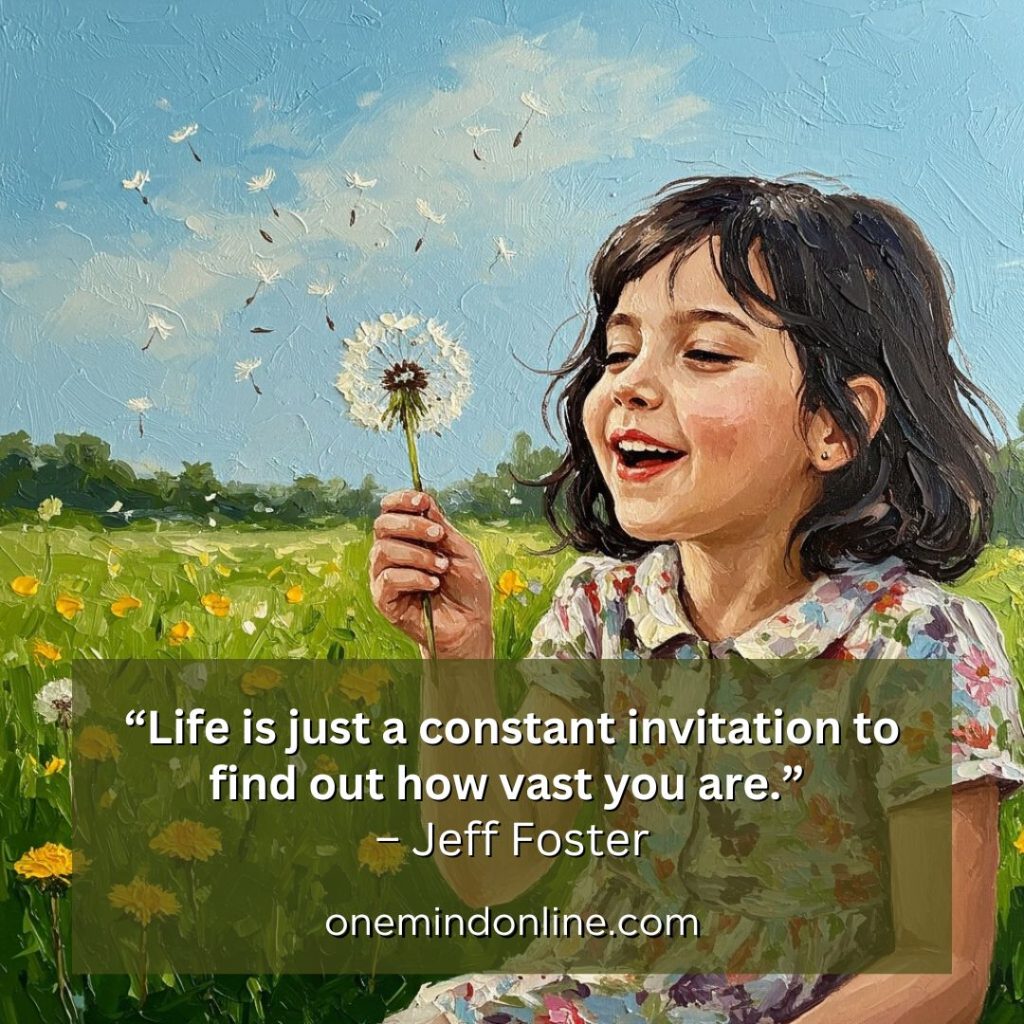
“Life is just a constant invitation to find out how vast you are.” – Jeff Foster
We tell ourselves we’ll be happy when we get the promotion, when we find the right relationship, when we lose the weight, or when we achieve that elusive state of enlightenment. We exhaust ourselves chasing external validation – love, acceptance, fame, success – believing these achievements will somehow unlock the “real” life we’ve been waiting for.
Because of our minds’ tendency to dwell on old wounds from the past or fret over fears about the future, we need to spend some time training our brains to pay attention to what is happening right here, right now where the actions we take, can have a real effect.
Today’s meditation journey is just this… can you just connect with this moment? Can you connect with your body in this moment? This is not an attempt at escaping from the world around us but a reminder to our brain and body to remain involved in what this very moment asks us to pay attention to. Because right here is where life is happening!
A few thoughts to help you ponder your ability to be present:
- “This is it. This moment is life.” Repeat this to yourself throughout the day as a reminder to appreciate the present.
- “What is happening right now?” Ask yourself this question regularly to shift your attention from mental chatter to your immediate experience.
- “I am alive.” Feel the truth of this statement in your body. Breathe deeply and savor the gift of being right here, right now.
Life is an invitation to explore the depths of your human experience. Don’t wait for the magic to begin, you ARE magic, so come alive right now! Magic is already happening, waiting to be discovered in the precious present moment.
– pierre –
Today’s LIVE meditation is: Come to your senses.
Today’s LIVE meditation
https://youtu.be/RFCsIS5xgB0 2025
https://youtu.be/ESqONR2GMSM 2023
https://youtu.be/RqFQdY_FEG0 2021
https://youtu.be/jvn4keYQEpU 2020
Practice the “Daily Dose”
Let’s put it into practice! Choose what works for you – daily, once a week or whenever inspiration strikes. Putting pen to paper wires the neural pathways that will create your new habits.
1 – Affirmation
Write down your favourite affirmation on a sticky note and place it somewhere that you’ll be able to see it the whole day.
- “This is it. This moment is life.” Repeat this to yourself throughout the day as a reminder to appreciate the present.
- “What is happening right now?” Ask yourself this question regularly to shift your attention from mental chatter to your immediate experience.
- “I am alive.” Feel the truth of this statement in your body. Breathe deeply and savor the gift of being right here, right now.
2 – A moment of reflection
Use today’s question as a journal prompt. If you don’t have the time to sit down and write, just take a moment to reflect on your response.
The Postponement Pattern: Reflect on the ways you postpone life. What future conditions are you waiting for before you allow yourself to fully engage with your current reality? Ask yourself: “what am I actually telling myself has to happen first before I can be happy?” Write down that condition, then get honest about whether it’s really necessary, or whether it’s a story that’s keeping you stuck. What would change today if you decided that condition didn’t have to be met first?
3 – Quotes to share
Send a quote to someone who needs it, or share them all on social media to spread the good vibes!


4 – Q&A for deeper learning
Read through the questions and answers and write down at least one “aha moment” that clicked for you.
Q1: How can I stop my mind from constantly wandering to the past and future?
Mind wandering is natural and normal – the goal isn’t to stop it completely but to notice when it happens and gently return to the present. Use your senses as anchors: feel your breath, notice physical sensations, or engage with your immediate environment. With practice, you’ll catch yourself sooner and return to presence more easily.
Q2: Isn’t it irresponsible to focus only on the present when I have goals and plans to consider?
Present-moment awareness doesn’t mean abandoning planning or goal-setting. It means being fully engaged and present while you are planning for the future (instead of anxiously obsessing) and then taking inspired action from a grounded state, making changes to the things that you can change. Most effective action actually comes from presence, not from scattered mental energy.
Q3: What if my present moment feels painful or difficult? Should I still try to embrace it?
Embracing the present doesn’t mean forcing yourself to enjoy difficult experiences. It means acknowledging what’s actually happening without adding layers of resistance or mental stories. This creates space for authentic responses and often reduces unnecessary suffering while honoring genuine challenges.
Q4: How do I know if I’m truly living in the present or just telling myself I am?
Genuine presence is marked by your growing ability to notice the chatter as it arises, without getting swept away by it, and then gently redirect your focus back to what’s actually here: your breath, your body, the sounds around you, the task at hand. It’s less about silencing the mind and more about developing a witnessing awareness that can observe thoughts arising and passing without becoming entangled in them. You’ll know you’re practicing real presence not because your mind has gone quiet, but because you catch yourself drifting into past regrets or future worries more quickly, and you’re able to lovingly bring your attention back home to this moment, again and again. That returning – not the absence of distraction – is the practice.
Q5: Can this approach help with anxiety and depression?
While present-moment practices can be supportive, they’re not a replacement for professional mental health care when needed. Many people find that grounding in the present reduces anxiety (which often stems from future-focused worry) and depression (which can involve past-focused rumination), but it’s important to work with qualified professionals for serious mental health concerns.
Q6: How can I maintain presence during busy or stressful periods?
Anchor presence to actions you already do dozens of times a day, so you don’t need extra time or willpower to remember. Before opening your laptop, take three slow breaths – inhale for four counts, exhale for six. Every time you reach for your phone, pause for one second and ask “Where do I want my focus to be?” before unlocking it. When walking between meetings or tasks, feel your feet actually contacting the ground for ten steps instead of rehearsing what you’ll say next. At red lights or in line, drop your shoulders and unclench your jaw – stress hides in the body first. Eating lunch, put your fork down between bites and notice one flavor or texture fully. None of these take extra time; they simply insert awareness into time you’re already spending. On especially chaotic days, pick just one of these anchors and use it obsessively rather than trying to remember all five – one practice done consistently will do more for your nervous system than five practices done never.
Q7: What’s the difference between being present and being passive or unmotivated?
True presence is actually highly engaged and responsive, not passive. When you’re genuinely present, you respond more authentically and effectively to what’s needed. Passivity often comes from disconnection or overwhelm, while presence brings clarity and appropriate action. Present-moment awareness can actually increase motivation by connecting you with what truly matters to you.