

“Your Daily Dose” is a quick two minute read packed with bite-sized wisdom from all the great teachers. But you could also choose to turn it into something more… a powerful daily practice for personal growth. Give it a try!
A message from today’s meditation:
Our minds are really powerful tools, but often they’re completely overworked tools that never get rest. Thoughts cascade endlessly – worries about tomorrow, regrets about yesterday, anxieties about everything in between. And so our minds, for all their remarkable capabilities, can also become our greatest adversaries. The same mental prowess that allows us to solve complex problems and create beautiful art can also spiral into relentless rumination. We think ourselves into corners, analyze ourselves into paralysis, and worry ourselves into exhaustion. The irony is profound: the tool meant to serve us, becomes our jailer. And one of the simplest ways to step out of the prison created by our minds, is to connect with the physical senses of your body.
Our senses, often taken for granted, hold the key to unlocking the door to a calm inner state. By turning our attention inwards, we reconnect with the present moment and begin the journey of self-discovery.
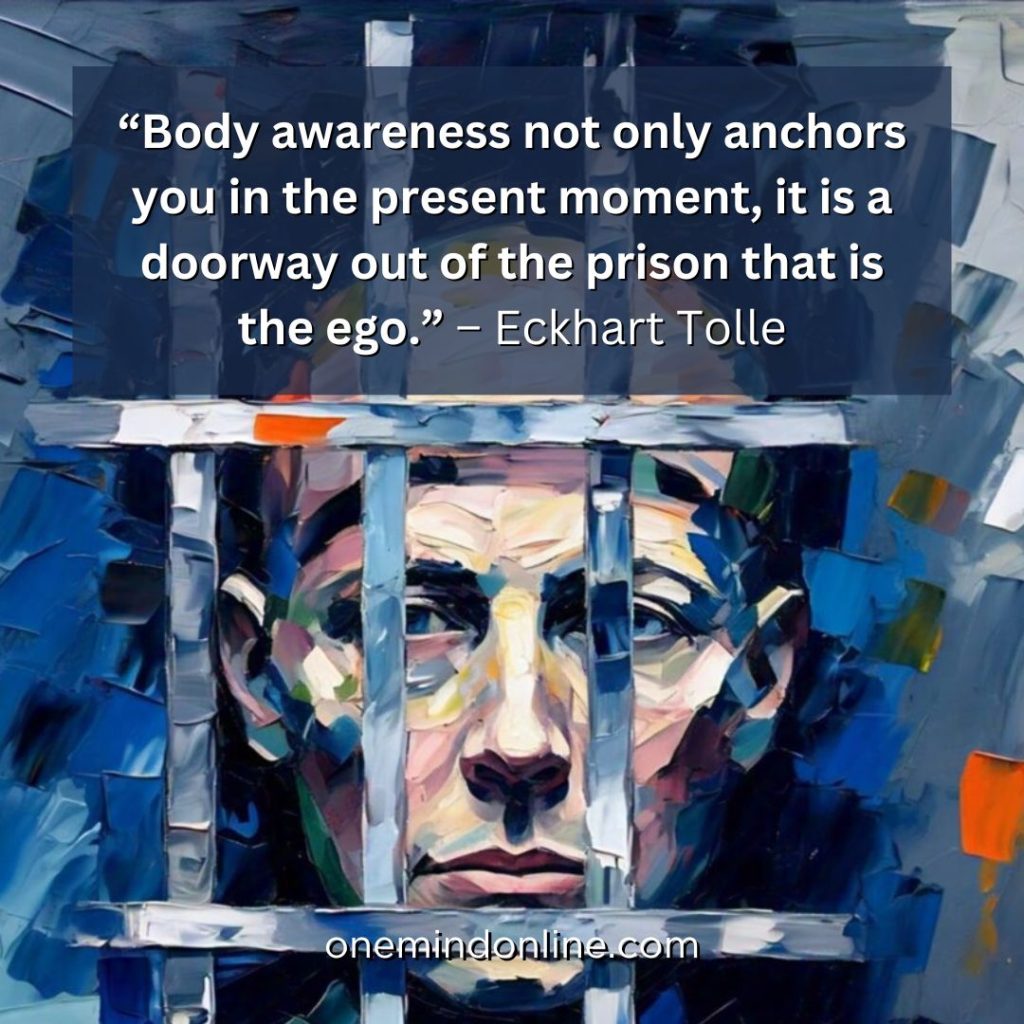
“Body awareness not only anchors you in the present moment, it is a doorway out of the prison that is the ego. It also strengthens the immune system and the body’s ability to heal itself.” – Eckhart Tolle
“Attention to the human body brings healing and regeneration. Through awareness of the body we remember who we really are.” – Jack Kornfield
“The mind’s first step to self awareness, must be through the body.” – George Sheehan
These aren’t just beautiful quotes, they’re invitations to a transformative practice. By deliberately engaging our body and its five senses, we create an anchor to the present moment, the only moment where peace actually exists.
Have a go at the following exercise:
- Breathe in slowly through your nose and allow your belly to fill with the breath. Hold your breath for a few moments and slowly breathe out through your mouth, as if you’re blowing through a straw. Repeat a few times.
- Notice what you can see around you. Choose the most obvious object, and also search around for the least obvious thing you can see. By all means label each item, but also remember to view them in detail as they really are. Spend a few moments looking curiously at each object, as if seeing it for the first time. See if you can notice whether your mind judges each object, and if it does, let that judgment go. Feel your breath if doing so helps.
- Repeat Step 2 but this time with sounds. What are the most obvious and least obvious sounds you can experience right now? Notice each sound and label it in your mind as you do so. For example, your thoughts may go ‘music, road traffic, breathing, rustling bag, people talking’. Listen to each sound for a few moments, with a sense of freshness and interest and without judging it.
- Do the same process again but with the most and least obvious scents. You may not find any obvious smells around, so just notice what you can; or make a mental note of noticing the smell of your next meal in a café, restaurant or your own kitchen.
- Try the process this time with different tastes. This aspect works particularly well while you’re having a meal or a drink.
- Repeat finally for touch. Notice how your body feels: for example, the sensation of your body touching the chair, a tightness in your shoulders, warmth on your arm, cool wind against your ankles or a belt slightly tight around your waist.
If you’re wondering how connecting with your senses can calm your mind, here’s how:
- Your conscious attention can be on only one thing at a time. If you’re focusing on what your body is feeling, your attention isn’t feeding your ruminating worries and concerns. As a result, they begin to lose a bit of their strength. Without your attention on your worries, they effectively don’t exist.
- You’re training your mind to be more focused on the present moment. With time, you find that living in the now is easier and you become less stuck in the cycle of repetitive thoughts.
By quieting the mind and connecting with your senses, you can break free from the prison of the ego and discover a wellspring of inner peace waiting to be tapped. Remember, the power to find calm lies within you, waiting to be awakened.
I hope that you have a great weekend!
– pierre –
Today’s LIVE meditation is: Come to your senses.
Today’s LIVE meditation
https://youtu.be/fNcNT7sILLk 2026
https://youtu.be/lFxIXaOw-zU 2024
https://youtu.be/dUHkEjt6Ehk 2023
Practice the “Daily Dose”
Let’s put it into practice! Choose what works for you – daily, once a week or whenever inspiration strikes. Putting pen to paper wires the neural pathways that will create your new habits.
1 – Affirmation
Write down your favourite affirmation on a sticky note and place it somewhere that you’ll be able to see it the whole day.
- “I am more than my thoughts; I am the awareness that observes them. “
- “My body is a sanctuary of presence, always available to anchor me in the now.”
- “When I return to my senses, I return to peace.”
- “Each breath is an opportunity to begin again, fresh and free.”
- “I release the need to control my mind and instead befriend my body’s wisdom.”
2 – A moment of reflection
Use today’s question as a journal prompt. If you don’t have the time to sit down and write, just take a moment to reflect on your response.
Judgment and Observation: The practice encourages noticing objects and sounds without judgment. Where in your life do you find yourself constantly judging—yourself, others, circumstances? What becomes possible when you simply observe without the layer of judgment? Experiment with this for one day and journal about what you discover.
3 – Quotes to share
Send a quote to someone who needs it, or share them all on social media to spread the good vibes!
4 – Q&A for deeper learning
Read through the questions and answers and write down at least one “aha moment” that clicked for you.
1. Why do our minds become our “worst enemy” as the article suggests?
Our minds are designed to solve problems, plan for the future, and learn from the past. However, without conscious direction, this problem-solving mechanism can run on autopilot, creating endless loops of worry, rumination, and anxiety. Instead of serving us, our thoughts begin to control us, generating suffering through imagined scenarios, harsh self-criticism, and constant mental noise that keeps us from experiencing peace in the present moment.
2. How exactly does focusing on the senses calm the mind?
Consciousness can only focus on one thing at a time. When you deliberately direct your attention to sensory experiences—what you see, hear, smell, taste, or feel physically—you’re essentially withdrawing attention from the thought-stream that generates worry and anxiety. Without your attention feeding these thoughts, they naturally lose strength and begin to dissipate. Additionally, the senses can only perceive what’s happening right now, so engaging them automatically brings you into the present moment where peace resides.
3. What does Eckhart Tolle mean by “the prison that is the ego”?
The ego, in this context, refers to our mental self-concept—the collection of thoughts, beliefs, stories, and identities we’ve accumulated about who we are. This mental construct constantly seeks validation, fears threats, compares itself to others, and lives primarily in past regrets or future anxieties. It’s a “prison” because it keeps us locked in mental patterns and separated from the direct, peaceful experience of simply being present in our bodies and in the current moment.
4. Do I need to practice this exercise in a quiet space, or can it be done anywhere?
This practice is remarkably versatile and can be done virtually anywhere—at your desk, on public transportation, in a waiting room, or while walking. You don’t need silence or a special environment. In fact, practicing in everyday settings with ambient noise and activity can be particularly powerful because it teaches you to find presence amid real-life circumstances rather than only in controlled, peaceful environments.
5. How long should I spend on each sense during the exercise?
There’s no rigid timeframe. When first learning, you might spend 2-3 minutes on each sense, creating a 10-15 minute practice. However, even 30 seconds of genuine sensory awareness can be beneficial. The quality of attention matters more than quantity. As you become more practiced, you can extend the time or simply drop into sensory awareness spontaneously throughout your day whenever you notice mental agitation.
6. What should I do when my mind judges what I’m experiencing during the practice?
Judgment is a natural function of the mind, so don’t be concerned when it arises. The practice is simply to notice that judgment has occurred and then gently let it go, returning attention to the pure sensory experience. For example, if you notice a sound and think “that’s annoying,” simply observe that judgment arose, acknowledge it without self-criticism, and return to listening to the sound itself. Over time, this trains you to separate direct experience from mental commentary.
7. How does body awareness strengthen the immune system, as Eckhart Tolle mentions?
Chronic stress and anxiety, which result from excessive mental activity, trigger the body’s stress response—releasing cortisol and other hormones that, when sustained over time, suppress immune function. By practicing body awareness and reducing mental rumination, you activate the parasympathetic nervous system (the “rest and digest” response), which reduces stress hormones, lowers inflammation, and allows the immune system to function optimally. Additionally, the state of presence and reduced anxiety creates conditions for the body’s natural healing mechanisms to work more effectively.