

“Your Daily Dose” is a quick two minute read packed with bite-sized wisdom from all the great teachers. But you could also choose to turn it into something more… a powerful daily practice for personal growth. Give it a try!
A message from today’s meditation:
Our minds can sometimes seem a bit like a chaotic weather system, with thoughts swirling like storm clouds and emotions crashing like thunder. But have you ever taken yourself outside in the middle of a thunderstorm to look up at all that turbulence, and remind yourself that not very far away, on the other side of those clouds, are perfectly clear skies? An endless expanse of blue, and unfettered sunlight…
Our own minds can be described in a very similar way.
“Don’t mistake the weather of your mind, for the sky of your BEING.” – Jeff Foster
Isn’t that just such a clear analogy? The weather, like our minds, in constant flux. And the ever blue sky, a representation of the deeper beings that we really are?
The original meaning of the word meditation is simply “to become familiar with” – and it’s understandable that this can feel like a very vague description to new meditators. So I’ll try and break it down into very easily digestible steps:
- The first thing we “become familiar with” is usually our very busy minds – thoughts, feelings, emotions, the inner critic, the inner child, all of the things that made us reach for meditation as a possible tool. Most often we try out meditation in an attempt to escape from these things only to find that as we sit down to meditate we come face to face with these same things even more directly than ever before, and we say “I can’t do this! Meditation is not for me! My mind is too busy! Meditation makes me anxious!”
- If we stick it out, the next thing we “become familiar with” is a recognition of what is temporary. I want to give you a few examples of how to think about this – If you sat still in one place and watched the ocean, just watching and becoming familiar with what you are seeing… how long would it take you to recognize that the tide rolls in and it also always rolls back out? If you sat equally still and just watched the sky, not doing anything but watching, how long would it take for the realization to dawn on you that clouds roll in and they also always roll out? Would you come to the conclusion that placing too much importance on the momentary level of the sea or the density of the clouds would be pointless, because in a short while it would be completely different? So then, if you were able to sit still in one place and just watch your mind without becoming involved in your thinking, how long would it take you to realize that thoughts and emotions roll in and they also roll on out, and that placing too much importance on the momentary state of your thoughts and feelings would be equally pointless, because in just a short while it’s likely to be completely different?
- And so with time – and this can take a while – the third thing that we “become familiar with” is an understanding of what has permanence. There lies within each of us a “sense of being” from where we have the capacity to observe the transient nature of all the things that flow in and also flow out. This space within you has been called “The Observer,” “The Soul,” “The Higher-self,” “The Witness,” the “I Am”… Whatever you choose to call this part of you, there is a permanence there, a sense of being “immovable” regardless of outside circumstances. The more that you “become familiar with” the permanence that lies within you, the more you are seeing through the timeless eyes of your soul.
Jeff Foster’s quote “don’t mistake the weather of your mind for the sky of your being” beautifully captures this truth – that your momentary emotional state is something that will always be shifting. That you can learn to trust that there is a steady deeper BEING to your human experience that you will always gently return to if you can find acceptance for the darker clouds that sometimes roll in and also roll out.
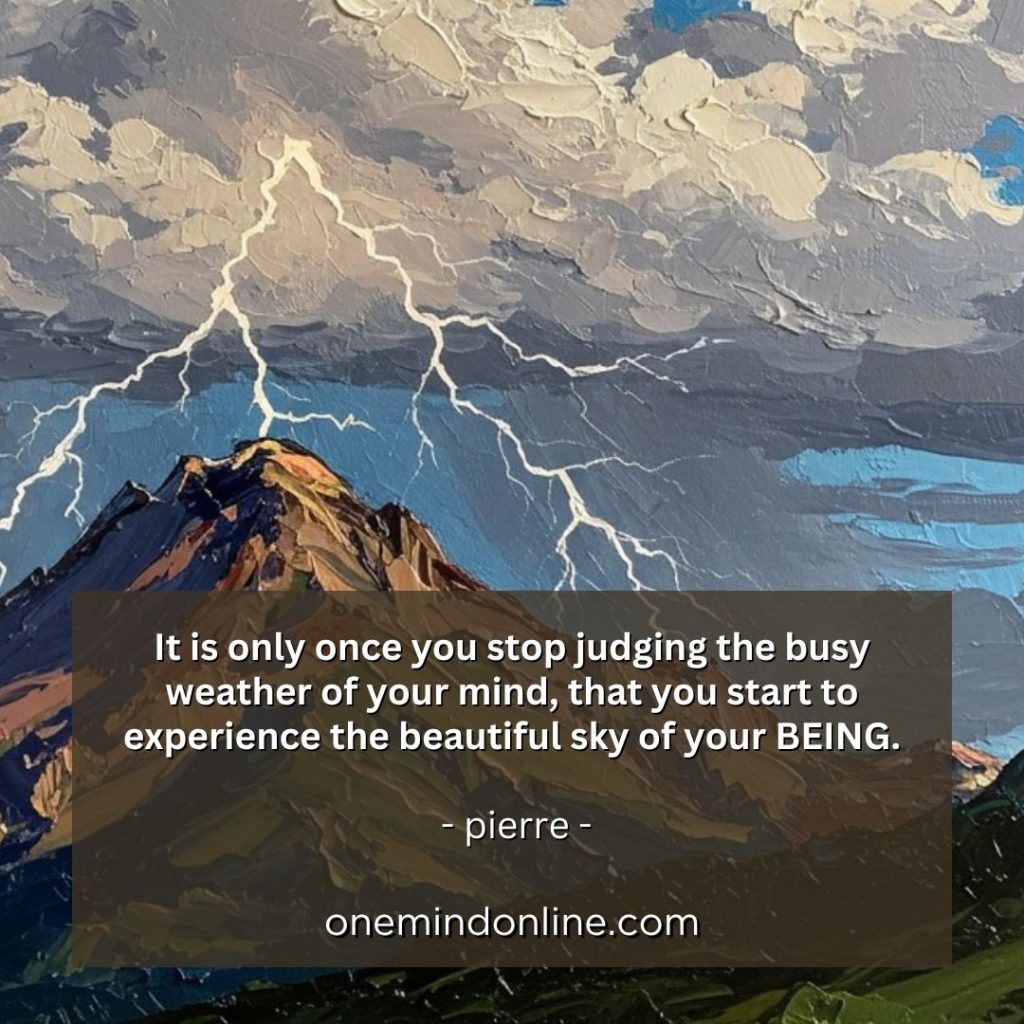
It is only once you stop judging the busy weather of your mind, that you start to experience the beautiful sky of your BEING.
Your true nature is not something that you have to work for or strive to achieve. Your true nature has always been a part of the soul that you already are. Surrender is the only route to the fullness of your being.
Guiding mantras to find your mountain:
- “My thoughts and feelings are like clouds – ever-changing and impermanent.”
- “Beneath the storm of emotions lies a calm, steady presence – my true being.”
- “I can choose to observe my thoughts without judgment, allowing them to come and go.”
- “Surrender allows me to connect with the vastness and peace that is always available within me.”
By adopting these mantras and cultivating a meditation practice, you can unveil the ever-present sky of your being, regardless of the ever-changing weather in your mind. Remember, the sun always shines above the clouds.
– pierre –
Today’s LIVE meditation is: I am the mountain.
Today’s LIVE meditation
https://youtu.be/vsD1wJDHWnQ 2025
https://youtu.be/_3GHrWt5x2s 2024
https://youtu.be/0yMzNMKfLqk 2023
Practice the “Daily Dose”
Let’s put it into practice! Choose what works for you – daily, once a week or whenever inspiration strikes. Putting pen to paper wires the neural pathways that will create your new habits.
1 – Affirmation
Write down your favourite affirmation on a sticky note and place it somewhere that you’ll be able to see it the whole day.
- “My thoughts and feelings are like clouds – ever-changing and impermanent.”
- “Beneath the storm of emotions lies a calm, steady presence – my true being.”
- “I can choose to observe my thoughts without judgment, allowing them to come and go.”
- “Surrender allows me to connect with the vastness and peace that is always available within me.”
2 – A moment of reflection
Use today’s question as a journal prompt. If you don’t have the time to sit down and write, just take a moment to reflect on your response.
Mapping Your Mental Weather Patterns: Think about the past week and identify the different types of “weather” that have moved through your mind. What emotions or thoughts tend to arrive like sudden thunderstorms? Which ones linger like persistent fog? Which mental states feel like gentle spring rain versus harsh winter storms? Write about how you typically react when these different weather patterns arise. Do you try to push them away, get swept up in them, or something else? What would it look like to simply observe them as temporary weather systems moving through the sky of your being?
3 – Quotes to share
Send a quote to someone who needs it, or share them all on social media to spread the good vibes!
4 – Q&A for deeper learning
Read through the questions and answers and write down at least one “aha moment” that clicked for you.
Q1: What’s the difference between my “Observer self” and my regular thoughts?
Your regular thoughts are like the weather – constantly changing, reacting, analyzing, and judging. Your Observer self is like the sky – spacious, steady, and unchanging regardless of what weather passes through. The Observer is the part of you that can notice “I’m thinking anxious thoughts” rather than being completely lost in anxiety. It’s the awareness that remains calm even when emotions are stormy. You access it not through thinking but through gentle, non-judgmental awareness.
Q2: How long does it typically take to experience this “sky of being” that’s described?
This varies greatly from person to person, and there’s no timeline to follow. Some people glimpse this deeper presence in their first meditation, while others take months or years to recognize it clearly. The key is understanding that it’s not something you create – it’s something you uncover. Like clouds gradually parting to reveal the sky that was always there, this peaceful presence becomes more apparent as you stop trying so hard to find it and simply allow yourself to be present with whatever arises.
Q3: What does “surrender” actually mean in practical terms during meditation?
Surrender means stopping the fight against what’s happening in your mind. Instead of trying to push away difficult thoughts or force yourself to feel calm, you allow whatever is present to be there without resistance. It’s like opening your hand instead of making a fist. Practically, this might mean thinking “okay, anxiety, you’re here right now” instead of “I shouldn’t be anxious.” Surrender is active acceptance – you’re not passive, but you’re not wrestling with your experience either.
Q4: Can I still work on improving myself while accepting my thoughts and emotions as temporary?
Absolutely. Recognizing the impermanent nature of thoughts and emotions doesn’t mean becoming passive about personal growth. In fact, it often makes change easier because you’re not fighting against yourself. You can acknowledge “I’m having self-critical thoughts right now” while also choosing to speak to yourself more kindly. The difference is that you’re working with your patterns from a place of awareness rather than being completely identified with them.
Q5: What if I can’t find this peaceful “Observer” part of myself? Does that mean it’s not there?
Just like the blue sky, The Observer is always present, but sometimes it’s obscured by intense mental weather. If you’re having trouble accessing it, try starting with very simple observations: “I notice I’m breathing,” “I can hear sounds around me,” or “I’m aware that I’m sitting.” The part of you that notices these things is your Observer self. It doesn’t always feel profound or special – sometimes it’s just quiet awareness. Even the awareness that you can’t find peace is itself the Observer recognizing your current state.
Q6: How can I remember this perspective when I’m really upset or stressed in daily life?
Start by practicing the weather metaphor during calmer moments so it becomes familiar. When you’re overwhelmed, try asking yourself: “What kind of weather is moving through my mind right now?” This simple question can create just enough space between you and your emotions to remember your deeper stability. You might also use physical reminders – looking at the actual sky, taking three conscious breaths, or placing your hand on your heart while remembering that storms always pass. The goal isn’t to never feel upset, but to maintain some connection to the part of you that knows “this too shall pass.”