

“Your Daily Dose” is a quick two minute read packed with bite-sized wisdom from all the great teachers. But you could also choose to turn it into something more… a powerful daily practice for personal growth. Give it a try!
A message from today’s meditation:
Have you experienced it yet? That profound, radiating sense of peace and love that seems to swell from the very center of your being? Perhaps it came during a moment of connection with a loved one, or taking in a breathtaking sunset, or in the aftermath of a profound personal breakthrough. This feeling, often described as having an “open heart,” is more than a fleeting emotion – it is a state of immense well-being, a connection to an inner light that is available to every single one of us.
If you haven’t felt this yet don’t give up, the potential for it is already within you, beating in your chest. The journey is one of being open to discovery, not forcing an outcome. Once you’ve experienced your heart bursting wide open, you’ll recognize the unmistakable presence of light within you. And here’s the beautiful truth: if you’ve felt it once, you can absolutely feel it again.
“By practicing meditation we establish love, compassion, sympathetic joy & equanimity as our home.” – Sharon Salzberg
“To be truly happy in this world is a revolutionary act… It is a radical change of view that liberates us so that we know who we are most deeply and can acknowledge our enormous ability to love.” – Sharon Salzberg
“It doesn’t matter how long we may have been stuck in a sense of our limitations. If we go into a darkened room and turn on the light, it doesn’t matter if the room has been dark for a day, a week, or ten thousand years – when we turn on the light, the whole room becomes illuminated. Once we access our capacity for love and happiness, the light has been turned on.” – Sharon Salzberg
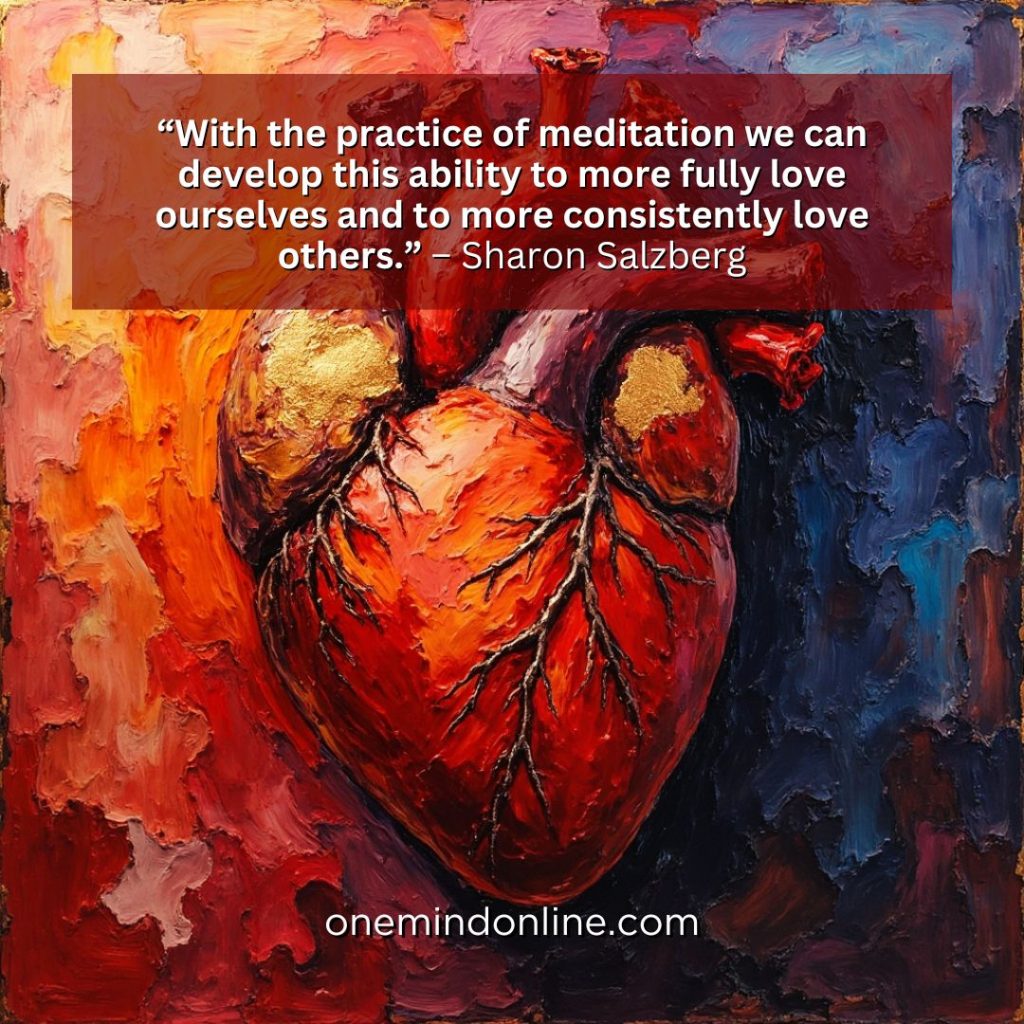
“With the practice of meditation we can develop this ability to more fully love ourselves and to more consistently love others.” – Sharon Salzberg
The darkness in your past – the years spent doubting yourself, feeling disconnected, or believing love was something others had access to but you did not – none of it determines what is possible for you right now. The light switch is always within reach.
The key, as Salzberg reminds us, is practice. Not perfection. Not one transformative session. Practice – the quiet, consistent act of returning home to yourself.
Through the repetition of regular meditation, we establish that this body and this mind is our most comfortable place, our home. And as our self-worth grows in the presence of our own self-acceptance, love spills from our overflowing cup onto the humans around us.
The path to an open heart isn’t reserved for a select few or those with special gifts. It’s available to anyone willing to turn inward with consistency and compassion. Your heart beats with the same rhythm as every other loving heart on this planet, carrying within it the same potential for profound connection and joy.
Here are some guiding mantras for living with an open heart:
- “This body, and this mind, is my home.”
- “My heart is capable of immense love and peace.”
- “Meditation is my tool for cultivating this inner light.”
- “Every day is a new opportunity to open my heart wider.”
- “With self-acceptance comes the ability to love more fully.”
The path is open to everyone. Don’t give up on the incredible potential that beats within your chest. Start your journey today, and discover the transformative power of an open heart.
Have a beautiful Friday beautiful humans!
– pierre –
Today’s LIVE meditation is: Sharing love.
Today’s LIVE meditation
https://youtu.be/fSWabsKSzoQ 2026
https://youtu.be/Ax_5qSJpEYY 2025
https://youtu.be/1R44Psrf7UQ 2024
Practice the “Daily Dose”
Let’s put it into practice! Choose what works for you – daily, once a week or whenever inspiration strikes. Putting pen to paper wires the neural pathways that will create your new habits.
1 – Affirmation
Write down your favourite affirmation on a sticky note and place it somewhere that you’ll be able to see it the whole day.
- “This body, and this mind, is my home.”
- “My heart is capable of immense love and peace.”
- “Meditation is my tool for cultivating this inner light.”
- “Every day is a new opportunity to open my heart wider.”
- “With self-acceptance comes the ability to love more fully.”
2 – A moment of reflection
Use today’s question as a journal prompt. If you don’t have the time to sit down and write, just take a moment to reflect on your response.
Consider the idea that love “spills from our overflowing cup onto the humans around us.” On a scale of 1 to 10, how full is your cup today? What specific actions or thoughts are draining it, and what actions or thoughts are filling it? What is one thing you can do today or tomorrow purely for the sake of filling your own cup, so you have more to offer yourself and others?
3 – Quotes to share
Send a quote to someone who needs it, or share them all on social media to spread the good vibes!

4 – Q&A for deeper learning
Read through the questions and answers and write down at least one “aha moment” that clicked for you.
Q1. What if I try to meditate and my mind feels too busy and chaotic? Does this mean I’m failing?
Not at all. In fact, noticing how busy your mind is is the first step. The goal of meditation isn’t to have an empty mind, which is nearly impossible, but to change your relationship with your thoughts. The practice is in gently noticing when your mind has wandered and kindly guiding it back, over and over. Every time you do this, you are strengthening your muscle of focus and self-compassion. A busy mind doesn’t mean you’re failing; it means you’re human and have the perfect opportunity to practice.
Q2. The article talks about love and peace, but I’m currently feeling a lot of anger and grief. Is it wrong to feel these “negative” emotions while trying to open my heart?
It is absolutely not wrong; it is essential. An open heart is a heart with the capacity to hold all human emotions – including anger, sadness, and grief – with acceptance and compassion. Trying to suppress these feelings is the opposite of openness. The practice helps you allow these emotions to be present without letting them consume you, creating a safe inner space for them to be felt and processed. And when sadness realizes that it’s allowed to be felt… then it pretty soon starts to feel happy.
Q3. How long will it take to experience the “open heart” feeling described in the article?
There is no universal timeline, and progress is not always linear. Some people notice subtle shifts in their daily calm and self-awareness within a few weeks of consistent practice. For others, the process is more gradual. It’s helpful to release any expectations of a specific outcome and instead focus on the act of practicing consistently.
Q4. Is meditation the only way to cultivate an open heart?
While the article highlights meditation as a proven and powerful tool, it is not the only path. Any activity that fosters mindfulness, presence, and self-compassion can lead to a more open heart. This can include practices like journaling, spending intentional time in nature, engaging in creative expression, practicing yoga, or cultivating deep, present connections with others. The key is the intention behind the practice: to connect with your inner self with awareness and kindness.
Q5. What does it mean that happiness is a “revolutionary act,” especially when there is so much suffering in the world?
This is a profound concept. It means that cultivating your own well-being is not a selfish act of escapism but a radical stance that strengthens you to better serve the world. When you operate from a place of inner peace and resilience (a “full cup”), you are less likely to be overwhelmed by the world’s suffering. Instead, you develop a greater capacity for compassion and effective, sustainable action. Your happiness becomes a resource that fuels your ability to contribute positively, rather than a distraction from problems.
Q6. I’ve felt that sense of deep connection and love before, but the feeling always fades. How do I make it permanent?
It’s natural for feelings, even profound ones, to be impermanent. The goal of practice is not to cling to a single emotional high and make it last forever. Rather, the goal is to establish love, peace, and equanimity as your “home base.” Through consistent practice, you create a familiar inner landscape that you can return to more easily and more quickly. The feeling may still come and go, but the path back to your open-hearted center becomes shorter and more familiar each time.
Q7. I find the concept of self-love difficult. How can I love myself when I am so aware of my flaws?
This is a common and deeply human struggle. The love cultivated through these practices is not the same as ego or arrogance. It is a fundamental acceptance of your whole self, flaws and all. Think of it as offering yourself the same compassion you might offer a dear friend who is struggling. You wouldn’t demand they be perfect to be worthy of your care. Meditation helps you practice this by observing your thoughts – even the self-critical ones – without judgment, which slowly builds a foundation of unconditional self-acceptance.