

“Your Daily Dose” is a quick two minute read packed with bite-sized wisdom from all the great teachers. But you could also choose to turn it into something more… a powerful daily practice for personal growth. Give it a try!
A message from today’s meditation:
Imagine yourself sitting at a cafe in the corner of a bustling marketplace. As you sip on your tea or coffee, you’re taking in the sounds of vendors hawking their wares, vibrant colours assaulting your eyes, and the intoxicating scent of exotic spices fill the air. Yet despite this sensory bombardment, you remain perfectly centered – a calm observer taking it all in without being overwhelmed.
This seemingly simple scenario holds the key to one of the most transformative practices in personal development: becoming the observer of yourself.
“We are what our thoughts have made us; So take care about what you think. Words are secondary. Thoughts live; They travel far.” – Swami Vivekananda
“Believing others is easy but believing in yourself that’s the real challenge” – Swami Vivekananda
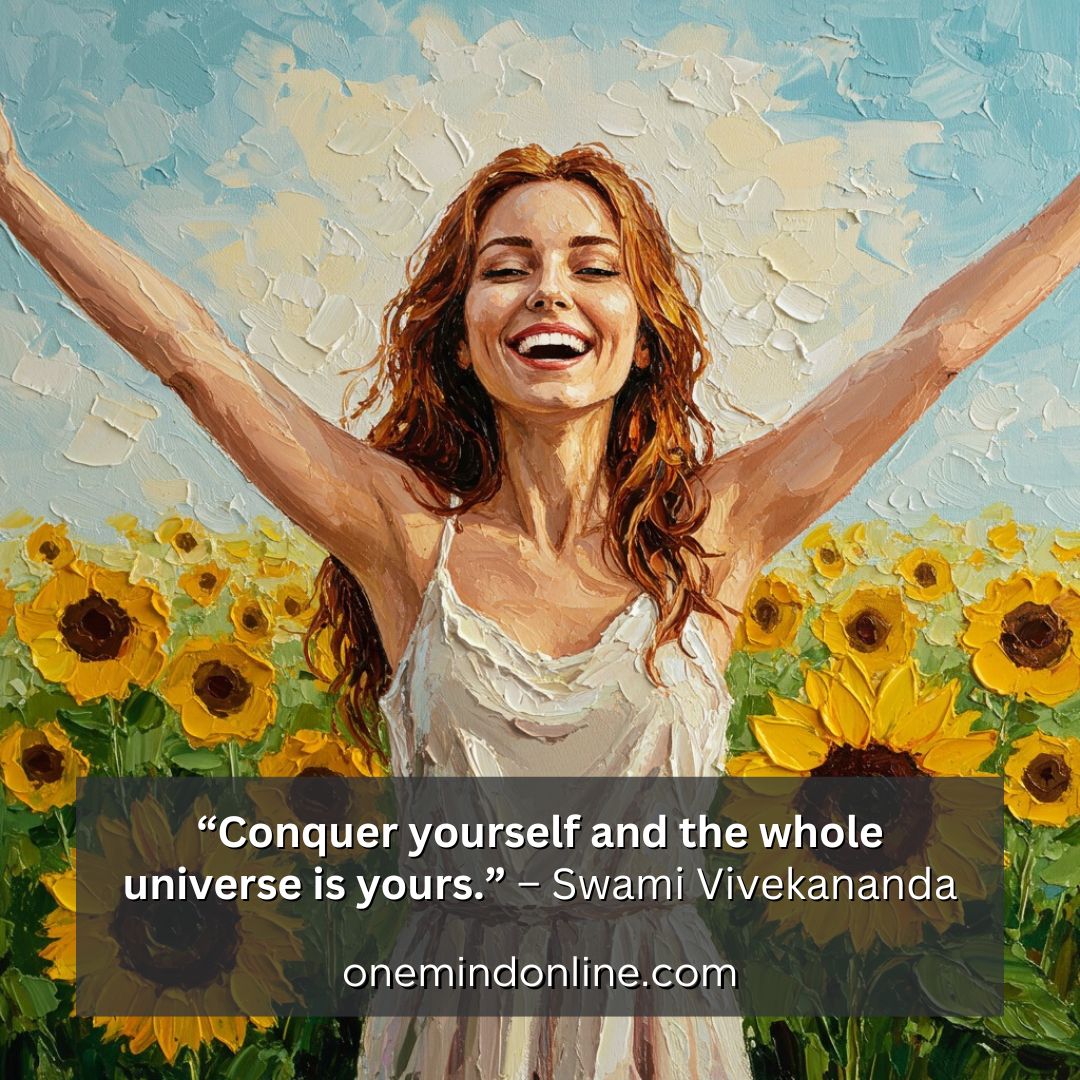
“Conquer yourself and the whole universe is yours.” – Swami Vivekananda
“The highest manifestation of strength is to keep ourselves calm and on our own feet.” – Swami Vivekananda
All of this is good advice, but HOW…?
HOW… to take care of what we think?
HOW… to believe in ourselves?
HOW… to conquer ourselves?
HOW… to keep ourselves calm?
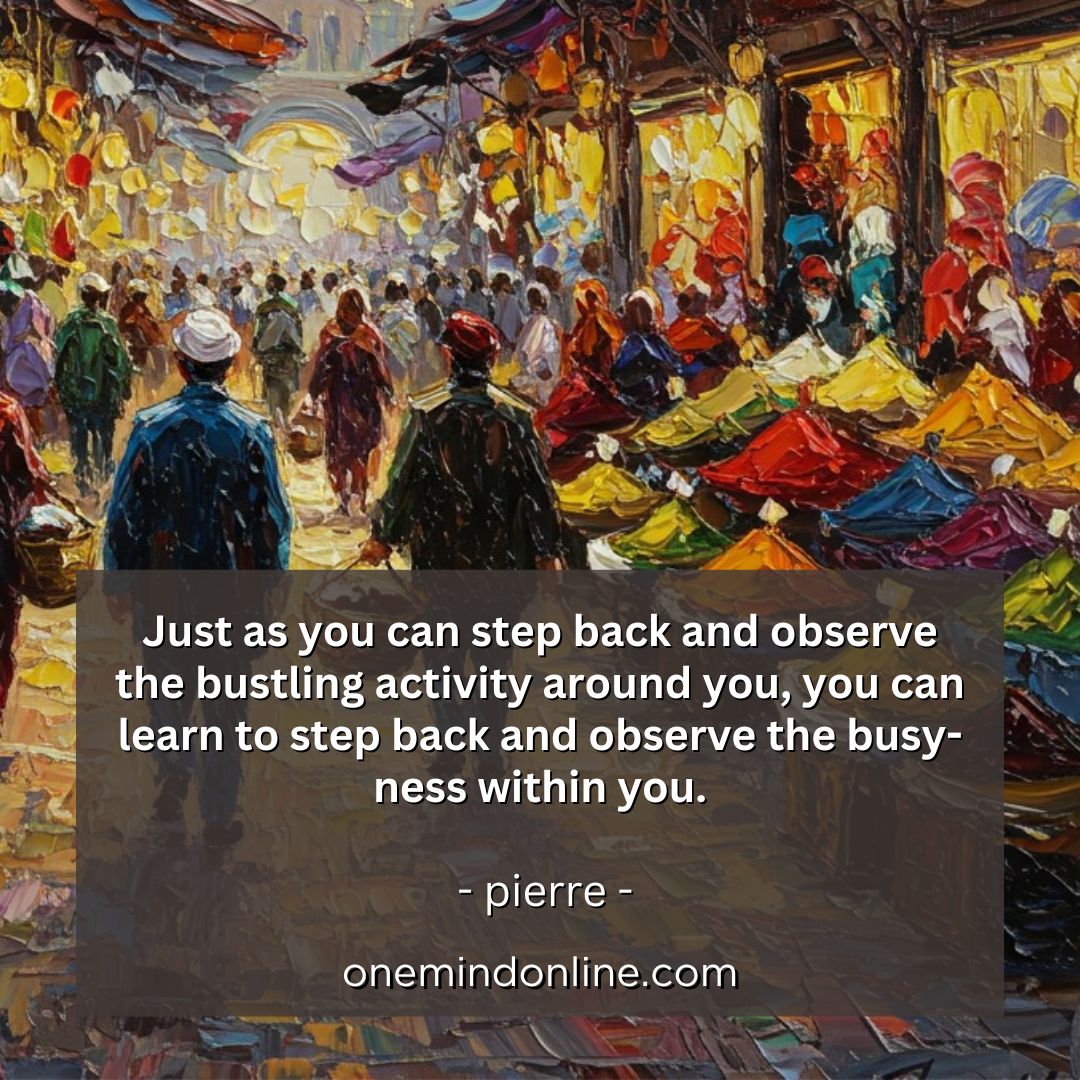
The answer lies in that marketplace café. Just as you can step back and observe the bustling activity around you, you can learn to step back and observe the busy-ness within you.
Can you take a step back, look at YOU and really see?
OBSERVE… what you are busy thinking…
OBSERVE… how you doubt yourself…
OBSERVE… how you are acting from old patterns…
OBSERVE… yourself struggling to stay calm…
It might not at first be clear what being the observer does in a practical sense because there is one crucial ingredient still missing… OBSERVE without judgement.
When you try to take such a deep look at yourself in the presence of self-judgement, then you are likely to react in fear by punishing yourself, by attacking yourself, or even the opposite – by trying to hide or numb the parts of you that you don’t really want to see.
When you’re able to take a look at you and just OBSERVE, you’ll start to learn about yourself. You’ll learn to understand why you do what you do. You’ll get to see how old programming plays a role in dictating your actions before you even get the chance to think. And without self-judgement you won’t be in fight-or-flight, and you’ll be able to see more clearly what the best course of action will be.
Today’s meditation is the very simple practice of taking a real good look at ourselves without judgement, by being able to allow our 5 physical senses to show us what experience they are having while we just observe.
As you embark on this journey of self-observation, consider these guiding mantras:
- “I am the observer of my thoughts, not their prisoner.“
- “With curiosity, I explore the landscape of my inner world.“
- “Amidst the storm, I observe my breath and find my center.“
- “I witness my patterns without judgment, and I choose conscious action.“
Becoming the observer is a practice, not a destination. There will be days when the storm rages, obscuring your view. But with consistent effort and gentle self-compassion, you’ll cultivate the unwavering presence of the observer within you, and become the co-author of your own story, one mindful moment at a time.
– pierre –
Today’s LIVE meditation is: Come to your senses.
Today’s LIVE meditation
https://youtu.be/A3JhEz4Ds_c 2024
https://youtu.be/p3JDGZcYfog 2023
https://youtu.be/WmZ42FDHHfk 2022
Practice the “Daily Dose”
Let’s put it into practice! Choose what works for you – daily, once a week or whenever inspiration strikes. Putting pen to paper wires the neural pathways that will create your new habits.
1 – Affirmation
Write down your favourite affirmation on a sticky note and place it somewhere that you’ll be able to see it the whole day.
- “I am the observer of my thoughts, not their prisoner.“
- “With curiosity, I explore the landscape of my inner world.“
- “Amidst the storm, I observe my breath and find my center.“
- “I witness my patterns without judgment, and I choose conscious action.“
2 – A moment of reflection
Use today’s question as a journal prompt. If you don’t have the time to sit down and write, just take a moment to reflect on your response.
The Observer Within: Imagine your future self, ten years from now, who has navigated many of life’s complexities and gained profound wisdom and compassion. This isn’t just an older you, but the most insightful and understanding version of yourself. If this future self could send you a message right now, what would they want you to know about your current struggles, your resilience in the face of challenges, and the incredible potential that lies ahead? Write a letter from your future self to your present self, offering guidance, reassurance, and perhaps a gentle nudge.
3 – Quotes to share
Send a quote to someone who needs it, or share them all on social media to spread the good vibes!
4 – Q&A for deeper learning
Read through the questions and answers and write down at least one “aha moment” that clicked for you.
Q1. What’s the difference between self-observation and self-criticism?
Self-observation is like being a neutral scientist studying your own experience with curiosity and compassion. Self-criticism, on the other hand, involves harsh judgment and often leads to shame or self-attack. When you observe, you’re simply noticing what’s happening without judging yourself for it. When you criticize, you’re in fight-or-flight mode, which clouds your ability to see clearly and choose conscious responses.
Q2. How do I know if I’m truly observing without judgment?
You’ll know you’re observing without judgment when you can witness your thoughts, emotions, and behaviors with the same curiosity you’d have watching clouds pass by. If you notice yourself getting frustrated, angry, or ashamed about what you’re observing, that’s a signal that judgment has crept in. True observation feels spacious and calm, even when what you’re observing is uncomfortable.
Q3. I keep getting caught up in my thoughts instead of observing them. What am I doing wrong?
Nothing is wrong – this is completely normal! Getting caught up in thoughts is like being pulled into the marketplace activity instead of sitting in the café corner. When you notice this happening, gently return to your observer position. The key is to not judge yourself for getting caught up, but to simply notice it and redirect your attention back to observation. This “catching and returning” is actually the practice itself.
Q4. How long does it take to develop this observer skill?
The beautiful thing about being the witness is that it’s both immediate and lifelong. You can access the observer in any moment, but developing the consistent ability to return to this perspective takes practice. Some people notice significant changes within weeks, while others find it takes months or years to feel natural. Remember, it’s not about reaching a destination but about cultivating a practice that deepens over time.
Q5. What should I do when I observe patterns I don’t like about myself?
The magic happens in the simple act of observing without immediately trying to change anything. When you can witness your patterns with curiosity rather than judgment, you naturally start the process of understanding their origins and purpose. This understanding often leads to organic change over time. Instead of forcing transformation, let the observation itself create the space for new choices to emerge naturally.
Q6. Can this practice help with anxiety and stress?
Absolutely. When you’re caught up in anxious thoughts, you’re essentially swimming in the storm. Becoming the observer is like finding a calm lighthouse that can witness the storm without being consumed by it. This doesn’t make the anxiety disappear immediately, but it gives you a stable vantage point from which you can observe your anxiety, understand its patterns, and choose how to respond rather than react automatically.
Q7. How do I practice this during busy, stressful moments when I can barely think straight?
Start with your five senses – they’re always available, even in chaos. Even for just 30 seconds, notice what you can see, hear, smell, taste, or feel physically. This grounds you in the present moment and naturally shifts you into observer mode. You can also use simple anchor phrases like “I notice I’m feeling stressed” or “I observe my heart racing.” The goal isn’t to eliminate the stress but to create a small pocket of awareness within it.