

Alan Watts (1915–1973) was a British-born philosopher, writer, and speaker best known for his exceptional ability to interpret and popularize Eastern philosophy for a Western audience. He served as a crucial bridge, making the profound wisdom of traditions like Zen Buddhism, Taoism, and Hinduism accessible, entertaining, and deeply relevant to modern life.
Key Contributions and Ideas
- Interpreter of Eastern Wisdom: Watts’s most significant contribution was his eloquent articulation of concepts often unfamiliar to the West, such as the Tao (the watercourse way of nature), non-duality (the interconnectedness of self and universe), and the essential principles of Zen. His 1957 bestseller, The Way of Zen, was pivotal in the rise of Eastern spirituality in the mid-20th century.
- Critique of Dualistic Thinking: A central theme in his work is the critique of the Western tendency toward dualistic thinking—seeing the world in terms of separate opposites like mind/body, self/other, good/evil. Watts urged a shift toward recognizing the fundamental unity and interconnectedness of all things, asserting that our individual ego is a helpful but ultimately illusory concept.
- The “Philosophical Entertainer”: Watts often referred to himself as a “philosophical entertainer” or “rascal guru,” reflecting his playful, engaging, and deliberately non-dogmatic approach. He encouraged listeners not to blindly follow a path but to explore various worldviews and simply observe life.
- Influence on the Counterculture: His teachings had a massive impact on the counterculture movement of the 1960s, helping to spur interest in meditation, yoga, psychotherapy, and environmentalism by providing a philosophical framework for liberation and higher consciousness.
In short, Alan Watts wasn’t just a teacher; he was a communicator who translated ancient wisdom into a modern language, challenging us to drop our rigid, anxious conceptions of self and reality, and embrace life as a playful, cosmic dance.
Click on the image for more context.

“Don’t hurry anything. Don’t worry about the future. Don’t worry about what progress you’re making. Just be entirely content to be aware of what is.” – Alan Watts
Click on the image for more context.

“The future is a concept, it doesn’t exist. There is no such thing as tomorrow. There never will be, because time is always now.” – Alan Watts
Click on the image for more context.

“By replacing fear of the unknown with curiosity, we open ourselves up to an infinite stream of possibility. We can let fear rule our lives or we can become childlike with curiosity, pushing our boundaries, leaping out of our comfort zones, and accepting what life puts before us.” – Alan Watts
Click on the image for more context.

“Life is not a problem to be solved. Life is an experience to be had.” – Alan Watts
Click on the image for more context.

“We thought of life by analogy with a journey, a pilgrimage, which had a serious purpose at the end, and the thing was to get to that end, success or whatever it is, maybe heaven after you’re dead. But we missed the point the whole way along. It was a musical thing and you were supposed to sing or to dance while the music was being played.” – Alan Watts
Click on the image for more context.

“You must not be afraid of playing wrong notes. Just forget it, play it wrong! But play!” – Alan Watts
Click on the image for more context.
“This is the real secret of life – to be completely engaged with what you are doing in the here and now. And instead of calling it work, realize that it is all play.” – Alan Watts
Click on the image for more context.
“If you can concentrate the mind for two seconds, you can do it for two minutes, and you can do it for two hours. Of course, if you want to make this kind of thing horribly difficult, you begin to think about whether you are concentrating, about how long you have concentrated, and about how much longer you are going to keep it up. All this is totally off the point. Concentrate for one second. If, at the end of this time, your mind has wandered off, concentrate for another second, and then another. Nobody ever has to concentrate for more than one second – this one.” – Alan Watts
Click on the image for more context.
“As muddy water is best cleared by leaving it alone, it could be argued that those who sit quietly and do nothing are making one of the best possible contributions to a world in turmoil.” – Alan Watts
Click on the image for more context.

“Do you have the patience to wait for the water to settle?” – Alan Watts
Click on the image for more context.
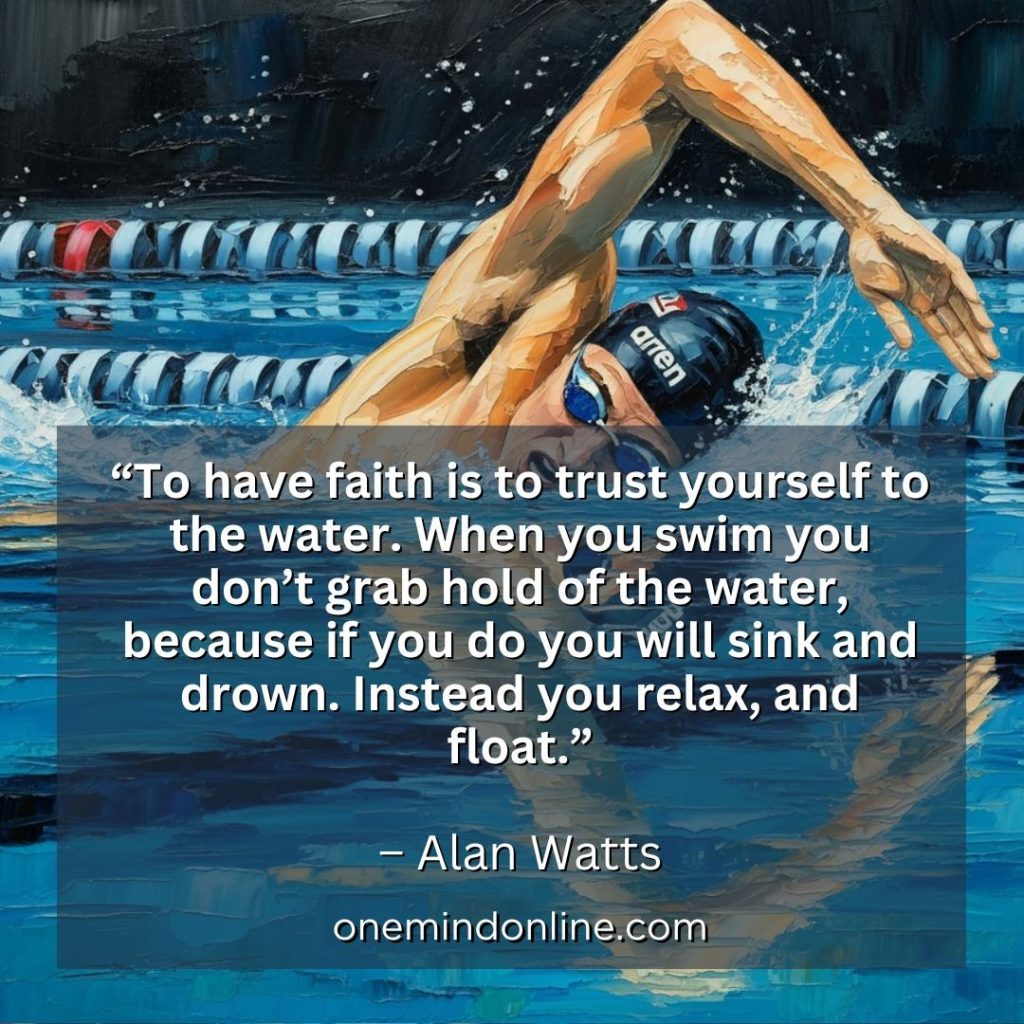
“To have faith is to trust yourself to the water. When you swim you don’t grab hold of the water, because if you do you will sink and drown. Instead you relax, and float.” – Alan Watts
Click on the image for more context.

“When we dance, the journey itself is the point, as when we play music the playing itself is the point. And exactly the same thing is true in meditation. Meditation is the discovery that the point of life is always arrived at in the immediate moment.” – Alan Watts
Click on the image for more context.

“For unless one is able to live fully in the present, the future is a hoax. There is no point whatsoever in making plans for a future which you will never be able to enjoy. Because even when your plans mature, you will still be living for some other future beyond. You will never, never be able to sit back with full contentment and say, “Now, I’ve arrived!” Your entire education has deprived you of this capacity because it was preparing you for the future, instead of showing you how to be alive now.” – Alan Watts
Click on the image for more context.
“The destination of life is this eternal moment.” – Alan Watts
Click on the image for more context.

“Nirvana is where you are, provided you don’t object to it.” – Alan Watts
Click on the image for more context.

“Well now let’s go back to falling in love. It’s quite crazy. Falling. You see? We don’t say “rising into love.” There is in it, the idea of the fall. And it goes back, as a matter of fact, to extremely fundamental things. That there is always a curious tie at some point between the fall and the creation. Taking this ghastly risk is the condition of there being life. You see, for all life is an act of faith and an act of gamble. The moment you take a step, you do so on an act of faith because you don’t really know that the floor’s not going to give under your feet… so, actually, therefore, the course of wisdom, what is really sensible, is to let go, is to commit oneself, to give oneself up and that’s quite mad. So we come to the strange conclusion that in madness lies sanity.” – Alan Watts
Click on the image for more context.

“Love is not something that is a sort of rare commodity, everybody has it.” – Alan Watts
Click on the image for more context.

“So then, the relationship of self to other is the complete realization that loving yourself is impossible without loving everything defined as other than yourself.” – Alan Watts
Click on the image for more context.

“When you find out that there was never anything in the dark side to be afraid of, then nothing is left but to love.” – Alan Watts
Click on the image for more context.
“To go out of your mind at least once a day is tremendously important. By going out of your mind, you come to your senses.” – Alan Watts
Click on the image for more context.

“A person who thinks all the time has nothing to think about except thoughts. So he loses touch with reality, and lives in a world of illusion.” – Alan Watts
Click on the image for more context.
“Of course, you can’t force your mind to be silent. That would be like trying to smooth ripples in water with a flatiron. Water becomes clear and calm only when left alone.” – Alan Watts
Click on the image for more context.
“This is what Zen means by being detached—not being without emotion or feeling, but being one in whom feeling is not sticky or blocked, and through whom the experiences of the world pass like the reflections of birds flying over water.” – Alan Watts
Click on the image for more context.
“Through our eyes, the universe is perceiving itself. Through our ears, the universe is listening to its harmonies. We are the witnesses through which the universe becomes conscious of its glory, of its magnificence.” – Alan Watts
Click on the image for more context.
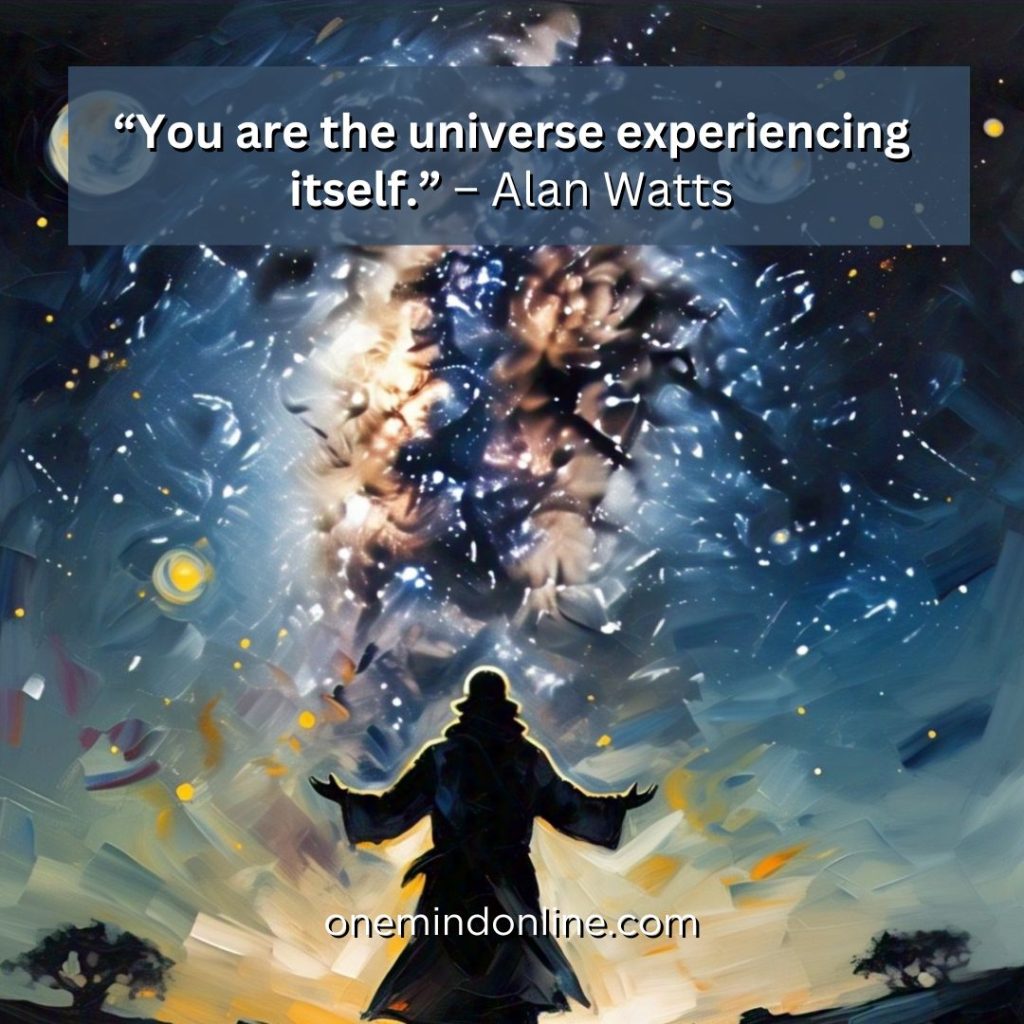
“You are the universe experiencing itself.” – Alan Watts
Click on the image for more context.

“To really do nothing, with perfection, is as difficult as doing everything.” – Alan Watts
Click on the image for more context.