
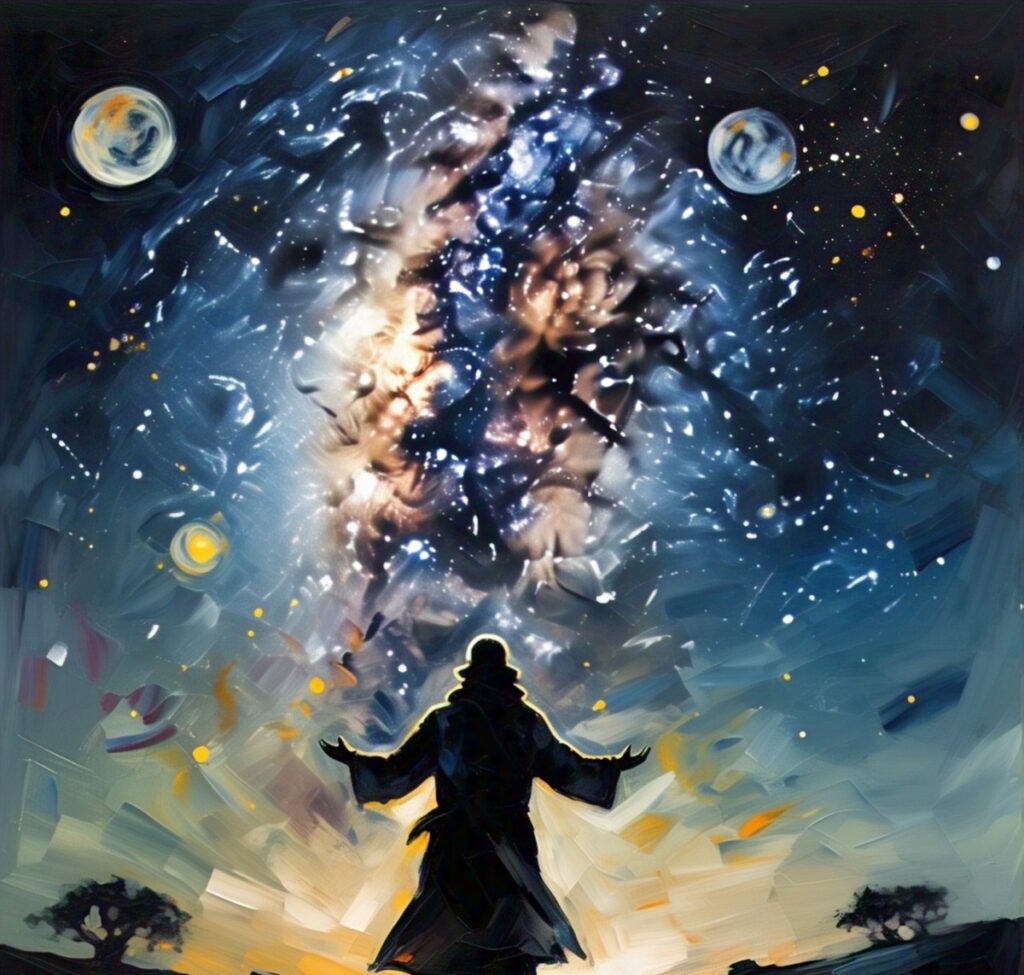
“Your Daily Dose” is a quick two minute read packed with bite-sized wisdom from all the great teachers. But you could also choose to turn it into something more… a powerful daily practice for personal growth. Give it a try!
A silent meditation for today………
In meditation and other mindfulness practices we often hear the term, “quiet the mind”. This may create the impression that we should somehow be able to just shut down our thoughts which of course sets us up for failure before we’ve even started, because shutting down the thinking in that way simply doesn’t work. But what if the goal isn’t really to silence every thought, but to learn that we can develop the ability to take a step back from our thoughts and become the witness rather than a slave to our thoughts?
The truth is we don’t need to stop all of our thinking. There is a space within us that is deeper than the thoughts, from where it becomes relatively easy to watch these thoughts with curiosity as they form up in our mind, play out their story and eventually dissolve.
In this place we learn that we can be unattached to the events that play out within us and outside of us. This sense of detachment doesn’t mean disconnection. Rather, it’s a freedom where nothing controls us – not our circumstances, not our emotions, not even our most persistent thoughts. Here, we discover that non-attachment doesn’t mean being separate from life, but being a participant in the wholeness. Not only are you a part of everything in the Universe, but the whole Universe exists in you…
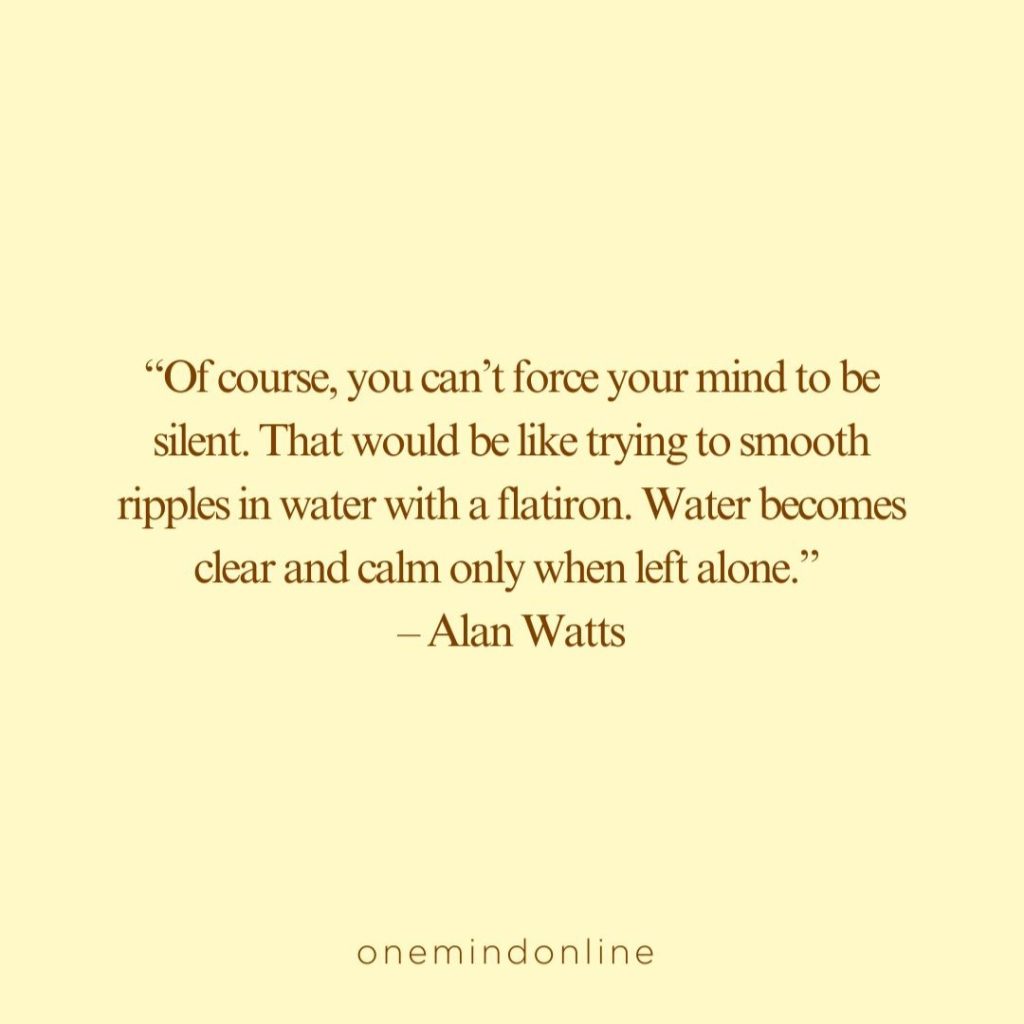
“Of course, you can’t force your mind to be silent. That would be like trying to smooth ripples in water with a flatiron. Water becomes clear and calm only when left alone.” – Alan Watts
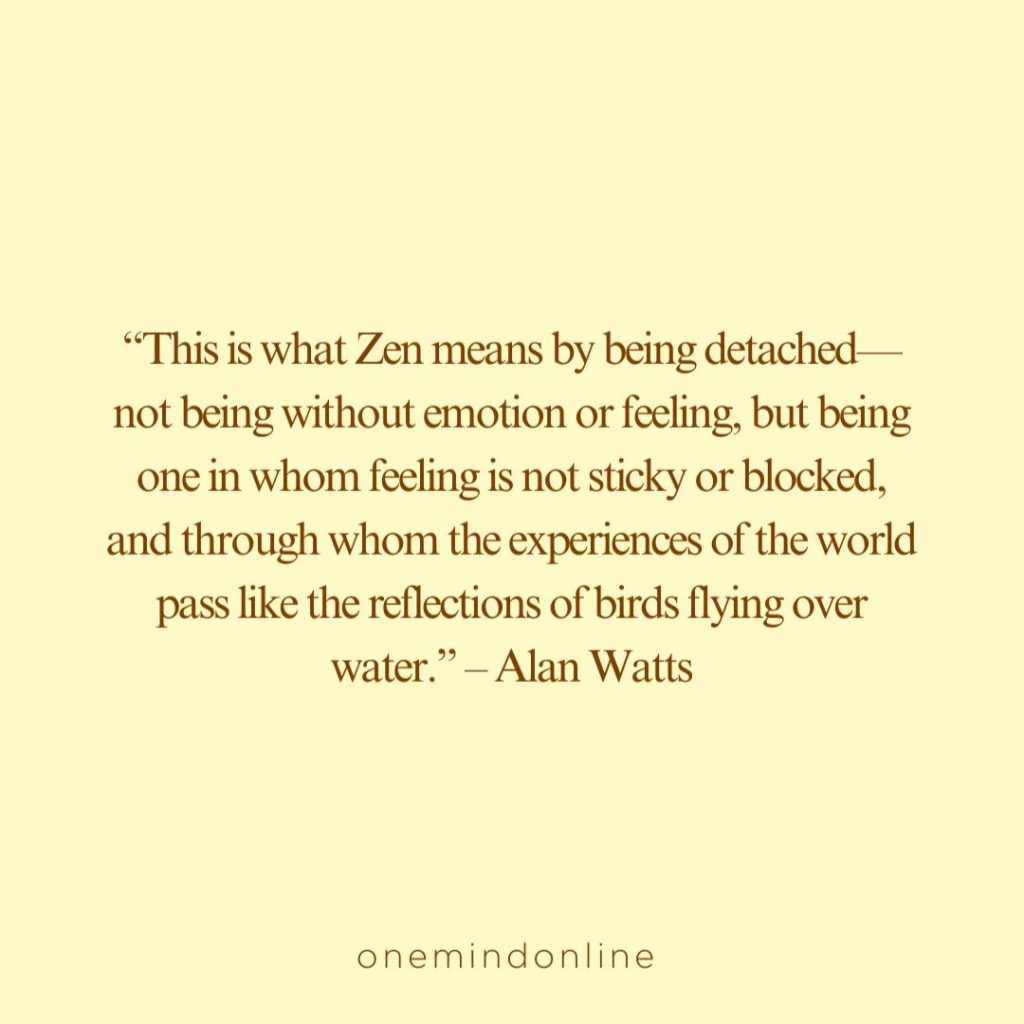
“This is what Zen means by being detached—not being without emotion or feeling, but being one in whom feeling is not sticky or blocked, and through whom the experiences of the world pass like the reflections of birds flying over water.” – Alan Watts
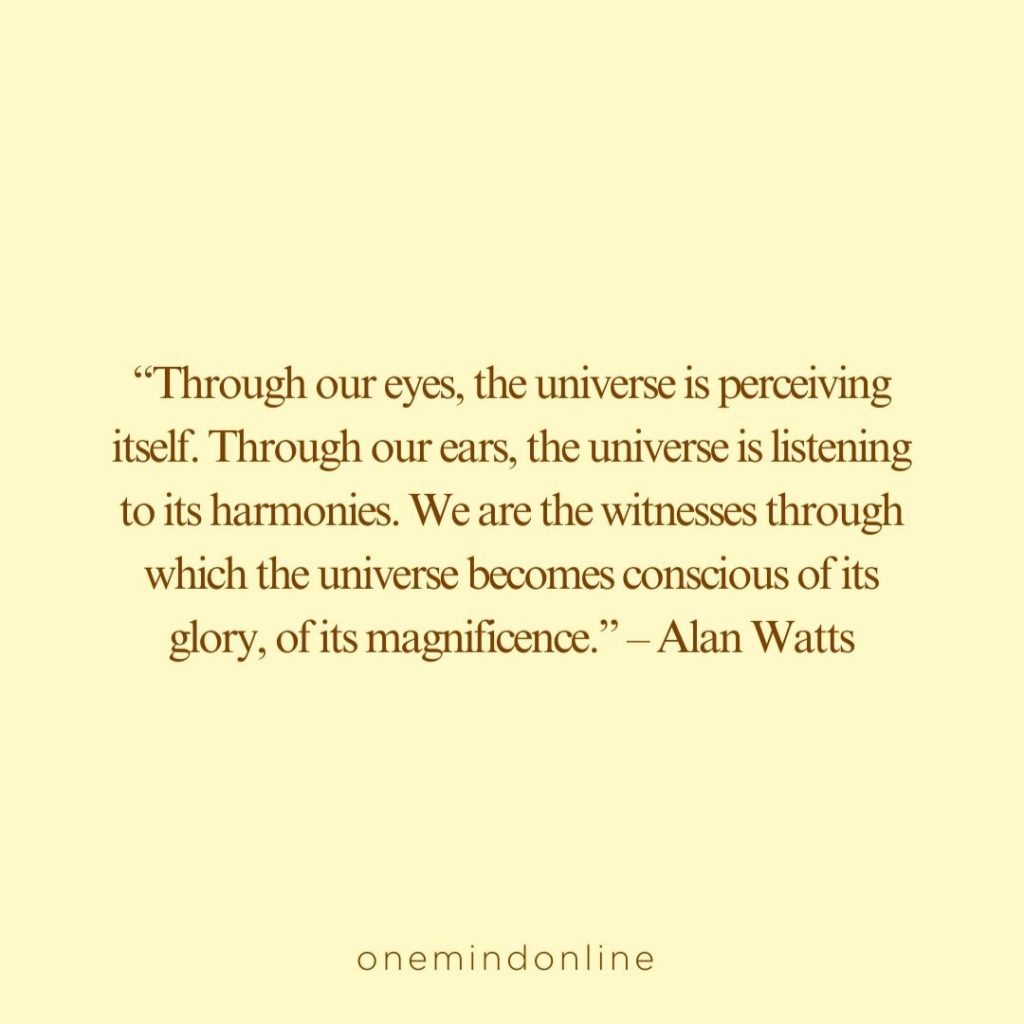
“Through our eyes, the universe is perceiving itself. Through our ears, the universe is listening to its harmonies. We are the witnesses through which the universe becomes conscious of its glory, of its magnificence.” – Alan Watts
“You are the universe experiencing itself.” – Alan Watts
The practice of meditation is a state of mindful observation, allowing us to witness our thoughts without becoming entangled in them. As this observer we cultivate a sense of equanimity, where we are neither overwhelmed by joy nor consumed by sorrow. We become receptive to the ebb and flow of life, embracing both pleasure and pain with equal acceptance.
And as the observer we come to the understanding that we are not merely isolated beings, but we are participating in consciousness itself as integral parts of the vast cosmic tapestry. Through the lens of our consciousness, we are the universe perceiving itself. Our senses become the instruments through which the cosmos experiences its own beauty and grandeur.
Embrace this grand tapestry that you are a part of:
- “I am the observer, watching thoughts and emotions pass like clouds across an open sky.”
- “I release my need to control every outcome, trusting in the natural flow of life moving through me.”
- “Nothing owns me – not my emotions, not my circumstances, not my past.”
- “Through my consciousness, the universe is experiencing itself.”
By tuning into the silence within we get to experience not just our own sense of consciousness, we surrender to consciousness itself. Thus we become open vessels for the vast intelligence of the universe to be expressed through.
Have a peaceful Sunday peeps!
– pierre –
Today’s LIVE meditation is: Finding silence.
Today’s LIVE meditation
https://youtu.be/2r4URICjWL0 2025
https://youtu.be/sftAPkstJNc 2024
https://youtu.be/JCjaBHX-aME 2023
https://youtu.be/IZUQkhf3-_c 2022
Practice the “Daily Dose”
Let’s put it into practice! Choose what works for you – daily, once a week or whenever inspiration strikes. Putting pen to paper wires the neural pathways that will create your new habits.
1 – Affirmation
Write down your favourite affirmation on a sticky note and place it somewhere that you’ll be able to see it the whole day.
- “I am the observer, watching thoughts and emotions pass like clouds across an open sky.”
- “I release my need to control every outcome, trusting in the natural flow of life moving through me.”
- “Nothing owns me – not my emotions, not my circumstances, not my past.”
- “Through my consciousness, the universe is experiencing itself.”
2 – A moment of reflection
Use today’s question as a journal prompt. If you don’t have the time to sit down and write, just take a moment to reflect on your response.
The Universe Through Your Senses: Alan Watts suggests that “through our eyes, the universe is perceiving itself.” Choose one sensory experience from today—something you saw, heard, touched, tasted, or smelled. Describe it in detail, but from the perspective that you are not just experiencing this sensation, but that the universe itself is experiencing it through you. How would the universe describe the experience that you are making available? How does this shift in viewpoint change your relationship with that moment?
3 – Quotes to share
Send a quote to someone who needs it, or share them all on social media to spread the good vibes!

4 – Q&A for deeper learning
Read through the questions and answers and write down at least one “aha moment” that clicked for you.
1. Do I need to stop all my thoughts to meditate successfully?
No, you don’t need to stop all your thinking. The goal isn’t to force your mind into silence—as Alan Watts said, that would be like trying to smooth water with a flatiron. Instead, meditation invites you to slip into a space deeper than thought, where you become the observer of your thinking rather than being caught up in it. Your thoughts can continue; you’re simply learning to witness them without attachment or identification.
2. What does it mean to be “detached” without being disconnected?
Detachment in this context doesn’t mean emotional numbness or separation from life. Rather, it’s a state where nothing owns you—not your emotions, circumstances, or thoughts. You can still feel deeply, but those feelings flow through you like reflections of birds on water rather than getting stuck or blocked. You’re fully engaged with life while remaining free within it. It’s the difference between being swept away by a river and flowing with it consciously.
3. How is it possible that “the universe exists in me”?
This points to the interconnected nature of consciousness. You’re not a separate observer looking at the universe from outside—you are an expression of the universe itself. Through your eyes, the cosmos sees; through your ears, it hears. Your consciousness isn’t just yours alone; it’s how the universe experiences itself. Every atom in your body was forged in stars, every thought is energy and information organizing itself. You contain the same elements, patterns, and creative force as galaxies—you’re not just in the universe, you are the universe expressed in human form.
4. What’s the difference between observing thoughts and being consumed by them?
When you’re consumed by thoughts, you become identified with them—”I am anxious,” “I am angry,” “I am not good enough.” When you observe thoughts, there’s a spaciousness where you recognize “there is anxiety,” “there is anger,” “there is a thought about not being good enough.” This subtle shift creates freedom. The observer position allows you to witness mental and emotional patterns without being controlled by them, cultivating equanimity where you’re neither overwhelmed by joy nor consumed by sorrow.
5. How do I practice “being the observer” in daily life, not just in meditation?
Start by creating small pauses throughout your day. When you notice a strong emotion arising, take a breath and mentally step back: “I notice I’m feeling frustrated” rather than “I am frustrated.” Watch your thoughts like clouds passing across the sky. Practice observing sensations in your body without immediately reacting. Notice when you’re judging experiences as “good” or “bad” and gently shift to neutral observation. The more you practice this perspective during calm moments, the more accessible it becomes during challenging ones.
6. What does it mean to practice “equanimity” and why is it important?
Equanimity is a state of balanced awareness where you remain steady amid life’s ups and downs. It doesn’t mean you don’t feel emotions; rather, you’re not thrown off-center by them. You can experience joy without clinging to it and face pain without being destroyed by it. Equanimity is important because it allows you to be fully present with life as it is, responding wisely rather than reacting impulsively. It’s the fruit of regular observer practice—a grounded peace that remains accessible even when circumstances change.
7. How does understanding “I am the universe experiencing itself” change how I live?
This understanding can profoundly shift your perspective on everything. It dissolves the illusion of separation that creates so much suffering—the feeling that you’re alone, isolated, or fundamentally disconnected from life. When you recognize yourself as the universe in conscious form, your problems don’t disappear, but they’re held in a larger context. Your experiences become more meaningful because they’re not just personal struggles but the cosmos exploring itself. You develop deeper compassion—for yourself and others—recognizing that we’re all expressions of the same underlying reality. It transforms existence from something happening to you into something happening through you and as you.