

“Your Daily Dose” is a quick two minute read packed with bite-sized wisdom from all the great teachers. But you could also choose to turn it into something more… a powerful daily practice for personal growth. Give it a try!
A message from today’s meditation:
We don’t talk about rising into love, but falling…
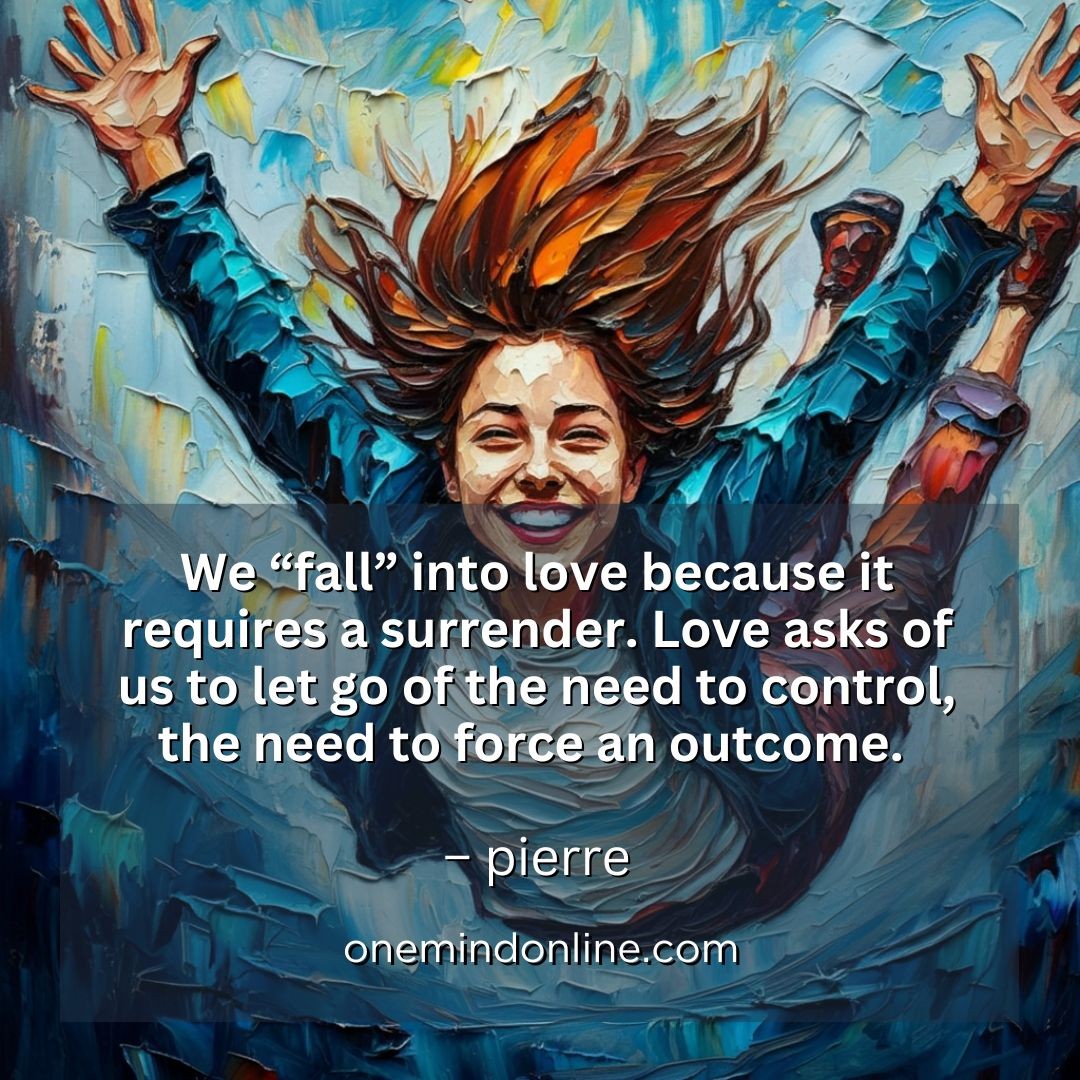
We “fall” into love because it requires a surrender. Love asks of us to let go of the need to control, the need to force an outcome.
Love is not something we need to search for to find, it is the truth of who we are, we are made of love. But in order for us to experience this, we will have to surrender completely to exactly who we are, and then… we see it in everybody…
“Well now let’s go back to falling in love. It’s quite crazy. Falling. You see? We don’t say “rising into love.” There is in it, the idea of the fall. And it goes back, as a matter of fact, to extremely fundamental things. That there is always a curious tie at some point between the fall and the creation. Taking this ghastly risk is the condition of there being life. You see, for all life is an act of faith and an act of gamble. The moment you take a step, you do so on an act of faith because you don’t really know that the floor’s not going to give under your feet… so, actually, therefore, the course of wisdom, what is really sensible, is to let go, is to commit oneself, to give oneself up and that’s quite mad. So we come to the strange conclusion that in madness lies sanity.” – Alan Watts
“Love is not something that is a sort of rare commodity, everybody has it.” – Alan Watts
“So then, the relationship of self to other is the complete realization that loving yourself is impossible without loving everything defined as other than yourself.” – Alan Watts
“When you find out that there was never anything in the dark side to be afraid of, then nothing is left but to love.” – Alan Watts
Often our experience of love has been so infected by the fears we formed around rejection and being accepted, that we become too scared to take a step in any direction at all for fear that the ground might give way.
We are made to do this though, falling is just a part of playing and perhaps we have forgotten to be playful. Perhaps we were tricked into believing that “grown ups” have it all figured out, and that after being a child you should always be getting it “right”, so now taking even the tiniest step has become something loaded with fear.
The moment that you lose your fear of falling you will fall head over heels in love with life again, trust me, and trust in the ability of your soul to catch you and hold you no matter how hard the fall.
The universe is designed to support you, even when the landing feels hard. We are made for this – falling is simply part of playing, and it’s time we remembered how to play again.
Embrace the fall:
- “I embrace uncertainty as the birthplace of possibility and growth.”
- “Loving myself fully allows me to love others without fear or reservation.”
- “I release my need to control every outcome and trust in life’s natural flow.”
- “I am worthy of love simply because I exist, not because of what I achieve.”
- “My vulnerability is not weakness; it is the gateway to authentic connection.”
So let us surrender to love, to life, to the unknown. Let’s embrace the fall. Let us surrender to the unknown. Let us trust in the divine. Let us trust that the universe will catch us, that we are always supported and guided.
Have a beautiful Friday peeps!
– pierre –
Today’s LIVE meditation is: Sharing love.
Today’s LIVE meditation
https://youtu.be/Gr4McfEG0HM 2025
https://youtu.be/5g9ITeRCigk 2024
https://youtu.be/fO5yq3mlEnQ 2023
https://youtu.be/aLjAwKnCINY 2022
Practice the “Daily Dose”
Let’s put it into practice! Choose what works for you – daily, once a week or whenever inspiration strikes. Putting pen to paper wires the neural pathways that will create your new habits.
1 – Affirmation
Write down your favourite affirmation on a sticky note and place it somewhere that you’ll be able to see it the whole day.
- “I embrace uncertainty as the birthplace of possibility and growth.”
- “Loving myself fully allows me to love others without fear or reservation.”
- “I release my need to control every outcome and trust in life’s natural flow.”
- “I am worthy of love simply because I exist, not because of what I achieve.”
- “My vulnerability is not weakness; it is the gateway to authentic connection.”
2 – A moment of reflection
Use today’s question as a journal prompt. If you don’t have the time to sit down and write, just take a moment to reflect on your response.
Life as a playful partner: Can you remember a time when you were able to approach life with more of a playful energy? Without fear of the outcome being perfect? Describe that experience. What made it feel safe or freeing? How can you invite more of that playfulness into your daily life?
3 – Quotes to share
Send a quote to someone who needs it, or share them all on social media to spread the good vibes!
4 – Q&A for deeper learning
Read through the questions and answers and write down at least one “aha moment” that clicked for you.
Q1: Why do we say “falling” in love instead of “rising” in love?
The word “falling” points to something our everyday language already knows: love is a surrender, not an achievement. We rise when we strive, climb, and take charge of an outcome, but we fall when we release our grip and trust what comes next. This is why love cannot blossom through control. In any relationship, trying to “make” another person think, feel, or behave the way we believe they should is not a form of love at all. It is fear dressed up as care, an attempt to manage the risk of being hurt by managing the other person. Love and control cannot occupy the same space, because control says “you must become what I need you to be,” while love says “I trust you to be who you are.” To fall into love is to give up the need to force an outcome and let another person remain free, which is exactly what makes a real connection possible. Controlling someone’s behaviour may produce compliance, but it can never produce intimacy. Only when we loosen our grip and take the leap, without knowing where we will land, does love have room to grow.
Q2: If love is our true nature, why is it so hard to experience?
Growing up, most of us didn’t learn what love is so much as we learned how to be accepted and avoid being rejected. As children, we were wholly dependent on the people around us, so we became skilled at reading the room: which behaviours earned approval, which feelings were welcome, and which parts of us were better hidden. Without realizing it, we organized ourselves around that one question, “What do I have to do to belong?” Over time, our whole idea of love took shape around the answer, so that love came to feel like something conditional, earned through performance and lost through mistakes. We carried this orientation into adulthood, where it quietly shapes our relationships. We shrink, please, perform, or protect ourselves, all in the name of staying safe from rejection. The difficulty, then, is not that love is absent, but that we are still living by rules written when we were small. We are so busy managing how we are seen that we cannot rest in what we are. But the love beneath the strategies was never taken from us. As we notice these old patterns and begin to accept ourselves as we are, we can stop organizing our lives around approval and start experiencing the love that was here all along.
Q3: How can I overcome my fear of rejection when opening my heart?
Start by accepting that it is entirely possible for who you are to not fit a particular person’s taste, and that this can feel like rejection. But a difference in taste is not a verdict on your worth, any more than a person who dislikes a certain food is passing judgment on the food. The only foundation you will ever have is liking who you are, regardless of whether someone else does. When you stand on that foundation, another person’s “no” can sting without shaking you, because your sense of self never depended on their approval. If you don’t like who you are, you have no foundation at all, and your only path is to keep contorting yourself to meet someone else’s requirements, shrinking, pleasing, and editing yourself to fit in. That is a lonely way to live, because even if you are accepted, it is a version of you that is being accepted, not you. So the work is less about eliminating the fear of rejection than about building a home within yourself that you can always return to. Open your heart as you are, and let each person’s response show you whether there is a true fit. Those who are not a match are not a measure of your value. They simply free you to find the people who are.
Q4: What does it mean to “surrender to love”?
Surrendering to love means releasing your need to control how love appears, who offers it, and what form it takes. It means accepting yourself completely – flaws and all – and extending that same acceptance to others. It’s about trusting that you’re supported even when you can’t see the safety net, much like trusting the floor will hold you with each step you take. But even more fundamentally, trusting that even if the floor does give way… you are the one who will catch you.
Q5: What does it mean that “in madness lies sanity”?
Alan Watts’s paradox turns on what we have been taught to call “sensible.” From an early age, we learn that the sensible person controls everything, avoids risk, and guards against uncertainty at every turn. We admire the one who never seems to misstep, and we quietly pity or distrust the one who leaps without knowing where they will land. In a society built on this logic, choosing to let go, and to embrace uncertainty looks rather mad. The truth is that taking a step always means risking a fall. Fear tells us to be scared of every step, while wisdom accepts that risk is simply part of the equation. Of course you could fall, but the only alternative is to never let go of the side, clinging to what feels safe while life flows past. Once you see this, you start to notice how many people never let go of the side, and how much of their caution is not really safety but a quiet kind of paralysis. Here is the sanity hidden inside the supposed “madness” of letting go: discovering that you can step forward and trust yourself to get up from every fall, and seeing clearly that a tight grip on the side was never the same as a life well lived.
Q6: How can I become more playful and less afraid of “falling” in life?
Begin by noticing where you have made ordinary decisions feel high-stakes: the text message you rewrite five times, the restaurant you research for an hour, the small choice that somehow feels like a verdict on your competence. Then gently challenge the belief behind it, the idea that adults must always “get it right.” Nobody actually has it all figured out, and the pressure to pretend otherwise is what turns every step into a potential disaster. From there, start with small experiments in spontaneity. Try something new without researching it exhaustively, or make a choice based on joy rather than optimization. Reconnect, too, with the activities that felt playful in childhood, whether that is drawing, dancing, climbing, or building something with no purpose at all, because they remind your body what it feels like to move without fear of failing. Most importantly, practice self-compassion when things don’t go as planned. When the experiment flops or the feeling comes out clumsily, resist the urge to treat it as proof that you should have stayed safe. Remember that falling is part of playing, not a sign of failure. Every child who learns to walk falls hundreds of times and keeps laughing, and you can relearn that lightness one small, imperfect step at a time.