

“Your Daily Dose” is a quick two minute read packed with bite-sized wisdom from all the great teachers. But you could also choose to turn it into something more… a powerful daily practice for personal growth. Give it a try!
A message from today’s meditation:
Most of us arrive at personal growth with the quiet hope that we can skip the uncomfortable parts. We want the peace, the clarity, the joy, without having to wade through the grief, the fear, or the old hurt that lives just beneath the surface. But the truth is more honest than that, and ultimately more freeing: the willingness to feel everything is exactly what leads us home – back to the wholeness that has always been our soul.
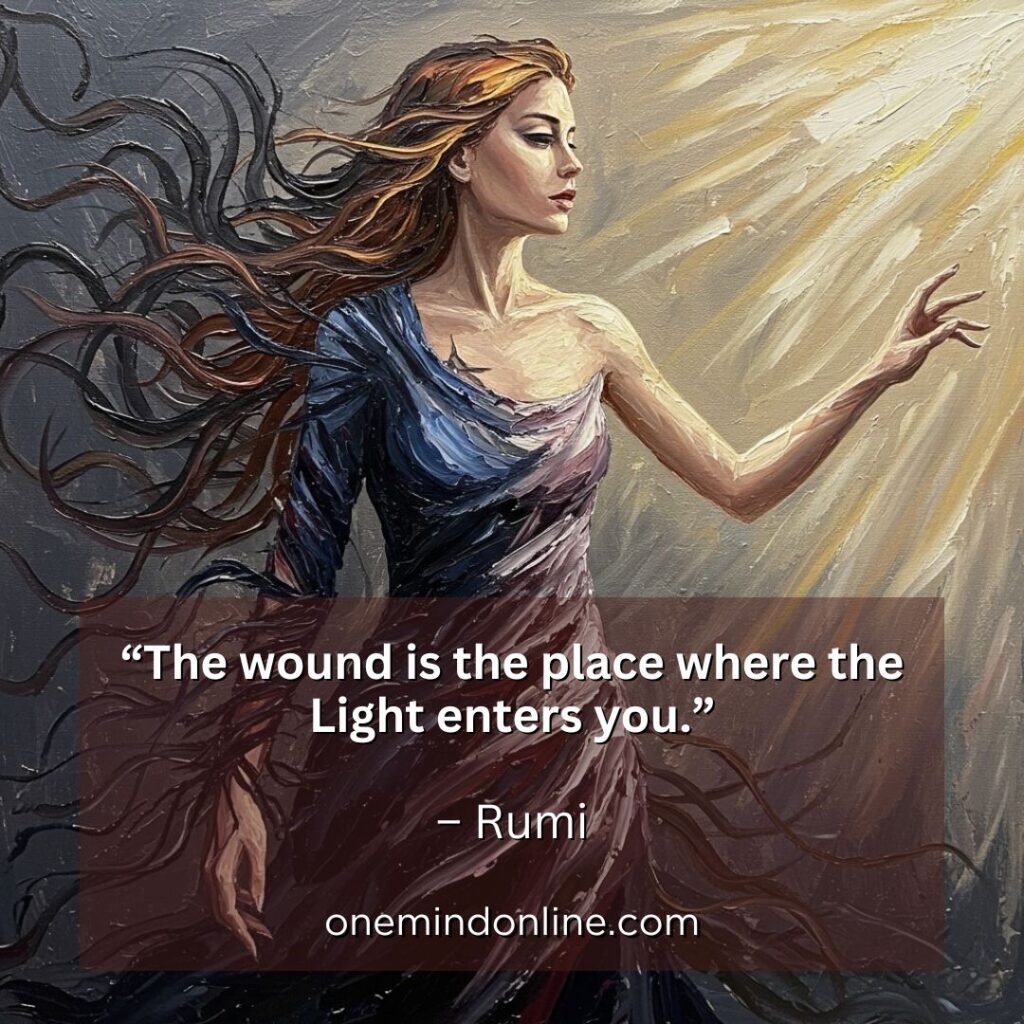
“The wound is the place where the Light enters you.” – Rumi
This is always where the real work always begins. Not in achievement, not in reinvention, but in the brave act of no longer avoiding our wounds. When we bring gentle attention to the scared and hurt parts of ourselves, something remarkable happens: we begin to understand that even our most painful patterns were never acts of self-destruction. They were acts of survival. Every defensive wall, every numbing habit, every emotional outburst or shutdown, these were parts of us fighting, in the only way they knew how, to keep us safe and alive.
And in that understanding, Rumi’s words stop being poetry and start being felt in the body. The wound opens. The light enters.
“When you do things from your soul, you feel a river moving in you, a joy.” – Rumi
We all know, on some level, what it feels like to act from the soul. There’s a quality to it, a flow, an aliveness, a sense of rightness. So why don’t we live there all the time? The answer is the same as before: our scared parts. The moment a fearful inner voice is activated, it becomes deafeningly loud because that’s what fear does. It demands full attention. It pulls us away from our depth and into survival mode. We can’t simply think our way back to soul-connected living. We have to heal the fears that keep pulling us away from our soul.
“These pains you feel are messengers. Listen to them.” – Rumi
“Be full of sorrow, that you may become a hill of joy; weep, so that you may break into laughter.” – Rumi
For many of us, the greatest obstacle isn’t having wounds, it’s our fear of feeling them. Early in life, most of us learned that certain emotions weren’t safe. We watched the adults around us shut down, explode, or disappear, and we drew a quiet conclusion: some feelings are too dangerous to have. So we closed our hearts, and in doing so, we also got stuck.
But you can learn to feel again. Every emotion that arises is a messenger carrying information, not a threat to be neutralised. The anger is pointing at a boundary. The grief is honouring something lost. The anxiety is asking for safety. When you learn to be with these feelings rather than run from them, you discover something extraordinary on the other side: freedom. Not the fragile freedom that control brings, but the deep freedom of a heart that can fearlessly hold all of it.
It is only when you have overcome the fear of feeling that you discover the truth at the centre of it all: your willingness to feel EVERYTHING always leads you back to “feeling” the wholeness that IS your soul.
Consider these guiding mantras for feeling your way into wholeness:
- “I allow myself to feel all emotions without judgment.”
- “My emotions are messengers; I will listen to their wisdom.”
- “Through the darkness of my wounds, light can enter.”
- “By embracing my wholeness, I connect with the joy of my soul.”
True growth lies not in suppressing our emotions, but in embracing them as doorways to a more authentic and fulfilling life.
Today’s meditation is a very simple practice in allowing whatever the current experience is, to be fully felt.
Have yourself the BEST Saturday!
– pierre –
Today’s LIVE meditation is: Come to your senses.
Today’s LIVE meditation
https://youtu.be/7cyGcSKaaMo 2025
https://youtu.be/Yve_fJSEhOI 2024
https://youtu.be/ePFdrJhNzm0 2023
Practice the “Daily Dose”
Let’s put it into practice! Choose what works for you – daily, once a week or whenever inspiration strikes. Putting pen to paper wires the neural pathways that will create your new habits.
1 – Affirmation
Write down your favourite affirmation on a sticky note and place it somewhere that you’ll be able to see it the whole day.
- “I allow myself to feel all emotions without judgment.”
- “My emotions are messengers; I will listen to their wisdom.”
- “Through the darkness of my wounds, light can enter.”
- “By embracing my wholeness, I connect with the joy of my soul.”
2 – A moment of reflection
Use today’s question as a journal prompt. If you don’t have the time to sit down and write, just take a moment to reflect on your response.
The article suggests that our wounds can be “the place where the Light enters you.” Reflect on a personal wound or challenging experience. What light or understanding has emerged from that darkness? How has dealing with this wound helped you understand a part of yourself that was previously hidden?
3 – Quotes to share
Send a quote to someone who needs it, or share them all on social media to spread the good vibes!




4 – Q&A for deeper learning
Read through the questions and answers and write down at least one “aha moment” that clicked for you.
Q1. What does it mean to “feel everything”?
Feeling everything means allowing your emotional experiences to be fully present without immediately suppressing, escaping, or judging them. It doesn’t mean being overwhelmed — it means developing the capacity to sit with whatever arises, including discomfort, grief, or fear, and to receive the information those feelings carry.
Q2. Why do we close ourselves off from feeling emotions in the first place?
Emotional shutdown is a coping mechanism, usually learned early in life. When a child witnesses or experiences trauma, or grows up in an environment where certain feelings are met with punishment, ridicule, or neglect, they learn to close their hearts to those feelings as an act of protection. What was once adaptive can become a source of stagnation in adulthood.
Q3. How do our “wounded parts” try to protect us?
Our wounded or scared inner parts developed in response to real experiences of pain or danger. They learned specific strategies — shutting down, over-controlling, seeking approval, avoiding conflict — that helped us survive difficult circumstances. Even our most limiting patterns were once a form of self-protection. Recognising this allows us to approach these parts with compassion rather than self-judgment.
Q4. What does it mean to “operate from your soul”?
Acting from the soul refers to a state of being where your choices, relationships, and creative expression flow from your deepest authentic self rather than from fear, habit, or the expectations of others. It’s often experienced as a sense of ease, joy, and inner alignment — what Rumi describes as “a river moving in you.”
Q5. Why is it do hard to simply live from a soul-connected place all the time?
Because fearful inner parts don’t respond to intention alone. The moment a scared part becomes activated — by stress, conflict, rejection, or uncertainty — its voice becomes overwhelming and pulls our attention away from our deeper self. Sustained soul-connected living requires healing the underlying fears that trigger these parts, not just willing ourselves to feel better.
Q6. What role does grief and sorrow play in this process?
Grief and sorrow are not detours from wholeness — they are part of the journey. As Rumi suggests, fully allowing sorrow creates the internal spaciousness that makes deep joy possible. Suppressed grief often blocks access to aliveness, warmth, and connection. Allowing ourselves to grieve is an act of radical self-respect and a doorway to renewal.
Q7. How do I start learning to feel again if I’ve been shut down for a long time?
Begin gently. Practices like mindful body awareness, breathwork, journaling, and somatic meditation can all help you re-establish contact with your inner landscape. The key is starting with curiosity rather than pressure — noticing sensations and emotions without needing to fix or change them. Working with a trauma-informed therapist or coach can also be deeply supportive if the shutdown is rooted in significant early experience.