

“Your Daily Dose” is a quick two minute read packed with bite-sized wisdom from all the great teachers. But you could also choose to turn it into something more… a powerful daily practice for personal growth. Give it a try!
A message from today’s meditation:
We live in a world obsessed with action. A desperate need to always be seen “doing”, and yet our constant busy-ness seems to primarily result in “never enough”. Never enough time, never enough money, never enough acceptance, never enough stuff…
Our lives become controlled by lists, goals and productivity hacks – the constant pressure to do something can leave us feeling burnt out and perpetually one step behind. However in all of our compulsive DOING, have we formed any clear understanding of the results of our actions?
Charles Eisenstein draws our attention to the products of our compulsions, asking us to pause for a moment and connect the dots. What are we actually creating while we are acting on autopilot?
“From our immersion in scarcity arise the habits of scarcity. From the scarcity of time arises the habit of hurrying. From the scarcity of money comes the habit of greed. From the scarcity of attention comes the habit of showing off. From the scarcity of meaningful labour comes the habit of laziness. From the scarcity of unconditional acceptance comes the habit of manipulation.” – Charles Eisenstein
“I am saying that there is a time to do, and a time not to do, and that when we are a slave to the habit of doing, then we are unable to distinguish between the two.” – Charles Eisenstein
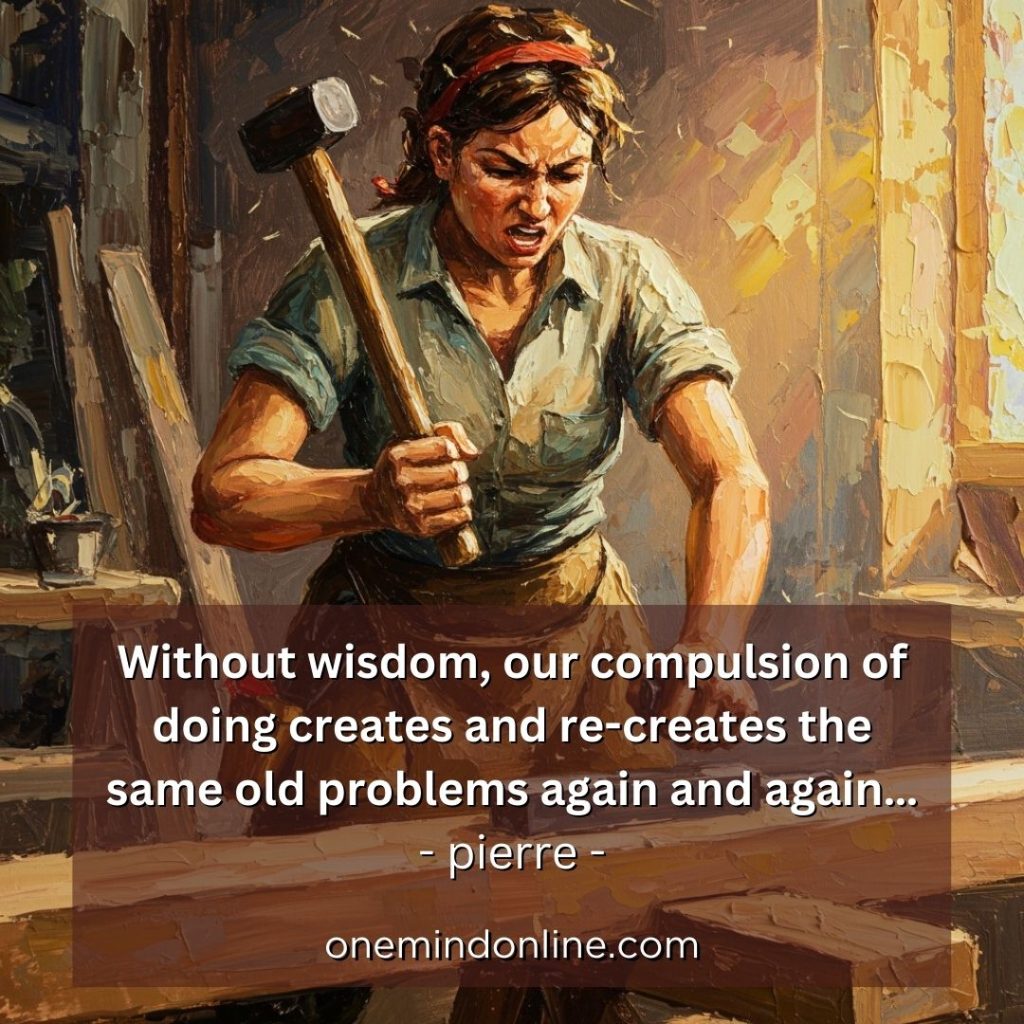
As a society we have worked ourselves into a corner of fear (scarcity), from where we are reactively “doing”. The compulsion to act without any deep understanding is what creates our hurrying, our greed and our manipulation. Without wisdom, our compulsion of doing creates and re-creates the same old problems again and again…
“The situation on Earth today is too dire for us to act from habit – to reenact again and again the same kinds of solutions that brought us to our present extremity. Where does the wisdom to act in entirely new ways come from? It comes from nowhere, from the void; it comes from inaction. When we see it, we realize it was right in front of us all along. It is never far away; yet at the same time it is in a different universe – a different Story of the World.” – Charles Eisenstein
“Here is another paradox: We become better people only when we give up the quest to become better people.” – Charles Eisenstein
The solution is not to try harder, but to try softer. Seek out “the void”, the silence, the nothingness from where you can practice being the observer. Be patient, give it time and from observing will come seeing. And from seeing we realize where our action will be helpful and where not.
It absolutely is a paradox yes, but if you want to be more effective you have to first stop trying, and just observe. When you act (react) from a place of scarcity, your energy is spent re-enforcing the habits of scarcity. Become the observer, and your actions will be inspired from clarity. This is where the wisdom comes from.
Here are some guiding mantras to remember on your journey to really seeing:
- “Before I act, I will pause and observe.”
- “My true power lies not in rushing, but in quiet awareness.”
- “First I find my calm center, then effective action.”
- “The answers I seek are often revealed in the space of stillness.”
- “I am a powerful observer, and from observation comes wisdom.”
The transformation from frantic doing to mindful being doesn’t happen overnight, but it starts with a single intentional pause. Today, right now, commit to one small act of stillness: set a timer for just five minutes, close your eyes, and simply observe your breath without trying to change anything. Notice the thoughts that arise, the urges to check your phone or jump back into action – and let them pass like clouds across the sky. This brief practice is your entry point into a different way of living. Do this daily for the next week, and watch as the clarity you’ve been chasing through endless productivity finally begins to emerge from the quiet spaces in between. The void is waiting, and within it lies the wisdom you need to act with true purpose. Will you give yourself permission to stop rushing and start seeing?
– pierre –
Today’s LIVE meditation is: Finding silence.
Today’s LIVE meditation
https://youtu.be/KzJYJzakvKM 2026
https://youtu.be/ZoCaBXChP2s 2023
Practice the “Daily Dose”
Let’s put it into practice! Choose what works for you – daily, once a week or whenever inspiration strikes. Putting pen to paper wires the neural pathways that will create your new habits.
1 – Affirmation
Write down your favourite affirmation on a sticky note and place it somewhere that you’ll be able to see it the whole day.
- “Before I act, I will pause and observe.”
- “My true power lies not in rushing, but in quiet awareness.”
- “First I find my calm center, then effective action.”
- “The answers I seek are often revealed in the space of stillness.”
- “I am a powerful observer, and from observation comes wisdom.”
2 – A moment of reflection
Use today’s question as a journal prompt. If you don’t have the time to sit down and write, just take a moment to reflect on your response.
The Paradox of Self-Improvement: Reflect on the quote: “We become better people only when we give up the quest to become better people.” In what ways has your “quest” to improve yourself actually just made you feel more “not enough”? What patterns do you keep on repeating precisely because you constantly feel the need to prove your worth? How does it feel to imagine yourself as already “enough,” even in stillness?
3 – Quotes to share
Send a quote to someone who needs it, or share them all on social media to spread the good vibes!


4 – Q&A for deeper learning
Read through the questions and answers and write down at least one “aha moment” that clicked for you.
Q1: Isn’t this approach just an excuse for laziness or inaction?
Not at all. This isn’t about avoiding responsibility or necessary action. It’s about breaking the cycle of reactive, habit-driven doing that stems from scarcity and fear. Strategic stillness and observation allow you to act from wisdom and clarity rather than panic. The goal is more effective, purposeful action—not the absence of action.
Q2: How do I know when it’s time to act versus time to observe?
This discernment comes from practicing observation itself. When you regularly create space for stillness, you develop the ability to sense the difference between reactive impulses (driven by fear or scarcity) and inspired action (driven by clarity). If you feel frantic, desperate, or compelled, it’s usually a sign to pause. When action feels clear, grounded, and purposeful, it’s more likely to be effective.
Q3: What does it mean to “seek the void” or practice stillness?
Seeking the void means intentionally creating space in your life for quiet reflection—whether through meditation, journaling, sitting in nature, or simply pausing before responding. It’s about stepping back from the noise and constant stimulation to observe your thoughts, feelings, and patterns without immediately reacting to them. This is where new insights and wisdom emerge.
Q4: How can stillness help me be more productive when I already have too much to do?
This is the paradox at work. When you’re constantly busy without clarity, you often spin your wheels, creating the same problems repeatedly or working on things that don’t truly matter. Stillness helps you see what’s actually important versus what’s just habit or fear-driven activity. You end up doing less but accomplishing more of what truly matters.
Q5: What are “habits of scarcity” and how do I recognize them in my life?
Habits of scarcity are reactive behavioral patterns that arise from feeling like we don’t have enough—whether that’s time, money, attention, or love. They include hurrying (scarcity of time), greed (scarcity of money), showing off (scarcity of attention), manipulation (scarcity of acceptance), and even laziness (scarcity of meaningful work). You can recognize them by noticing when you act from fear, desperation, or a sense that you’re “not enough” rather than from a grounded, clear place.
Q6: If I stop trying to become a better person, won’t I just stay stuck where I am?
The paradox suggests that the constant striving to improve often comes from a place of feeling inadequate or “not good enough”—which is itself a scarcity mindset. This frantic self-improvement can actually keep you stuck in the same patterns. When you observe yourself with compassion instead of constantly trying to fix yourself, real transformation naturally emerges. You stop reinforcing the belief that you’re broken and start acting from wholeness.
Q7: How do I start incorporating this practice into my daily life?
Begin small. Set aside just 5-10 minutes daily for stillness—meditation, quiet sitting, or simply observing your breath. Before making decisions or reacting to situations, practice pausing for a few breaths. Notice when you feel rushed or compelled to act, and ask yourself: “Am I acting from clarity or from fear?” Keep a journal to observe your patterns without judgment. The key is consistency and patience—wisdom doesn’t arrive on demand, but it does arrive through regular practice.