
“Your Daily Dose” is a quick two minute read packed with bite-sized wisdom from all the great teachers. But you could also choose to turn it into something more… a powerful daily practice for personal growth. Give it a try!
A message from today’s meditation:
Let’s be real, life throws quite a lot at us. Between overflowing inboxes and newsfeeds filled with negativity, it’s easy to feel overwhelmed and cynical. Today’s message is really simple – never let go of the child within you who used to believe that the world can be a more beautiful place. The part of you who knows that we are stronger together – when we look out for one another. Don’t ever believe the “proof” you were given that this is a “dog-eat-dog world.”
Here’s the secret: amidst the noise, a spark of hope still flickers. We all have a knowing, a deep sense that life can be more beautiful, more connected, and more meaningful. The question is, how do we tap back into that optimism and translate it into reality?
The following piece is from Charles Eisenstein’s book “Sacred Economics”:
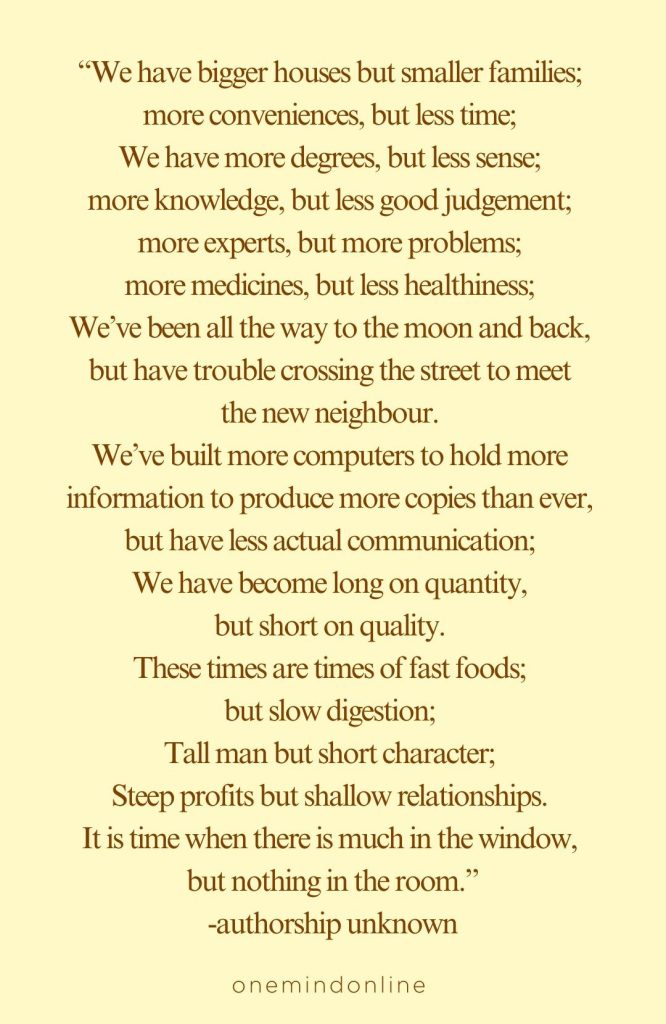
“We have bigger houses but smaller families;
more conveniences, but less time;
We have more degrees, but less sense;
more knowledge, but less good judgement;
more experts, but more problems;
more medicines, but less healthiness;
We’ve been all the way to the moon and back,
but have trouble crossing the street to meet
the new neighbour.
We’ve built more computers to hold more
information to produce more copies than ever,
but have less actual communication;
We have become long on quantity,
but short on quality.
These times are times of fast foods;
but slow digestion;
Tall man but short character;
Steep profits but shallow relationships.
It is a time when there is much in the window,
but nothing in the room.”
-authorship unknown
“The cynic thinks that he is being practical and that the hopeful person is not. It is actually the other way around. Cynicism is paralysing, while the naive person tries what the cynic says is impossible and sometimes even succeeds.” – Charles Eisenstein
“We live within a cultural mythology that tells us we are separate beings in competitive relation for power, even for survival. We long to return to a culture of inclusiveness, cooperation, and the sharing of gifts.” – Charles Eisenstein
“Is it too much to ask, to live in a world where our human gifts go toward the benefit of all? Where our daily activities contribute to the healing of the biosphere and the well-being of other people?” – Charles Eisenstein
The answer is no, this is not too much to ask!
We all have a knowing that we can live in a more beautiful way, but we are not going to achieve this in solitary confinement, each on our own island. Seek out and surround yourself with people who believe in possibilities!
This isn’t optional or secondary to your personal growth, it’s essential. The company we keep either amplifies our cynicism or nurtures our hope. Choose friends, communities, and spaces that remind you of what’s possible rather than what’s broken. Find the people who are building, creating, and believing despite the odds. Let their courage fortify yours. Because the truth is, we cannot sustain hope in isolation. We were never meant to. The vision of a more beautiful world needs to be held collectively, strengthened in community, and lived out together. Your optimism will waver – that’s human. But when you’re surrounded by fellow believers, you’ll find that when your faith falters, theirs will carry you, and when theirs dims, yours will light the way. This is how we keep the flame alive.
This message doesn’t really speak about today’s meditation journey, but it does speak to simplicity and it begs us to ask the question, “can we stop for a moment and try to remember what we are doing all of this for in the first place?”
Here are some guiding mantras to keep that spark alive:
- “I choose to believe in possibilities.”
- “My optimism is a strength, not a weakness.”
- “I surround myself with those who share my vision.”
- “Every action, big or small, contributes to a better world.”
Join us – come and drop from your head into your body for a moment, experience the building blocks of your human being for a bit. And then we can all head out into the world again and do the things that we do, but maybe we’ll have a deeper sense of remembering why we were trying doing them in the first place.
Enjoy your Saturday.
– pierre –
Today’s LIVE meditation is: Come to your senses.
Today’s LIVE meditation
https://youtu.be/DHvLyNFGYlM 2026
https://youtu.be/T0ex3Uw-lOM 2025
https://youtu.be/fbrFfnxMIS8 2023
Practice the “Daily Dose”
Let’s put it into practice! Choose what works for you – daily, once a week or whenever inspiration strikes. Putting pen to paper wires the neural pathways that will create your new habits.
1 – Affirmation
Write down your favourite affirmation on a sticky note and place it somewhere that you’ll be able to see it the whole day.
- “I choose to believe in possibilities.”
- “My optimism is a strength, not a weakness.”
- “I surround myself with those who share my vision.”
- “Every action, big or small, contributes to a better world.”
2 – A moment of reflection
Use today’s question as a journal prompt. If you don’t have the time to sit down and write, just take a moment to reflect on your response.
The Quantity vs. Quality Paradox: Looking at the list of modern contradictions (more degrees but less sense, more conveniences but less time, etc.), which one resonates most deeply with your own life? What is one area where you’ve prioritized quantity over quality, and how might you begin to reverse that pattern?
3 – Quotes to share
Send a quote to someone who needs it, or share them all on social media to spread the good vibes!


4 – Q&A for deeper learning
Read through the questions and answers and write down at least one “aha moment” that clicked for you.
Q1: Isn’t cynicism just being realistic? Why is hope better?
This is one of the biggest misconceptions of our time. Cynicism disguises itself as wisdom and practicality, but it’s actually deeply impractical because it paralyzes action. As Charles Eisenstein points out, “Cynicism is paralysing, while the naive person tries what the cynic says is impossible and sometimes even succeeds.” Hope isn’t about denying reality—it’s about refusing to let reality’s limitations define what’s possible. Every major advancement in human history came from people who were called naive or unrealistic by the cynics of their time.
Q2: How do I maintain hope when I’m constantly bombarded with negative news and information?
Start by consciously curating what you consume. This doesn’t mean burying your head in the sand, but rather being intentional about the ratio of negativity to inspiration in your daily intake. If you realize that you often feel negative about reality, or have a sense of hopelessness about what’s happening in the world, then remind yourself that you don’t need to consume all of this outside information. It may feel like we need the “news” in order to survive but we really don’t! If the news was about reality, then we’d be shown at least an equal amount of everything that is beautiful and inspiring about the world, but that’s not what we’re getting because news and information is not about reality but about profit. So take the responsibility to show yourself everything that is great about the world. Retrain your algorithms to show you only positivity by deleting and unsubscribing from anything that is negative.
Q3: What does it mean to have “more degrees but less sense” or “more knowledge but less good judgment”?
This paradox points to the difference between intellectual accumulation and embodied wisdom. We’ve created systems that reward credential-gathering and information-hoarding, but these don’t necessarily translate to good judgment, common sense, or the ability to live well. True wisdom comes from integrating knowledge with lived experience, from connecting the head to the heart and body. It’s about quality of understanding, not just quantity of facts.
Q4: How can I find my community of people who believe in possibilities?
Start by being that person yourself. When you openly express hope and possibility-thinking, you naturally attract like-minded individuals. Look for communities centered around personal growth, meditation, social change, creative expression, or any endeavor that seeks to build rather than tear down. Pay attention to who energizes you versus who drains you. And remember, building this community is an ongoing practice, not a one-time event—it requires intention and cultivation.
Q5: What if I’ve tried to be hopeful before and been disappointed? How do I protect myself?
Hope isn’t about guaranteed outcomes—it’s about maintaining openness to possibility despite uncertainty. Disappointment is part of the human experience, but it doesn’t negate the value of having tried. The alternative—cynical withdrawal—guarantees disappointment because it prevents you from even attempting. Protect yourself not by closing down, but by developing resilience and surrounding yourself with supportive people who can help you process setbacks without losing your fundamental orientation toward possibility.
Q6: How does this philosophy apply to everyday life and practical decisions?
It starts with the simple question: “What am I doing all of this for in the first place?” Before making decisions—whether about your career, relationships, how you spend your time, or what you consume—pause and check in with your deeper purpose. Ask whether your choices contribute to connection, beauty, and the well-being of others, or whether they’re driven by the competitive, scarcity-based mythology of our culture. Small, daily choices aligned with your values create the foundation for larger transformation.
Q7: What’s the connection between personal development and creating a better world?
As the article suggests, we’re not going to create a more beautiful world “in solitary confinement, each on our own island.” Personal development isn’t selfish navel-gazing when it’s connected to the larger web of life. When you do the inner work—reconnecting with your body, remembering your purpose, cultivating hope—you become a more effective agent of positive change. The two are inseparable: we need to heal ourselves to heal the world, and healing the world requires our personal participation. Every action, big or small, contributes to the whole.