
“Your Daily Dose” is a quick two minute read packed with bite-sized wisdom from all the great teachers. But you could also choose to turn it into something more… a powerful daily practice for personal growth. Give it a try!
A message from today’s meditation:
Hello Fearless Creator!
Welcome to a new week of exploring your creative potential. Our teacher for this week is Matt Kahn who is the author of a few books that you’ll probably enjoy exploring: “All for love”, “The Universe always has a plan”, “Everything is here to help you”, and “Whatever arises, love that.”
The main theme of Matt’s message for the start of our week is this – remember to breathe. I don’t think I have ever heard breath described in such an empowering way:
“My mind is a manifestation of breath. The more aligned with breath I am, the clearer my mind becomes. My body is a manifestation of breath. The more aligned with breath I am, the more vibrant and open my body becomes. My emotions are a manifestation of breath. The more aligned with breath I am, the more harmonious my emotions shall be. My world is a manifestation of breath. The more aligned with breath I am, the more fulfilling my relationships shall be. Every aspect of reality is a manifestation of breath. The more aligned with breath I am, the more real I shall be. Instead of living in the reality of my ego’s fantasy I shall dwell in the reality of my soul’s eternal light, where I can simply abide with my breath as an announcer of well-being, becoming aware that within me as my breath, well-being and perfection are always existing. And as I signal to the Universe that I recognize my breath as evidence of perfection, I am ready, willing, and able to receive more perfection. And to receive it with worthiness and joy as a gift for myself and for those who don’t know the worthiness of their own eternal light, allowing my happiness to be a service to all. And so I’m free.” – Matt Kahn
I want to lift out a few thoughts from this piece which gives me grounding for my week ahead:
When I pay attention to my breath, it becomes the announcer of wellbeing, my breath says, “feel how the lungs fill, feel how the belly rises, if I can breathe this well then everything is okay…”
When I pay attention to my breath, I remember that there were times of fear and anxiety when I thought “surely I can’t make it through this” but here I am. And I am here because within me, as my breath, wellbeing always exists…
When I recognize my breath as evidence of perfection I become ready, willing and able to receive more perfection…
Take a moment at the start of this week to do a little mental rehearsal of how you’d like to deal with the pressures of the week ahead. Close your eyes and see the image of you paying attention to your breath. See your body rise and also fall as you fill up and then slowly deflate the ‘balloon in your belly’.
Don’t just breathe with your nose, don’t even just breathe with your lungs but with every breath engage every cell in your body in the rise and the fall of the inhale and also the exhale. Aligning every cell in your body with your breath wakes up every part of you to the announcement of wellbeing that is so clearly present in this moment. Let every part of your body recognise the proof of perfection in your breath this moment.
As you feel your lungs expand and slowly contract, rehearse this mantra for the difficult moments in the week ahead:
- “I feel how my breath announces wellbeing in my body.”
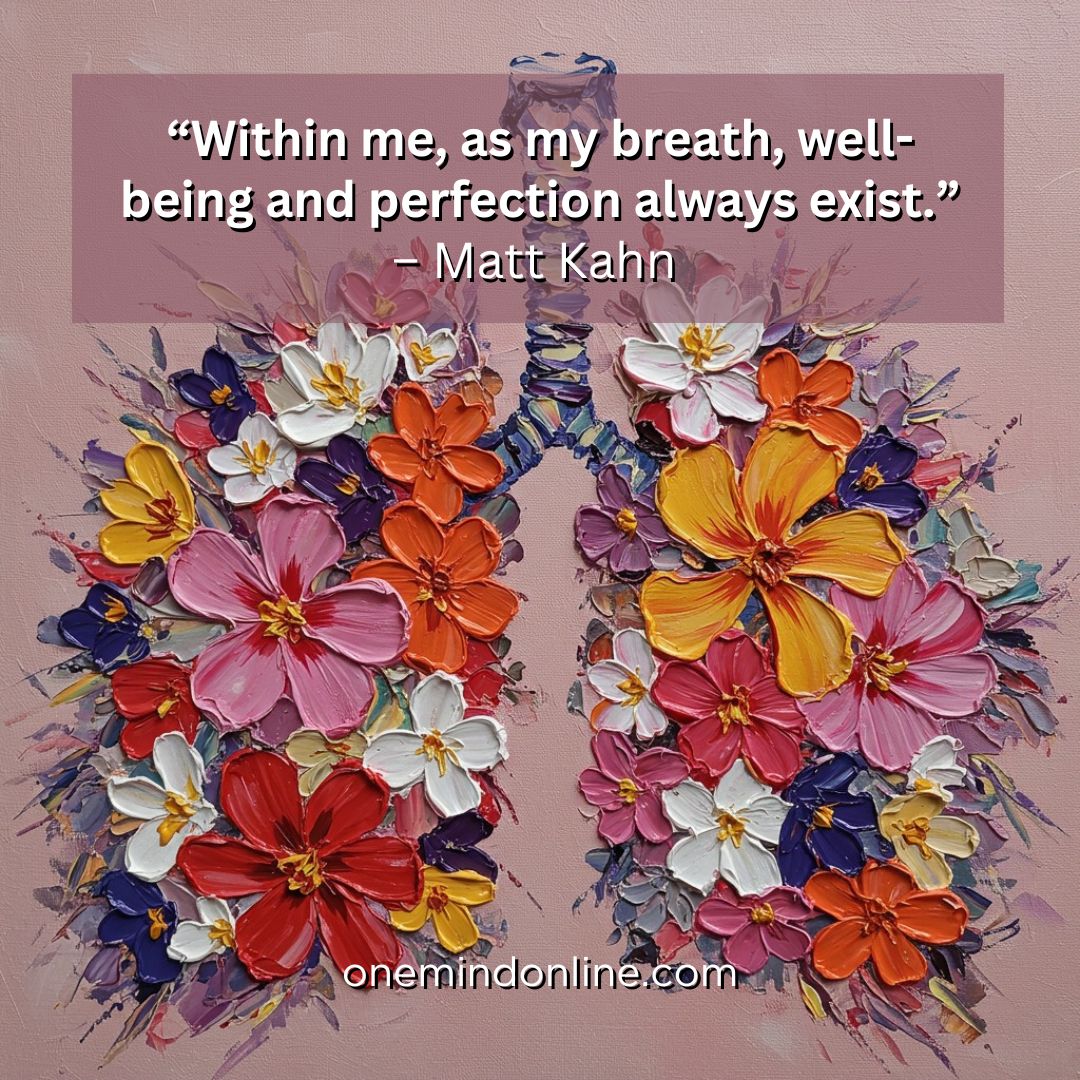
- “Within me, as my breath, wellbeing and perfection are always existing.”
- “I am ready, willing and able to receive more perfection in worthiness and joy.”
After a few deep, conscious breaths every cell in your body will be ready to deal with whatever the next step is that you need to take.
I wish you a really good week.
Remember to breathe…
– pierre –
Today’s LIVE meditation is: Jumpstart the week!
Today’s LIVE meditation
https://youtu.be/IQ9-izs3bEE 2026
https://youtu.be/of0I68Tnah0 2024
https://youtu.be/pJ5a9GPiWn4 2023
Practice the “Daily Dose”
Let’s put it into practice! Choose what works for you – daily, once a week or whenever inspiration strikes. Putting pen to paper wires the neural pathways that will create your new habits.
1 – Affirmation
Write down your favourite affirmation on a sticky note and place it somewhere that you’ll be able to see it the whole day.
- “I feel how my breath announces wellbeing in my body.”
- “Within me, as my breath, wellbeing and perfection are always existing.”
- “I am ready, willing and able to receive more perfection in worthiness and joy.”
2 – A moment of reflection
Use today’s question as a journal prompt. If you don’t have the time to sit down and write, just take a moment to reflect on your response.
Full-Body Breathing and Cellular Awareness: Reflect on the suggestion in today’s message: “Don’t just breathe with your nose, don’t even just breathe with your lungs but with every breath engage every cell in your body in the rise and the fall of the inhale and also the exhale. Aligning every cell in your body with your breath wakes up every part of you to the announcement of wellbeing that is so clearly present in this moment. Let every part of your body recognise the proof of perfection in your breath this moment.” – Experiment with this practice for a few minutes, then write about the experience. How does it feel different from regular breathing? What parts of your body seem to respond most readily to conscious breath? How might this practice help you feel more connected to your physical self and present moment awareness?
3 – Quotes to share
Send a quote to someone who needs it, or share them all on social media to spread the good vibes!
4 – Q&A for deeper learning
Read through the questions and answers and write down at least one “aha moment” that clicked for you.
Q1. What does it mean that “my mind is a manifestation of breath”?
This concept suggests that our mental clarity and cognitive function are directly connected to our breathing patterns. When we breathe consciously and deeply, we oxygenate our brain more effectively, which can lead to clearer thinking, reduced mental fog, and improved focus. The quality of our breath directly influences the quality of our mental state, making conscious breathing a powerful tool for mental clarity and emotional regulation.
Q2. How can I practically use my breath as an “announcer of well-being” during stressful moments?
When stress builds, the mind tends to leap into the future, rehearsing everything that could go wrong, and your breath is the simplest way to bring you back to what is actually true right now. Try this: pause, place a hand on your belly, and notice whether you are breathing. Feel the lungs fill, feel the belly rise, and feel the slow release on the way out. If you are able to breathe well in this moment, that is proof that, right now, everything is in fact okay. Your body is doing its most essential work without needing any effort or permission from you. This doesn’t mean your challenges aren’t real or that difficult decisions don’t await you. It means that the crisis your mind is narrating is not the same as this present moment, and in this moment you are alive, supplied with oxygen, and supported by a body that keeps showing up for you. You can even let your breath speak to you: “Feel how the lungs fill, feel how the belly rises. If I can breathe this well, then everything is okay.” Recall, too, the times you were sure you couldn’t make it through, and yet here you are, carried by the same steady breath. Repeat this whenever fear or pressure rises, and you’ll find that what feels like an emergency in your thoughts softens in the light of what your breath already knows, which is that well-being is here, now, and available to you.
Q3. What does “engaging every cell in your body” while breathing actually mean?
In your answer explore the following: For a moment, don’t just breathe automatically, and make your next few breaths even more active. As you inhale, raise yourself up taller than you normally do – stretch out your spine and lift the top of your head towards the ceiling while you draw the air in through your lungs and inflate an imaginary balloon in your belly. When you exhale, don’t just let the air our, follow the downwards flow though your body – soften your spine, slump down your shoulders and even drop your head. Notice how it feels when breath becomes something that every cell in your body is participating in. Panicked and shallow breathing triggers fight-or-flight and literally divides the systems in your body to compete for resources. Full body breathing unites all the systems in your body in wholeness, bringing homeostasis and health.
Q4. Can conscious breathing really help with emotional regulation?
There’s an old saying that goes, “When you own your breath, no one can steal your peace,” and neuroscience offers a compelling reason why it holds true. Breathing is unique among our body’s automatic functions because we can also control it consciously, which makes it a direct doorway into the nervous system. When stress hits, the amygdala, the brain’s threat detector, triggers the sympathetic “fight-or-flight” response, and our breath becomes fast and shallow. But this works in reverse too. Slow, deliberate breathing, especially with a longer exhale, stimulates the vagus nerve and shifts the body toward parasympathetic activation, which lowers heart rate, increases heart rate variability, and sends a signal of safety back up to the brain. Research also suggests that slow breathing influences activity in brain regions involved in arousal and emotion, helping the prefrontal cortex, the seat of clear thinking, regain the upper hand over reactive circuitry. So in your next stressful moment, pause and place a hand on your belly. Feel it rise as the lungs fill, then let the exhale run slightly longer than the inhale, and remind yourself, “If I can breathe this well, everything is okay.” You aren’t imagining a calm you don’t have. You’re using the one lever of your physiology that you can control to let your body confirm the message your breath is already announcing, which is that in this moment, you are safe enough to respond calmly rather than react in fear.
Q5. How does my personal breathing practice serve others?
When you cultivate inner peace and well-being through conscious breathing, you naturally radiate that energy to others. Your calm presence can help those around you feel more at ease. Additionally, when you embody the recognition of your own worthiness and perfection, you model this possibility for others who may struggle with self-acceptance. Your inner work becomes a form of service by demonstrating what’s possible when we align with our breath and inner wisdom.
Q6. What’s the difference between automatic breathing and conscious breathing?
Automatic breathing happens without our awareness – it’s controlled by our autonomic nervous system and adjusts based on our body’s needs. Conscious breathing involves bringing mindful attention to the breath, often deepening it, slowing it down, or breathing in specific patterns. While automatic breathing keeps us alive, conscious breathing can enhance our well-being, clarity, and emotional state. Both are necessary, but conscious breathing allows us to actively participate in optimizing our physical and mental state.