Need a burst of brilliance in a flash? This inspiring article is a speedy 2-minute adventure. But if you’re ready to put on your explorer hat and journey to the very heart of the matter, our menu is your treasure map to deeper understanding!
Today’s theme is surrender.
What exactly IS surrender when it’s not just a pretty word that makes me sound all spiritual? How do we become really practical about the benefits of surrender?
It’s easy to resist the idea of surrender, because it feels like “If I surrender I’ll be allowing the things around me to control me. I’ll be at the mercy of my environment.”
Sometimes it helps to understand something, by taking a look at its opposite. When we are not in surrender, we are always fighting what’s happening. In the absence of surrender we are always in resistance, always in survival mode. And if I always react to my environment by fighting it, then the truth is that I AM at the mercy of what’s happening around me. My environment is 100% in control of how I act.
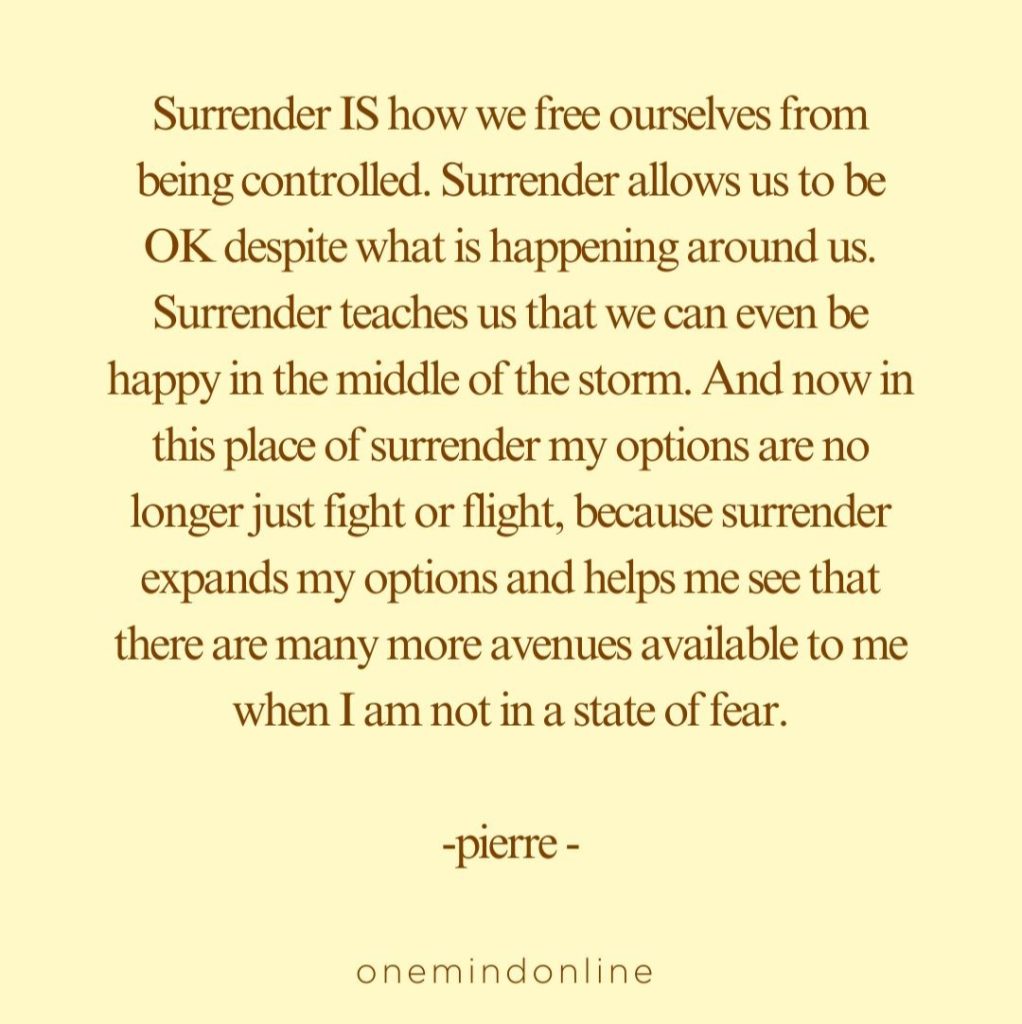
Surrender IS how we free ourselves from being controlled. Surrender allows us to be OK despite what is happening around us. Surrender teaches us that we can even be happy in the middle of the storm. And now in this place of surrender my options are no longer just fight or flight, because surrender expands my options and helps me see that there are many more avenues available to me when I am not in a state of fear.
From this place of surrender I might see that a kind word would be more helpful than fighting.
From this place of surrender I might see that taking no action at all is most helpful because there is nothing that I can control here, I should just let things run their course.
But please understand that being in surrender doesn’t mean taking fighting or running off the table as possible options. There ARE moments when pushing back or stepping up to the fight are the best course of action, but it’s the difference between letting your fear push you into the fight or seeing with clarity that this is the wisest choice.
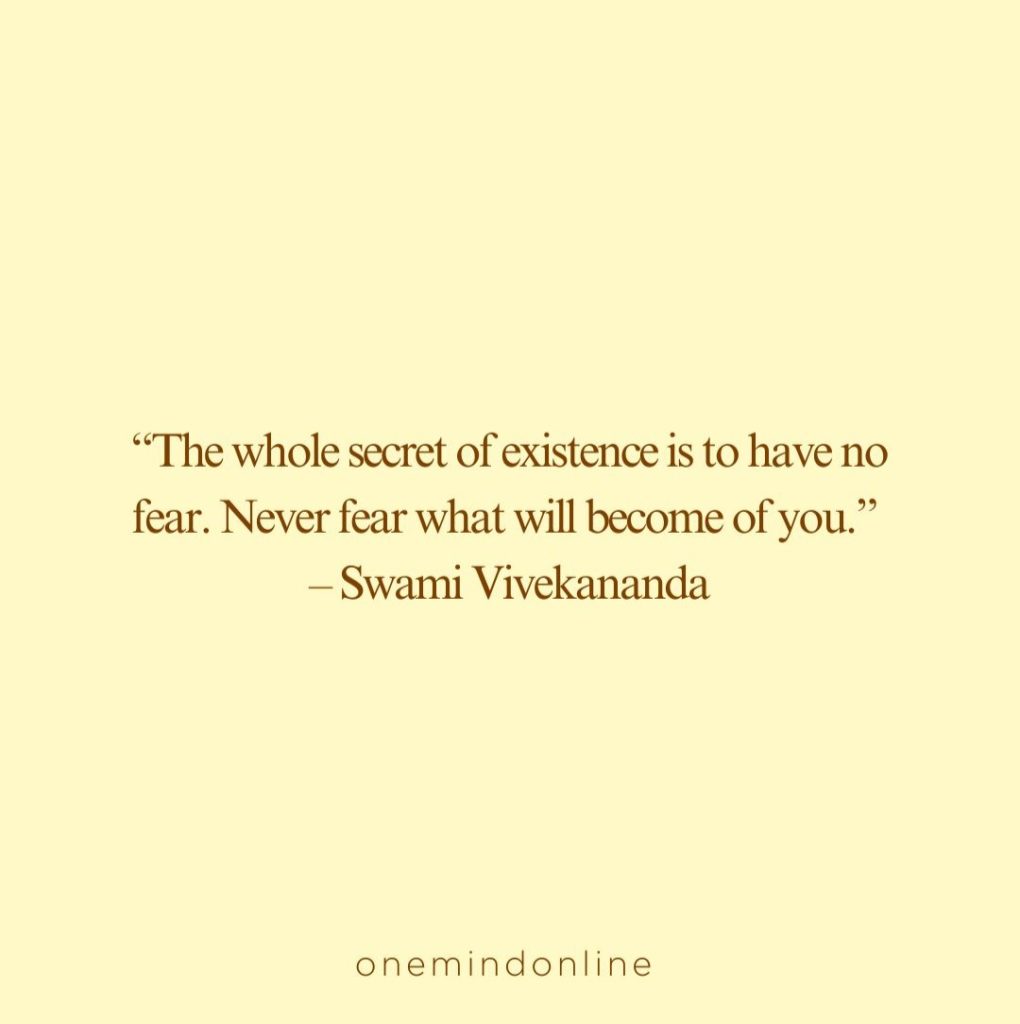
“The whole secret of existence is to have no fear. Never fear what will become of you.” – Swami Vivekananda
“That man has reached immortality who is disturbed by nothing material.” – Swami Vivekananda
“Never think there is anything impossible for the soul. It is the greatest heresy to think so. If there is sin, this is the only sin; to say that you are weak.” – Swami Vivekananda
“In a conflict between the heart and the brain, follow your heart.” – Swami Vivekananda
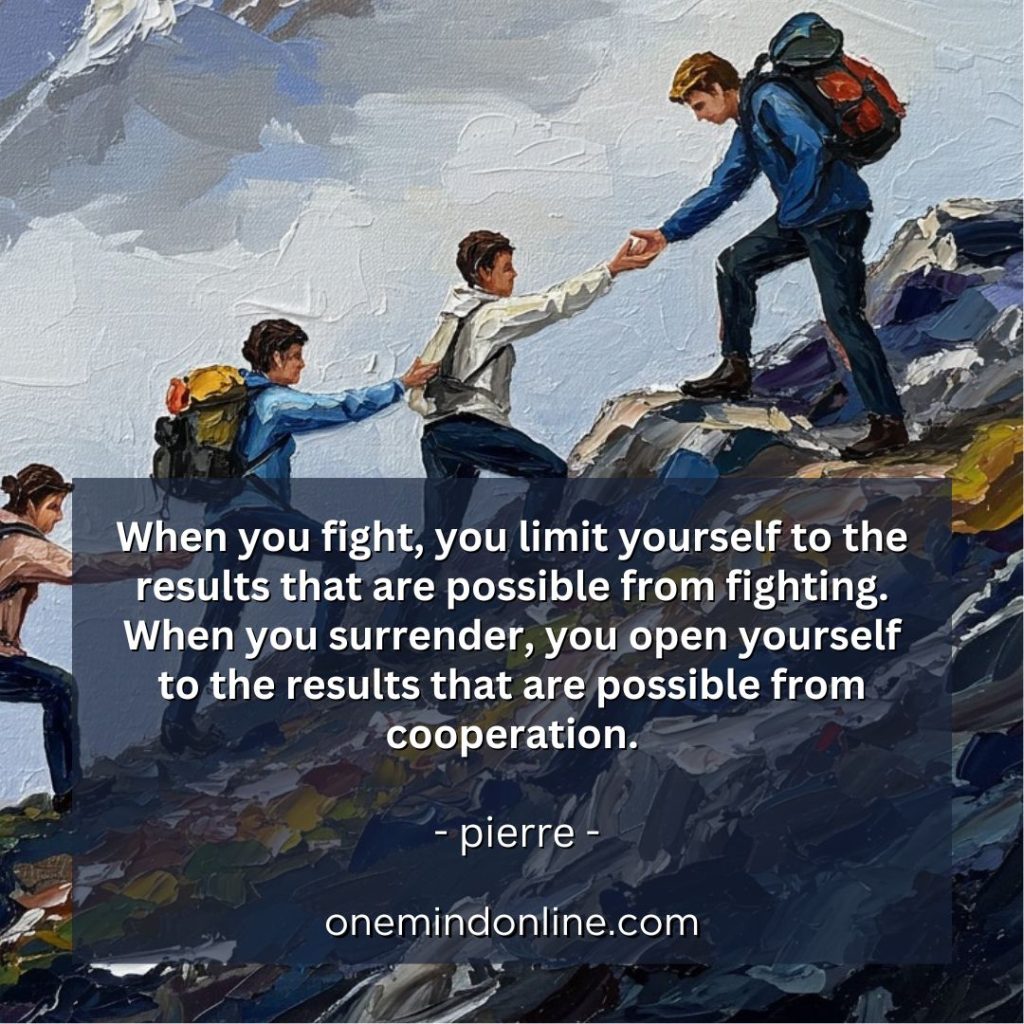
When you fight, you limit yourself to the results that are possible from fighting. When you surrender, you open yourself to the results that are possible from cooperation.
So take a deep breath. Release the tension you’re holding. Ask yourself what might be possible if you stopped fighting this moment and started working with it instead.
A few thoughts to ponder as you explore the power of surrender in your own life:
- I become free when I release my need to control.
- I trust my inner wisdom to guide me through uncertainty.
- Peace exists within me, regardless of external storms.
- I choose to respond rather than react, wisdom over fear.
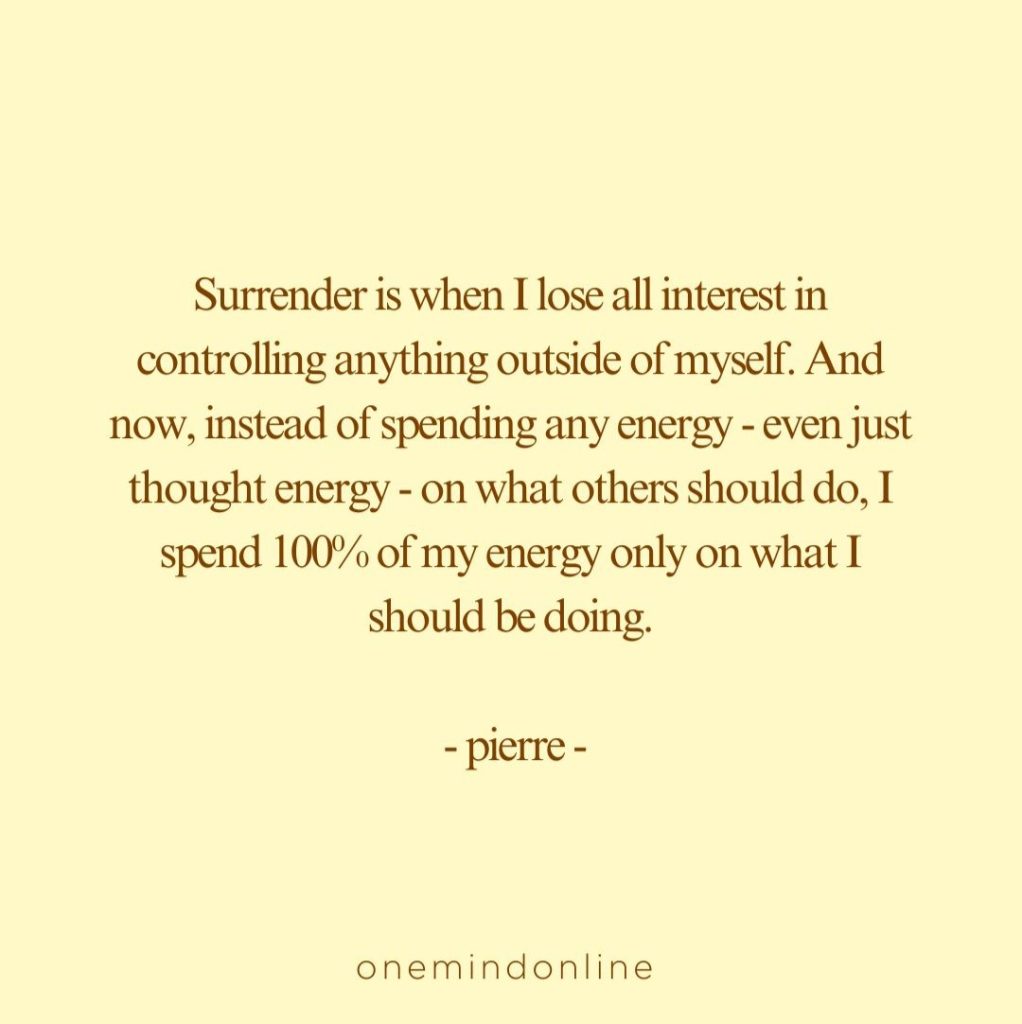
Surrender is when I lose all interest in controlling anything outside of myself. And now, instead of spending any energy – even just thought energy – on what others should do, I spend 100% of my energy only on what I should be doing.
– pierre –
Today’s LIVE meditation is: Surrender.
A moment of reflection
(If you have the time, use this question as a journal prompt, because whenever you put pen to paper you’re wiring the neural pathways that create your new habits. But if you don’t have the time, just take a moment to reflect on your response.)
The paradox of surrender: It’s easy to misunderstand surrender. The ego believes, “If I surrender I’ll be allowing the things around me to control me. I’ll be at the mercy of my environment”. And the Soul knows that, “when I’m fighting the world and trying to control the outcomes around me, THEN my environment is 100% in control of how I act.”
Recall specific experiences where your efforts to manage the behavior of others or to micromanage external situations resulted in you endlessly repeating the same reactive patterns. How did your relentless pursuit of control, in essence, make you a puppet of your surroundings? As you reflect now, pinpoint where surrender might have presented more liberating and empowering alternatives, allowing you to break free from those recurring cycles.
Today’s LIVE meditation
https://youtu.be/GqaPAQiY9as 2025
https://youtu.be/wVoG7Ylhej4 2024
https://youtu.be/lWt1qUpCpoI 2023
https://youtu.be/SbWKKlBgha8 2022
Q&A for deeper learning
1. Isn’t surrender just giving up and being passive?
Not at all. True surrender is actually an active choice that requires tremendous courage and awareness. It’s the difference between being a victim of circumstances and being a conscious participant in your life. When you surrender, you’re not giving up—you’re giving up the illusion that you can control everything while opening yourself to respond from wisdom rather than fear. This often leads to more effective action, not less.
2. How do I know when to surrender versus when to fight?
The key distinction lies in your motivation and inner state. Are you fighting because fear is pushing you into battle, or are you choosing to act because you’ve seen with clarity that this is the wisest response? When you’re in a state of surrender, you can still choose to “fight” or take strong action, but it comes from a place of conscious choice rather than reactive fear. Check in with your body—reactive fighting often feels tense and desperate, while conscious action feels grounded and purposeful.
3. Won’t people take advantage of me if I surrender?
This is a common misconception. Surrender doesn’t mean becoming a doormat or failing to set boundaries. In fact, when you’re not constantly in reactive mode, you often see situations more clearly and can respond more effectively. You might actually become better at protecting yourself because you’re acting from wisdom rather than fear. Healthy boundaries can be maintained—and often better maintained—from a place of inner peace.
4. How can I be happy during difficult times? Isn’t that just denial?
Finding peace or even happiness during difficult times isn’t about denying reality or pretending everything is fine. It’s about recognizing that your inner state doesn’t have to be controlled by external circumstances. You can acknowledge that something difficult is happening while still maintaining your emotional equilibrium. This actually allows you to respond more effectively to challenges because you’re not depleting your energy through constant emotional reactivity.
5. What if surrendering means I won’t achieve my goals?
This fear stems from the belief that struggle and force are necessary for achievement. However, when you surrender, you often find more creative and efficient paths to your goals. You stop limiting yourself to the results that are possible from fighting alone and open yourself to the results that are possible from cooperation, flow, and aligned action. Many people find they achieve more, not less, when they stop forcing outcomes and start working with life’s natural rhythms.
6. How do I practically apply surrender in everyday stressful situations?
Start small. When you notice yourself getting triggered or reactive, pause and take a deep breath. Ask yourself: “What am I fighting right now?” and “What would it look like to work with this situation instead of against it?” You don’t have to surrender to everything at once—practice with minor daily irritations first. Notice how your options expand when you’re not in fight-or-flight mode. Over time, this becomes a natural way of responding to life’s challenges.
7. Is surrender compatible with ambition and wanting to improve my life?
Absolutely. Surrender isn’t about becoming complacent or stopping your growth. It’s about approaching your ambitions from a place of inner peace rather than desperate need. When you’re not constantly fighting reality, you have more energy and clarity to direct toward your goals. You can still work hard and strive for improvement, but you do it from a place of joy and purpose rather than from a place of resistance and fear. This often leads to more sustainable success and greater fulfillment.
One thought on “When you surrender, you open yourself to the results that are possible from cooperation.”
Comments are closed.