
“Your Daily Dose” is a quick two minute read packed with bite-sized wisdom from all the great teachers. But you could also choose to turn it into something more… a powerful daily practice for personal growth. Give it a try!
A message from today’s meditation:
We are often on some kind of autopilot, going through the motions in our work, in our relationships, being more connected to the fears and insecurities in our minds than to the actual actions we’re busy taking.
Thich Nhat Hanh invites us to switch off the autopilot, as he gently nudges us towards presence.
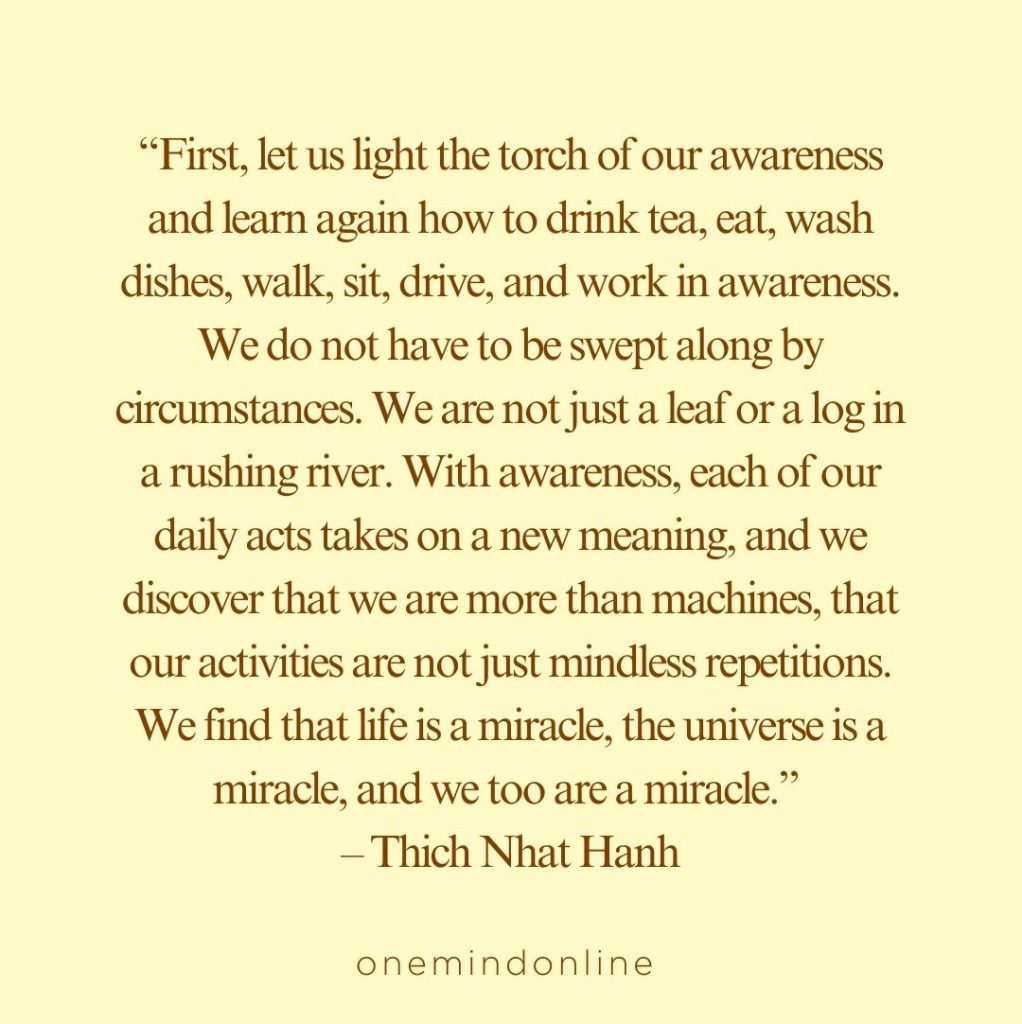
“First, let us light the torch of our awareness and learn again how to drink tea, eat, wash dishes, walk, sit, drive, and work in awareness. We do not have to be swept along by circumstances. We are not just a leaf or a log in a rushing river. With awareness, each of our daily acts takes on a new meaning, and we discover that we are more than machines, that our activities are not just mindless repetitions. We find that life is a miracle, the universe is a miracle, and we too are a miracle.” – Thich Nhat Hanh
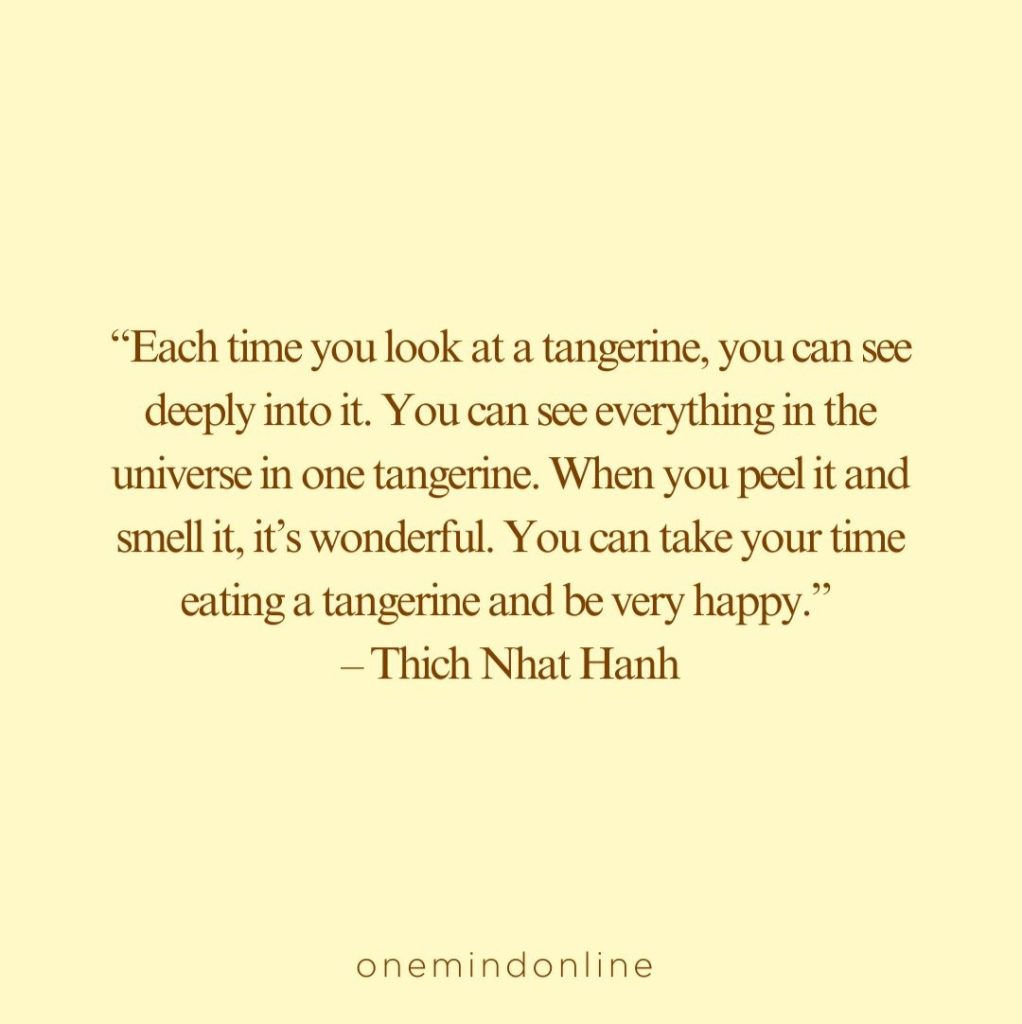
“Each time you look at a tangerine, you can see deeply into it. You can see everything in the universe in one tangerine. When you peel it and smell it, it’s wonderful. You can take your time eating a tangerine and be very happy.” – Thich Nhat Hanh
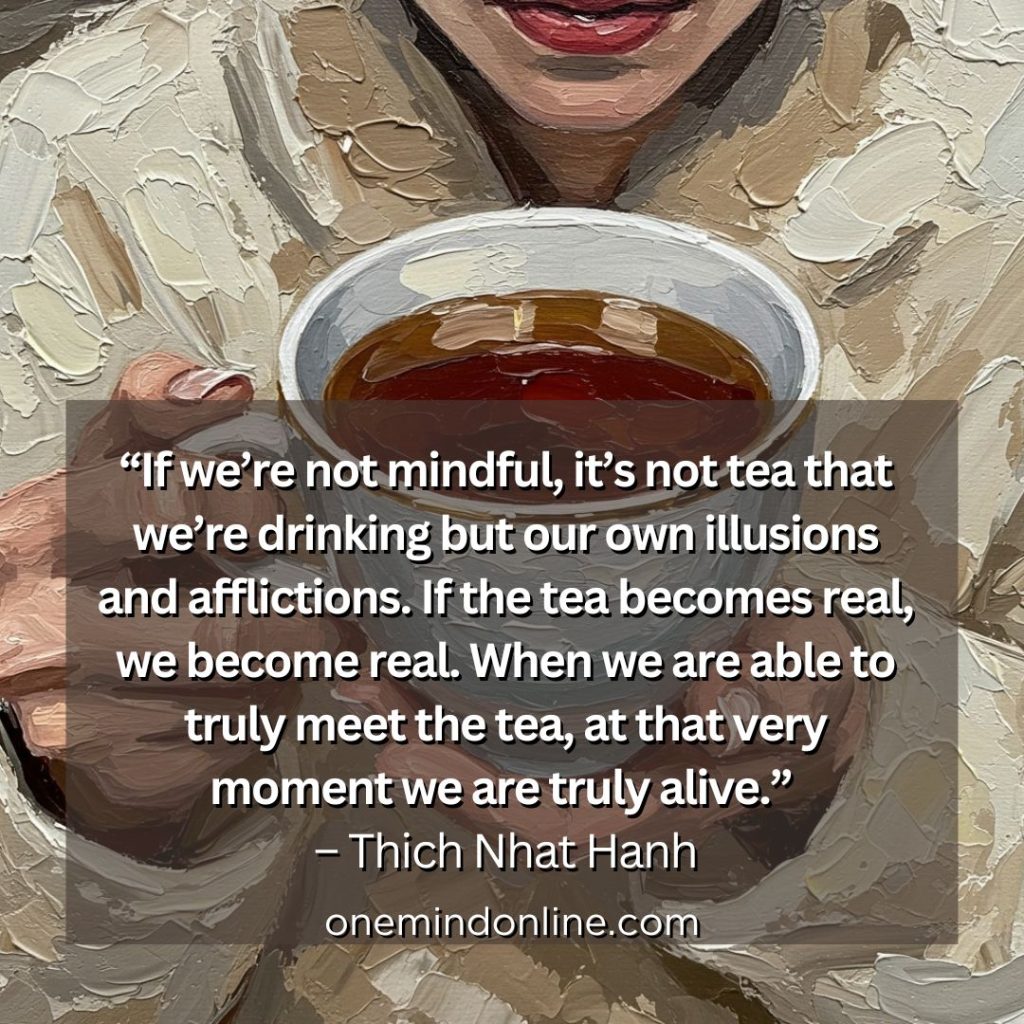
“If we’re not mindful, it’s not tea that we’re drinking but our own illusions and afflictions. If the tea becomes real, we become real. When we are able to truly meet the tea, at that very moment we are truly alive.” – Thich Nhat Hanh
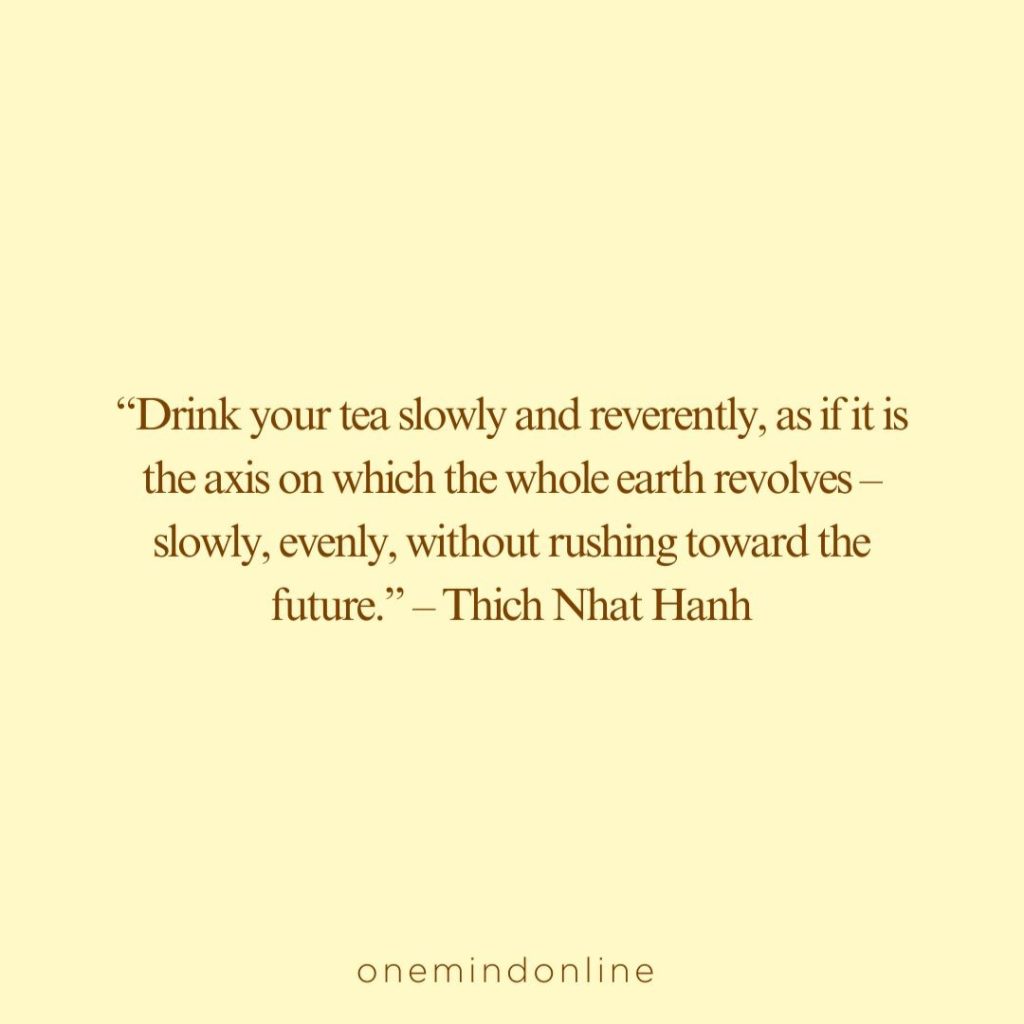
“Drink your tea slowly and reverently, as if it is the axis on which the whole earth revolves – slowly, evenly, without rushing toward the future.” – Thich Nhat Hanh
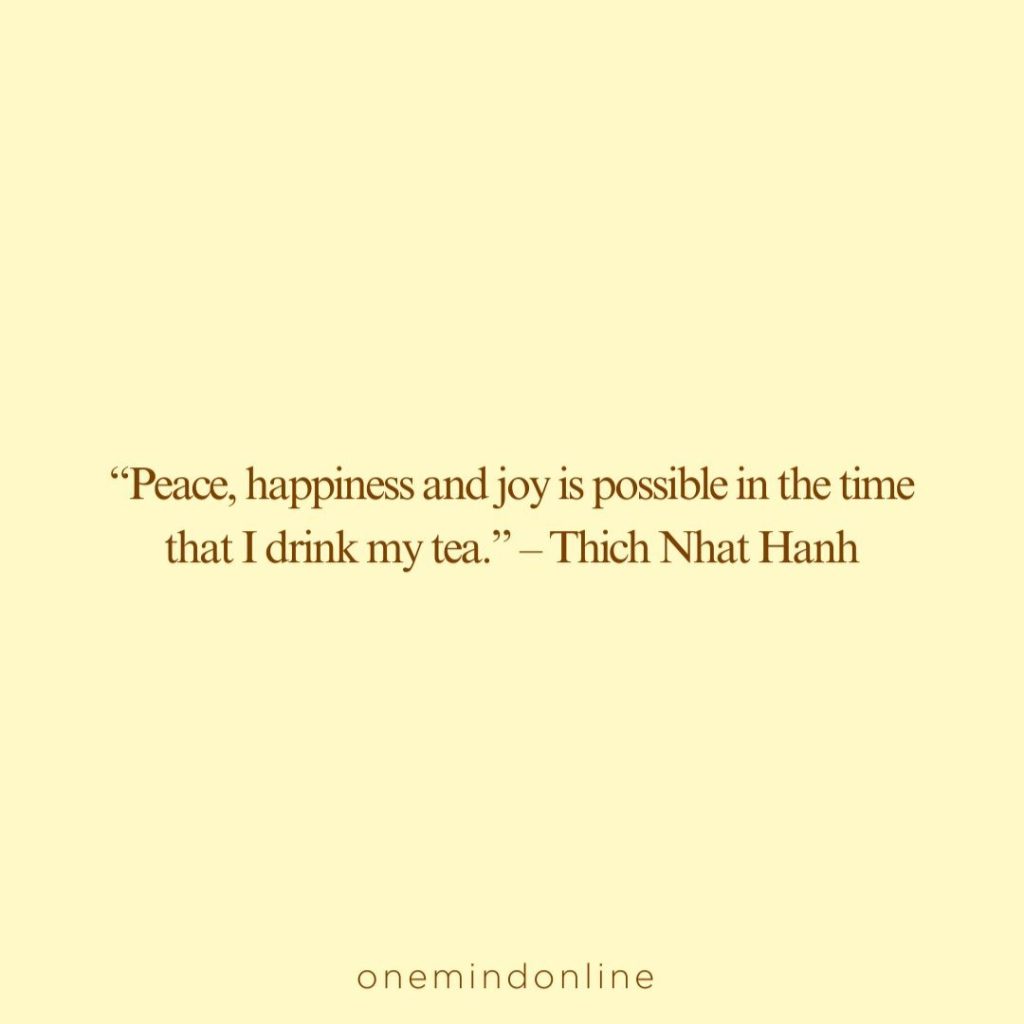
“Peace, happiness and joy is possible in the time that I drink my tea.” – Thich Nhat Hanh
If we are not mindful then it’s not really the tea that we are drinking, we don’t even really taste it because while we’re mindlessly lifting a cup to our mouth we’re still much more involved with our inner illusions and afflictions than with the contents of this cup.
My favourite line of his is, “…when the tea becomes real, we become real…” because in that moment we have stepped out of our patterns and into presence, potentially making ourselves available to what this moment presents to us.
This is of course not just about tea but about everything we do. We so easily siphon off our energy to the future or the past where we have no agency at all, leaving us with less energy to apply ourselves right here in the moment where we are creating the future.
A few guiding mantras:
- “Slow down. Savor the tea, the moment.”
- “Be present. Don’t get lost in past or future anxieties.”
- “Engage your senses. See, smell, taste, touch – be fully present.”
- “Find peace in the now. Every moment holds the potential for joy.”
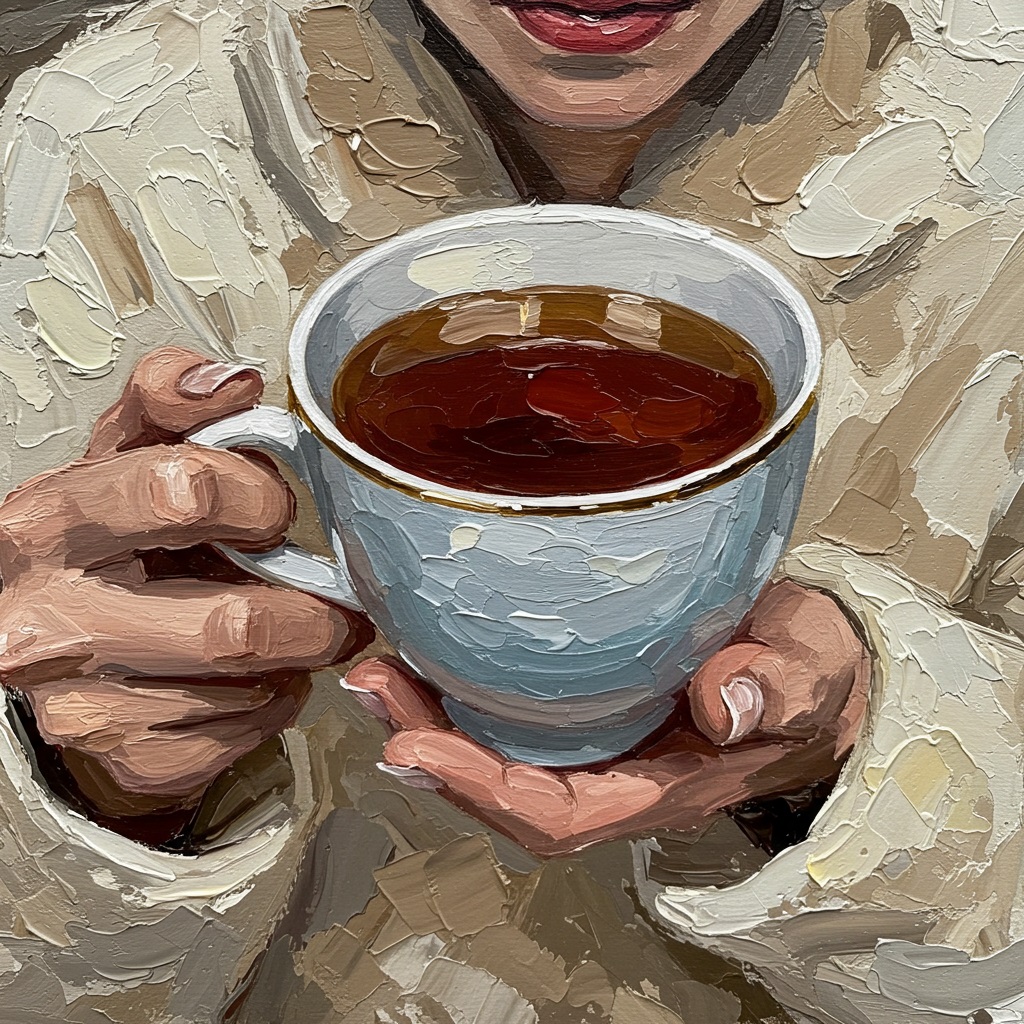
Put your hands around a cup of tea or coffee, and open yourself to the full experience – feel, taste and smell.
When the tea becomes real, you become real.
– pierre –
Today’s LIVE meditation is: Come to your senses.
Today’s LIVE meditation
https://youtu.be/LoRsLPeEA4I 2026
https://youtu.be/D5afSLi7Zoc 2025
https://youtu.be/XvL7DMFLaK4 2024
https://youtu.be/IEtNfnpFsRA 2022
Practice the “Daily Dose”
Let’s put it into practice! Choose what works for you – daily, once a week or whenever inspiration strikes. Putting pen to paper wires the neural pathways that will create your new habits.
1 – Affirmation
Write down your favourite affirmation on a sticky note and place it somewhere that you’ll be able to see it the whole day.
- “Slow down. Savor the tea, the moment.”
- “Be present. Don’t get lost in past or future anxieties.”
- “Engage your senses. See, smell, taste, touch – be fully present.”
- “Find peace in the now. Every moment holds the potential for joy.”
2 – A moment of reflection
Use today’s question as a journal prompt. If you don’t have the time to sit down and write, just take a moment to reflect on your response.
Energy Allocation: The article suggests that we “siphon off our energy to the future or the past where we have no agency at all.” Where does your mental energy typically go? Make two lists: one of past events you frequently replay, and one of future scenarios you often ruminate over. Then write about where you’d like to consciously direct your attention. What would you choose to consciously direct your energy towards, whenever you catch your thoughts being stuck in either the past or future?
3 – Quotes to share
Send a quote to someone who needs it, or share them all on social media to spread the good vibes!

4 – Q&A for deeper learning
Read through the questions and answers and write down at least one “aha moment” that clicked for you.
Q1: What does it mean when Thich Nhat Hanh says “when the tea becomes real, we become real”?
This statement points to the relationship between presence and authenticity. When we’re on autopilot, lost in thoughts about the past or future, we’re not fully here—we’re living in mental abstractions rather than reality. When we bring complete awareness to something as simple as drinking tea, actually experiencing its taste, warmth, and aroma, we step out of our habitual thought patterns and into genuine presence. In that moment of true contact with reality, we become real too—fully alive and engaged rather than mechanically going through motions.
Q2: How is mindful tea drinking relevant to personal development?
Mindful tea drinking is a microcosm of how we approach all of life. If we can’t be present for something as simple as drinking tea, we’re likely absent during important conversations, creative work, and meaningful moments. Learning to be fully present with a cup of tea trains us to be present for everything else. It’s not about the tea—it’s about developing the capacity to show up fully for our lives instead of sleepwalking through them.
Q3: I have a busy life with lots of responsibilities. How can I possibly slow down enough to drink tea mindfully?
The practice isn’t about adding more time to your day—it’s about changing your relationship to the time you already have. You’re already drinking coffee or tea, eating meals, and washing dishes. The question is whether you’re truly present for these activities or mentally elsewhere. Paradoxically, when you slow down and become more present, you often become more effective because you’re fully engaged rather than fragmented. Start with just one mindful moment per day and build from there.
Q4: What does it mean to drink our “illusions and afflictions” instead of tea?
When we’re not mindful, our attention is consumed by worries, fears, regrets, fantasies, and mental narratives—what Buddhism calls “afflictions.” We might physically be drinking tea, but mentally we’re replaying an argument, rehearsing a difficult conversation, or worrying about the future. In this state, we’re not actually tasting the tea; we’re just going through the motions while our mind churns through these mental patterns. We’re drinking our own psychological content rather than experiencing what’s actually present.
Q5: How do I start practicing presence if I’ve spent years on autopilot?
Begin with simple sensory anchors. Choose one routine activity—perhaps your morning beverage, a shower, or your commute—and commit to engaging all five senses during that time. Notice what you see, hear, smell, taste, and feel physically. When your mind wanders (and it will), gently bring your attention back to the sensory experience. Start with just a few minutes daily. Presence is like a muscle that strengthens with practice.
Q6: Why does Thich Nhat Hanh emphasize not “rushing toward the future”?
Rushing toward the future keeps us perpetually unsatisfied and disconnected from the only moment where life actually happens—now. When we’re always focused on what’s next, we miss the beauty, joy, and opportunity in what is. Additionally, we have no actual power in the future; our only point of influence is the present moment. By constantly projecting ourselves forward, we abandon the very place where we can take meaningful action and create the future we desire.
Q7: Can this practice really lead to peace and happiness, or is it just about relaxation?
This practice is about something deeper than temporary relaxation—it’s about fundamentally changing how we relate to our experience. Most of our suffering comes from resisting what is, dwelling on what was, or anxiously anticipating what might be. When we learn to be fully present, we step out of this cycle of suffering and into direct contact with life. This doesn’t mean challenges disappear, but we meet them with clarity and groundedness rather than anxiety and reactivity. The peace Hanh describes isn’t an escape from life but a more authentic way of engaging with it.