

“Your Daily Dose” is a quick two minute read packed with bite-sized wisdom from all the great teachers. But you could also choose to turn it into something more… a powerful daily practice for personal growth. Give it a try!
A message from today’s meditation:
What is freedom? Can you find the answer in this quote?
“The true task of spiritual life is not found in faraway places or unusual states of consciousness. It is here in the present. It asks of us a welcoming spirit to greet all that life presents to us with a wise, respectful, and kindly heart. We can bow to both beauty and suffering, to our entanglements and confusion, to our fears and to the injustices of the world. Honouring the truth in this way is the path to freedom.” – Jack Canfield
Could you find the answer? Read it again if you didn’t…
Can you be right where you are and find yourself not captured by what’s happening in the world around you? Can you be with what IS without giving in to the compulsion to run, or to hide, or to fight, or to control? Can you be right where you are and just breathe and find that you are in fact OK? And if you are able to breathe, can you feel that you do actually have some room to move, even if it’s just a little? And if you really are OK and if you have some room to move, do you realize that you could in fact also be happy, right here, right now?
If you are able to find freedom right here, right where you are, then no outer circumstances will ever rob you of freedom ever again.
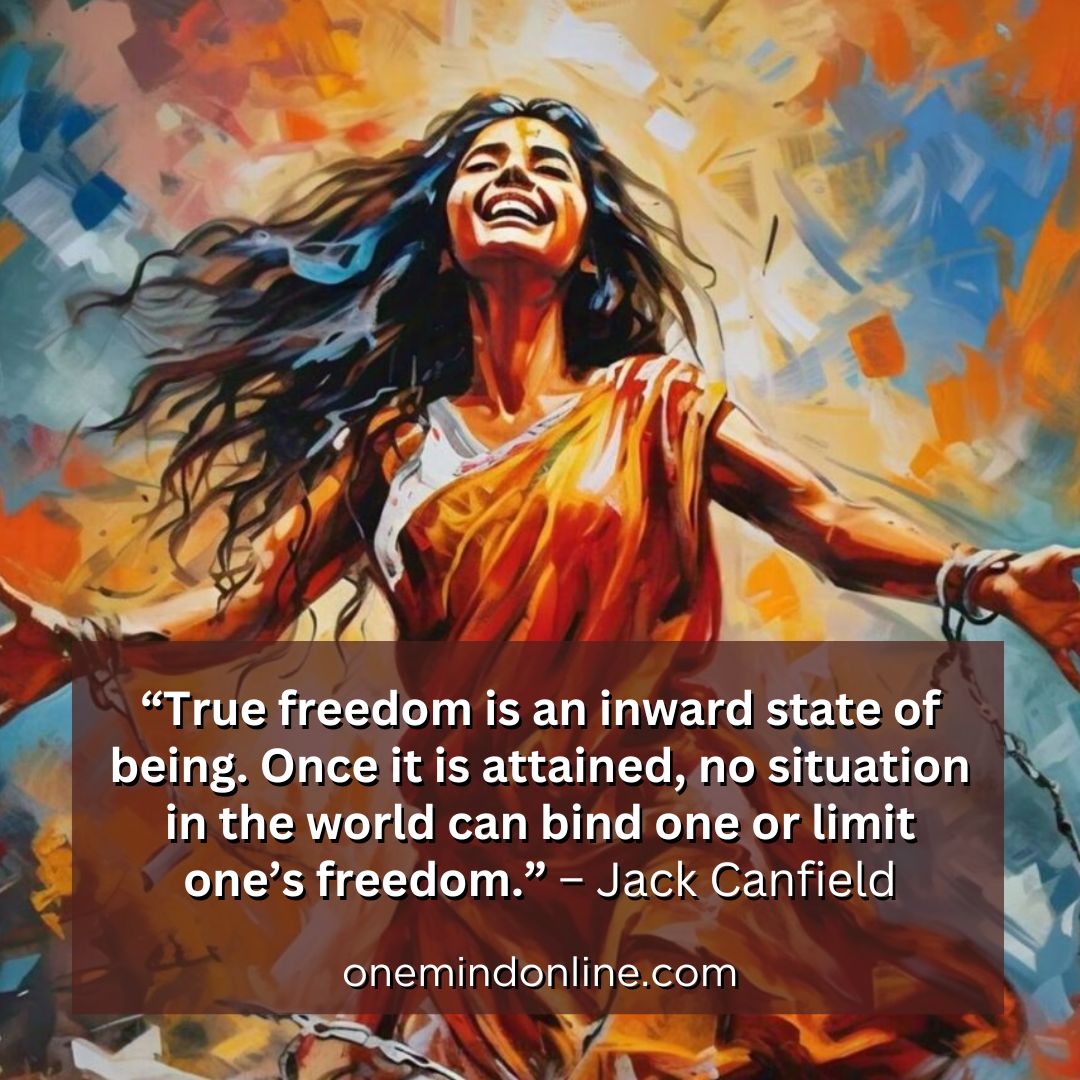
“True freedom is an inward state of being. Once it is attained, no situation in the world can bind one or limit one’s freedom.” – Jack Canfield
Freedom is the state of not being the prisoner of your thoughts, and if you can’t find yourself being free right where you are, then no amount of outer freedom will ever set you free.
“As I walked out the door toward the gate that would lead to my freedom, I knew if I didn’t leave my bitterness and hatred behind, I’d still be in prison.” – Nelson Mandela.
Wherever your mind goes, your body will follow. If you are unable to experience freedom of mind, your body will never be free. You hold the key to your freedom!
“Every single cell in your body is affected by every single thought that you have.” – Jack Canfield
Our meditation journey today, in its simplicity, is an exercise in freedom. It’s the opportunity to allow the current situation to be experienced just as it is, and find that I’m ok. I don’t need to run, I don’t need to hide, I don’t need to fight, I can just breathe and find that I am free in this very moment.
Sit with these thoughts for a moment, and try and feel them:
- Be present: Focus on the here and now, without dwelling on the past or worrying about the future.
- Accept: Embrace your experiences, both positive and negative, without judgement.
- Breathe: Deep breathing can help calm your mind and body, promoting a sense of peace and tranquility.
- Trust: Trust in the process of life and believe in your ability to find freedom within yourself.
Remember, freedom isn’t about escaping your problems; it’s about finding peace within them. It’s about choosing to be present, to be kind, and to embrace the journey of life.
Have a beautiful Saturday peeps! Be FREE!
– pierre –
Today’s LIVE meditation is: Come to your senses.
Today’s LIVE meditation
https://youtu.be/En2E5QtmPLw 2025
https://youtu.be/uQrjEC8shlE 2024
https://youtu.be/tdJuTnC87IE 2023
https://youtu.be/nFjlbZb12Z8 2022
Practice the “Daily Dose”
Let’s put it into practice! Choose what works for you – daily, once a week or whenever inspiration strikes. Putting pen to paper wires the neural pathways that will create your new habits.
1 – Affirmation
Not really affirmations today, but some really useful principles to apply, and they go particularly well with today’s meditation practice. Write down your favourite one and place it somewhere that you’ll be able to see it the whole day.
- Be present: Focus on the here and now, without dwelling on the past or worrying about the future.
- Accept: Embrace your experiences, both positive and negative, without judgement.
- Breathe: Deep breathing can help calm your mind and body, promoting a sense of peace and tranquility.
- Trust: Trust in the process of life and believe in your ability to find freedom within yourself.
2 – A moment of reflection
Use today’s question as a journal prompt. If you don’t have the time to sit down and write, just take a moment to reflect on your response.
Your Inner Nelson Mandela: Nelson Mandela said he knew that leaving bitterness and hatred behind was essential to his freedom. What “bitterness and hatred” or resentments are you carrying that might be keeping you imprisoned, even when your external circumstances are fine? Write a letter to yourself about what you would need to release in order to walk through your own “gate to freedom.” What would it feel like to let these burdens go?
3 – Quotes to share
Send a quote to someone who needs it, or share them all on social media to spread the good vibes!
4 – Q&A for deeper learning
Read through the questions and answers and write down at least one “aha moment” that clicked for you.
Q1: Does practicing inner freedom mean I should just accept everything, even injustice and mistreatment?
No, inner freedom doesn’t mean becoming passive or tolerating harmful situations. It means responding from a place of clarity and wisdom rather than reacting from emotional turmoil. When you’re not imprisoned by your own reactivity, you can actually take more effective action. You can “surrender to” the reality that this is what we are dealing with right now, while still working to change it, but from a place of strength rather than victimhood. This inner freedom gives you more power, not less.
Q2: How can I find freedom “right where I am” when my circumstances genuinely need to change?
Finding freedom “right where you are” doesn’t mean pretending your circumstances are fine or staying put when change is needed. It means recognizing that if you are in the middle of bad circumstances, splashing around in fear is not going to make things better. Think of someone caught in deep water: panic burns energy, clouds judgement, and pulls them under faster, while a moment of stillness lets them float, breathe, and see which way the shore lies. In the same way, when you stop fighting the fear and let yourself breathe, you create a little room to move, and from that space you can think clearly, ask for help, and take wise, deliberate steps toward the change you need. Inner freedom doesn’t replace action, it is what makes your action effective, because decisions made from calm presence are far more likely to lead you out of difficulty than decisions made in a frantic scramble to escape it.
Q3: What’s the difference between “accepting” a situation and giving up on improving it?
Acceptance means acknowledging reality as it is without wasting energy on resistance or denial. This actually frees up mental and emotional resources to focus on constructive action. Giving up is passive resignation, while acceptance is active presence. When you accept what is, you can clearly see what can be changed and what cannot, allowing you to direct your energy more effectively.
Q4: How do I practice this when my mind is constantly racing with anxious thoughts?
When your mind is racing with anxious thoughts, remember that you can always stop for long enough to take a breath and ask yourself, “Can I be okay for just this one breath?” Then, “And for this breath? And for this one?” You don’t have to quiet your mind or fix everything at once, only get through the breath you’re on. It can help to picture your racing thoughts as a band of wild horses your brain is producing. You can choose to be taken on that ride, clinging to the back of one wild horse after another and being dragged wherever they go. Or you can choose to stay behind the fence and simply watch them run. The horses may keep coming, but watching from behind the fence means you are no longer being carried off by them. And even while the wild horses are running, you can still choose what your next step will be. That small choice is where your freedom lives, and each conscious breath makes it a little easier to find.
Q5: Is this approach just spiritual bypassing – avoiding real problems with positive thinking?
This practice is the opposite of spiritual bypassing. It’s about fully facing reality without the filter of resistance or denial. True spiritual maturity involves “bowing to both beauty and suffering,” not pretending everything is fine. You’re not avoiding problems; you’re changing how you relate to them so you can address them more effectively. This isn’t positive thinking – it’s present moment awareness.
Q6: How can breathing and mindfulness actually change my physical reality?
Science shows that our thoughts directly affect our physiology – stress hormones, immune function, heart rate, and even gene expression. When you shift from reactive thinking to present moment awareness, you activate the parasympathetic nervous system, which promotes healing and clarity. This isn’t magical thinking; it’s basic neuroscience. A calm, clear mind makes better decisions, sees more options, and creates better outcomes in the physical world.
Q7: What if I try this approach but still feel trapped and unhappy?
If you try this approach and still feel trapped and unhappy, it helps to understand that there are many, many people who have everything they could possibly want, and still feel trapped and unhappy. That tells us something important: the feeling of being trapped doesn’t come from what we have or lack, but from what is happening inside the mind. Freedom is the state of not being the prisoner of your thoughts, and no amount of outer abundance can unlock a door that only your own awareness can open. So if the feeling persists, don’t treat it as proof that you’re failing or that this path doesn’t work. Treat it as information, and turn your attention gently toward the thoughts that are holding you in place. You might ask, “Can I be okay with feeling trapped, just for this breath?” Meeting even this feeling with a welcoming, kindly heart is already a small step toward freedom. If the heaviness stays with you, it is also wise to reach out to a trusted friend, counsellor or health professional, because asking for support is itself an act of freedom.