

“Your Daily Dose” is a quick two minute read packed with bite-sized wisdom from all the great teachers. But you could also choose to turn it into something more… a powerful daily practice for personal growth. Give it a try!
A message from today’s meditation:
On Saturday will be Human Rights day in South Africa, so even though it’s not Saturday yet, I’d like to make today’s journey a special celebration of being human!
We often get caught up in the illusion of being separate entities. But a closer look reveals the intricate web of human cooperation that sustains us.
Our reminder is that we can’t be human all on our own. We are only human because of all the humans around us. You live in a house that was built by someone else. You drive a car that was built by someone else. You go to the store and buy products that were made by other people…
Human cooperation has come such a long way, yet we so often still fall into the trap of seeing ourselves as separate:
“In Africa there is a concept known as ‘ubuntu’ – the profound sense that we are human only through the humanity of others; that if we are to accomplish anything in this world it will in equal measure be due to the work and achievement of others.” – Nelson Mandela
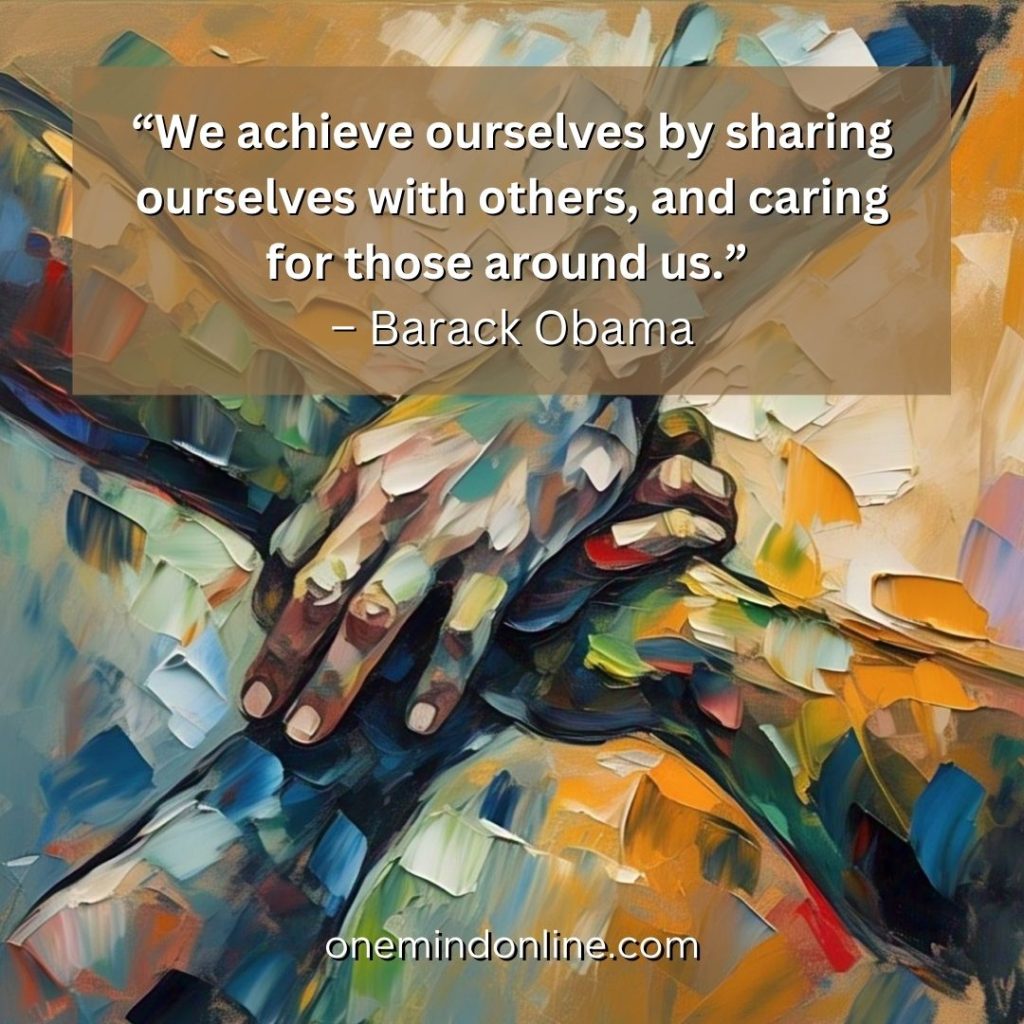
Speaking of his meeting with Nelson Mandela… “There is a word in South Africa – Ubuntu – that describes his greatest gift: his recognition that we are all bound together in ways that can be invisible to the eye; that there is a oneness to humanity; that we achieve ourselves by sharing ourselves with others, and caring for those around us.” – Barack Obama
“One of the sayings in our country is Ubuntu – the essence of being human. Ubuntu speaks particularly about the fact that you can’t exist as a human being in isolation. It speaks about our interconnectedness. You can’t be human all by yourself, and when you have this quality – Ubuntu – you are known for your generosity. We think of ourselves far too frequently as just individuals, separated from one another, whereas you are connected and what you do affects the whole World. When you do well, it spreads out; it is for the whole of humanity.” – Desmond Tutu
This is always true…
Our accomplishments, big or small, are woven from the threads of the work and contributions of others.
Remember the invisible threads that bind us – the baker who baked your bread, the teacher who educated you, the doctor who cares for your health. We are a symphony of individuals, each playing a vital role in the grand composition of humanity. So let’s move beyond separateness and embrace the power of togetherness.
Embrace the power of Ubuntu: Mantras for a connected life:
- “I am a part of something bigger than myself. My success is intertwined with the well-being of others.”
- “My actions have ripple effects. I choose to be a force for good in the interconnected web of humanity.”
- “Collaboration is key. I actively seek opportunities to support others and learn from their strengths.”
- “Every interaction matters. I treat everyone with kindness and respect, recognizing the shared humanity that binds us.”
Today’s meditation really is a lot of fun. Please invite the child within you to come out and play with us.
Here’s one more South African word for you – Simunye! We are one!
– pierre –
Today’s LIVE meditation is: Ubuntu.
Today’s LIVE meditation
https://youtu.be/21s6g7yIbCw 2024
Practice the “Daily Dose”
Let’s put it into practice! Choose what works for you – daily, once a week or whenever inspiration strikes. Putting pen to paper wires the neural pathways that will create your new habits.
1 – Affirmation
Write down your favourite affirmation on a sticky note and place it somewhere that you’ll be able to see it the whole day.
- “I am a part of something bigger than myself. My success is intertwined with the well-being of others.”
- “My actions have ripple effects. I choose to be a force for good in the interconnected web of humanity.”
- “Collaboration is key. I actively seek opportunities to support others and learn from their strengths.”
- “Every interaction matters. I treat everyone with kindness and respect, recognizing the shared humanity that binds us.”
2 – A moment of reflection
Use today’s question as a journal prompt. If you don’t have the time to sit down and write, just take a moment to reflect on your response.
Tracing Your Web of Connection: Think about your typical day and map out all the people whose work makes your life possible—from those you interact with directly to those whose contributions are invisible. How does recognizing this web of support change your sense of gratitude and responsibility?
3 – Quotes to share
Send a quote to someone who needs it, or share them all on social media to spread the good vibes!

4 – Q&A for deeper learning
Read through the questions and answers and write down at least one “aha moment” that clicked for you.
Q1: What exactly does Ubuntu mean?
Ubuntu is an African philosophical concept, particularly from South African languages, that translates roughly as “I am because we are.” It expresses the idea that our humanity is fundamentally relational—we become human through our connections with other humans. It emphasizes interdependence, community, and the recognition that individual well-being is inseparable from collective well-being.
Q2: How is Ubuntu different from Western concepts of community?
While Western thought often starts with the individual and then considers how individuals form communities, Ubuntu reverses this—it suggests that the individual only exists meaningfully within the context of relationships. It’s not just about being kind or community-minded; it’s recognizing that your very identity is shaped by and depends on others. You don’t just live in community; you are constituted by it.
Q3: Is Ubuntu relevant outside of African cultures?
Absolutely. While Ubuntu originates from African philosophy, the truth it points to—our fundamental interconnectedness—is universal. Every person depends on countless others for their survival and flourishing, regardless of culture. Ubuntu offers wisdom that’s particularly needed in individualistic societies where people often feel isolated despite being materially comfortable.
Q4: How can I practice Ubuntu in my daily life?
Start by consciously acknowledging the web of people who make your life possible—from those you interact with to those whose work is invisible. Practice gratitude for these contributions. Treat every interaction as meaningful, recognizing that how you engage with others affects the whole. Seek opportunities to contribute to others’ well-being, understanding that this isn’t separate from your own flourishing but essential to it.
Q5: Doesn’t Ubuntu ignore the importance of personal responsibility and achievement?
Not at all. Ubuntu doesn’t diminish personal effort or accountability—it contextualizes them. You can work hard and take responsibility for your choices while also recognizing that your ability to do so depends on countless others. The point isn’t that individuals don’t matter, but that individuals never exist in isolation. Even your capacity for personal responsibility was nurtured by others.
Q6: How does Ubuntu relate to generosity and kindness?
According to Ubuntu philosophy, generosity isn’t just a moral virtue—it’s a natural expression of understanding reality correctly. When you recognize that your well-being is inseparable from others’ well-being, helping others isn’t altruism; it’s intelligent self-interest rightly understood. As Desmond Tutu noted, those who embody Ubuntu “are known for their generosity” because they understand the truth of interconnection.
Q7: Can Ubuntu help with feelings of loneliness or isolation?
Yes, though not as a quick fix. Ubuntu invites us to recognize that even when we feel alone, we’re supported by countless visible and invisible connections. The bread you eat, the shelter you have, the language you speak—all connect you to others. Practicing Ubuntu awareness—consciously acknowledging these connections and actively nurturing relationships—can shift the experience of isolation by revealing the web of humanity you’re already part of.