

“Your Daily Dose” is a quick two minute read packed with bite-sized wisdom from all the great teachers. But you could also choose to turn it into something more… a powerful daily practice for personal growth. Give it a try!
A message from today’s meditation:
Have you ever started a new project with fierce determination, only to see results fall short of your initial expectations? Maybe you hit a wall with a creative endeavor, or progress on a fitness goal feels agonizingly slow. These moments of frustration are all too familiar, and it’s easy to get discouraged. But what if there was a different perspective, one that embraced the messiness of growth and the beauty of the unknown?
This week, we delve into the wisdom of meditation teacher Sharon Salzberg, who offers the powerful message of trusting in the unfolding.
“Often we can achieve an even better result when we stumble yet are willing to start over, when we don’t give up after a mistake, when something doesn’t come easily but we throw ourselves into trying, when we’re not afraid to appear less than perfectly polished.” – Sharon Salzberg
Our journey is rarely a straight line to success; stumbles and missteps are inevitable. Yet, it’s within these moments that we cultivate resilience and refine our approach.
“That is life, starting over one breath at a time.” – Sharon Salzberg
“We like things to manifest right away, and they may not. Many times, we’re just planting a seed and we don’t know exactly how it is going to come to fruition. It’s hard for us to realize that what we see in front of us might not be the end of the story.” – Sharon Salzberg
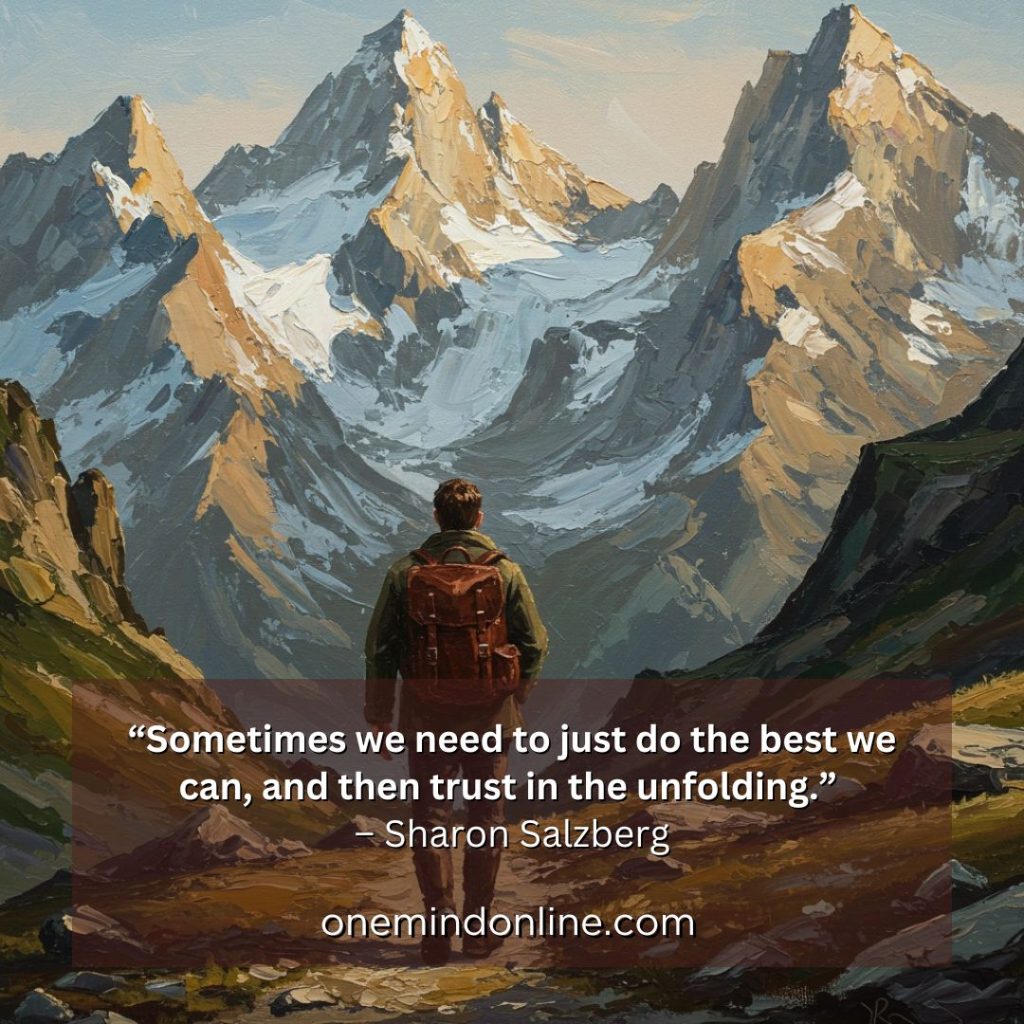
“Sometimes we need to just do the best we can, and then trust in the unfolding.” – Sharon Salzberg
The effort that you put in is the only thing that you have some control over – we never control the outcome, only our own input. Can you do your best today and then lay your head on the pillow tonight in full surrender knowing you’ll do your best again tomorrow – and just trust in the unfolding?
A few mantras to inspire trust in the unfolding.
- “I am willing to try again.” Failure is not a period, it’s a comma. Each attempt, successful or not, is a valuable learning experience. Embrace the opportunity to refine your approach and step forward with renewed determination.
- “One breath at a time.” Feeling overwhelmed? Take a deep breath and come back to the present moment. Progress happens incrementally, so focus on giving your best effort in each moment, rather than getting lost in the vastness of the long-term goal.
- “I’ll plant the seeds and water them even if I can’t be sure what the tree will look like yet.” Let go of the need to control the outcome. Focus on the process, the commitment you bring each day, and trust that the universe will orchestrate the results in its own perfect timing.
- “I will keep doing my best, and trust in the unfolding.” Remember, the only thing truly within your control is the effort you dedicate. Release the pressure of needing to see immediate results, and instead, cultivate faith in the process.
Embrace every part of the journey with open arms. Give yourself permission to learn, grow, and stumble along the way. Celebrate the small victories, learn from the setbacks, and trust that with consistent effort and a touch of surrender, beautiful things are bound to unfold.
Wishing you a beautiful week!
– pierre –
Today’s LIVE meditation is: Jumpstart the week!
Today’s LIVE meditation
https://youtu.be/irFmDK_WgwM 2025
https://youtu.be/JStvD7eOEn8 2024
https://youtu.be/wLsCsJKCv1k 2023
https://youtu.be/7wqllCfTe4o 2022
Practice the “Daily Dose”
Let’s put it into practice! Choose what works for you – daily, once a week or whenever inspiration strikes. Putting pen to paper wires the neural pathways that will create your new habits.
1 – Affirmation
Write down your favourite affirmation on a sticky note and place it somewhere that you’ll be able to see it the whole day.
- “I am willing to try again.” Failure is not a period, it’s a comma. Each attempt, successful or not, is a valuable learning experience. Embrace the opportunity to refine your approach and step forward with renewed determination.
- “One breath at a time.” Feeling overwhelmed? Take a deep breath and come back to the present moment. Progress happens incrementally, so focus on giving your best effort in each moment, rather than getting lost in the vastness of the long-term goal.
- “I’ll plant the seeds and water them even if I can’t be sure what the tree will look like yet.” Let go of the need to control the outcome. Focus on the process, the commitment you bring each day, and trust that the universe will orchestrate the results in its own perfect timing.
- “I will keep doing my best, and trust in the unfolding.” Remember, the only thing truly within your control is the effort you dedicate. Release the pressure of needing to see immediate results, and instead, cultivate faith in the process.
2 – A moment of reflection
Use today’s question as a journal prompt. If you don’t have the time to sit down and write, just take a moment to reflect on your response.
The seeds you’re planting right now: Consider the areas of your life where you’re currently investing effort but haven’t yet seen the results you’re hoping for. This might be a skill you’re developing, a relationship you’re nurturing, a health goal you’re working toward, or a personal quality you’re cultivating. Explore these questions: 1) What “seeds” are you planting in your life right now through your daily actions and choices? 2) Where do you find yourself becoming impatient or discouraged because results aren’t manifesting quickly enough? 3) What would it look like to tend to these areas of growth with more trust and less anxiety about outcomes? 4) If you knew that your consistent efforts would eventually bear fruit (even if in ways you can’t currently imagine), how would this change your approach to your daily practice?
3 – Quotes to share
Send a quote to someone who needs it, or share them all on social media to spread the good vibes!

4 – Q&A for deeper learning
Read through the questions and answers and write down at least one “aha moment” that clicked for you.
Q1: How do I know the difference between “trusting the unfolding” and just giving up or being lazy?
The key distinction lies in your daily commitment and inner intention. Trusting the unfolding means you continue showing up consistently with your best effort while releasing attachment to specific timelines or outcomes. Giving up means you stop taking action altogether. When you’re truly trusting the process, you’re still watering the seeds daily, and you’re still pulling out the weeds. You can’t quit watering your garden and say, “I’m just trusting in the unfolding.” But also… if the action you’re taking is constantly digging up the seeds to check if they’re growing yet, you’re not allowing any unfolding to happen. So show up every day, do the best that you can every day, and trust in the unfolding.
Q2: What if I’ve been “trusting the process” for years but still don’t see any meaningful results?
This is one of the most challenging aspects of personal growth. First, consider whether you might be looking for results in too narrow a way – sometimes growth happens in areas we didn’t expect or in forms we don’t immediately recognize. Second, examine whether you need to adjust your approach. Sometimes we’re missing just a small insight that could radically change how we do what we do. But keep maintaining your commitment while you’re making adjustments, if you stop tending to the garden altogether, weeds will take over. Remember Sharon Salzberg’s insight that “what we see in front of us might not be the end of the story.” Your efforts may be creating invisible foundations for breakthroughs that haven’t manifested yet.
Q3: How can I practice “starting over one breath at a time” when I feel completely overwhelmed by my goals?
When overwhelm strikes, it’s usually because you’re trying to carry the weight of the entire journey in a single moment. The “one breath at a time” approach means radically shrinking your focus to what you can do right now, today, or even in the next hour. Instead of thinking “I need to lose 50 pounds,” think “I can make one healthy choice with this meal.” Instead of “I need to write a book,” think “I can write one paragraph today.” This isn’t about lowering your standards – it’s about breaking overwhelming goals into manageable, present-moment actions that you can actually accomplish.
Q4: Is there a difference between being patient with the process and settling for less than I deserve?
Absolutely. Patience with the process means you’re committed to growth and willing to let it unfold naturally, while settling means you’ve stopped believing in your potential. When you’re being patient, you’re still taking action, learning, and evolving – you’re just not demanding that results appear on your timeline. Settling feels stagnant and resigned, while patience feels alive and engaged. True patience actually requires courage because it means continuing to invest in yourself even without immediate rewards. If you’re consistently growing and challenging yourself, you’re not settling – you’re cultivating the conditions for authentic success.
Q5: How do I deal with other people’s expectations and timelines when I’m trying to trust my own unfolding?
This is particularly challenging in our achievement-obsessed culture. Remember that others’ timelines are based on their fears, experiences, and limitations – not yours. You can acknowledge their concerns while staying true to your path. Sometimes it helps to share your philosophy with trusted people in your life, explaining that you’re committed to meaningful progress rather than rushed results. Set boundaries around conversations that pressure you to speed up your process. Most importantly, strengthen your internal compass so that external noise doesn’t shake your commitment to authentic growth over performative achievement.
Q6: What does it look like practically to “do your best” without becoming perfectionistic?
Doing your best means showing up with full presence and effort given your current circumstances and capacity – not achieving some impossible standard of perfection. Some days your best might be a two-hour focused work session; other days it might be just showing up for ten minutes when you’re dealing with personal challenges. The key is honesty with yourself about what you’re genuinely capable of in each moment, then giving that wholeheartedly. Perfectionism demands flawless execution, while doing your best honors your humanity and fluctuating energy levels. It’s about consistency over perfection, presence over performance.
Q7: How can I maintain hope and motivation when progress feels painfully slow?
Slow progress is still progress, and often the most sustainable kind. Reframe your relationship with time by celebrating small wins and recognizing that lasting change happens gradually. Keep a growth journal where you note small shifts, insights, and improvements that might otherwise go unnoticed. Connect with others on similar journeys who understand the long game of personal development. Remember that the person you’re becoming through the process of patient growth is often more valuable than the specific goal you started with. Finally, trust Sharon Salzberg’s wisdom that your consistent efforts are creating changes you can’t yet see—the roots grow before the flowers bloom.