

“Your Daily Dose” is a quick two minute read packed with bite-sized wisdom from all the great teachers. But you could also choose to turn it into something more… a powerful daily practice for personal growth. Give it a try!
A message from today’s meditation:
We all strive for inner peace and a sense of freedom, yet life often throws us curveballs. Almost daily we are met with obstacles and stumbling blocks that we couldn’t have planned for, leaving us feeling frustrated, anxious, and out of control. The good news is that being happy doesn’t need us to avoid these challenges, but rather, peace finds us when we cultivate a deep inner acceptance of whatever arises.
“Die to everything of yesterday so that your mind is always fresh, always young, always innocent and full of vigor and passion for today.” – Jiddu Krishnamurti
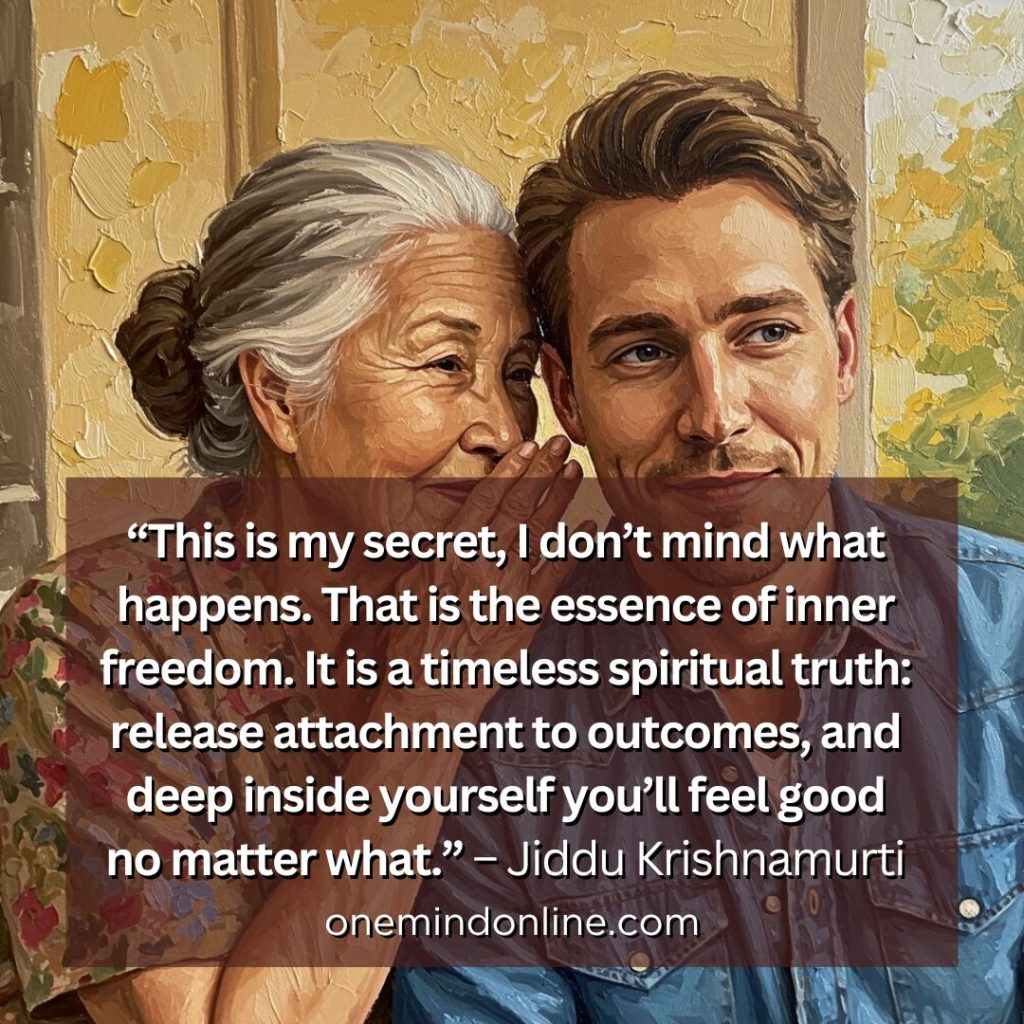
“This is my secret, I don’t mind what happens. That is the essence of inner freedom. It is a timeless spiritual truth: release attachment to outcomes, and deep inside yourself you’ll feel good no matter what.” – Jiddu Krishnamurti
As powerful as this wisdom is – “I don’t mind what happens” – it’s damn difficult to apply! “I don’t mind what happens” doesn’t mean that we don’t care about anything ever, what Krishnamurti is trying to say is closer to when Eckhart says, “accept the resent moment as if you had chosen it.”
I don’t mind what happens means – I don’t have any preconceived ideas of what this moment “should have been.” Here the moment is, I am here, I am now, and I will deal with this moment as it arises.
I don’t mind what happens means – I will not have resistance to what this moment is. I will let it flow and I will spend my energy on what’s in front of me where I can actually be effective.
I don’t mind what happens means – I will die to everything of yesterday and be fresh and new in this moment, so that I don’t have old thoughts that try to convince me that this moment is anything less than perfect.
“Being present” is not just a spiritual idea, it’s the best productivity tool that you have. Living right here in this moment means that all your energy gets directed toward what’s right in front of you, and not diluted by distraction from yesterday or tomorrow. Being present is the most effective application of your energy.
Remember, every day is a new beginning. Embrace it with these mantras:
- “I am present. I am aware. I am empowered.”
- “Freedom from preconceived notions: Ditch the “shoulds” and “could haves.” Be open to the unique magic unfolding right now.”
- “I won’t resist what is: Let go of the struggle, flow with the current, and focus your energy where it counts.”
Join us for today’s meditation to tune into the power that you have in the present moment.
Have a beautiful day!
– pierre –
Today’s LIVE meditation is: The power of NOW.
Today’s LIVE meditation
https://youtu.be/AoAHnXyvcn8 2026
https://youtu.be/cWniQDgW_jA 2025
https://youtu.be/pEpvS6DZNoM 2024
https://youtu.be/wXyXBdLJrxo 2023
Practice the “Daily Dose”
Let’s put it into practice! Choose what works for you – daily, once a week or whenever inspiration strikes. Putting pen to paper wires the neural pathways that will create your new habits.
1 – Affirmation
Write down your favourite affirmation on a sticky note and place it somewhere that you’ll be able to see it the whole day.
- “I am present. I am aware. I am empowered.”
- “Freedom from preconceived notions: Ditch the “shoulds” and “could haves.” Be open to the unique magic unfolding right now.”
- “I won’t resist what is: Let go of the struggle, flow with the current, and focus your energy where it counts.”
2 – A moment of reflection
Use today’s question as a journal prompt. If you don’t have the time to sit down and write, just take a moment to reflect on your response.
Explore your “shoulds.” Make a list of preconceived ideas you carry about how your life, relationships, or career “should” be. Where did these expectations come from? Which ones are causing you the most suffering? What would it feel like to release just one of them?
3 – Quotes to share
Send a quote to someone who needs it, or share them all on social media to spread the good vibes!


4 – Q&A for deeper learning
Read through the questions and answers and write down at least one “aha moment” that clicked for you.
Q1: Does “I don’t mind what happens” mean I should just accept harmful situations or injustice?
Absolutely not. This philosophy isn’t about passive resignation to harm or wrongdoing. It’s about not wasting energy resisting the reality that something has happened. Once you accept that a situation exists, you can respond more effectively. You can still take decisive action, set boundaries, and work for change—but from a place of clarity rather than reactive resistance. Acceptance of what is doesn’t mean approval; it means acknowledging reality so you can engage with it powerfully.
Q2: How is “not minding what happens” different from not caring about anything?
There’s a crucial distinction between detachment and apathy. “Not minding what happens” means you’re not attached to one specific outcome, not that you’re indifferent to life. You can care deeply about your work, relationships, and values while simultaneously releasing your grip on exactly how things unfold. This creates space for engagement without the suffering that comes from demanding reality conform to your expectations. You care fully while holding outcomes lightly.
Q3: If I accept the present moment as it is, won’t that make me less motivated to change or improve things?
Paradoxically, acceptance often increases effectiveness. When you’re not spending energy fighting against current reality, you have more clarity and power to direct toward actual solutions. Resistance keeps you stuck in emotional reactivity; acceptance moves you into strategic response. The most effective change-makers accept where things are now as the starting point, then work skillfully from there rather than arguing with reality.
Q4: What does it practically mean to “die to everything of yesterday”?
It means approaching each moment without letting past experiences, judgments, and expectations dictate your perception of now. Yesterday you had a conflict with your partner; today you meet them fresh, rather than carrying resentment. Last week your project failed; today you begin anew without that failure clouding your vision. It’s about not allowing your history to write your present story. This requires conscious practice—noticing when you’re viewing the present through yesterday’s lens and choosing to let it go.
Q5: How can being present actually improve productivity?
When your mind is scattered across regrets about the past and worries about the future, only a fraction of your attention focuses on your current task. Being fully present consolidates all your mental energy into this moment, allowing for deeper focus, better problem-solving, and more creative thinking. Multitasking between past, present, and future is actually the least productive state. Presence isn’t just peaceful; it’s powerful.
Q6: This sounds wonderful but incredibly difficult. How do I actually practice this in daily life?
Start small with moments rather than trying to transform your entire approach overnight. When you notice resistance arising—frustration in traffic, anger at a changed plan, anxiety about an outcome—pause and ask: “Can I accept that this is what’s happening right now?” Notice the physical sensation of softening your body. Practice bringing your full attention to one simple task completely. Build the muscle gradually. Even catching yourself in resistance once a day and choosing acceptance is progress.
Q7: What if I try to accept the present moment but I just can’t—I’m too upset or the situation is too painful?
That’s completely valid, and pushing yourself to “accept” before you’re ready is just another form of resistance. Sometimes acceptance comes in layers. First, you might need to accept that you’re not accepting—that you’re angry, hurt, or afraid, and that’s okay. Be compassionate with yourself. Acceptance isn’t about suppressing emotions; it’s about not adding extra suffering by demanding things be different than they are. Feel what you feel, and when you’re ready, you can begin to work with reality as it is. Healing takes time, and that’s part of accepting what is too.