

“Your Daily Dose” is a quick two minute read packed with bite-sized wisdom from all the great teachers. But you could also choose to turn it into something more… a powerful daily practice for personal growth. Give it a try!
A message from today’s meditation:
When we talk about fear, or listen to talks about overcoming fear, and hear that everything we’ve ever wanted is on the other side of fear – it often sounds like the ways to overcome our fears are things like jumping out of an airplane or diving with sharks!
But let’s be real, most of our fears aren’t created by our resistance to extreme adventures. Our deepest, most paralyzing fears lurk in the shadows of our own self-perception, in the way we feel about ourselves and think about ourselves. The whispers of “not good enough” and the relentless “what ifs”, are what genuinely hold us back from the lives we dream of living.
Krishnamurti’s message today gets to the root cause of the fears that determine our paths.
“One of the major causes of fear is that we do not want to face ourselves as we are.” – Jiddu Krishnamurti
The fears that shape our paths aren’t about external dangers. They’re about the internal landscape we’re too frightened to explore.
The view that I have of myself. What I fear I am, and what I’m scared I might never be… these are the fears that steer my thoughts and my daily actions and reactions.
“Fear is one of the greatest problems in life. A mind that is caught in fear lives in confusion, in conflict, and therefore must be violent, distorted, and aggressive. It dare not move away from its own patterns of thinking, and this breeds hypocrisy. Until we are free from fear, we may climb the highest mountain, invent every kind of God, but we will remain in darkness.” – Jiddu Krishnamurti
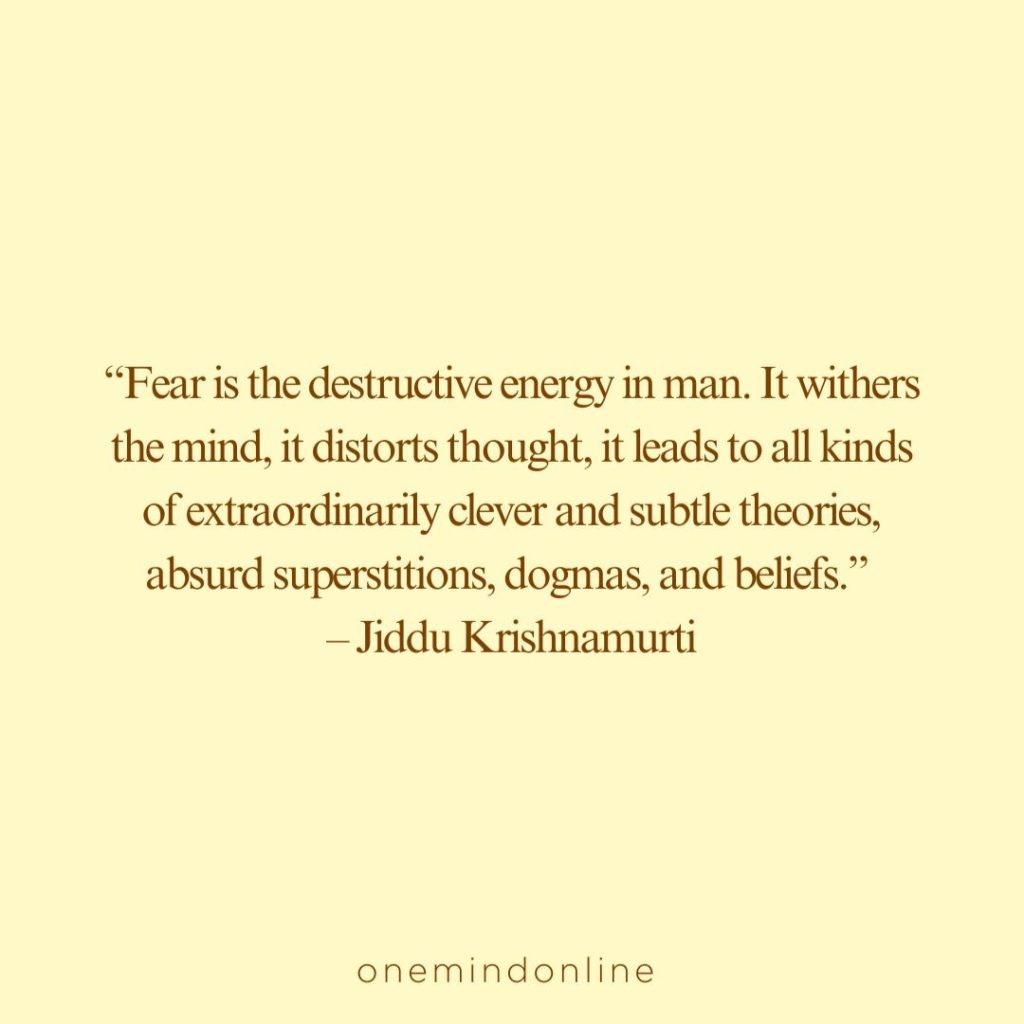
“Fear is the destructive energy in man. It withers the mind, it distorts thought, it leads to all kinds of extraordinarily clever and subtle theories, absurd superstitions, dogmas, and beliefs.” – Jiddu Krishnamurti
“What is needed, rather than running away or controlling or suppressing or any other resistance, is understanding fear; that means watch it, learn about it, come directly into contact with it. We are to learn about fear, not how to escape from it.” – Jiddu Krishnamurti
“If you come across fear, stare into its eyes. Face it and you will notice that fear fades away.” – Jiddu Krishnamurti
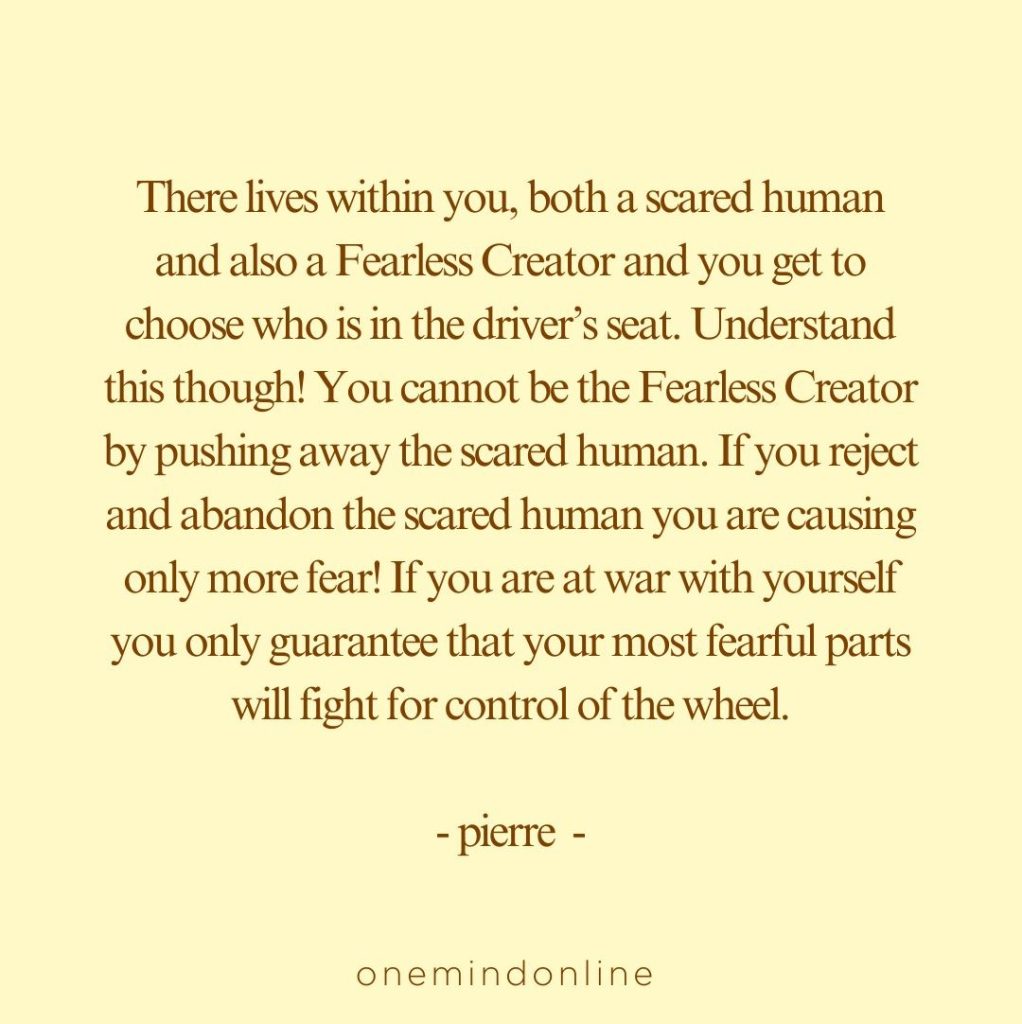
There lives within you, both a scared human and also a Fearless Creator and you get to choose who is in the driver’s seat. Understand this though! You cannot be the Fearless Creator by pushing away the scared human. If you reject and abandon the scared human you are causing only more fear! If you are at war with yourself you only guarantee that your most fearful parts will fight for control of the wheel.
But if you listen to the scared human. If you allow him/her to be heard. If you ask them why they’re scared, if you seek to understand and to hold the scared human, then a softening happens, the fear gradually subsides.
And what’s more, ask yourself this question, “If I am looking at the scared human. If I am listening to and holding the scared human, then who am I BEING?”
Well of course you are being the Fearless Creator!
Affirmations for the fearless creator that you are:
- “My fears do not define me; they are messengers asking to be heard and understood.”
- “I have the courage to face myself exactly as I am, without judgment or rejection.”
- “When I hold my scared self with compassion, I embody my most powerful self.”
- “The path to fearlessness begins with acceptance, not with conquest.”
We spend our lives running from imagined deficiencies, insecurities, and perceived limitations. We fear not living up to some self-constructed ideal, creating a constant undercurrent of anxiety that shapes our choices and actions.
We break the bonds that fear holds over us only once we come face to face with our fears about ourselves, and look at them in their eyes until understanding brings a softening to our gaze.
Today’s meditation explores the role that fear plays in the formation of our personalities, and the work that we can do to get beyond our fearful voices. Please join us.
– pierre –
Today’s LIVE meditation is: A sense of self.
Today’s LIVE meditation
https://youtu.be/fsDzA3N_DGM 2026
https://youtu.be/xCcjt3rOTXE 2025
https://youtu.be/O2ONLI9Q13o 2024
https://youtu.be/V95q_jA7G1s 2023
Practice the “Daily Dose”
Let’s put it into practice! Choose what works for you – daily, once a week or whenever inspiration strikes. Putting pen to paper wires the neural pathways that will create your new habits.
1 – Affirmation
Write down your favourite affirmation on a sticky note and place it somewhere that you’ll be able to see it the whole day.
- “My fears do not define me; they are messengers asking to be heard and understood.”
- “I have the courage to face myself exactly as I am, without judgment or rejection.”
- “When I hold my scared self with compassion, I embody my most powerful self.”
- “The path to fearlessness begins with acceptance, not with conquest.”
2 – A moment of reflection
Use today’s question as a journal prompt. If you don’t have the time to sit down and write, just take a moment to reflect on your response.
The Voice of Your Scared Human: When you quiet your mind and truly listen, what is your “scared human” trying to tell you? Write a dialogue between your wisest self, and this frightened part of you. What specific fears does it express, and where might these fears have originated in your past? What does your wisdom know that your scared self needs to hear from you?
3 – Quotes to share
Send a quote to someone who needs it, or share them all on social media to spread the good vibes!





4 – Q&A for deeper learning
Read through the questions and answers and write down at least one “aha moment” that clicked for you.
Q1: Why is facing ourselves so frightening?
Facing ourselves is frightening because it means confronting the gap between who we think we should be and who we actually are. We’ve spent years constructing narratives about ourselves—some flattering, some deeply critical—and examining these stories requires us to acknowledge uncomfortable truths we’ve been avoiding. This self-examination threatens the identity we’ve carefully built and maintained.
Q2: What’s the difference between suppressing fear and understanding it?
Suppressing fear means pushing it down, ignoring it, or pretending it doesn’t exist. This creates internal conflict because the fear doesn’t disappear—it simply operates beneath the surface, influencing your decisions unconsciously. Understanding fear means observing it without judgment, exploring its origins, and recognizing what it’s trying to protect you from. This compassionate awareness gradually dissolves fear’s power over you.
Q3: How can I tell if I’m being controlled by fear?
Signs that fear is controlling you include: avoiding certain conversations or situations without clear reason, feeling paralyzed when making decisions, harshly criticizing yourself, constantly seeking external validation, staying in your comfort zone despite feeling unfulfilled, or experiencing anxiety about being “found out” as inadequate. When fear drives your choices, you’ll notice a pattern of playing small and second-guessing yourself.
Q4: What does it mean to be at war with yourself?
Being at war with yourself means rejecting parts of who you are—your vulnerabilities, mistakes, imperfections, or fears. It’s the internal dialogue where one part of you criticizes, shames, or tries to force another part to change. This creates exhausting internal conflict where you simultaneously want to grow and resist growth, want to be authentic yet hide your true self.
Q5: How do I practically “hold” my scared human with compassion?
Start by acknowledging your fear without judgment: “I notice I’m feeling afraid right now.” Then, ask gentle questions: “What are you afraid of? What do you need to feel safe?” Speak to yourself as you would to a frightened child or dear friend—with patience, kindness, and understanding. You might place a hand on your heart and offer yourself words of comfort. This practice creates internal safety rather than internal conflict.
Q6: Can understanding fear really make it go away?
Understanding fear doesn’t make it vanish instantly, but it fundamentally changes your relationship with it. When you understand the roots of your fear and treat it with compassion, it loses its controlling power. The fear may still arise in certain situations, but instead of being hijacked by it, you can acknowledge it, understand its message, and choose your response consciously. Over time, this practice does lead to significant reduction in fear’s intensity.
Q7: What’s the connection between fear and personal growth?
Fear and personal growth are intimately connected because growth requires stepping into the unknown—and the unknown triggers fear. However, the specific fears that block growth aren’t about external risks but about internal ones: fear of discovering you’re not who you thought you were, fear of being inadequate, or fear of facing painful truths. Real personal development happens when you cultivate the courage to face these internal fears with honesty and compassion, allowing you to move beyond self-imposed limitations.