Ready for a quick dose of inspiration? This article is a 2-minute sprint. Now, if you’re in the mood to go a longer distance, take a peek at our extended menu!
A message from today’s meditation:
Have you fully realized how every single moment holds the potential for something incredible. Opportunities to connect, to grow, to truly experience life – all waiting to be grasped. Yet, so often, we miss them entirely. We get caught up in the autopilot of our past, dwelling on what was or worrying about what might be. This constant mental ping-pong between past and future leaves us disconnected from the only place where opportunity truly exists: the present moment.
What makes the grip of our past so powerful is that all of our lived experience creates a recording within us which has the feeling of familiarity. The sense of familiarity that our past holds, can be one the biggest stumbling blocks to fully participating in the present moment.
“It takes a lot of courage to release the familiar and seemingly secure, and to embrace the new. But there is no real security in what is no longer meaningful anyway.” – Alan Cohen
“Everything will change when your desire to move on exceeds your desire to hold on.” – Alan Cohen
“To grow, you must be willing to let your present and future be totally unlike your past. Your history is not your destiny.” – Alan Cohen
“Being present” is not some new-age fad of skipping reality and living only for the moment, it’s simply the most productive you can be when you decide to spend your energy in the only realm where it has an effect – right here, right now.
No more pouring energy into fears from the past.
No more pouring energy into anxiety about the future.
Instead, moment by moment, asking yourself these questions:
- “What does this moment require of me?“
- “What does this moment invite me to take action on?”
- “What does this moment make available to me?”
There is opportunity in every moment, but it becomes available to us only when we make ourselves available to this present moment. We miss it when we are trapped in the automatic response from our past.
Being present doesn’t necessarily make it easier, but it does make your response a lot more effective.
A few thoughts to unlock the power of presence:
- Notice the grip of the past on your present. Are you clinging to outdated patterns?
- Identify your repetitive thoughts. Are they empowering or hindering your growth?
- Choose courage over comfort. Embrace the unknown possibilities that lie ahead.
- Ask yourself the empowering question: What does this moment offer me?
By incorporating these practices into your daily life, you’ll be well on your way to unlocking the power of presence. Remember, opportunity awaits in every single moment. Be present, and watch your life transform.
– pierre –
Today’s LIVE meditation is: The power of NOW.
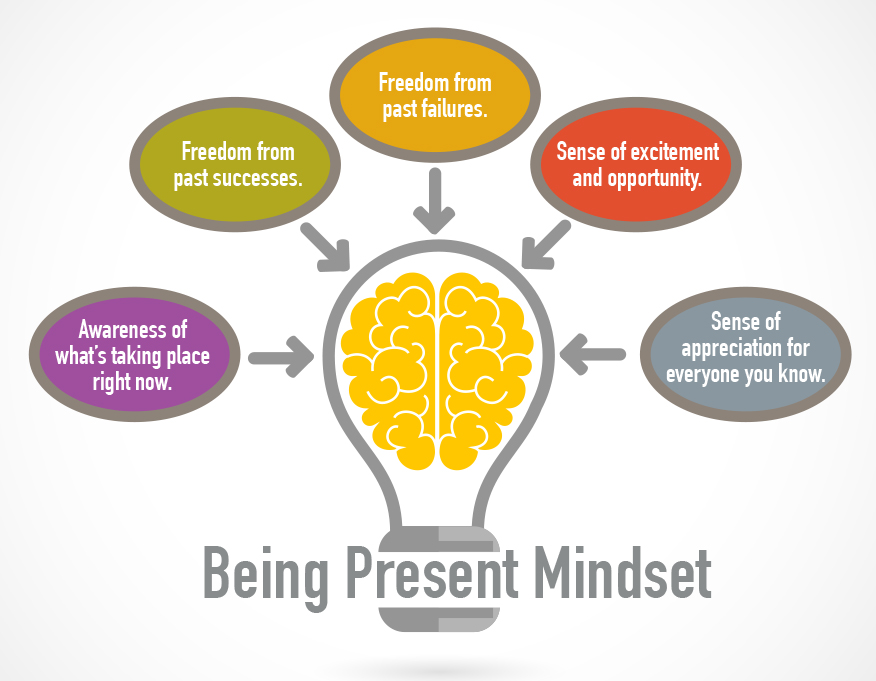
(Image credit: Strategic Coach – https://resources.strategiccoach.com/the-multiplier-mindset-blog/the-being-present-mindset)
A moment of reflection
(If you have the time, use this question as a journal prompt, because whenever you put pen to paper you’re wiring the neural pathways that create your new habits. But if you don’t have the time, just take a moment to reflect on your response.)
Rewriting Your Response Script: Think of a challenging situation or relationship that consistently triggers your automatic responses – those knee-jerk reactions that seem to happen before you can even think. This might be a difficult conversation with a family member, a stressful work scenario, or a personal insecurity that gets activated. Write out your typical automatic response pattern in detail. What thoughts race through your mind? What emotions arise? How do you usually react, and what are the predictable outcomes of this pattern?
Now, using the three powerful questions from the article, rewrite this scenario: “What does this moment require of me? What does this moment invite me to take action on? What does this moment make available to me?” What new responses become possible? What growth opportunities exist within this challenge that you might have been missing? Write a detailed vision of how you could engage with this situation as the person you’re becoming rather than the person you’ve always been.
Today’s LIVE meditation
https://youtu.be/UXQN-7Av934 2024
https://youtu.be/p8fIZKr2ECw 2023
https://www.youtube.com/watch?v=_G9eK5im0LE 2022
Q&A for deeper learning
1. Q: I understand the concept of being present, but I keep finding myself lost in thoughts about the past or future. Am I failing at this?
A: You’re not failing – you’re human. The mind’s tendency to wander into past and future is completely natural and has helped our species survive. The key isn’t to eliminate these thoughts but to develop awareness of when they’re happening and gently redirect your attention back to the present. Think of it like training a muscle – each time you notice you’ve drifted and consciously return to the present, you’re strengthening your capacity for awareness. The “noticing” itself is the practice, not the perfect maintenance of present-moment focus.
2. Q: My past experiences have taught me valuable lessons. Isn’t letting go of the familiar like throwing away important wisdom?
A: There’s a crucial difference between learning from your past and being imprisoned by it. Your experiences contain valuable wisdom, but that wisdom is meant to inform your present choices, not dictate them. When you’re truly present, you can access these lessons consciously and apply them skillfully rather than being unconsciously controlled by them. The goal isn’t to forget your past but to prevent it from automatically writing your future. You become the conscious author of your responses rather than a passive prisoner of your conditioning.
3. Q: Sometimes being present feels overwhelming because I become more aware of difficult emotions or uncomfortable situations. How do I handle this?
A: This is actually a sign that your practice is working. When you stop numbing yourself with mental time travel, you naturally become more sensitive to what’s actually happening in your life. The discomfort you’re feeling isn’t created by being present – it was already there, you were just avoiding it. Present-moment awareness gives you the opportunity to address these feelings directly rather than letting them unconsciously drive your behavior. Start with small doses of presence, and remember that feeling your emotions fully is what allows them to move through you rather than getting stuck in your system.
4. Q: I worry that if I stop planning for the future and analyzing the past, I’ll become irresponsible or make poor decisions. How do I balance presence with practical life management?
A: Present-moment awareness actually enhances your decision-making abilities rather than diminishing them. When you’re fully present, you can engage in planning and reflection from a place of clarity rather than anxiety or compulsion. The difference is conscious engagement versus unconscious preoccupation. You can set aside specific times for strategic thinking and planning while ensuring that these activities serve your present goals rather than becoming escape mechanisms from current reality. Presence gives you the power to choose when and how to engage with past and future rather than being at their mercy.
5. Q: What if the people around me aren’t interested in growth or living consciously? How do I maintain my practice in environments that don’t support it?
A: Your commitment to presence is a gift you give yourself and others, regardless of their level of awareness. When you show up fully present in your interactions, you create an invitation for others to do the same – though they may not consciously recognize it. Focus on being a living example rather than trying to convince others to change. Your presence becomes a stabilizing force in any environment. Remember, you’re not responsible for other people’s level of consciousness, but you are responsible for your own. Sometimes the most profound impact you can have is simply being authentically present while others are scattered.
6. Q: I’ve been practicing presence for a while, but I don’t feel like my life is transforming dramatically. What am I missing?
A: Transformation often happens in subtle, incremental ways that are easy to miss if you’re looking for dramatic external changes. The shifts might be showing up as increased clarity in decision-making, improved relationships, reduced anxiety, or a general sense of being more grounded. Sometimes we’re so focused on what we think transformation should look like that we miss what’s actually changing. Consider keeping a simple daily log of moments when you felt present and the quality of your experience during those times. The cumulative effect of these moments creates profound change over time, even if each individual moment feels ordinary.
7. Q: When I try to be present, I often feel like I’m not “doing” anything productive. How do I reconcile presence with the need to achieve goals and make progress?
A: This concern reveals a common misconception that presence is passive. In reality, present-moment awareness is the most productive state you can cultivate because it allows you to direct your energy where it can actually have an impact. When you’re fully present, your actions become more intentional, your focus more concentrated, and your results more effective. The three questions from the practice – “What does this moment require of me? What does this moment invite me to take action on? What does this moment make available to me?” – are designed to help you identify the most impactful actions you can take right now. Presence isn’t about doing less; it’s about doing what matters most with complete engagement.