

Fancy a quick shot of inspiration? This article is a zippy 2-minute read. But if you’re feeling like a super sleuth wanting to uncover all the secrets, our menu of extra goodies is just the place to dig in!
A message from today’s meditation:
Our teacher for this week is Swami Vivekananda, a philosopher from India who lived during the 1800’s. He became known in the Western world when he travelled to the USA in 1893 to speak at the world parliament of religions as the representative of India.
Hereafter he was invited to speak and teach all over the US and Europe with his core message being: “all living beings are an embodiment of the divine self; therefore, service to God could be rendered by service to humankind.”
Today’s meditation journey follows from these thoughts:
“Where can we go to find God if we cannot see Him in our own hearts and in every living being.” – Swami Vivekananda
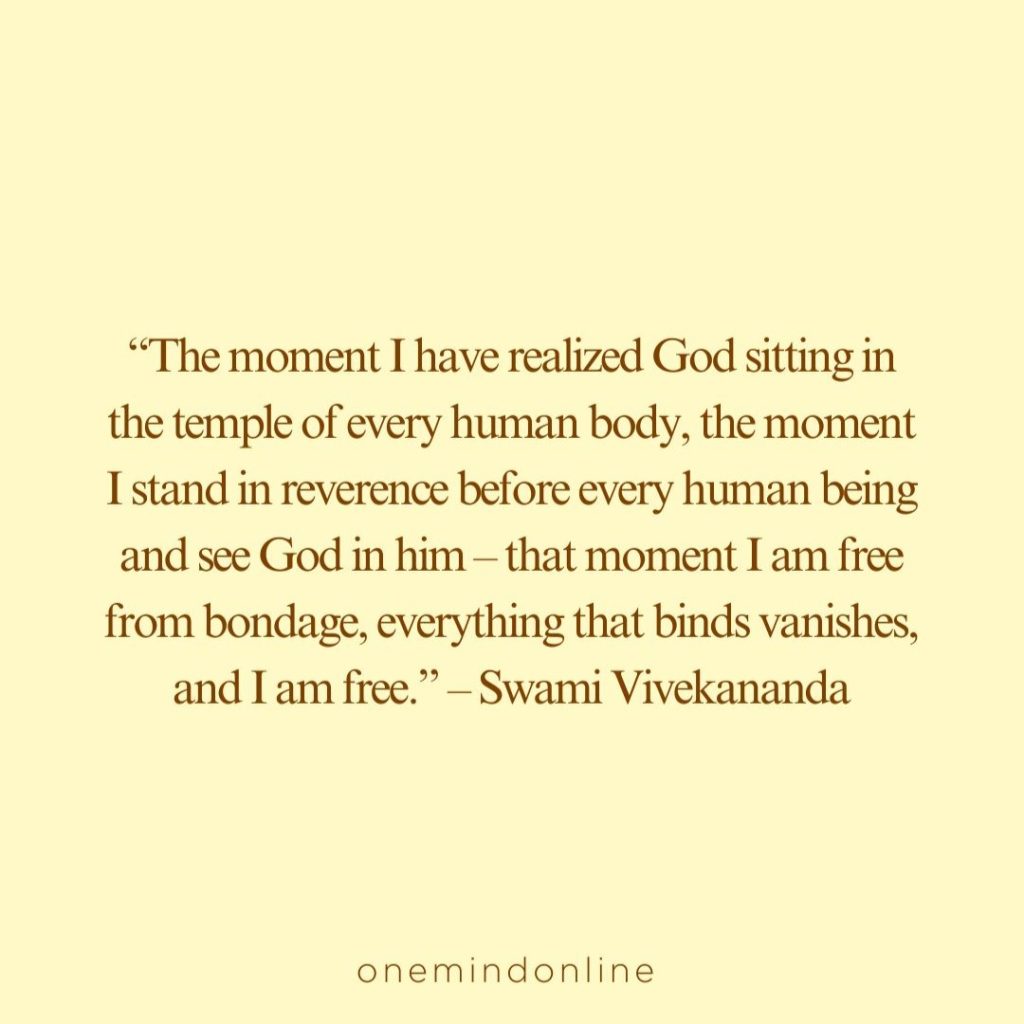
“The moment I have realized God sitting in the temple of every human body, the moment I stand in reverence before every human being and see God in him – that moment I am free from bondage, everything that binds vanishes, and I am free.” – Swami Vivekananda
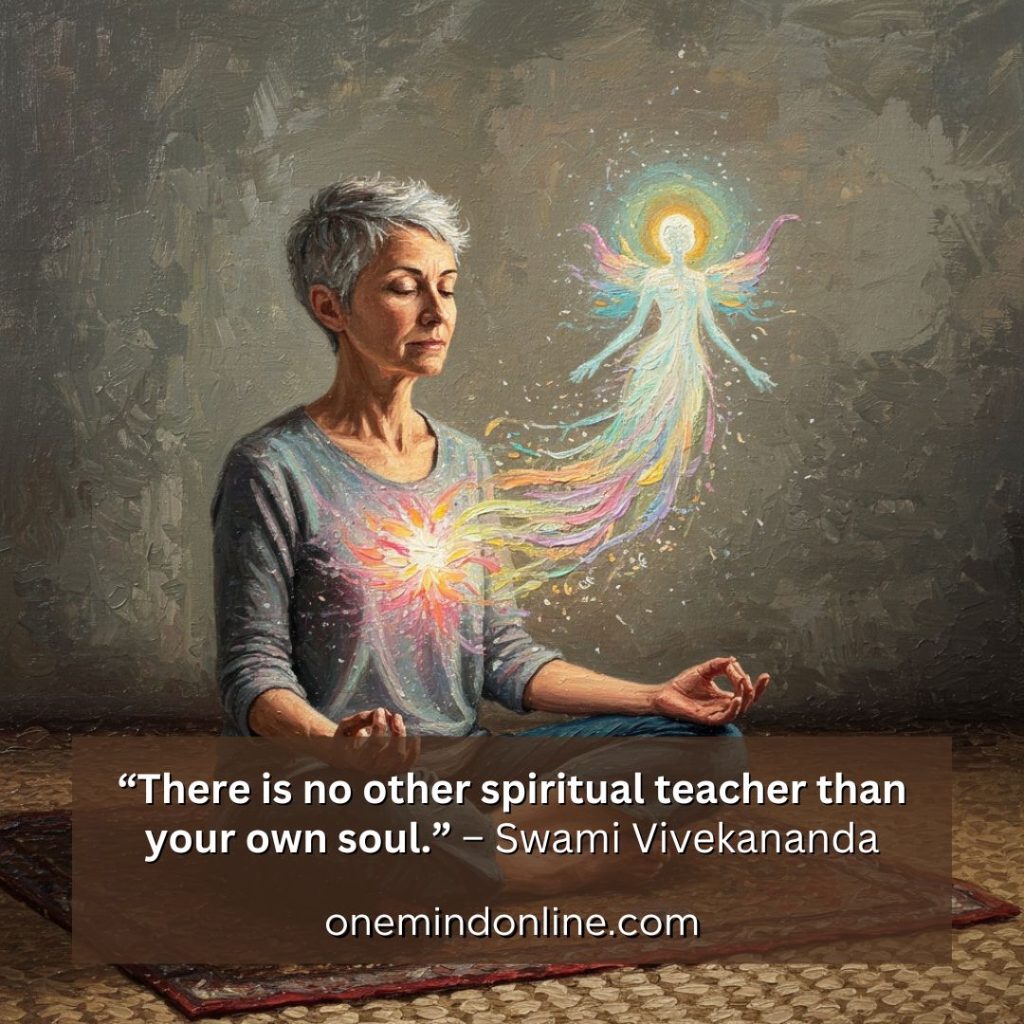
“There is no other spiritual teacher than your own soul.” – Swami Vivekananda
“In one word, this ideal is that you are divine.” – Swami Vivekananda
There is no place in the world to travel to where the presence of God exclusively lives, but within your-SELF. You have divine wisdom in you, we all do! And we can learn to sit at the feet of our soul and listen.
So, how do we unlock this divine wisdom within? A consistent practice of meditation offers a gentle path towards learning how to listen. It’s not about achieving enlightenment overnight; it’s about establishing a practice of introspection and self-discovery. It’s about showing up consistently to the conversation your soul has been trying to have with you. Every moment of stillness, every breath of awareness, every instance of self-compassion is a step toward unlocking the teacher within.
Today’s guided meditation focuses on the Serenity Prayer, a powerful tool for cultivating your ability to listen to the voice of wisdom speak from your soul.
Here are a few thoughts to open you to the wisdom of your soul:
- “There is no other spiritual teacher than your own soul.” – Allow your soul to guide you.
- “See the divine in every living being.” – Cultivate compassion and understanding.
- “You are the very essence of the divine.” – Recognize and embrace your inherent potential.
Remember, the divine isn’t some distant entity; it’s the very essence of who you are. Open your heart, listen to your soul, and witness the magnificent power unfold within you. You are a vessel for wisdom to flow through. Embrace the journey, and allow your soul to be your guide.
– pierre –
Today’s LIVE meditation is: The serenity prayer.
A moment of reflection
(If you have the time, use this question as a journal prompt, because whenever you put pen to paper you’re wiring the neural pathways that create your new habits. But if you don’t have the time, just take a moment to reflect on your response.)
Discovering Your Inner Teacher: Reflect on a recent challenge or decision you’ve been facing. Before seeking external advice, sit quietly and ask your soul what it knows about this situation. Write about what comes up when you listen deeply to your inner voice. What wisdom emerges when you trust that you already have the answers within you? How does this inner guidance feel different from external opinions or societal expectations?
Today’s LIVE meditation
https://youtu.be/HUmWGnW1zfY 2025
https://youtu.be/m3z-ivZW3jg 2024
https://youtu.be/73IaS2U_sU8 2023
https://youtu.be/eOdn1ce93XM 2022



Q&A for deeper learning
1. Q: What does it mean that “there is no other spiritual teacher than your own soul”?
A: This doesn’t mean you should reject all external guidance or teachers. Rather, it means that the ultimate authority and wisdom for your life comes from within. External teachers, books, and experiences can point you toward truth, but your soul is the final interpreter of what resonates and what doesn’t. Your inner wisdom knows what’s right for your unique path and circumstances in ways that no external source can fully understand.
2. Q: How can I learn to trust my inner voice when I’m so used to seeking external validation?
A: Start small. Begin by asking your inner wisdom about low-stakes decisions and notice what feels right in your body and heart. Practice meditation or quiet reflection regularly to become familiar with how your soul communicates with you. Over time, you’ll develop confidence in distinguishing between your authentic inner voice and the noise of fear, conditioning, or external expectations.
3. Q: What if I don’t feel “divine” or don’t believe I have this inner wisdom?
A: This is completely normal and doesn’t negate the truth of your divine nature. Often, years of conditioning, trauma, or negative messaging can disconnect us from our inherent wisdom. The practice is about remembering, not becoming. Start with small acts of self-compassion and notice the intelligence in your body, the creativity in your mind, and the love in your heart. These are expressions of your divine nature.
4. Q: How do I “see the divine in every living being” when some people seem to act in harmful ways?
A: Seeing the divine in others doesn’t mean condoning harmful behavior or bypassing necessary boundaries. It means recognizing that beneath all conditioning, pain, and destructive patterns, there exists a core essence that is inherently whole. This perspective can help you respond from compassion rather than pure reactivity, while still protecting yourself and others from harm.
5. Q: Is meditation the only way to connect with my inner teacher?
A: While meditation is a powerful tool for inner connection, it’s not the only path. Your soul can speak through creative expression, time in nature, journaling, movement, dreams, and quiet contemplation. The key is creating space for inner listening, whatever form that takes. Some people connect through service to others, while others find their inner voice through artistic expression or physical practices.
6. Q: How do I know if what I’m hearing is my soul’s wisdom or just my ego or fears talking?
A: Your soul’s wisdom typically feels expansive, loving, and peaceful, even when delivering challenging truths. It often comes with a sense of “rightness” or recognition. Fear-based thoughts tend to be urgent, critical, and contracting. Ego-driven thoughts often focus on superiority, control, or external validation. With practice, you’ll learn to distinguish between these different voices within you.
7. Q: Can this inner wisdom approach work alongside traditional therapy or medical treatment?
A: Absolutely. Inner wisdom complements rather than replaces professional help. Your soul’s wisdom might actually guide you toward seeking appropriate professional support when needed. This approach is about developing your capacity for self-awareness and intuitive guidance, not about replacing necessary medical or psychological care. The goal is integration—using all available resources, including your inner wisdom, to support your healing and growth.