

“Your Daily Dose” is a quick two minute read packed with bite-sized wisdom from all the great teachers. But you could also choose to turn it into something more… a powerful daily practice for personal growth. Give it a try!
A message from today’s meditation:
Our teacher for this week is Swami Vivekananda, an Indian monk, philosopher and author who was instrumental in bringing Yoga to the western world. At the end of the 1800’s he extensively toured the U.S.A., England and Europe hosting hundreds of lectures and is credited with raising interfaith awareness.
At the start of this new week, Swami Vivekananda reminds you that you know how to do this!
You already hold the key to all of the wisdom you will ever need. The muddy water that keeps you from seeing with clarity, gets stirred up only by the splashing of your own fears. Form new, healthier relationships with your old fears, and clarity will become available in the calm water that is your true nature.
“True guidance is like a small torch in a dark forest, it doesn’t show everything at once. But gives enough light for the next step to be safe.” – Swami Vivekananda
“All the powers in the universe are already ours. It is we who have put our hands before our eyes and cry that it is dark.” – Swami Vivekananda
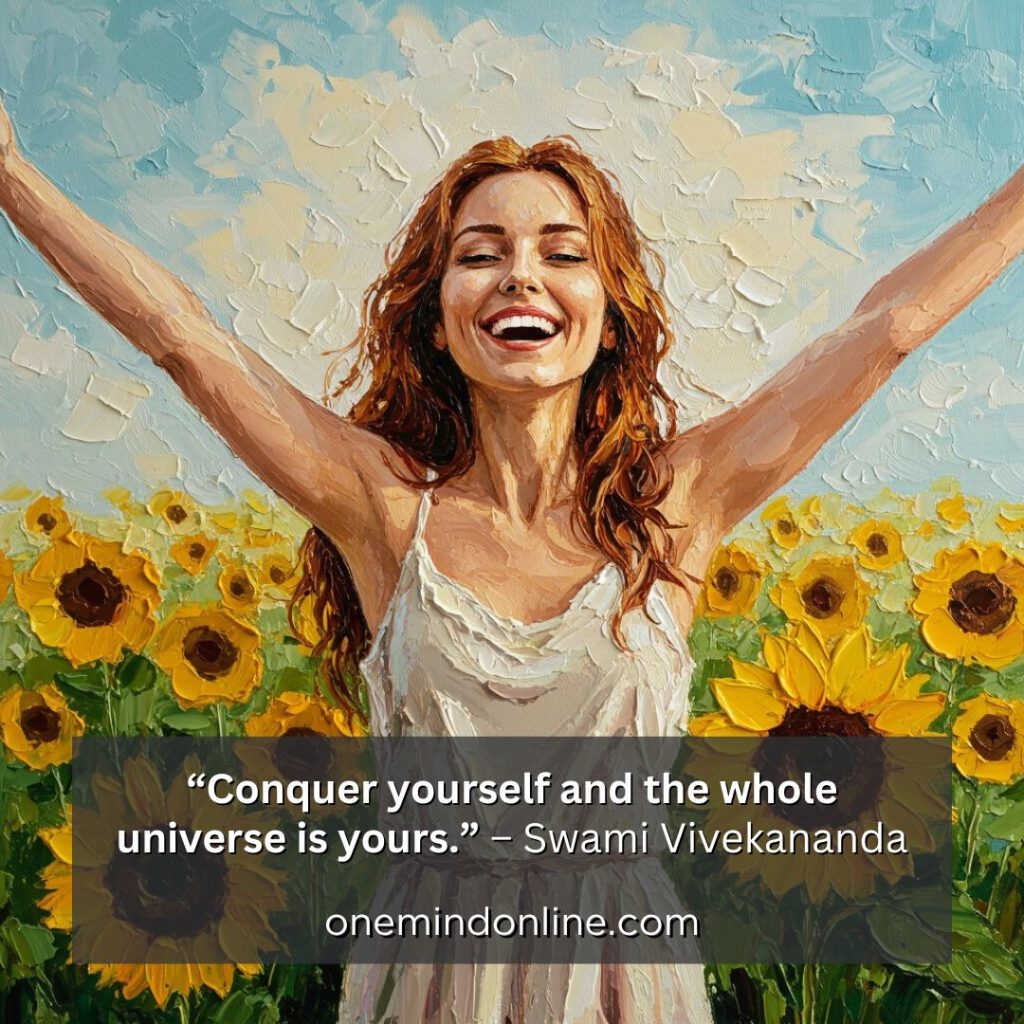
“Conquer yourself and the whole universe is yours.” – Swami Vivekananda
Conquering yourself isn’t about suppressing fear or pretending it doesn’t exist. It’s about developing a healthier relationship with fear – recognizing it as information rather than instruction. Fear like all emotions is a messenger, it brings information that perhaps we need to hear. But we don’t put the messenger in charge of making decisions do we?
When you stop letting fear make your decisions, something remarkable happens: you begin to access the vast universe of potential that has always existed within you. You start creating from possibility rather than limitation, from abundance rather than scarcity.
We can create from a place of fear or we can create from a place of freedom. The problem with fear as a motivator is that we are trying to create while looking over our shoulder, and then the best we can ever do is only just escape punishment or bad consequences. With fear in the driver’s seat we’re unable to see the possibilities available to us and will never create to our true potential.
Today’s meditation explores your own balance of fear vs freedom, join us to get your week off to a great start.
Affirmations to set yourself free:
- “Fear is information, not instruction – Fear is a messenger, not a decision maker.”
- “Clarity is my true nature – When I stop splashing in fear, the water becomes clearer.”
- “I focus only on the next small step – Each small step forward empowers me to take the next.”
- “A universe of possibilities opens up to me – when I stop creating from fear and start creating from freedom.”
Fear doesn’t have to be an obstacle; it can be a stepping stone. By conquering your fears and embracing the journey, you unlock the vast universe of potential that lies within you.
Wishing you a productive week creating from a place of freedom, and not from a place of fear.
– pierre –
Today’s LIVE meditation is: Jumpstart the week!
Today’s LIVE meditation
https://youtu.be/XpSxHF4sBqo 2025
https://youtu.be/68NXGFLpAwE 2024
https://youtu.be/DgDKH1XFKXg 2023
https://youtu.be/Pwx-iwTlfnY 2022
Practice the “Daily Dose”
Let’s put it into practice! Choose what works for you – daily, once a week or whenever inspiration strikes. Putting pen to paper wires the neural pathways that will create your new habits.
1 – Affirmation
Write down your favourite affirmation on a sticky note and place it somewhere that you’ll be able to see it the whole day.
- “Fear is information, not instruction – Fear is a messenger, not a decision maker.”
- “Clarity is my true nature – When I stop splashing in fear, the water becomes clearer.”
- “I focus only on the next small step – Each small step forward empowers me to take the next.”
- “A universe of possibilities opens up to me – when I stop creating from fear and start creating from freedom.”
2 – A moment of reflection
Use today’s question as a journal prompt. If you don’t have the time to sit down and write, just take a moment to reflect on your response.
Reflect on Vivekananda’s quote: “All the powers in the universe are already ours. It is we who have put our hands before our eyes and cry that it is dark.” What “hands” have you placed over your own eyes? Write about the internal barriers you’ve created – the stories you tell yourself about what you can’t do, who you’re not, or what’s not possible for you. Then, describe what might be revealed if you slowly removed these hands. What abilities, opportunities, or dreams might you discover? What would your life look like if you truly believed you already possess everything you need to succeed?
3 – Quotes to share
Send a quote to someone who needs it, or share them all on social media to spread the good vibes!



4 – Q&A for deeper learning
Read through the questions and answers and write down at least one “aha moment” that clicked for you.
Q1. What does “conquer yourself” actually mean in practical terms?
Conquering yourself means developing mastery over your internal responses rather than trying to control external circumstances. It’s about recognizing when fear, doubt, or limiting beliefs are driving your decisions and choosing to act from a place of wisdom and courage instead. Practically, this might mean having that difficult conversation you’ve been avoiding, starting the project you’ve been putting off, or simply noticing when you’re making excuses and choosing differently. It’s not about suppressing emotions, it’s about becoming the conscious director of your own life rather than a passive reactor to circumstances.
Q2. How can I tell the difference between healthy caution and fear-based avoidance?
Healthy caution involves thoughtful risk assessment and preparation, while fear-based avoidance typically involves creating stories about why action isn’t possible or necessary. Healthy caution asks “How can I do this safely?” while fear-based avoidance asks “Why shouldn’t I do this at all?” If you find yourself constantly moving the goalposts (“I’ll do it when I have more money/time/experience”), creating elaborate justifications for inaction, or feeling a sense of contraction and heaviness around the topic, you’re likely dealing with fear-based avoidance. Healthy caution helps you take the next step safely; fear-based avoidance prevents you from taking the next step at all.
Q3. I understand the concept intellectually, but how do I actually start “creating from freedom” instead of fear?
Start by becoming aware of your current patterns. Notice when you’re making decisions to avoid something negative versus pursue something positive. Begin with small, low-stakes situations where you can practice choosing courage over comfort. For example, speak up in a meeting, try a new hobby, or have an honest conversation with a friend. Each time you choose freedom over fear, you’re building your “freedom muscle.” The key is consistency, not perfection – you’re retraining your nervous system to see opportunity where it used to see threat.
Q4. What if my fears seem rational and based on real past experiences?
It’s worth being honest here: not all fear is illusion. There are real, physical dangers in the world, and no amount of reframing changes that some situations genuinely call for caution. So the goal isn’t to decide whether a fear is “rational,” because most fears are rational in some sense – they usually point back to something that was absolutely real. The more useful question is whether this particular fear, right now, is helping you or hurting you. A fear that keeps you alert crossing a busy street is doing its job. A fear that keeps you from ever crossing the street again because you were once nearly hit by a car (or even actually hit) is no longer protecting you – it’s running the show. This is the discernment Vivekananda points to: the water isn’t muddy because fear is bad, it’s muddy because we’ve stopped checking whether the old alarm still matches the present moment. Honoring what a past experience taught you doesn’t require letting it dictate every future decision. The practice is learning to ask, each time, “Is this fear informing me or is it controlling me?” – and answering honestly, even when the fear has a real story behind it.
Q5. What about external obstacles that are genuinely beyond my control?
While you can’t control external circumstances, you always have some degree of choice in how you respond to them. The practice of self-conquest isn’t about denying external reality – it’s about maximizing your agency within whatever constraints exist. Sometimes the most powerful form of self-conquest is accepting what you cannot change while taking full responsibility for what you can. This might mean adapting your goals, finding creative solutions, or simply changing your relationship to the obstacle. The question shifts from “How do I eliminate this obstacle?” to “How do I grow through working with this obstacle?”
Q6. This sounds like a lot of work. Is there a simpler way to start?
The beautiful thing about this approach is that it can start with something incredibly simple: the next time you notice yourself avoiding something because you’re afraid, take one small step toward it instead. Don’t worry about conquering all your fears or transforming your entire life – just practice taking the next right step. As Vivekananda said, true guidance is like a small torch that shows just enough light for the next step to be safe. You don’t need to see the whole path; you just need to be willing to take one step. The complexity comes from our resistance to simplicity, not from the practice itself. Start small, be consistent, and trust that each step builds on the last.