

“Your Daily Dose” is a quick two minute read packed with bite-sized wisdom from all the great teachers. But you could also choose to turn it into something more… a powerful daily practice for personal growth. Give it a try!
A message from today’s meditation:
We move through our days surrounded by people – on crowded streets, in coffee shops, across digital screens – yet how often do we truly see them? In our autopilot existence, we reduce the intricate beings around us to mere background figures in our own personal narratives, not recognizing each individual as a complex universe unto themselves. What if we shifted our perspective? What if we saw in each person, not a stranger, but a reflection of our own inherent wholeness? This is the journey we embark on today, one that begins within and extends outward, creating a ripple effect of compassion and acceptance.
Do you have an awareness of your own wholeness?
“The wholeness and freedom we seek is our true nature, who we really are.” – Jack Kornfield
“We are already complete. All we need is the clarity to recognize the wholeness that we are.” – Rod Stryker
The wholeness we seek is already who we are. We simply need to find acceptance for all that we are to experience that we can hold it all in wholeness. As we consolidate all of our human aspects, we learn that our individual wholeness extends to a larger oneness.
“Reclaim your belonging, first by reconnecting with your soul – and then by loving the world from that powerful inner centre of love, sovereignty and wholeness.” – Hiro Boga
“A person experiences life as something separated from the rest – a kind of optical delusion of consciousness. Our task must be to free ourselves from this self-imposed prison, and through compassion, to find the reality of Oneness.” – Albert Einstein
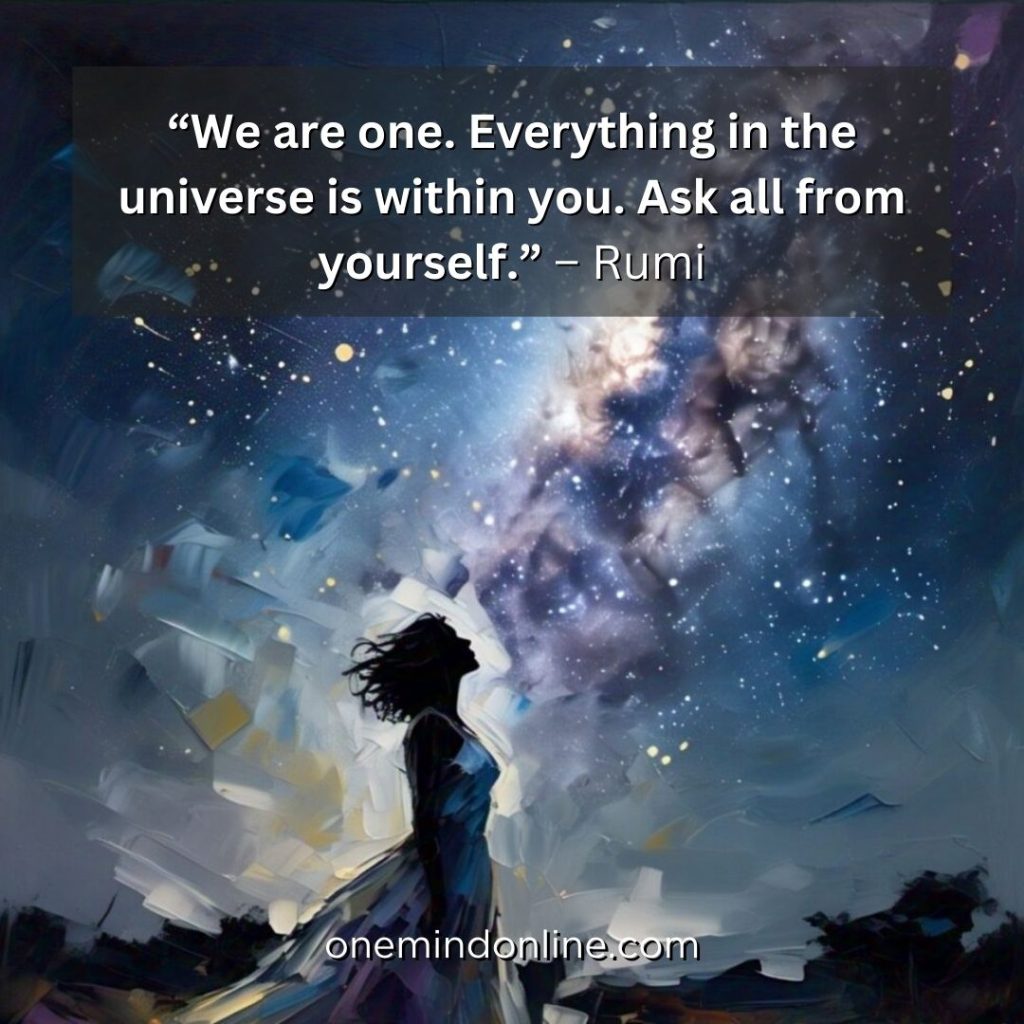
“We are one. Everything in the universe is within you. Ask all from yourself.” – Rumi
When your journey within inevitably leads to your own wholeness, then it becomes increasingly clear that the humans around you are a part of that same wholeness too.
Wholeness doesn’t mean perfection though. It means accepting the full spectrum of our human experience – the light and shadow, joy and sorrow, courage and fear. Accepting and integrating these seemingly opposing parts fosters a sense of internal unity, allowing us to experience the world from a place of balance and authenticity. And when we can hold the balance of these opposites within ourselves, then we allow the humans around us to authentically express their own emotional range too.
Here are a few mantras to accompany you on this journey:
- “I am whole and complete, exactly as I am.”
- “I embrace all aspects of myself with love and acceptance.”
- “I connect with others from a place of wholeness, fostering a sense of interconnectedness.”
Today’s message invites you on a journey towards this oneness. Join us for our LIVE meditation session on “Tonglen,” a practice that cultivates compassion and understanding for oneself and others. Let’s embark on this path together, embracing our own wholeness and extending that acceptance to the beautiful tapestry of humanity around us.
– pierre –
Today’s LIVE meditation is: Tonglen
Today’s LIVE meditation
https://youtu.be/0YIKIcOhd4Q 2026
https://youtu.be/Q4byhgWWY8k 2025
https://youtu.be/Q597gXXoDgo 2024
https://youtu.be/KG-PI8GGOwU2022
https://www.youtube.com/watch?v=OFKdtf8vdSU 2021
Practice the “Daily Dose”
Let’s put it into practice! Choose what works for you – daily, once a week or whenever inspiration strikes. Putting pen to paper wires the neural pathways that will create your new habits.
1 – Affirmation
Write down your favourite affirmation on a sticky note and place it somewhere that you’ll be able to see it the whole day.
- “I am whole and complete, exactly as I am.”
- “I embrace all aspects of myself with love and acceptance.”
- “I connect with others from a place of wholeness, fostering a sense of interconnectedness.”
2 – A moment of reflection
Use today’s question as a journal prompt. If you don’t have the time to sit down and write, just take a moment to reflect on your response.
The Mirror of Connection: Think of someone you find difficult to understand or accept. What aspects of yourself might you be rejecting that you also see (or fear seeing) in them? How does your relationship with your own wholeness (accepting your own spectrum, including both light and shadow) affect your ability to recognize their complexity?
3 – Quotes to share
Send a quote to someone who needs it, or share them all on social media to spread the good vibes!


4 – Q&A for deeper learning
Read through the questions and answers and write down at least one “aha moment” that clicked for you.
Q1: What does “wholeness” actually mean in a practical sense?
Wholeness means accepting and integrating all aspects of yourself—both the parts you celebrate and the parts you’d rather hide. It’s not about being perfect or having it all together; it’s about recognizing that your vulnerabilities, fears, joys, and strengths all belong to you and all deserve compassion. Practically, it means stopping the habit of rejecting parts of yourself and instead acknowledging your full emotional and psychological range as valid and human.
Q2: How can recognizing my own wholeness change how I see others?
When you stop fragmenting yourself internally, you naturally stop reducing others to one-dimensional characters. You begin recognizing that the person who cut you off in traffic, your frustrating coworker, or even people with opposing viewpoints are complex beings navigating their own journeys. This recognition doesn’t require you to agree with everyone, but it allows you to engage with others from compassion rather than judgment because you’ve learned to do the same for yourself.
Q3: Why do we struggle to see ourselves as already whole?
From childhood, we receive messages that we need to improve, achieve, or change to be acceptable. Society, media, and even well-meaning loved ones reinforce the idea that we’re incomplete—that happiness, success, or worthiness lies just beyond our current state. This conditioning creates a habit of looking outside ourselves for validation and completeness, making it difficult to recognize the inherent wholeness that’s always been present.
Q4: What is the connection between inner wholeness and outer oneness?
Inner wholeness is the foundation for recognizing outer oneness. When you experience yourself as a complete, integrated being—holding contradictions, emotions, and experiences in balance—you develop the capacity to see that same complexity in others. This recognition dissolves the illusion of separation, revealing that individual wholeness is actually participation in a larger, interconnected whole. Your journey inward naturally expands outward into deeper connection with humanity.
Q5: How do I practice accepting the parts of myself I don’t like?
Start with curiosity instead of judgment. When a quality you dislike surfaces—perhaps impatience, jealousy, or insecurity—pause and ask, “What is this part of me trying to protect or communicate?” Often, traits we reject are coping mechanisms or unmet needs in disguise. Practice speaking to these parts with the same kindness you’d offer a struggling friend. Acceptance doesn’t mean you can’t grow or change; it means you stop making your inherent worth conditional on eliminating certain aspects of yourself.
Q6: What is tonglen meditation and how does it help with wholeness?
Tonglen is a Tibetan Buddhist practice where you breathe in suffering (your own or others’) and breathe out relief, compassion, or healing. It reverses our usual instinct to avoid pain and cling to pleasure. This practice cultivates wholeness by training you to hold difficult experiences with compassion rather than rejection. It also dissolves the artificial boundary between self and other, reinforcing the truth that we share a common humanity in both suffering and joy.
Q7: Can I work on my inner wholeness while still setting boundaries with others?
Absolutely—in fact, wholeness requires healthy boundaries. Recognizing someone’s complexity and humanity doesn’t mean accepting harmful behavior or sacrificing your wellbeing. True wholeness includes honoring your needs, limits, and values. The difference is that you can set boundaries from a place of self-respect and clarity rather than from fragmentation, fear, or the need to control others. Wholeness allows you to say “no” to what doesn’t serve you while still maintaining compassion for the person you’re setting boundaries with.