

“Your Daily Dose” is a quick two minute read packed with bite-sized wisdom from all the great teachers. But you could also choose to turn it into something more… a powerful daily practice for personal growth. Give it a try!
A message from today’s meditation:
The data is clear: when we are engaged with our hearts we are different. Research into heart-brain coherence reveals that bringing attention to our hearts causes the mind to slow down, allowing our thoughts to become more rational and focused. This isn’t mysticism – it’s measurable, repeatable science that points to an ancient wisdom we’ve somehow forgotten in our modern world.
To continue the conversation about what’s measurable, it’s clear that the quality of our thoughts have a measurable effect on our body’s energy systems. Positive thoughts and feelings add energy to our system – an optimistic perspective, a feeling of appreciation, or a gesture of kindness, for example, are energy assets. While negative thoughts and feelings deplete our store of energy – anger, jealousy, and judgmental thoughts, for example, are all energy deficits, draining our bodies of energy.
So if “negative thoughts” are “bad” for us, what do we do about this? Do we declare war on negative thoughts? Do we fake having positivity? These are the exact questions that The Heartmath Institute has been pouring their research into – finding reliable, measurable ways of getting ourselves to a place of feeling “good”.
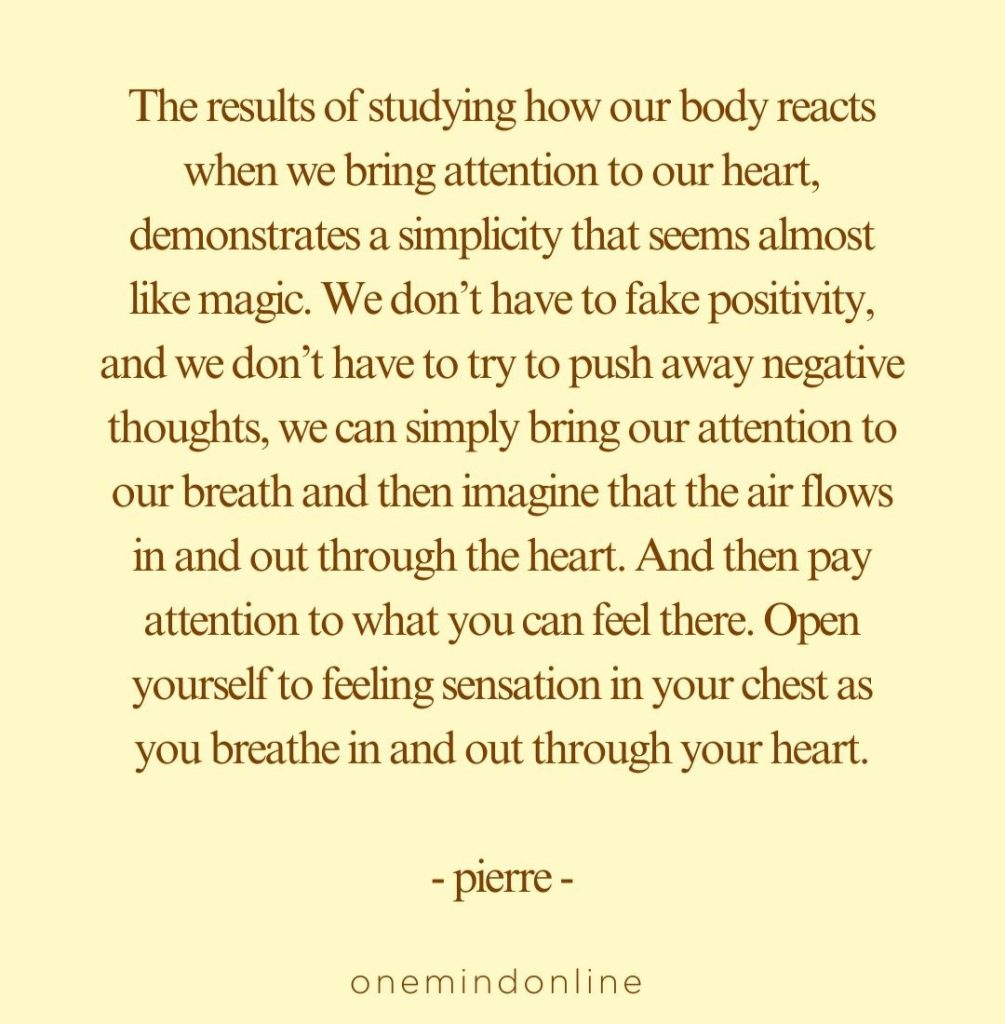
The results of studying how our body reacts when we bring attention to our heart, demonstrates a simplicity that seems almost like magic. We don’t have to fake positivity, and we don’t have to try to push away negative thoughts, we can simply bring our attention to our breath and then imagine that the air flows in and out through the heart. And then pay attention to what you can feel there. Open yourself to feeling sensation in your chest as you breathe in and out through your heart.
Connecting your thoughts and your heart, leads to what is called heart/brain coherence, a field of study that is gaining more and more attention. And what is clear from the results is that this heart/mind connection always brings your body and mind into a more positive state.
Our teacher for this week is Jack Kornfield, and today’s quotes explore some of his teachings about the heart.
“Look at every path closely and deliberately. Try it as many times as you think necessary. Then ask yourself and yourself alone one question. This question is one that only a very old man asks. My benefactor told me about it once when I was young. And my blood was too vigorous for me to understand it. Now I do understand it. I will tell you what it is: ‘does this path have a heart?’ If it does, the path is good. If it doesn’t, it is of no use.” – Jack Kornfield
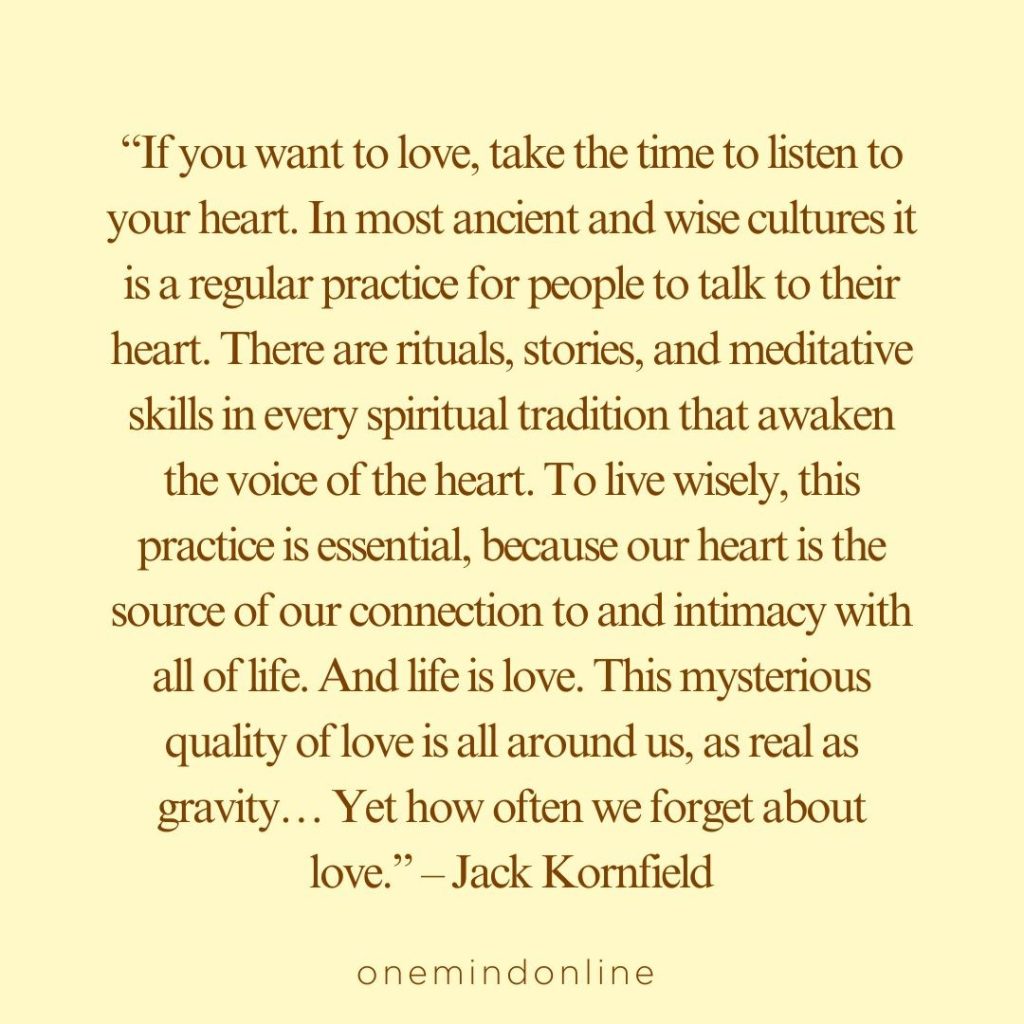
“If you want to love, take the time to listen to your heart. In most ancient and wise cultures it is a regular practice for people to talk to their heart. There are rituals, stories, and meditative skills in every spiritual tradition that awaken the voice of the heart. To live wisely, this practice is essential, because our heart is the source of our connection to and intimacy with all of life. And life is love. This mysterious quality of love is all around us, as real as gravity… Yet how often we forget about love.” – Jack Kornfield
“No amount of outer technology, no amount of computers and biotechnology and nanotechnology is going to stop the continuation of warfare and racism and environmental destruction. What’s called for on the Earth at this time is really a change of heart … the question is really not the future of humanity, but the presence of eternity.” – Jack Kornfield
There are limits to what external technology and intellectual strategy can solve. No algorithm can fix the human disconnect that leads to conflict or environmental decay. So whether you are seeking to heal your own nervous system or to have an impact on a bigger scale, the heart offers a reliable compass, one used by wise cultures for millennia.
What the future of humanity needs is no different from what each of us need, a change of heart right here in the present. By shifting our focus from the relentless chatter of the mind to the steady rhythm of the heart, we bridge the gap between trying to create change by brute force, and trusting in the inherent wisdom of life itself.
When we lead from the heart, we move beyond mere survival and into a state of true connection, proving that the most sophisticated technology we possess is the one beating right inside our chests.
Mantras for a Heart-Centered Life:
- “My breath guides me.” Focus on your breath to anchor yourself in the present moment.
- “I choose to see the good in myself and others.” Cultivate a positive perspective.
- “My heart guides my actions.” Make choices that align with your inner wisdom.
- “I am a source of love and light.” Recognize your inherent capacity for compassion.
Have a beautiful weekend, beautiful people!
– pierre –
Today’s LIVE meditation is: Heart Coherence.
Today’s LIVE meditation
https://youtu.be/nzS_1CtOVU4 2026
https://youtu.be/i5gkNY0HU-U 2025
https://youtu.be/P0mgGxoqntk 2024
https://youtu.be/F9lUBdZ5ivw 2023
https://www.youtube.com/watch?v=3H3aLw_hbQw 2020
Practice the “Daily Dose”
Let’s put it into practice! Choose what works for you – daily, once a week or whenever inspiration strikes. Putting pen to paper wires the neural pathways that will create your new habits.
1 – Affirmation
Write down your favourite affirmation on a sticky note and place it somewhere that you’ll be able to see it the whole day.
- “My breath guides me.” Focus on your breath to anchor yourself in the present moment.
- “I choose to see the good in myself and others.” Cultivate a positive perspective.
- “My heart guides my actions.” Make choices that align with your inner wisdom.
- “I am a source of love and light.” Recognize your inherent capacity for compassion.
2 – A moment of reflection
Use today’s question as a journal prompt. If you don’t have the time to sit down and write, just take a moment to reflect on your response.
Exploring Your Energy Account: Reflect on the past week and identify three specific moments when you experienced “energy assets” (positive emotions) and three moments of “energy deficits” (negative emotions). What patterns do you notice? What situations or people tend to drain or replenish your energy?
3 – Quotes to share
Send a quote to someone who needs it, or share them all on social media to spread the good vibes!


4 – Q&A for deeper learning
Read through the questions and answers and write down at least one “aha moment” that clicked for you.
Q1: What exactly is heart-brain coherence?
Heart-brain coherence is a physiological state where your heart, mind, and emotions are aligned and working in harmony. When you practice heart-focused breathing—imagining breath flowing in and out through your heart—your heart rhythm becomes more ordered and coherent. This coherent heart rhythm sends positive signals to the brain, which then responds by synchronizing with the heart, creating a state of optimal functioning where you feel calmer, think more clearly, and access your inner wisdom more easily.
Q2: Do I need to force positive thoughts for this practice to work?
No, absolutely not. You don’t need to force positive thoughts to create heart/brain coherence, but getting to heart/brain coherence is very likely to lead to more positive thoughts. Simply bringing gentle attention to your heart and breath naturally shifts your physiological state toward coherence. Authenticity is key—acknowledge whatever you’re feeling while simultaneously creating space for a shift by focusing on your heart center.
Q3: How long does it take to feel the benefits of heart-focused breathing?
Many people notice immediate effects—a sense of calm, reduced mental chatter, or emotional relief—within just a few minutes of practice. However, like any skill, the benefits deepen with consistent practice. Even spending 3-5 minutes several times a day focusing on your heart and breath can create significant positive changes in your stress levels, decision-making, and overall wellbeing over time.
Q4: What does Jack Kornfield mean by asking “does this path have a heart?”
This question is an invitation to evaluate your choices based on whether they align with love, wisdom, and your deepest values rather than external pressures, ego, or fear. A path “with heart” is one that may be challenging but feels meaningful and true to who you are. A path “without heart” might look good on paper but feels empty or disconnected from your authentic self. It’s a gut-check question that bypasses the rational mind and taps into your intuitive wisdom.
Q5: Is heart-centered living just spiritual bypassing or avoiding real-world problems?
Not at all. Heart-centered living doesn’t mean ignoring injustice or pretending everything is fine. In fact, Kornfield specifically states that what’s needed to address warfare, racism, and environmental destruction is “a change of heart”—meaning that genuine heart-centered awareness leads to more engagement with real-world problems, but from a place of wisdom, compassion, and sustainable energy rather than reactivity, burnout, or hatred. It’s about being grounded in love while taking meaningful action.
Q6: How can focusing on my individual heart change the future of humanity?
The teaching emphasizes that we can’t wait for others to create the change we need—it starts with each person taking responsibility for their own inner work. When you align your head and heart, you naturally make better decisions, treat others with more compassion, and contribute to rather than drain collective energy. This ripples outward. Additionally, research in heart coherence suggests that when multiple people practice together, there may be a measurable effect on the surrounding environment. Change truly does begin within.
Q7: What if I can’t feel anything when I focus on my heart?
This is completely normal, especially when you’re beginning this practice. Our culture has trained us to live primarily in our heads, so reconnecting with heart sensations takes time. Start simply by placing your hand on your chest and feeling the physical warmth and gentle movement as you breathe. Don’t worry about feeling specific emotions or having profound experiences—just the act of directing attention to your heart area begins to create the coherence effect. With patience and practice, your sensitivity will naturally develop. Remember: the practice works physiologically even when you don’t “feel” anything dramatic.