
“Your Daily Dose” is a quick two minute read packed with bite-sized wisdom from all the great teachers. But you could also choose to turn it into something more… a powerful daily practice for personal growth. Give it a try!
A message from today’s meditation:
“Coming to our senses” assists in grounding ourselves in the full physical experience of this moment. It draws our thinking away from chasing phantom ideas, into the fully immersed experience of what this moment is making available.
I’d like to share with you the beautifully articulated words of Laura Meyer, describing what bringing our attention to our senses leads to.
———-
Our senses are the way we interpret and experience the world. We gather information about our experiences through our senses. For many of us, these senses have become dull and numb, and we wonder why we aren’t experiencing a life of more quality and richer experience.
The practice is simply to be more present to our five senses in this moment: What am I hearing? seeing? feeling? tasting? smelling?
- Seeing clearly. Begin observing any stories your mind tells you when you look at a newer car, a magazine, a picture or people walking. Notice the mind engage in past memories, future thoughts, judging, assuming, and anywhere else your mind travels outside of what you are actually seeing. Just observe, just notice. This is enough.
- Listen deep. Make sure you are hearing the other person, and not hearing what you want to hear. Am I listening to you? Or to the thoughts of the past or future? Is your mind busy planning and judging … I’m sorry, what did you say? Make sure you are not hearing things that were not said due to an anxious or angered mind. Just practice hearing in this moment, allowing thoughts to fade to the background. What do I hear? A telephone? Birds? A closing door? Stay here for a moment. Relax and just hear.
- Feel fully. Hugs go unfelt; emotions go unnoticed, leaving us feeling unsatisfied in our lives. Emotional feelings create many of our choices because we tend to be reactive. It behooves us to pay attention. Do I feel sad? Frustrated? Peaceful? Just begin to ask, “How do I feel in this moment?” We limit our lives with “good” and “bad.” What does that mean for you? And next time you give a hug, a kiss or a pat on the back, stop for a moment to actually experience it. Don’t let that moment slip by.
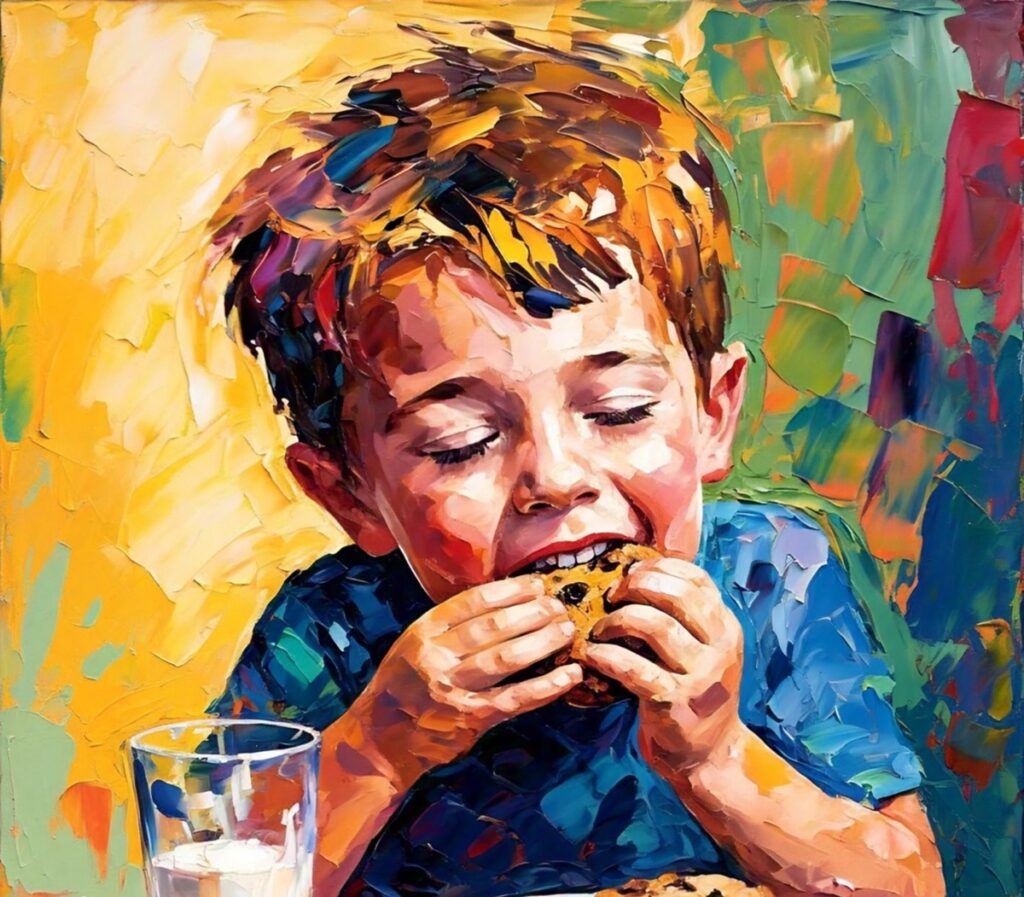
- Taste with intention. Often we eat without truly tasting. Eat, drink, and be merry? Or eat, drink, and be unsatisfied? We deprive ourselves of this daily human experience, and then we are left without a taste for life. What are you tasting? Is it cold, sweet, bitter, crunchy? Begin connecting to your food as a way to connect to your life.
- Inhale the world. Do you even remember you have a sense of smell? Inhale and smell. If you smell nothing, inhale again. Still nothing? Pull a leaf, spray perfume, smell your food — just smell. That’s all. Just smell and see if you don’t experience more of your life.
Keep your eyes open, pay attention, and watch your life become rich with experience.
– Laura C Meyer
———-
Mantras for a Sensory Fiesta:
- “I am fully present to the richness of this moment.”
- “My senses are doorways to deeper experience and connection.”
- “I witness my thoughts while staying grounded in the present.”
- “I taste, touch, see, hear, and smell my life with intention.”
- “Every moment offers an invitation to come alive – and I accept.”
Join us today for a guided meditation through the senses, and unlock the vibrant life simmering right beneath the surface. Open your eyes, open your senses, and watch your world come alive!
– pierre –
Today’s LIVE meditation is: Come to your senses.
Today’s LIVE meditation
https://youtu.be/SKIeIEgHVfs 2024
https://youtu.be/TsWjiYD-xQM 2023
Practice the “Daily Dose”
Let’s put it into practice! Choose what works for you – daily, once a week or whenever inspiration strikes. Putting pen to paper wires the neural pathways that will create your new habits.
1 – Affirmation
Write down your favourite affirmation on a sticky note and place it somewhere that you’ll be able to see it the whole day.
- “I am fully present to the richness of this moment.”
- “My senses are doorways to deeper experience and connection.”
- “I witness my thoughts while staying grounded in the present.”
- “I taste, touch, see, hear, and smell my life with intention.”
- “Every moment offers an invitation to come alive – and I accept.”
2 – A moment of reflection
Use today’s question as a journal prompt. If you don’t have the time to sit down and write, just take a moment to reflect on your response.
The Unlived Moments: Reflect on a recent hug, meal, or conversation that you moved through without truly experiencing. Describe what you were thinking about instead. What pattern do you notice in where your attention habitually goes? What might you be protecting yourself from by staying distracted? How will you practice being more present in future?
3 – Quotes to share
Send a quote to someone who needs it, or share them all on social media to spread the good vibes!

4 – Q&A for deeper learning
Read through the questions and answers and write down at least one “aha moment” that clicked for you.
Q1: Why have my senses become dull in the first place?
Our senses often become dulled due to chronic distraction, stress, and the fast pace of modern life. When we’re constantly multi-tasking, planning, and worrying about the future or rehashing the past, we’re not actually present to process sensory information. Additionally, our devices constantly pull attention away from immediate physical experience, training us to prioritize mental stimulation over embodied awareness.
Q2: How is “coming to our senses” different from just paying attention?
“Coming to our senses” is a specific form of attention that anchors awareness in physical sensory experience rather than mental narratives. While general attention can still be caught up in thoughts, judgments, and interpretations, sensory awareness directs us to raw experience: the actual sound, smell, taste, touch, or sight before our mind adds meaning to it. It’s the difference between thinking about a sunset and actually seeing the colors.
Q3: Do I need to practice all five senses at once, or can I focus on one?
You can absolutely focus on one sense at a time—in fact, this is often more effective when beginning. Choose the sense that feels most accessible or most dulled for you and practice with that for several days or weeks. As you develop facility with one sense, naturally expand to others. The goal isn’t perfection across all senses but rather deepening your capacity for presence through whichever doorway works for you.
Q4: How does emotional feeling relate to the five physical senses?
Emotional feeling, while not one of the traditional five senses, is a form of somatic or embodied sensing. Emotions create physical sensations in our body—tightness in the chest, butterflies in the stomach, warmth in the face. By learning to feel these physical manifestations fully, we become more emotionally aware and less reactive. We notice feelings as they arise rather than being blindsided by them after they’ve built up, and this gives us more space in which we can choose a new response.
Q5: What if I try to taste or smell and genuinely experience nothing?
If you’re struggling to register taste or smell, this itself is valuable information—it reveals just how disconnected you’ve become from that sense. Start with stronger stimuli: freshly ground coffee, citrus peels, dark chocolate, peppermint. The practice isn’t about having extraordinary sensory experiences but about retraining your attention to register what’s actually there. With consistent practice, subtler sensations will become noticeable.
Q6: How long does it take to “reawaken” dulled senses?
There’s no fixed timeline, as it depends on your starting point and consistency of practice. However, many people report noticing shifts within days of deliberate sensory practice. You might suddenly hear birds you never noticed, taste complexity in simple foods, or feel textures more vividly. The transformation is often gradual but cumulative—small awakenings that compound over time into a notably richer experience of life.
Q7: Can this practice help with anxiety and overthinking?
Yes, profoundly. Anxiety and overthinking thrive when attention is caught in mental loops about past or future. Sensory awareness interrupts these loops by redirecting attention to the present moment, which exists only in physical reality, not in thought. By repeatedly bringing yourself back to what you’re actually sensing right now, you train your nervous system to settle and your mind to release its grip on anxious narratives. It’s not about eliminating thoughts but about not being dominated by them.