

“Your Daily Dose” is a quick two minute read packed with bite-sized wisdom from all the great teachers. But you could also choose to turn it into something more… a powerful daily practice for personal growth. Give it a try!
A message from today’s meditation:
Imagine a chest overflowing with the priceless gems of knowledge, wisdom, and limitless potential. Each of us has a chest like this within us, yet for most of us, this treasure remains locked, just beyond our reach. We sense its presence, feel its weight, but cannot access its riches. What keeps these treasures sealed? And more importantly, what is the key that can finally open it?
The key to this treasure lies not in any external force providing you the solution. The key to this chest is practice… the gentle, consistent practice of self-discovery. This is the essence of meditation, a journey of becoming intimately familiar with your own mind, your heart, and your true being.
“He who knows others is wise. He who knows himself is enlightened.” – Lao Tzu
“Knowing others is intelligence; knowing yourself is true wisdom. Mastering others is strength; mastering yourself is true power.” – Lao Tzu
Really knowing yourself is a core principle of any ancient wisdom – having deep knowledge of SELF.
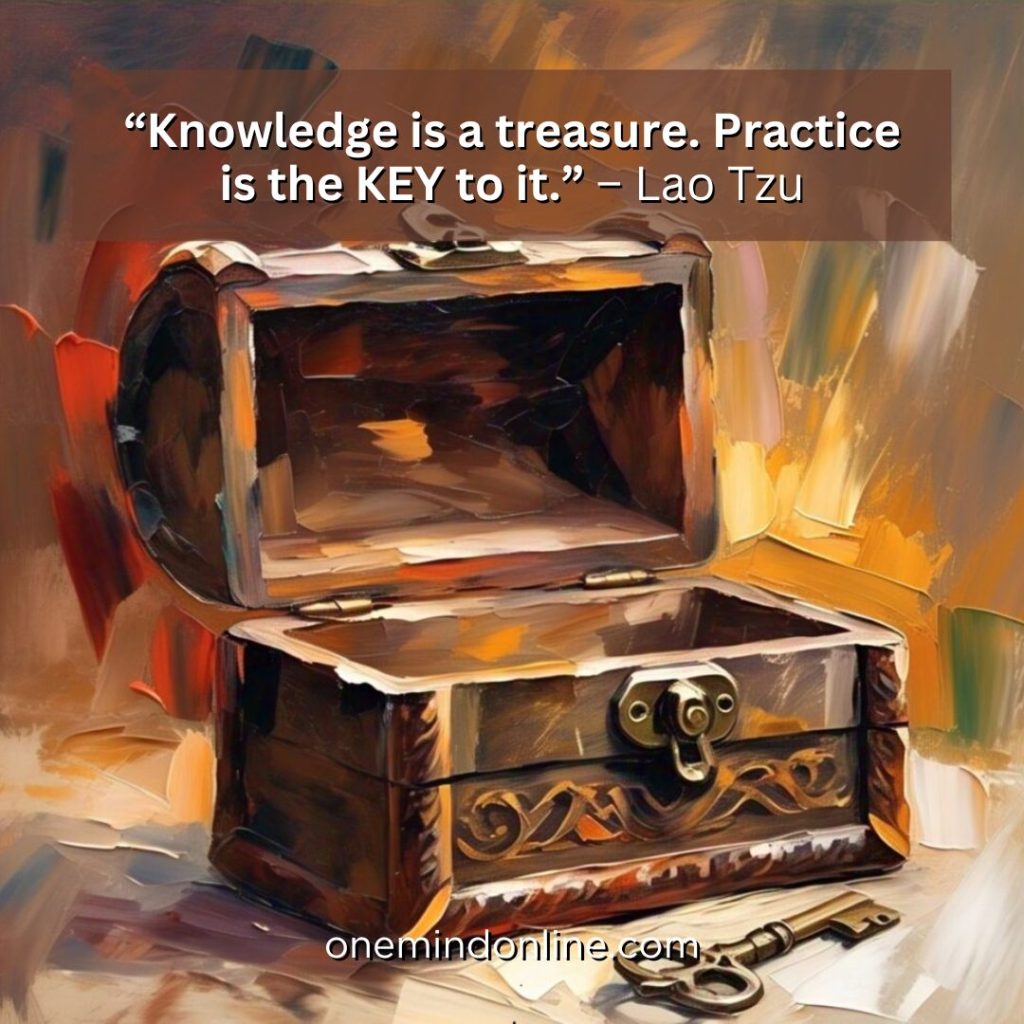
“Knowledge is a treasure. Practice is the KEY to it.” – Lao Tzu
Knowledge is like having treasure in a locked chest. It’s so close but yet so far because even the richest treasure is not worth anything if it is locked away from you – if you have no access to it. You already have SO much knowledge that’s not being put to good use yet, and the key to unlocking this treasure is practice.
The word “meditation” literally means “to become familiar with.” And what we become familiar with through consistent practice is SELF – our thoughts, emotions, patterns, and the deepest layers of our being.
Many of us harbor a secret hope: that one day we’ll reach a place where we’re never triggered, never experience unwanted emotions, never feel unsettled again. But what if we’re aiming at the wrong target?
Consider this alternative:
What if every thought and feeling you have – even the most uncomfortable ones – became intimately familiar to you? What if you were never blindsided by an emotion because you understood exactly why it shows up, where it comes from, and how to work with it? What if everything within you was welcomed and accepted?
Imagine the freedom this would bring. When difficult emotions arise, you wouldn’t be thrown off balance. Instead, you’d move through them with ease and speed, quickly returning your attention to what matters most. This isn’t about suppression or avoidance – it’s about genuine understanding born from familiarity.
This is the gift of practice. Everything you practice, you get better at. Through meditation, you’re not trying to eliminate parts of yourself; you’re learning to know yourself so deeply that nothing within you is a stranger anymore.
Your inner treasure chest awaits. The key is in your hand – you need only use it. Each moment of practice, each meditation session, turns that key a little more. With consistency and patience, the chest opens, and the wisdom you’ve always possessed becomes available to guide your life.
Here are some guiding mantras to remember on your journey:
- “Every experience is an opportunity for self-discovery. Embrace each thought and emotion as a valuable teacher.”
- “Practice makes perfect. Consistent meditation cultivates the deep understanding that unlocks your inner treasure.”
- “Accept yourself fully. You are worthy of love and understanding, just as you are.”
- “Focus on progress, not perfection. You’re on a journey, not a race. Celebrate every step forward.”
You have access to a treasure chest of wisdom, but without practice this chest will remain locked away from you. You have to put it into practice… join us…
– pierre –
Today’s LIVE meditation is: A sense of self.
Today’s LIVE meditation
https://youtu.be/_5k0S5HrHGQ 2026
https://youtu.be/fD7XFE0PLOo 2025
https://youtu.be/hjAXT1bguI4 2024
https://youtu.be/7Q8vAeE80PU 2023
Practice the “Daily Dose”
Let’s put it into practice! Choose what works for you – daily, once a week or whenever inspiration strikes. Putting pen to paper wires the neural pathways that will create your new habits.
1 – Affirmation
Write down your favourite affirmation on a sticky note and place it somewhere that you’ll be able to see it the whole day.
- “Every experience is an opportunity for self-discovery. Embrace each thought and emotion as a valuable teacher.”
- “Practice makes perfect. Consistent meditation cultivates the deep understanding that unlocks your inner treasure.”
- “Accept yourself fully. You are worthy of love and understanding, just as you are.”
- “Focus on progress, not perfection. You’re on a journey, not a race. Celebrate every step forward.”
2 – A moment of reflection
Use today’s question as a journal prompt. If you don’t have the time to sit down and write, just take a moment to reflect on your response.
From Mastering Others to Mastering Self: Write about a time when you focused your energy on trying to change or control someone else’s behavior. What would it look like to redirect that same energy toward understanding and mastering your own reactions and patterns instead?
3 – Quotes to share
Send a quote to someone who needs it, or share them all on social media to spread the good vibes!


4 – Q&A for deeper learning
Read through the questions and answers and write down at least one “aha moment” that clicked for you.
Q1: What does it mean that “practice is the key” to unlocking inner wisdom?
This metaphor suggests that knowledge and wisdom already exist within you, but they remain inaccessible without consistent practice. Just as a locked treasure chest holds riches you cannot use, your inner wisdom needs the “key” of regular meditation and self-reflection to become available to you. Practice doesn’t create the treasure—it gives you access to what’s already there.
Q2: How is meditation different from just thinking about myself?
Meditation means “to become familiar with.” Unlike analytical thinking, which tries to solve or fix, meditation is about developing intimate familiarity with your thoughts, emotions, and patterns without judgment. It’s the difference between reading about swimming and actually getting in the water—meditation is direct experience of your inner landscape, not just intellectual understanding.
Q3: Will meditation make my negative emotions go away?
No, and that’s actually the wrong goal. The purpose isn’t to eliminate “unwanted” emotions but to become so familiar with them that they no longer blindside or control you. When you deeply understand why certain emotions arise, where they come from, and how to work with them, you can move through them with ease rather than being overwhelmed by them.
Q4: What does “knowing yourself” actually look like in practice?
Self-knowledge means understanding your emotional patterns, recognizing your triggers before they control you, knowing which thoughts serve you and which don’t, and accepting all aspects of yourself without judgment. It’s the ability to witness your inner world with clarity and respond consciously rather than react automatically.
Q5: How long does it take to “unlock the treasure chest” through meditation?
This isn’t a destination you arrive at but an ongoing journey. You’ll likely notice benefits—increased self-awareness, quicker emotional recovery, greater peace—within weeks of consistent practice. However, the process of becoming deeply familiar with yourself is lifelong. Each practice session turns the key a little more, gradually opening you to deeper layers of wisdom.
Q6: What if I already have self-knowledge but still struggle? Don’t I already know myself?
There’s a crucial difference between intellectual knowledge and embodied familiarity. You might cognitively know that you have certain patterns, but meditation helps you develop lived, moment-to-moment awareness of these patterns as they arise. This direct familiarity—not just knowing about yourself but being intimately acquainted with your inner workings—is what transforms knowledge into wisdom.
Q7: How does mastering myself differ from mastering others, as Lao Tzu suggests?
Mastering others is about external control and influence—a form of strength that depends on circumstances outside yourself. Mastering yourself means understanding and skillfully working with your own mind, emotions, and reactions—a true power that no external situation can take away. When you’re no longer controlled by your own triggers and patterns, you possess an unshakeable power that serves you in every situation.