

“Your Daily Dose” is a quick two minute read packed with bite-sized wisdom from all the great teachers. But you could also choose to turn it into something more… a powerful daily practice for personal growth. Give it a try!
A message from today’s meditation:
We’ve all heard the old saying, “know thyself.” But what does it mean to truly know oneself? Some parts of ourselves are easy to know, normally the parts of our personality that we enjoy. Perhaps who we are when we’re with friends, perhaps our sense of humour or our accomplishments. But then there are almost always parts of our “self” that we don’t like so much, and that we would rather not know. And the truth is we cannot really know ourselves without opening our arms to our shadow too.
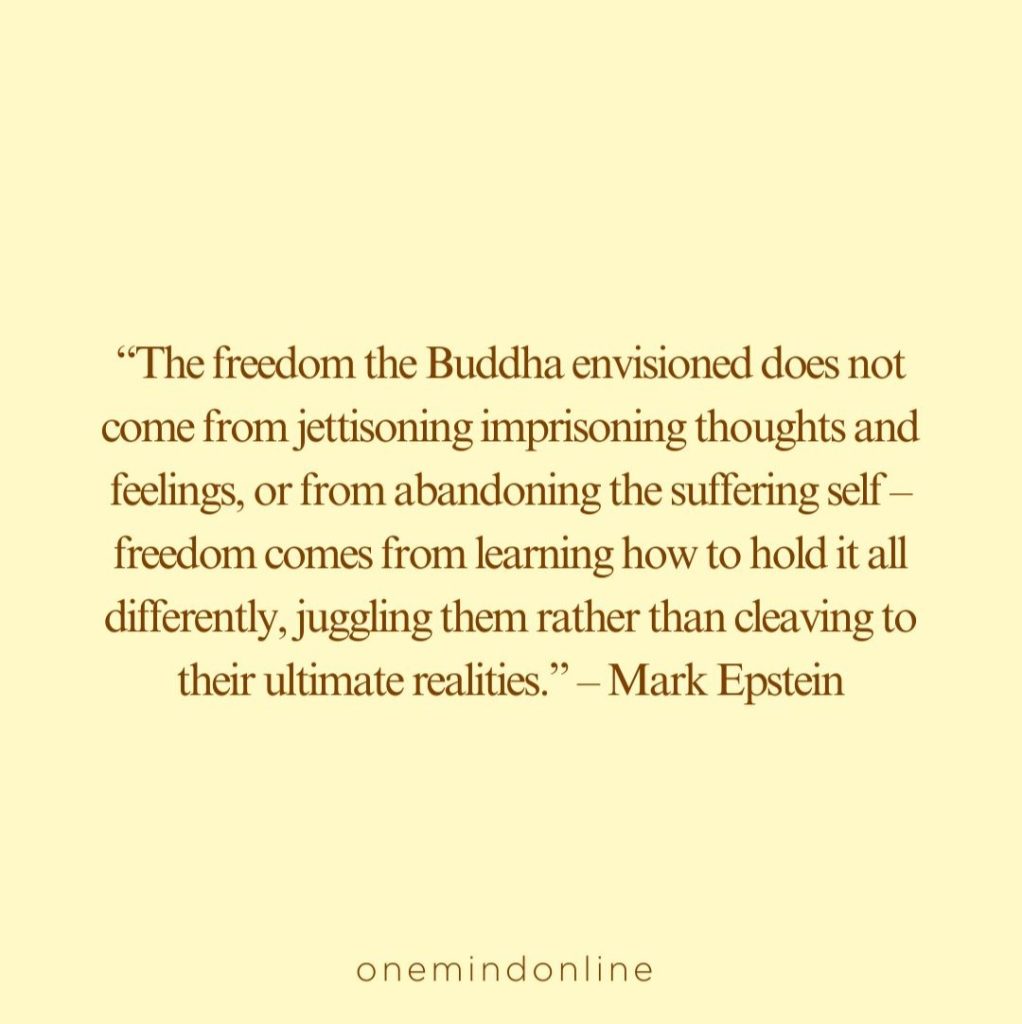
“The freedom the Buddha envisioned does not come from jettisoning imprisoning thoughts and feelings, or from abandoning the suffering self – freedom comes from learning how to hold it all differently, juggling them rather than cleaving to their ultimate realities.” – Mark Epstein
To me, this realisation years ago was a paradigm shift!
While you are rejecting any part of YOU, you will not be whole. PERIOD. The road to wholeness is through finding acceptance for every single part of you, especially the “worst” parts. Nothing inside of you is “bad”, every part of you has in some way just been trying SO hard to help you cope.
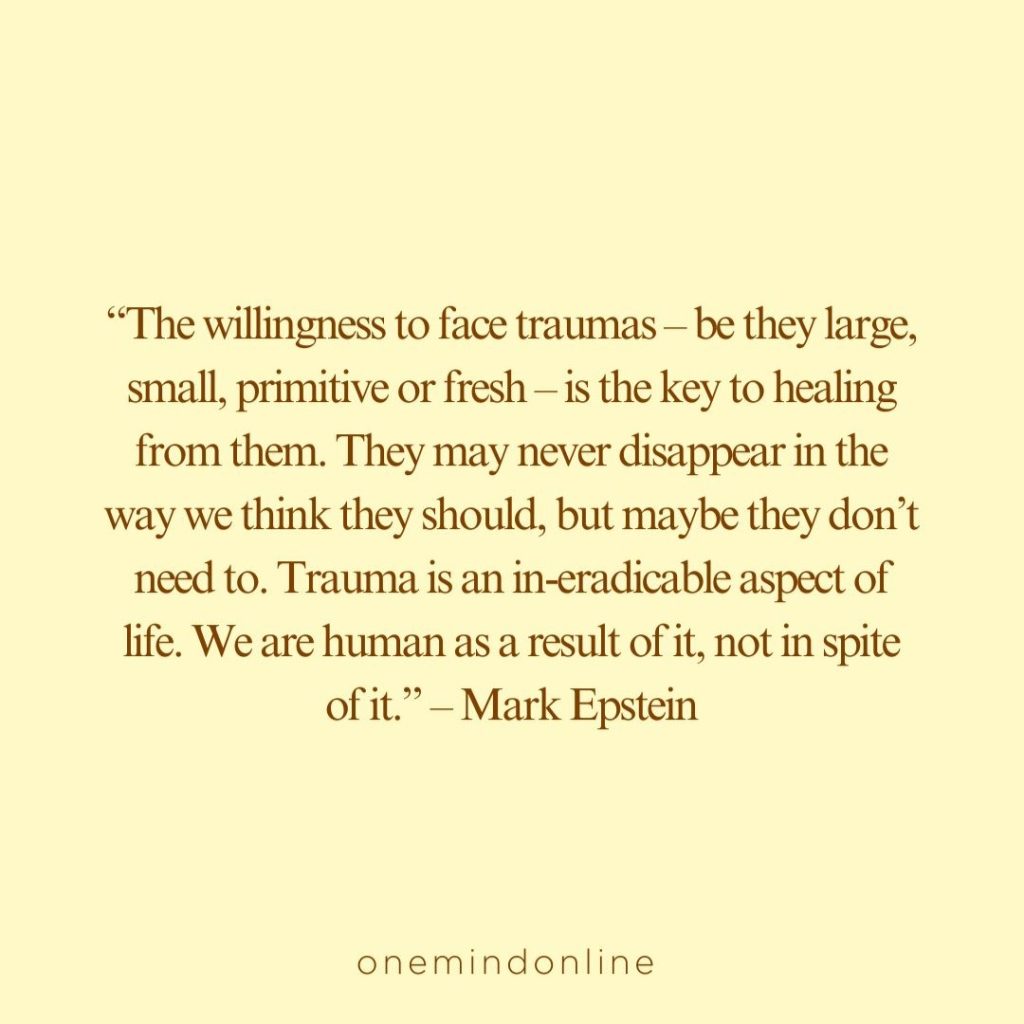
“The willingness to face traumas – be they large, small, primitive or fresh – is the key to healing from them. They may never disappear in the way we think they should, but maybe they don’t need to. Trauma is an in-eradicable aspect of life. We are human as a result of it, not in spite of it.” – Mark Epstein
I LOVE that last sentence! “We are human as a result of our traumas, not in spite of them.”
Trauma does not just happen to a few unlucky people; it is the bedrock of our psychology. Death and illness touch us all, but even the everyday sufferings of loneliness and fear are traumatic. In his book “The Trauma of Everyday Life,” Mark Epstein uncovers the transformational potential of trauma, revealing how it can be used for the mind’s own development.
Our lived experience – our traumas – create the parts of our “selves” that we often have most difficulty with. But for as long as we fight a battle against these parts of ourselves, we’ll be trapped in a war that we can’t win. Clearly, fighting is not the answer.
Holding, is what brings us to wholeness. Learning how to listen to what is crying inside. No longer rejecting – but accepting every part of you – is what leads to freedom from this war.
My wish for you is freedom. The kind of freedom you only realize when you notice that old triggers just don’t have the same hold on you that they used to have.
A few affirmations to help unlock true freedom:
- “I am whole, including the parts of myself I’ve been afraid to see.”
- “My shadows deserve compassion, not combat.”
- “Every part of me has been trying to protect me in the only way it knew how.”
- “I am learning to hold all of myself with kindness.”
May you find the freedom to be yourself, flaws and all. Have a beautiful day!
– pierre –
Today’s LIVE meditation is: A sense of self.
Today’s LIVE meditation
https://youtu.be/ihbEOvpIQZA 2025
https://youtu.be/ReMoWxHYa18 2024
https://youtu.be/9HgInJhNE8Y 2023
https://youtu.be/Xun0OsYu98Y 2022
Practice the “Daily Dose”
Let’s put it into practice! Choose what works for you – daily, once a week or whenever inspiration strikes. Putting pen to paper wires the neural pathways that will create your new habits.
1 – Affirmation
Write down your favourite affirmation on a sticky note and place it somewhere that you’ll be able to see it the whole day.
- “I am whole, including the parts of myself I’ve been afraid to see.”
- “My shadows deserve compassion, not combat.”
- “Every part of me has been trying to protect me in the only way it knew how.”
- “I am learning to hold all of myself with kindness.”
2 – A moment of reflection
Use today’s question as a journal prompt. If you don’t have the time to sit down and write, just take a moment to reflect on your response.
Freedom Realized: Describe a moment when you noticed an old trigger or wound didn’t affect you the way it used to. What had shifted in how you were “holding” that experience? What did that taste of freedom feel like, and how can you cultivate more of it?
3 – Quotes to share
Send a quote to someone who needs it, or share them all on social media to spread the good vibes!


4 – Q&A for deeper learning
Read through the questions and answers and write down at least one “aha moment” that clicked for you.
Q1: What does it mean to “embrace your shadow”?
A: Embracing your shadow means acknowledging and accepting the parts of your personality that you’ve rejected, hidden, or labeled as “bad.” It’s about recognizing that these aspects of yourself developed as coping mechanisms and deserve compassion rather than condemnation. Your shadow isn’t your enemy—it’s a part of you that needs to be understood and integrated into your whole self.
Q2: Why can’t I just get rid of the parts of myself I don’t like?
A: Because rejecting parts of yourself creates internal division and prevents wholeness. When you’re at war with yourself, you fragment your energy and identity. These “unwanted” parts don’t disappear when ignored—they often grow stronger or manifest in unhealthy ways. True healing comes from acceptance and integration, not elimination.
Q3: Does accepting my flaws mean I’m giving up on self-improvement?
A: Not at all. Acceptance and growth aren’t opposites—acceptance is actually the foundation for authentic growth. When you stop fighting yourself and start understanding why certain patterns exist, you create space for genuine transformation. You can hold compassion for where you are while still moving toward where you want to be.
Q4: How is trauma related to personal development?
A: Trauma shapes our psychology and creates both our wounds and our resilience. Rather than being something to simply “get over,” trauma can be understood as a teacher that reveals our capacity for survival, adaptation, and growth. By facing and integrating traumatic experiences, we develop deeper self-understanding and emotional maturity.
Q5: What does it mean to “hold” your trauma differently?
A: Holding trauma differently means changing your relationship with painful experiences rather than trying to make them disappear. Instead of fighting, suppressing, or being controlled by trauma, you learn to acknowledge it with compassion, understand its impact, and integrate it into your life story without letting it define you completely.
Q6: How do I know if I’m making progress in accepting myself?
A: You’ll notice that old triggers lose their power over you. You’ll find yourself responding to difficult situations with more curiosity than reactivity. You’ll experience less internal criticism and more self-compassion. The war inside quiets down, and you feel more integrated and whole, even with your imperfections.
Q7: What if some parts of me actually are harmful or destructive?
A: Even destructive patterns developed as attempts to protect you, though they may now cause harm. The key is to understand the original protective function while taking responsibility for current impact. With compassionate awareness, you can honor what these parts were trying to do while consciously choosing healthier responses. Acceptance doesn’t mean allowing harm—it means understanding the roots of behavior so you can truly transform it.