

“Your Daily Dose” is a quick two minute read packed with bite-sized wisdom from all the great teachers. But you could also choose to turn it into something more… a powerful daily practice for personal growth. Give it a try!
A message from today’s meditation:
Everything around us is in motion. Seasons turn, plans fall through, people come and go, and even the best days eventually end. If your happiness depends on life staying exactly the way you like it, you’ll spend your days waiting for a stability that never arrives, and real contentment will always be just out of reach.
If happiness is something that is waiting for you around some distant corner somewhere in the future when finally things have come together in the way you want, then I want you to know this… happiness will always be slipping from your grasp.
“Authentic happiness comes from being in conscious connection with our inner being rather than dependency on outer things and circumstances which are constantly in a state of flux.” – Michael Beckwith
“Stop the mental chatter about what’s wrong and what’s not complete. There is a presence of Love that is always seeking to express itself through you.” – Michael Beckwith
“If the grass is greener somewhere else… then start watering your own lawn!” – Michael Beckwith
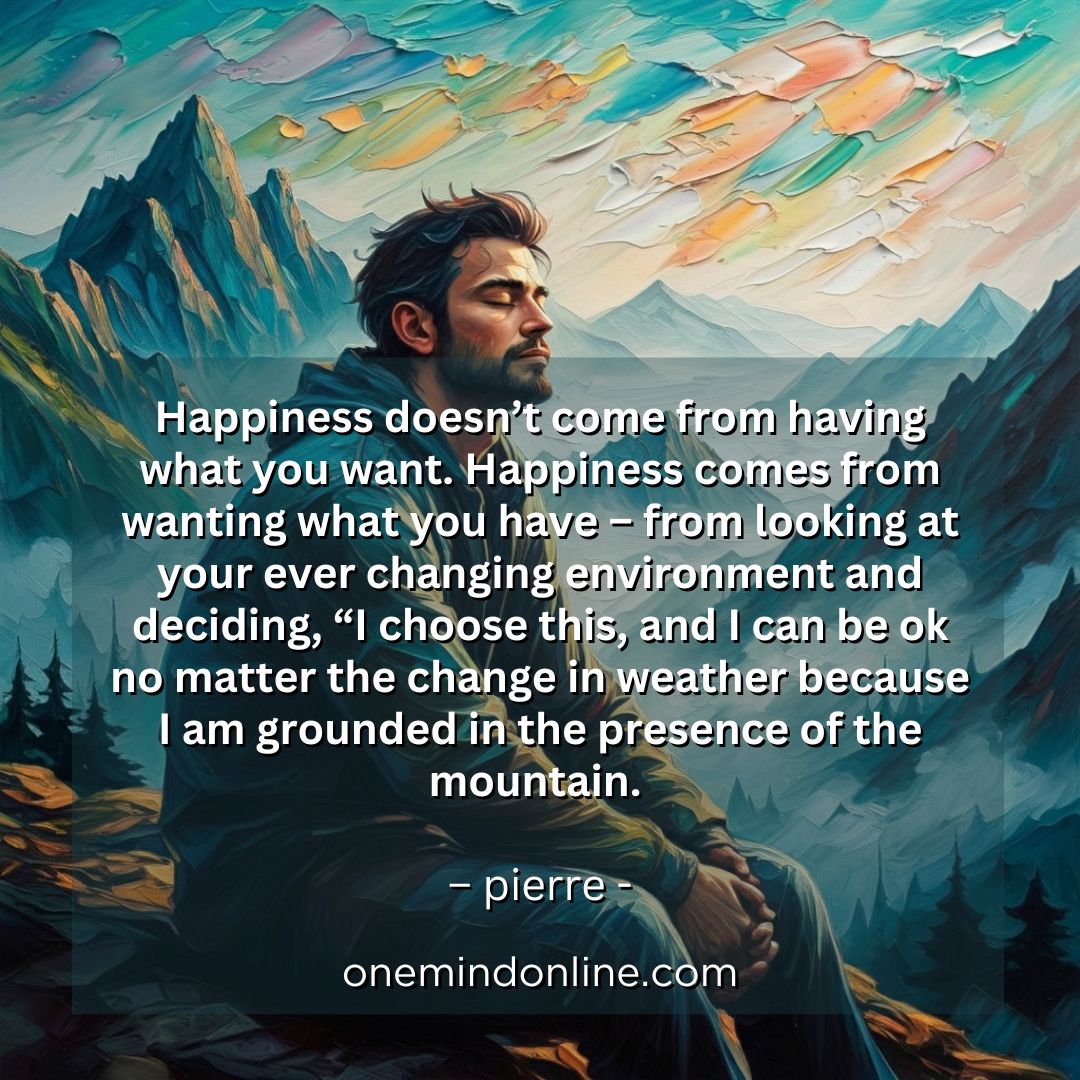
Happiness doesn’t come from having what you want. Happiness comes from wanting what you have – from looking at your ever changing environment and deciding, “I choose this, and I can be ok no matter the change in weather because I am grounded in the presence of the mountain.”
So water your own lawn, foster your own connection with the immovable nature of your “being”. It is an inside job, learning to be OK no matter what external circumstances we are facing.
Let your inner-being be your grounding and your guidance.
Mantras for self-reflection:
- “I am grounded in my inner being.”
- “I am the mountain. I am steady and strong.”
- “I let go of my attachment to external outcomes.”
- “I appreciate the beauty and value of the present moment.”
In conclusion, lasting happiness is not about having what we want, but wanting what we have. It’s about finding peace within ourselves and learning to appreciate the beauty and value of the present moment. By cultivating our inner mountain, we can weather any storm and experience a deep sense of contentment and well-being.
– pierre –
Today’s LIVE meditation is: I am the mountain.
Today’s LIVE meditation
https://youtu.be/i8sc4R1D-wI 2025
https://youtu.be/h2myOza94Lk 2023
https://youtu.be/ZZlXbst3pkQ 2022
Practice the “Daily Dose”
Let’s put it into practice! Choose what works for you – daily, once a week or whenever inspiration strikes. Putting pen to paper wires the neural pathways that will create your new habits.
1 – Affirmation
Write down your favourite affirmation on a sticky note and place it somewhere that you’ll be able to see it the whole day.
- “I am grounded in my inner being.”
- “I am the mountain. I am steady and strong.”
- “I let go of my attachment to external outcomes.”
- “I appreciate the beauty and value of the present moment.”
2 – A moment of reflection
Use today’s question as a journal prompt. If you don’t have the time to sit down and write, just take a moment to reflect on your response.
Redefining Happiness in the Present: Write about the difference between “wanting what you have” versus “having what you want.” Describe your current circumstances without judgment, then explore what it would mean to truly want and appreciate these exact conditions. What would change in your daily experience if each moment was accepted as complete and valuable, rather than as an irritation that lacks the ingredients of what you “actually” want.
3 – Quotes to share
Send a quote to someone who needs it, or share them all on social media to spread the good vibes!

4 – Q&A for deeper learning
Read through the questions and answers and write down at least one “aha moment” that clicked for you.
Q1. What does it mean to be “grounded in your inner being”?
Being grounded in your inner being means recognizing that beneath the constant shifting of your thoughts, moods, and circumstances, there is a part of you that stays steady. Your job title, your finances, your relationships, and even your emotions rise and fall like weather, but the quiet awareness that observes all of it does not change. This is the part of you that was present before the latest success or disappointment and will remain after it passes. This isn’t about suppressing emotions or becoming indifferent, but rather developing a stable foundation that allows you to experience life’s ups and downs without losing your center. You can still feel joy, grief, or frustration, but you experience them from a stable place rather than being swept away. Like a mountain that doesn’t need the sky to be clear in order to stay what it is, you learn that your steadiness was never created by good circumstances, so bad ones cannot take it away.
Q2. How can I stop depending on external circumstances for my happiness?
Start by recognizing when you’re placing conditions on your happiness (“I’ll be happy when…”). Practice gratitude for what you currently have rather than focusing on what’s missing. Develop daily practices that connect you to your inner stability – meditation, journaling, or simply taking moments to appreciate the present. Remember that external things can enhance life, but they shouldn’t be the foundation of your well-being.
Q3. What if my current circumstances are genuinely difficult? How can I “want what I have”?
Wanting what you have doesn’t mean pretending your difficulties aren’t real. What it asks is that you stop adding an extra layer of resistance on top of what’s already happening. When we fight reality with thoughts like “this shouldn’t be happening” or “I can’t be okay until this changes,” we suffer twice: once from the circumstance itself, and again from our struggle against it. Letting go of that second layer doesn’t make the situation easy, but it frees up energy and clarity. Even in the middle of hardship, you can usually find something to appreciate: a person who shows up for you, a small moment of calm, or a strength you didn’t know you had. And choosing to be okay with where you are right now doesn’t mean giving up on where you want to go. You can hold gratitude for your life as it is while staying fully committed to what you want to create, because acceptance isn’t resignation. It’s the steady ground you build from.
Q4. How do I know if I’m making progress in developing my “inner mountain”?
Signs of progress include feeling less reactive to external changes, experiencing moments of peace even during challenges, finding it easier to appreciate simple pleasures, and noticing that your mood isn’t as dependent on getting what you want. You might also find yourself less concerned with comparing your life to others and more focused on nurturing your own growth and circumstances.
Q5. What does “watering your own lawn” look like in practical terms?
Watering your own lawn means investing time and energy in improving your own life rather than envying others. This could involve developing your skills, nurturing your relationships, taking care of your health, creating a home environment you love, or pursuing interests that bring you joy. It’s about focusing on what you can control and influence rather than wishing you had someone else’s life.
Q6. Can I still have goals and ambitions while practicing this inner approach to happiness?
Absolutely. Having goals and working toward them becomes even more fulfilling when you’re not dependent on achieving them for your happiness. You can pursue dreams and ambitions from a place of inner stability rather than desperate need. This approach often leads to better outcomes because you’re not attached to results in a way that creates anxiety and limits your performance.
Q7. How can I deal with the “mental chatter” about what’s wrong in my life?
Start by recognizing that this mental chatter is just thoughts, not ultimate truth. Practice observing these thoughts without immediately believing or engaging with them. When you notice the mental commentary about what’s lacking, gently redirect your attention to what’s present and working in your life. Meditation, mindfulness practices, and conscious gratitude can help quiet this inner critic and connect you with the “presence of Love” that Michael Beckwith describes.