
“Your Daily Dose” is a quick two minute read packed with bite-sized wisdom from all the great teachers. But you could also choose to turn it into something more… a powerful daily practice for personal growth. Give it a try!
A message from today’s meditation:
The thirst for knowledge might be seen as the foundation of all human development. But there is a quiet paradox at the heart of personal growth: that the more we know, the less we may actually see. Knowledge – the very thing we’ve been taught to accumulate, revere, and display – can become a kind of blindfold. Not because it is false, but because it feels so certain.
Every culture, every age, has elevated knowledge as the supreme human virtue. “Knowledge is power,” we say, and we build entire systems of education around that belief. And yet, something important gets lost when knowledge hardens into certainty.
Having knowledge is of course objectively a good thing, but there are two stories to tell about knowledge…
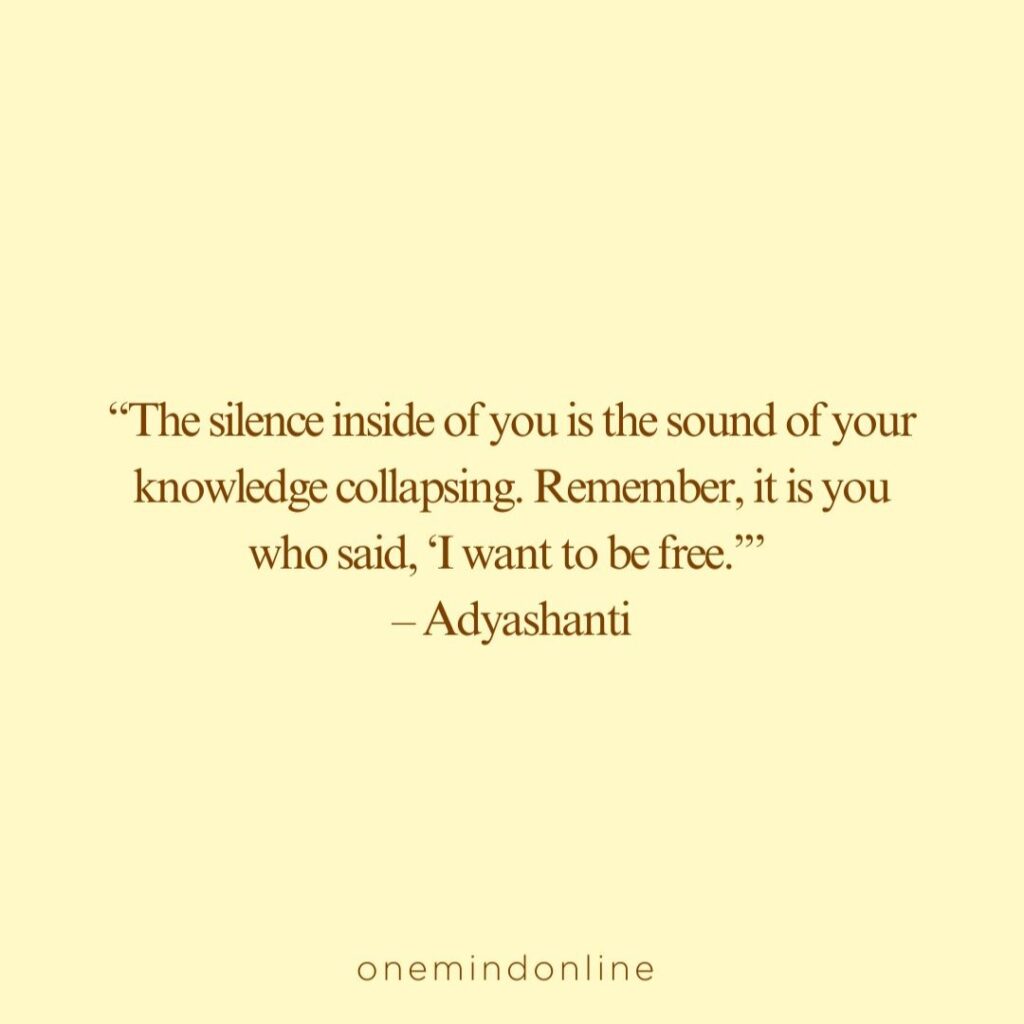
“The silence inside of you is the sound of your knowledge collapsing. Remember, it is you who said, ‘I want to be free.’” – Adyashanti
“Beyond even any teaching, though, the aspect of spiritual life that is the most profound is the element of grace. Grace is something that comes to us when we somehow find ourselves completely available, when we become openhearted and open-minded, and are willing to entertain the possibility that we may not know what we think we know. In this gap of not knowing, in the suspension of any conclusion, a whole other element of life and reality can rush in. This is what I call grace. It’s that moment of “ah-ha!”—a moment of recognition when we realize something that previously we never could quite imagine.” – Adyashanti
I’d like to pause for a moment and have you re-read the words, “when we somehow find ourselves completely available, when we become openhearted and open-minded, and are willing to entertain the possibility that we may not know what we think we know.”
Have you ever noticed how “knowing” can make you operate completely unconsciously? There’s something about knowing that feels like a kind of, “closing of the book”, and closing ourselves to seeing more.
I’ll use a really simple example and you’re invited to add a bit of imagination to make it more personal to you:
Visualize for a moment walking from your bedroom to the kitchen. Travel that journey with your mind as a reminder to yourself. You’ve walked that route so many times and know it so well that you don’t have to think about it at all.
How unconscious have you become while walking that path? Unaware of any of the steps you take?
But imagine for a moment walking that familiar old route at night to fetch a glass of water, and while you walk suddenly experiencing a power failure… pitch black darkness… and in an instant, being hyper conscious comes flooding back, suddenly becoming aware of every foot placement again, which would otherwise have happened unconsciously.
This is not a “bad” thing, but it’s worth realizing that this is what our minds do with everything we “know.” Familiarity creates autopilot, and autopilot dims our presence. We stop truly seeing the people we love most. We stop hearing what’s actually being said. We navigate life on memory, not experience.
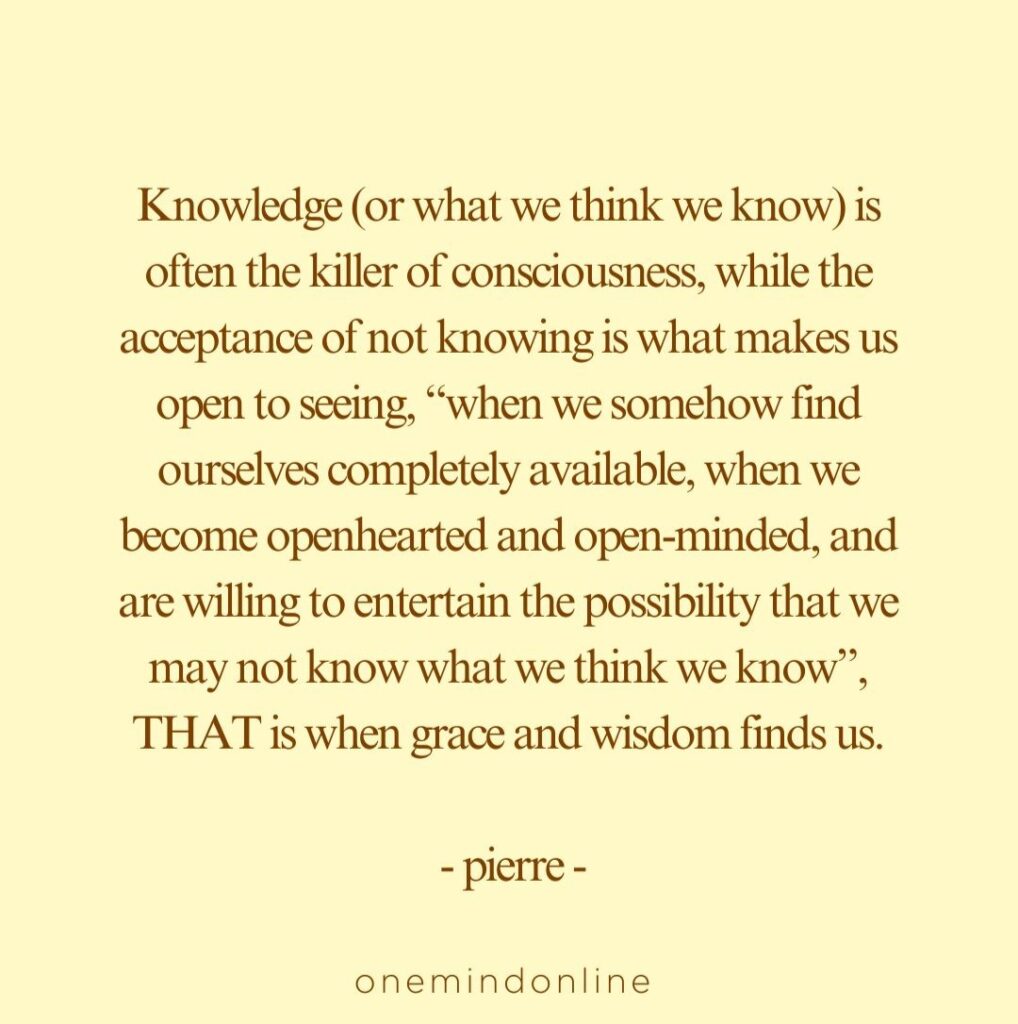
Knowledge (or what we think we know) is often the killer of consciousness, while the acceptance of not knowing is what makes us open to seeing, “when we somehow find ourselves completely available, when we become openhearted and open-minded, and are willing to entertain the possibility that we may not know what we think we know”, THAT is when grace and wisdom finds us.
Of course we should embrace knowledge while also reminding ourselves that all the knowledge in the world won’t protect us from sometimes getting it “wrong”, because “As the Island of our Knowledge grows, so do the shores of our ignorance.” A quote from John Archibald Wheeler that recognizes that the more knowledge we gather, the more likely it is that our ignorance grows unseen as well.
If I am always aware of my own ignorance, I can use the accumulation of knowledge to grow wisdom, instead of falling into the trap of certainty.
Today’s meditation is called “The Serenity Prayer” which will include asking the question: “Please show me what I am not seeing.” This simple question opens us to new possibilities and perspectives that our certainty might otherwise blind us to.
Here are some guiding mantras for self-reflection:
- “Please show me what I am not seeing – I approach even familiar situations with fresh eyes today.”
- “I release the need for certainty. Openness is my strength.”
- “I am awake to this moment. I am not running on memory alone – I am fully here.”
- “My curiosity is stronger than my conclusions. I remain a student of life.”
- “In the space of not knowing, I welcome grace, wisdom, and new possibility.”
By embracing “not knowing,” we cultivate a space for growth, curiosity, and deeper understanding. Remember, the journey of personal development is a lifelong exploration, not a destination. So, keep asking questions, stay open-minded, and allow yourself to be surprised by the wisdom that emerges from the fertile ground of not knowing.
– pierre –
Today’s LIVE meditation is: The serenity prayer.
Today’s LIVE meditation
https://youtu.be/VuIxumK7voA 2026
https://youtu.be/7jWz1JYEXBk 2025
https://youtu.be/S8d4FkqitGg 2024
https://youtu.be/R515Zv1yAbk 2023
Practice the “Daily Dose”
Let’s put it into practice! Choose what works for you – daily, once a week or whenever inspiration strikes. Putting pen to paper wires the neural pathways that will create your new habits.
1 – Affirmation
Write down your favourite affirmation on a sticky note and place it somewhere that you’ll be able to see it the whole day.
- “Please show me what I am not seeing – I approach even familiar situations with fresh eyes today.”
- “I release the need for certainty. Openness is my strength.”
- “I am awake to this moment. I am not running on memory alone – I am fully here.”
- “My curiosity is stronger than my conclusions. I remain a student of life.”
- “In the space of not knowing, I welcome grace, wisdom, and new possibility.”
2 – A moment of reflection
Use today’s question as a journal prompt. If you don’t have the time to sit down and write, just take a moment to reflect on your response.
What would change if I asked ‘please show me what I am not seeing’ every morning? Sit with this question as a genuine practice, not just a thought experiment. Which relationships, habits, or assumptions would you look at differently? What might grace have been trying to show you?
3 – Quotes to share
Send a quote to someone who needs it, or share them all on social media to spread the good vibes!


4 – Q&A for deeper learning
Read through the questions and answers and write down at least one “aha moment” that clicked for you.
Q1. What does it mean that “knowing is the killer of consciousness”?
When we believe we fully “know” something, we stop being curious about it. Our brain puts that knowledge on autopilot, making us less present and aware. This certainty prevents us from seeing new perspectives or information that might contradict or enhance what we think we know. True consciousness requires staying open and receptive rather than settling into fixed certainties.
Q2. How can I tell if I’m operating on “autopilot” in certain areas of my life?
Look for areas where you have strong, immediate reactions without reflection, where you follow the same patterns without question, or where you find yourself saying “that’s just how it is.” Another sign is feeling irritated when someone questions your approach or perspective. These are often indications that your brain has filed something under “known” and stopped being curious about it.
Q3. Isn’t knowledge still valuable? The article seems to suggest otherwise.
The article doesn’t dismiss the value of knowledge—rather, it warns against clinging to knowledge with absolute certainty. Knowledge itself is beneficial, but the belief that our knowledge is complete or unchangeable limits our growth. The ideal approach is to hold knowledge lightly, using it as a foundation for asking better questions rather than as an endpoint that closes further inquiry.
Q4. What exactly is the “grace” that Adyashanti refers to in the article?
Adyashanti describes grace as something that comes when we make ourselves completely available by becoming openhearted and open-minded. It’s the unexpected insight or understanding that arrives when we suspend our conclusions and admit we might not know what we think we know. It’s that “aha!” moment of recognition that couldn’t have emerged from our existing framework of knowledge alone.
Q5. How can I practice “beginner’s mind” in situations where I genuinely do have expertise?
Even with expertise, you can practice approaches like: asking “What might I be missing here?”; deliberately seeking perspectives that challenge your assumptions; being curious about outliers or exceptions to what you “know”; listening to novices’ questions without dismissing them; and periodically returning to fundamentals with fresh eyes. Remember that expertise that remains curious is more valuable than expertise that becomes rigid.
Q6. What’s the benefit of acknowledging my ignorance rather than focusing on what I know?
Acknowledging ignorance keeps you humble, curious, and open to growth. It prevents the arrogance that often accompanies certainty and makes learning new things difficult. As Wheeler’s quote suggests, recognizing the expanding “shores of our ignorance” as our knowledge grows isn’t discouraging—it’s exciting. It means there’s always more to discover and that your potential for growth is limitless.
Q7. How can I apply the concept of “Please show me what I am not seeing” in everyday situations?
You can apply this mantra by: pausing before making judgments; asking clarifying questions in conversations rather than assuming you understand; considering alternate perspectives in conflicts; reviewing past decisions with openness to seeing what you missed; meditating on complex problems with this question in mind; journaling about situations from different viewpoints; and inviting trusted friends to share what they see that you might not. This practice gradually develops greater awareness and reduces unconscious biases.