

“Your Daily Dose” is a quick two minute read packed with bite-sized wisdom from all the great teachers. But you could also choose to turn it into something more… a powerful daily practice for personal growth. Give it a try!
A message from today’s meditation:
Know yourself as the “being” beneath the thoughts…
Take a moment and really feel this statement…
You have thoughts, feelings, emotions… is that who you really are? Or is there a being on a deeper level with the ability to observe all these chemical reactions without getting caught up in them?
“To know yourself as the Being underneath the thinker, the stillness underneath the mental noise, the love and joy underneath the pain… is freedom, salvation, enlightenment.” – Eckhart Tolle
“Observe your thoughts, don’t believe them. Be the silent watcher of your thoughts and behaviour. You are beneath the thinker. You are the stillness beneath the mental noise. You are the love and joy beneath the pain.” – Eckhart Tolle
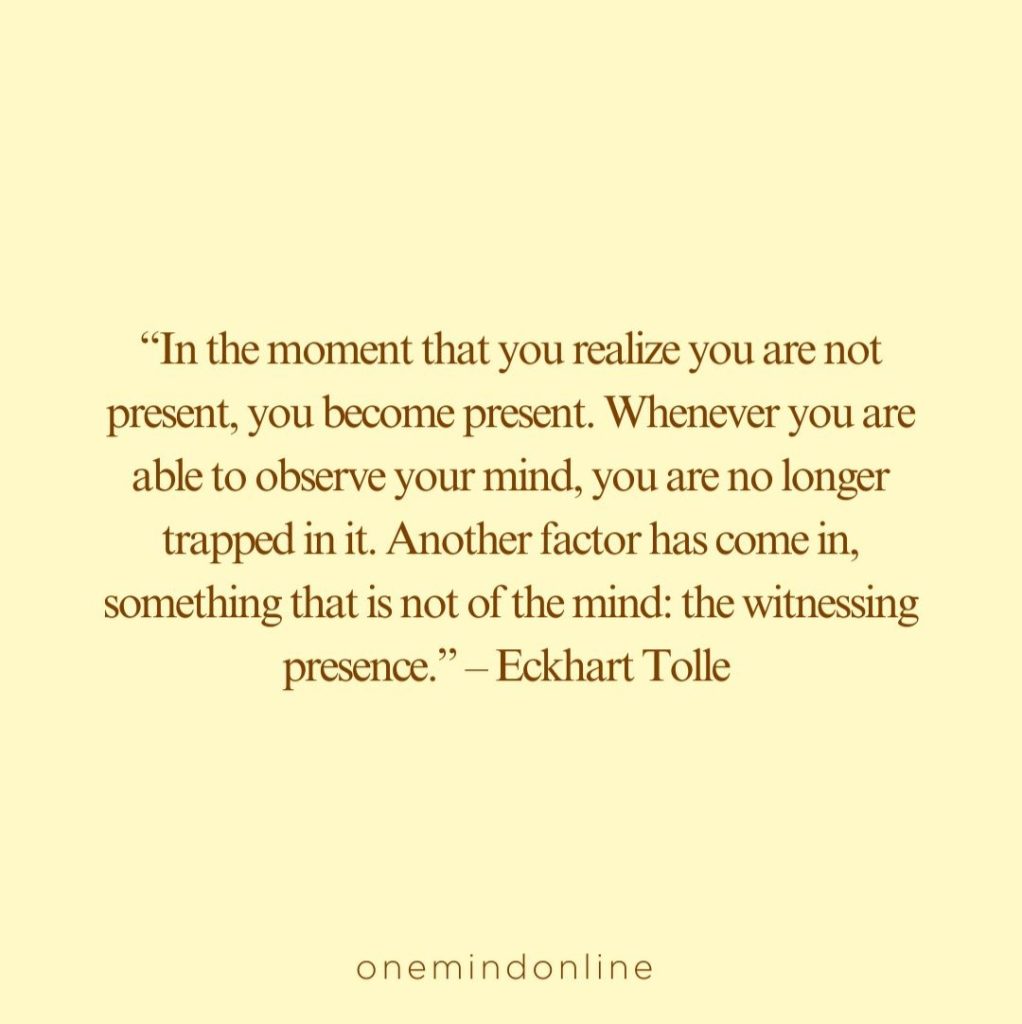
“In the moment that you realize you are not present, you become present. Whenever you are able to observe your mind, you are no longer trapped in it. Another factor has come in, something that is not of the mind: the witnessing presence.” – Eckhart Tolle
We all have more than one experience of our “self”. Often it feels like different voices speaking from within, or different parts of our “selves”. Do you automatically believe that your thoughts are who you are? Or do you instinctively resist and fight a war with the thoughts inside of you?
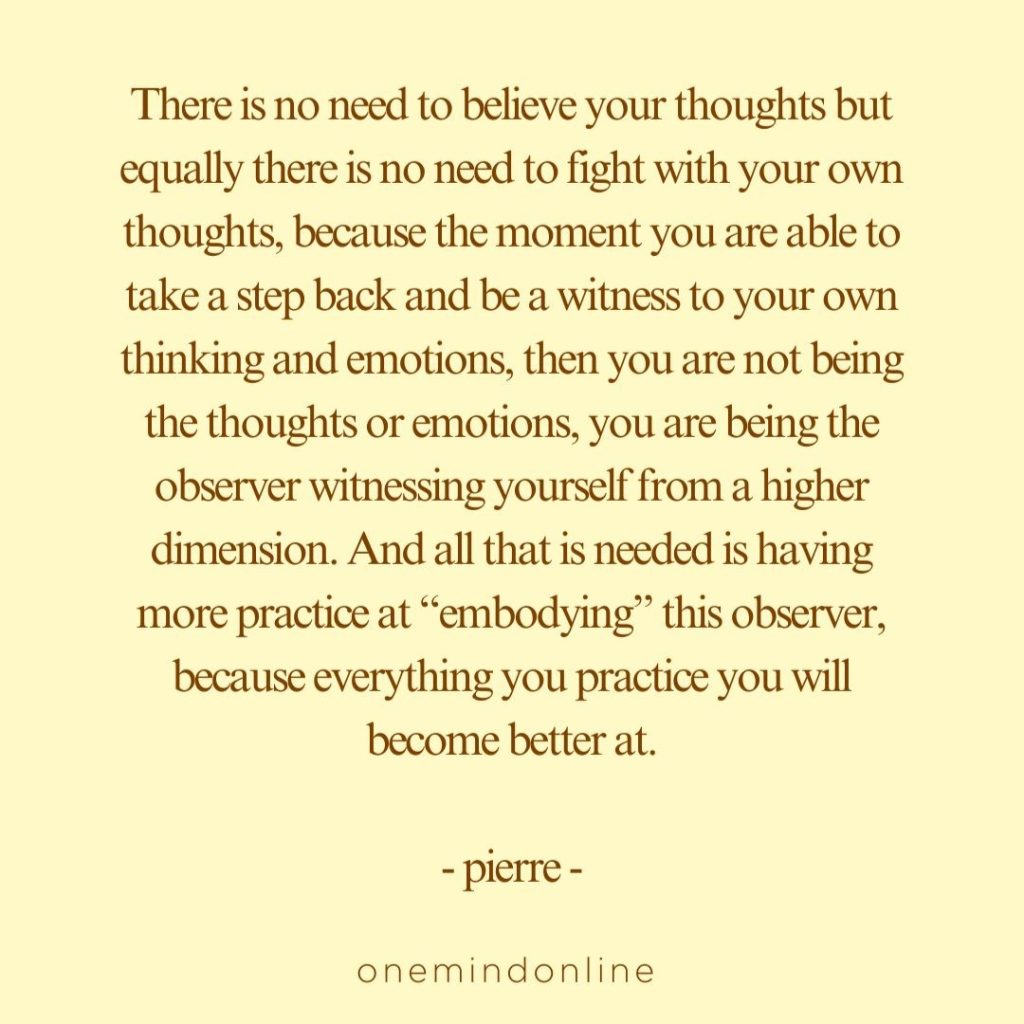
There is no need to believe your thoughts but equally there is no need to fight with your own thoughts, because the moment you are able to take a step back and be a witness to your own thinking and emotions, then you are not being the thoughts or emotions, you are being the observer witnessing yourself from a higher dimension. And all that is needed is having more practice at “embodying” this observer, because everything you practice you will become better at.
This is what makes meditation so powerful. Every meditation is an exercise in stepping outside of the human “pain body” to look at yourself with wisdom, and with continued practice you’ll find yourself acting less from your old wounds and more from your soul.
Mantras for your journey:
- “I am not my thoughts. I am the witness.”
- “I am not my emotions. I am the observer.”
- “I am not my pain. I am the love beneath it.”
Join me for today’s LIVE meditation: “The Observer.” Let’s find peace amidst the noise, together.
– pierre –
Today’s LIVE meditation is: The observer.
Today’s LIVE meditation
https://youtu.be/rN_sv5uh3YY 2026
https://youtu.be/_Xo62kE3dWY 2024
https://youtu.be/oukOpuAxvt0 2022
Practice the “Daily Dose”
Let’s put it into practice! Choose what works for you – daily, once a week or whenever inspiration strikes. Putting pen to paper wires the neural pathways that will create your new habits.
1 – Affirmation
Write down your favourite affirmation on a sticky note and place it somewhere that you’ll be able to see it the whole day.
- “I am not my thoughts. I am the witness.”
- “I am not my emotions. I am the observer.”
- “I am not my pain. I am the love beneath it.”
2 – A moment of reflection
Use today’s question as a journal prompt. If you don’t have the time to sit down and write, just take a moment to reflect on your response.
The “Voices” Within: We all have multiple different aspects of our self that “speak” from within. Write about these different parts – which ones do you automatically believe? Which ones do you fight against? What might change if you simply observed them all without judgment or resistance?
3 – Quotes to share
Send a quote to someone who needs it, or share them all on social media to spread the good vibes!


4 – Q&A for deeper learning
Read through the questions and answers and write down at least one “aha moment” that clicked for you.
Q1: What does it mean to be “the observer” of my thoughts?
Being the observer means recognizing that there’s a part of you that can watch your thoughts without being consumed by them. Just as you can watch clouds pass across the sky, you can observe thoughts moving through your mind without identifying as those thoughts. This witnessing presence is your true self—the awareness that exists beneath the mental chatter.
Q2: If I’m not my thoughts, then who am I?
You are the awareness, the consciousness, the being that experiences thoughts, emotions, and sensations. You are the stillness and presence that remains constant even as thoughts and feelings come and go. This witnessing presence is described as “the love and joy beneath the pain”—it’s the essential you that exists beyond temporary mental and emotional states.
Q3: How is observing my thoughts different from fighting against them?
Fighting your thoughts keeps you engaged in a battle with your own mind, which actually gives those thoughts more power and energy. Observing, on the other hand, creates space and distance. When you simply watch your thoughts without judgment or resistance, they lose their grip on you. Observation is neutral and compassionate; fighting is adversarial and exhausting.
Q4: How can meditation help me become more of an observer?
Meditation provides dedicated time to practice stepping back from your thoughts and emotions. Each meditation session strengthens your ability to witness your inner experience rather than being swept away by it. Like any skill, the more you practice observing in meditation, the more naturally this ability will arise in your daily life. Over time, you’ll find yourself responding from wisdom rather than reacting from old patterns.
Q5: What is the “pain body” mentioned in the article?
The pain body is a concept from Eckhart Tolle referring to the accumulated emotional pain, trauma, and negative experiences we carry within us. It’s the collection of old wounds that can trigger automatic reactions and patterns. When you act from the pain body, you’re responding from past hurts rather than present awareness. Becoming the observer allows you to recognize these patterns without being controlled by them.
Q6: Is it realistic to observe all my thoughts without getting caught up in them?
Perfect, constant observation isn’t the goal—that would be unrealistic. The practice is about increasing moments of awareness. As Tolle says, “In the moment that you realize you are not present, you become present.” Even noticing that you’ve been lost in thought is itself a moment of witnessing presence. With practice, these moments become more frequent, and you’ll find yourself spending less time trapped in mental patterns.
Q7: How do I start practicing being the witness in my everyday life?
Start small by creating pause points throughout your day. When you notice strong emotions or repetitive thoughts, take a breath and ask yourself, “What is observing this right now?” Practice labeling your experiences: “There’s anxiety” instead of “I am anxious.” This simple shift in language helps create distance between the observer (you) and the observed (the emotion). Regular meditation practice will strengthen this capacity, making it easier to access the witnessing presence whenever you need it.