

“Your Daily Dose” is a quick two minute read packed with bite-sized wisdom from all the great teachers. But you could also choose to turn it into something more… a powerful daily practice for personal growth. Give it a try!
A message from today’s meditation:
We’ve been sold a lie about growth. Somewhere along the way corporate boardrooms convinced us that progress must be linear, unwavering and ever increasing quarter on quarter. We see it in shareholders’ panic/disgust at the slightest earnings dip. We see it in social media feeds demanding endless growth. Our idea of “growth” has been perverted into something completely unnatural, and tragically, we’ve internalized this impossible standard, applying it to ourselves with ruthless efficiency.
But here’s the truth: you are not a machine designed for perpetual output. You are human, and that means you ebb and you flow. You grow and contract. You take steps forward and sometimes, necessarily, you take steps back because growth is a dance, and not the flick of a light switch.
Today’s meditation is called “I am the mountain” and I specifically wanted to find a poem about a mountain to share with you. And WOW! I found “The Mountain Poem” by Laura Ding-Edwards. While the poem doesn’t exactly reflect the nature of today’s meditation, it beautifully captures the need to put your burdens down from time to time and just take a moment to be human.
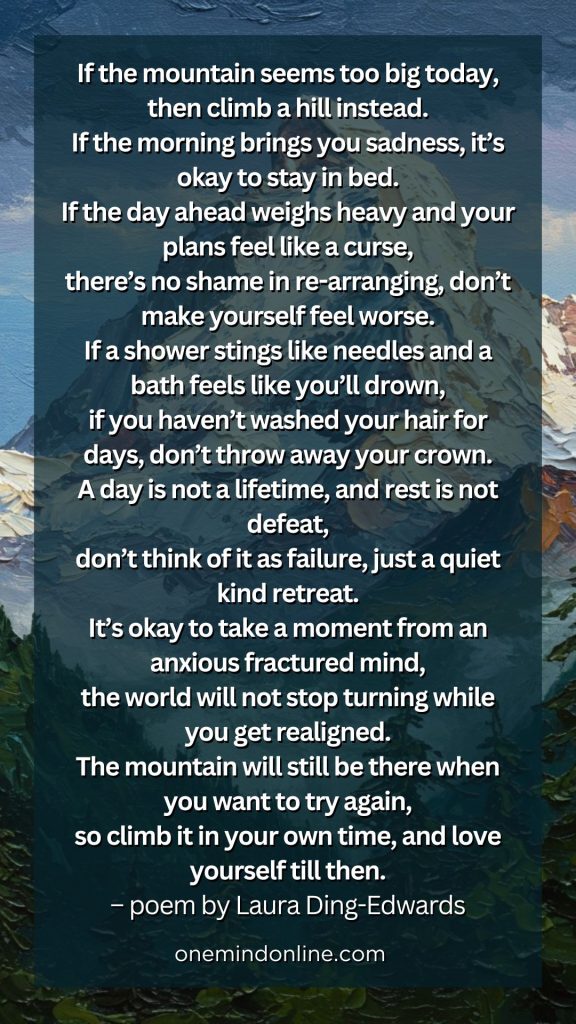
The Mountain Poem
If the mountain seems too big today, then climb a hill instead.
If the morning brings you sadness, it’s okay to stay in bed.
If the day ahead weighs heavy and your plans feel like a curse,
there’s no shame in re-arranging, don’t make yourself feel worse.
If a shower stings like needles and a bath feels like you’ll drown,
if you haven’t washed your hair for days, don’t throw away your crown.
A day is not a lifetime, and rest is not defeat,
don’t think of it as failure, just a quiet kind retreat.
It’s okay to take a moment from an anxious fractured mind,
the world will not stop turning while you get realigned.
The mountain will still be there when you want to try again,
so climb it in your own time, and love yourself till then.
– Poem by Laura Ding-Edwards
Please remember that you are not a machine. While there ARE those days when you do need to push yourself, there are also many moments in which you have to put everything down and just rest, without feeling guilty about it.
It seems we often struggle with finding a balance between when to push and when to put things down. Join us for today’s meditation journey to practice finding your calm centre in the middle of any storm. From this calm space it’s much easier to see when to go hard and when to go home.
A few thoughts to help you find the mountain in you:
- Centering Yourself: Take a moment to breathe, to find your calm center even amidst the chaos. This calm space allows you to see the bigger picture and determine whether it’s a day to push on, or a day to rest.
- Self-Compassion: Remember, you are not a machine. Cut yourself some slack when you need it. If a shower feels overwhelming, a bath feels suffocating, and your hair hasn’t seen shampoo in days – don’t “throw away your crown” (as the poem says). A day of rest doesn’t diminish your worth.
- Reframing Growth: Growth isn’t a constant upward climb; it’s a dance. There will be steps forward and steps back, days of progress and days of stillness. Embrace this dance, and trust that even on those quiet days, you’re still moving in the right direction.
By finding balance we can cultivate a life that is both fulfilling and sustainable. There can be harmony between action and rest, between ambition and acceptance. By honoring our humanness and practicing self-compassion, we can navigate life’s challenges with grace and emerge stronger than ever.
– pierre –
Today’s LIVE meditation is: I am the mountain.
https://youtu.be/7jqi_Qe5NmU 2024
https://www.youtube.com/watch?v=sbtSEFtBUDs 2022
Today’s LIVE meditation
Practice the “Daily Dose”
Let’s put it into practice! Choose what works for you – daily, once a week or whenever inspiration strikes. Putting pen to paper wires the neural pathways that will create your new habits.
1 – Affirmation
Not affirmations today, but a few thoughts on cultivating the mountain in you. Write down your favourite one and place it somewhere that you’ll be able to see it the whole day.
- Centering Yourself: Take a moment to breathe, to find your calm center even amidst the chaos. This calm space allows you to see the bigger picture and determine whether it’s a day to push on, or a day to rest.
- Self-Compassion: Remember, you are not a machine. Cut yourself some slack when you need it. If a shower feels overwhelming, a bath feels suffocating, and your hair hasn’t seen shampoo in days – don’t “throw away your crown” (as the poem says). A day of rest doesn’t diminish your worth.
- Reframing Growth: Growth isn’t a constant upward climb; it’s a dance. There will be steps forward and steps back, days of progress and days of stillness. Embrace this dance, and trust that even on those quiet days, you’re still moving in the right direction.
2 – A moment of reflection
Use today’s question as a journal prompt. If you don’t have the time to sit down and write, just take a moment to reflect on your response.
Your Relationship with Rest: Write honestly about how you feel when you rest. Do you experience guilt, anxiety, or peace? Where did you learn these feelings about rest? What would it mean to truly believe that “a day is not a lifetime, and rest is not defeat”?
3 – Quotes to share
Send a quote to someone who needs it, or share them all on social media to spread the good vibes!
4 – Q&A for deeper learning
Read through the questions and answers and write down at least one “aha moment” that clicked for you.
Q1: How do I know when to push through discomfort versus when to rest?
A: This requires developing what we might call “wise discernment.” Pushing through discomfort that leads to growth (like the challenge of learning something new) feels different from ignoring your body’s genuine distress signals. From a centered, calm place, ask yourself: Is this resistance born from fear of change, or is my body/mind genuinely depleted? Growth discomfort often comes with a sense of possibility; depletion comes with numbness or dread. When in doubt, err on the side of compassion.
Q2: Isn’t resting when things feel hard just avoiding responsibility?
A: There’s a crucial difference between strategic rest and avoidance. Rest is an active choice to restore your resources so you can show up more fully later. Avoidance is running from something indefinitely. Ask yourself: Am I resting to restore, or hiding to escape? If you’re genuinely depleted, rest isn’t shirking responsibility—it’s taking responsibility for your wellbeing so you can sustain your commitments long-term.
Q3: What if I rest and then never want to return to climbing the mountain?
A: This fear often keeps people trapped in burnout. But here’s what typically happens: when you allow genuine rest without guilt, you naturally begin to feel the desire to engage again. Motivation returns when we’re resourced. If after adequate rest you still have no desire to pursue a goal, that’s valuable information—perhaps the mountain itself needs re-examining, not your commitment to climb it.
Q4: How can I practice self-compassion without making excuses for myself?
A: Self-compassion isn’t about lowering standards or avoiding accountability; it’s about speaking to yourself the way you’d speak to someone you love who’s struggling. You can acknowledge both “this is genuinely hard right now” and “I’m capable of handling this” without contradiction. The key is removing the harsh self-judgment that actually undermines your ability to move forward effectively.
Q5: What does “finding your calm center” actually mean in practical terms?
A: Your calm center is that grounded, clear-minded state where you can observe your thoughts and feelings without being overwhelmed by them. Practically, it’s accessed through practices that regulate your nervous system: deep breathing, meditation, time in nature, or any activity that helps you feel present. From this space, decisions become clearer because you’re responding from wisdom rather than reacting from stress.
Q6: Why does our culture make rest feel so wrong?
A: We live in a system that equates constant productivity with value, partly driven by economic models that prioritize endless growth (the “shareholder” mentality mentioned in the article). This creates a culture where rest feels like lost potential rather than necessary renewal. Recognizing this helps you see that the problem isn’t you—it’s a cultural narrative that fundamentally misunderstands human nature. You can choose differently.
Q7: How do I apply this “ebb and flow” philosophy while still achieving my goals?
A: Think of it like training for a marathon. Elite athletes don’t run at full intensity every day—they incorporate rest days, varied intensity, and recovery because that’s how bodies actually build strength. The same applies to any goal. You’ll likely achieve more by honoring your natural rhythms than by forcing constant output. This means planning for seasons of focused effort and seasons of consolidation, trusting that both are essential to sustainable success.