

“Your Daily Dose” is a quick two minute read packed with bite-sized wisdom from all the great teachers. But you could also choose to turn it into something more… a powerful daily practice for personal growth. Give it a try!
A message from today’s meditation:
The world around us is a swirling vortex of events, most of which are completely beyond our control. Yet we often find ourselves desperately trying to shape the world to our liking, it’s almost as if we think that we can grasp at the reins of a dozen wild horses and make them listen to us. This futile pursuit of control can lead to a life of constant stress, anxiety, and unhappiness. It is in these moments of turmoil that we must learn to let go, to surrender, and to discover the true source of peace within ourselves.
You can’t change what happens in the world around you, but you CAN change how you respond to what happens in the world around you.
“You see, suffering has nothing to do with events, but with one’s reaction to events. What’s happening is merely what’s happening. How you feel about it, that is another matter entirely. I have given you the tools with which to respond and react to events in a way which reduces – in fact, eliminates pain, but you have not used them.” – Neale Donald Walsch
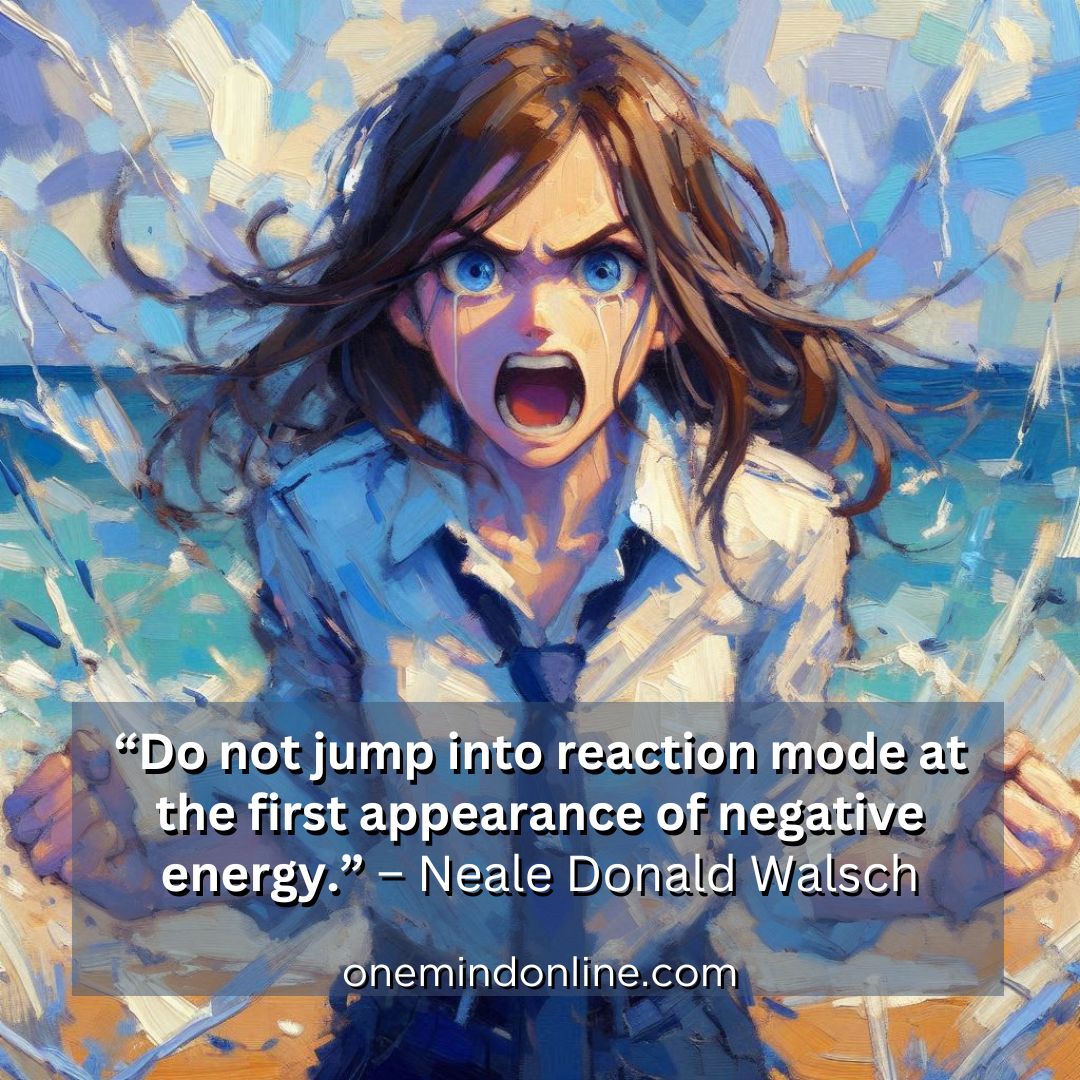
“Do not jump into reaction mode at the first appearance of negative energy. Just breathe, and relax.” – Neale Donald Walsch
“You cannot change the outer event, so you must change the inner experience.” – Neale Donald Walsch
Just as there is constant movement, constant change, in the world around us… so too our inner world is in constant flux. Within us, thoughts and emotions are always flowing in and out like clouds in the sky, and we need to create a similar spaciousness in our response to our inner world as we’ve learned to have with the world around us.
When we master the pause, something remarkable happens: negative energy transforms into opportunities for growth. Rather than being victims of circumstance, we become conscious participants in our own experience. This doesn’t mean becoming passive or disconnected from life. Instead, it means engaging with life from a place of inner stability rather than reactive chaos. We learn to respond rather than react, to choose rather than be chosen for.
It is helpful to have a simple routine that gives us the opportunity to practice spaciousness. The ability to stop, breathe and just observe for a while… not letting our fear steer our reactions… but choosing how it is that we wish to respond.
Today’s meditation is one such simple practice, please join us and learn to master the art of the pause.
A few affirmations you help you embrace the pause:
- “I will pause before I respond.”
- “I can choose how I respond to any situation.”
- “Meditation is my refuge from the chaos of the world.”
- “I will cultivate a sense of spaciousness within myself.”
- “My inner peace is not dependent on external circumstances.”
So the next time you find yourself caught in the grip of negative energy, remember to pause, breathe, and choose a different response. By cultivating a sense of spaciousness and choosing how you respond, you can transform negative energy into opportunities for growth and transformation.
– pierre –
Today’s LIVE meditation is: Come to your senses
Today’s LIVE meditation
https://youtu.be/ldV3ajMO2Ck 2025
https://youtu.be/ARFM7GygR0A 2024
https://youtu.be/Z4MISVetpng 2023
https://youtu.be/-c7BssvdQ24https://youtu.be/-c7BssvdQ24 2022
Practice the “Daily Dose”
Let’s put it into practice! Choose what works for you – daily, once a week or whenever inspiration strikes. Putting pen to paper wires the neural pathways that will create your new habits.
1 – Affirmation
Write down your favourite affirmation on a sticky note and place it somewhere that you’ll be able to see it the whole day.
- “I will pause before I respond.”
- “I can choose how I respond to any situation.”
- “Meditation is my refuge from the chaos of the world.”
- “I will cultivate a sense of spaciousness within myself.”
- “My inner peace is not dependent on external circumstances.”
2 – A moment of reflection
Use today’s question as a journal prompt. If you don’t have the time to sit down and write, just take a moment to reflect on your response.
Mapping Your Inner Weather: Neale Donald Walsch mentions that our thoughts and emotions flow “like clouds in the sky.” Spend time observing your inner landscape over the past week. What patterns do you notice in your emotional responses? When do you feel most spacious and centered, and when do you feel most reactive? What triggers tend to collapse your sense of spaciousness?
3 – Quotes to share
Send a quote to someone who needs it, or share them all on social media to spread the good vibes!
4 – Q&A for deeper learning
Read through the questions and answers and write down at least one “aha moment” that clicked for you.
Q1: What exactly is meant by “the pause” and how is it different from just waiting?
The pause is a conscious choice to create space between an external trigger and your response. Unlike passive waiting, it’s an active practice of breathing, observing, and choosing how to respond rather than reacting automatically. It’s the moment where you reclaim your power to choose your response instead of being swept away by immediate emotions or impulses.
Q2: How can I remember to pause when I’m in the middle of a stressful situation?
Start by practicing the pause during smaller, less emotionally charged moments throughout your day. This builds the neural pathway for pausing. You can also create physical or mental cues – like taking three deep breaths, placing your hand on your heart, or silently saying “pause” to yourself. The key is consistent practice during calm moments so the skill is available during storms.
Q3: Does choosing how to respond mean I should suppress my emotions?
Not at all – but there’s a crucial difference between feeling our emotions and acting from them. When we suppress emotions, we push them below the surface where they don’t disappear but instead fester, building pressure until we inevitably act out from that accumulated tension, often in ways we later regret. Feeling our emotions fully is actually essential precisely so that we don’t act from them unconsciously. The practice is to first feel and process what’s arising, giving it the space to move through us, and then check in with our wisdom by asking, “What is the wisest next step I should take?” When we skip this step and act directly from emotion, we’re really acting from old, conditioned patterns – reactive programming laid down long before this moment. And as long as we keep acting from that old program, we ensure we keep repeating the past, and nothing in our lives will change. The pause isn’t about bypassing feeling; it’s about creating the space between feeling and action where genuine choice becomes possible.
Q4: What if pausing makes me seem weak or passive to others?
It’s actually the opposite of what you might fear – it’s not pausing that makes you look weak, it’s reacting in exactly the way they expect you to react that you show your weakness. When they can push your buttons and you react exactly like they know you will, you’re essentially handing over control of who you are to whatever triggered you, following a script that anyone who knows your patterns could have written in advance. That’s where the vulnerability lies. Pausing, on the other hand, signals that you’re not on autopilot – that you have enough inner strength to interrupt the expected pattern and choose your own path forward. What looks like hesitation is actually sovereignty: you’re demonstrating that external events don’t get to dictate your behaviour. Over time, people come to recognize this quality not as weakness but as a quiet, unshakeable strength – the kind that can’t be provoked or manipulated because it doesn’t run on autopilot.
Q5: How long should “the pause” be? Is there a right amount of time?
There’s no fixed formula – the right length depends largely on how practiced you are at finding this pause. If this is new territory for you, it’s likely you’ll need a considerable amount of time at first: space to self-regulate your nervous system, gather yourself emotionally, and then genuinely check in with your inner wisdom before responding. This might mean minutes, hours, or even a full night’s sleep in the beginning, and that’s completely appropriate, take whatever time you need. But like any skill that becomes well practiced, the pause grows more accessible with repetition – what once took considerable time will gradually compress into moments, then into a single conscious breath. Trust that the current length you need reflects where you are in the practice, not a limitation you should judge yourself for. With consistency, this skill becomes available faster and faster over time, until it feels less like an effort and more like a natural rhythm woven into how you move through life.
Q6: Can this approach work for major life crises or trauma, not just daily stress?
While the pause is valuable during major difficulties, serious trauma often requires additional support from mental health professionals. The pause can be part of a broader healing toolkit, but it’s not a substitute for proper therapy or medical care when dealing with significant trauma. Use it as a complement to, not a replacement for, professional support when needed.
Q7: What if I keep forgetting to pause and find myself reacting the same old ways?
This is a completely normal part of the process, and it’s worth understanding that changing old patterns doesn’t start with the pattern disappearing – it starts with the awareness of the pattern’s existstance. While the ultimate goal is to catch the pattern arising before you react, in the beginning it’s quite normal to only become aware that you’ve reacted the same old way again after the reaction has already happened. This after-the-fact awareness isn’t failure; it’s actually the necessary first stage of the process. Each time you notice, even in hindsight, “there’s that pattern again,” you’re strengthening the very awareness that will eventually let you catch it earlier and earlier – first after you react, then in the middle of reacting, and eventually before you react at all. Be patient with this unfolding, and resist the urge to judge yourself for reacting the same old way. You’re not failing at pausing; you’re in the middle of rewiring something that took years to form, and that recognition itself is real progress.