
“Your Daily Dose” is a quick two minute read packed with bite-sized wisdom from all the great teachers. But you could also choose to turn it into something more… a powerful daily practice for personal growth. Give it a try!
A message from today’s meditation:
Hey! It’s Monday! Let’s jump in together!
Our teacher for this week is Jack Canfield, co-author of the phenomenal Chicken Soup for the Soul book series. Canfield teaches the importance of clearly defining one’s vision and then following up with consistent, disciplined action.
If I had to ask you right now to show me your “clear vision” would you be able to reach for it, pick it up and show me exactly what it is that you want from life?
Let me be clearer. Is this something that you have written down somewhere? A continuously evolving picture that becomes clearer over time. Can you close your eyes and immediately see the image of what it is that you are busy creating?
Here’s a way of making this as easy as possible… allow yourself to daydream. You don’t have to start out being only “realistic”, in fact be deliberate about making as much fun as possible, but do start writing down your daydream and allow it to evolve. Let it be a work in progress that you are constantly reviewing, adding something new to, or shaving off the bits that you’ve outgrown.
If this is not something that is already within easy reach right now, then it’s time to put pen to paper and start creating!
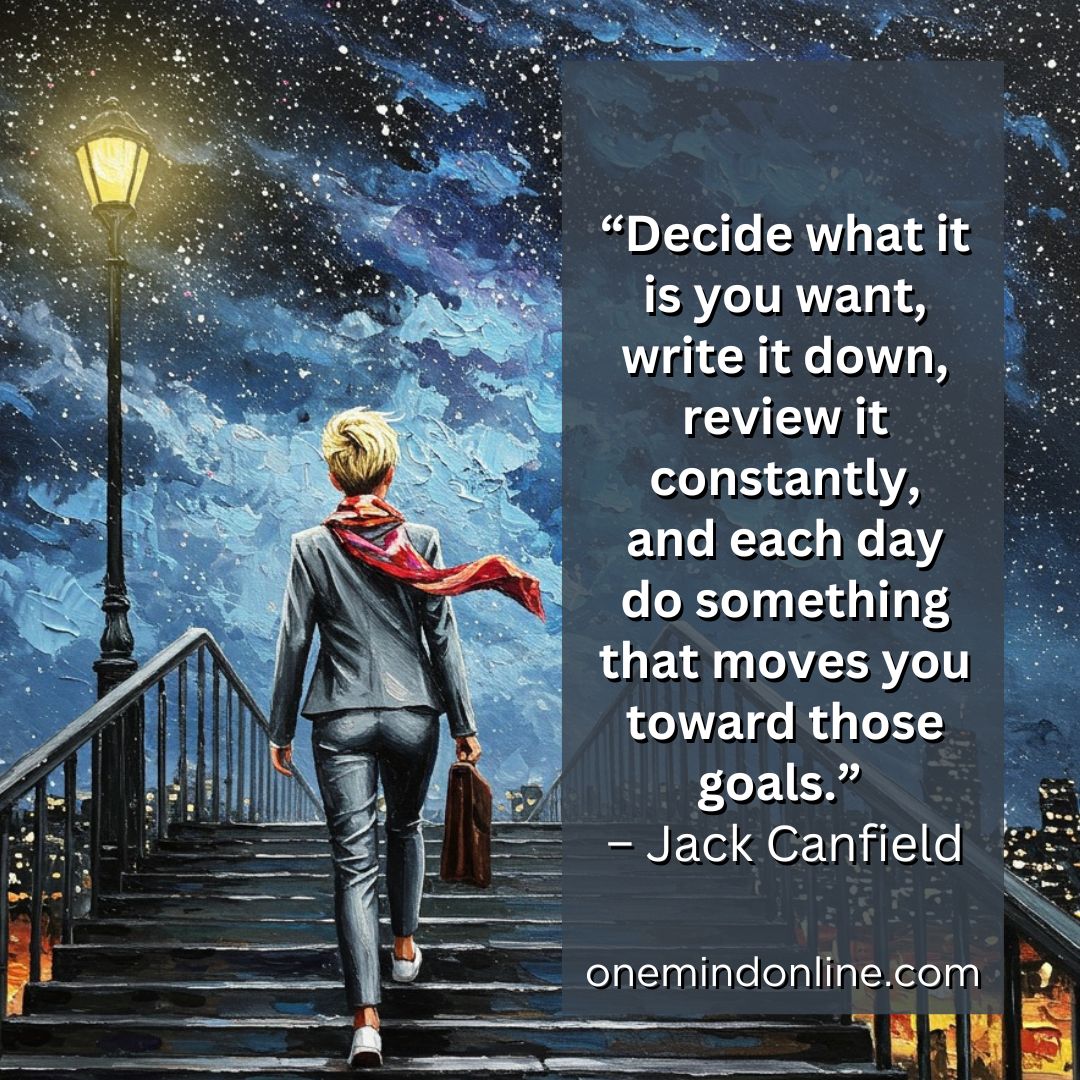
“Decide what it is you want, write it down, review it constantly, and each day do something that moves you toward those goals.” – Jack Canfield
“Decide what you want. Believe you can have it. Believe you deserve it and believe it’s possible for you. And then close your eyes and every day for several minutes, visualize already having what you want, feeling the feelings of already having it. Come out of that and focus on what you’re grateful for already, and really enjoy it. Then go into your day and release it to the Universe and trust that the Universe will figure out how to manifest it.” – Jack Canfield
Today’s meditation journey recognizes that in order to create the “NEW” in our life, we are going to have to change how we respond to the “OLD”.
We have to become aware of the patterns that we perpetuate when we continue to react from the old programme that we learnt while we were deep in survival mode, because every old reaction that we repeat will continue to re-create the situation of our past.
“You only have control over three things in your life – the thoughts you think, the images you visualize, and the actions you take (your behaviour). How you use these three things determines everything you experience. If you don’t like what you are producing and experiencing, you have to change your responses.” – Jack Canfield
“If you want something different, you are going to have to do something different.” – Jack Canfield
Look at the week ahead and decide pro-actively how you want to show up. Use your past experience to plan and rehearse how you want to respond differently when/if the same old problems show up again.
Set the intention to have awareness of the thoughts and behaviours that hold you back, and then become determined to not let old reactions happen on autopilot. What are the old thoughts and behaviours that you will not let slip under the radar this week, and how will you consciously choose to respond differently?
What is your new response to life going to be this week?
A few affirmations for a clear vision:
- “I am breaking free from old patterns that no longer serve my highest good.”
- “I choose my thoughts, visualizations, and actions with intention and purpose.”
- “I have the power to create a clear vision for my life and take daily steps toward it.”
- “I respond to challenges from wisdom, not from outdated survival programming.”
- “I am grateful for my past experiences and excited about consciously creating my future.”
Achieving your goals requires a combination of vision, determination, and intentional action. By creating a clear blueprint for your life, breaking free from old patterns, and embracing new behaviours, you can turn your dreams into reality.
– pierre –
Today’s LIVE meditation is: Jumpstart the week!
Today’s LIVE meditation
https://youtu.be/hNGoxukysDM 2025
https://youtu.be/3AF1CSe55ss 2024
https://youtu.be/vU8mPs7TQTY 2023
https://youtu.be/VIGsstdWwVM 2022
Practice the “Daily Dose”
Let’s put it into practice! Choose what works for you – daily, once a week or whenever inspiration strikes. Putting pen to paper wires the neural pathways that will create your new habits.
1 – Affirmation
Write down your favourite affirmation on a sticky note and place it somewhere that you’ll be able to see it the whole day.
- “I am breaking free from old patterns that no longer serve my highest good.”
- “I choose my thoughts, visualizations, and actions with intention and purpose.”
- “I have the power to create a clear vision for my life and take daily steps toward it.”
- “I respond to challenges from wisdom, not from outdated survival programming.”
- “I am grateful for my past experiences and excited about consciously creating my future.”
2 – A moment of reflection
Use today’s question as a journal prompt. If you don’t have the time to sit down and write, just take a moment to reflect on your response.
Designing Your Life’s Blueprint: Close your eyes and allow yourself to daydream for a moment. Let’s give it a title, “My beautiful life,” and then create it in your mind. What would your beautiful life look like if you had could build it the way you want? Describe this vision in vivid detail, including how it feels, what you’re doing, who you’re with, and what impact you’re having. Now, looking at this vision, what elements feel most authentic and exciting to you? What parts of this dream are you ready to start working toward, even in small ways?
3 – Quotes to share
Send a quote to someone who needs it, or share them all on social media to spread the good vibes!
4 – Q&A for deeper learning
Read through the questions and answers and write down at least one “aha moment” that clicked for you.
Q1. What if I don’t know what I want from life?
First, I want you to know how absolutely normal this is. Most people I talk to really don’t know what they want from life, so please don’t be too hard on yourself. Not knowing isn’t a personal failing, it’s the starting point for most of us. But it’s also worth taking seriously, because as Seneca said, “If a man knows not to which port he sails, no wind is favorable.” Without a destination, even good opportunities and favorable circumstances have nothing to carry you toward. The good news is that you don’t need a perfect, fully formed plan to begin. Start by allowing yourself to daydream without worrying about being realistic, and write down whatever comes up, even if it seems silly or impossible. Treat it as a work in progress that you review often, adding what excites you and letting go of what you’ve outgrown. Your port doesn’t have to be fixed forever, it just has to be clear enough to point your sails in a direction today.
Q2. How can I tell the difference between realistic goals and just wishful thinking?
The honest truth is that when we first set out, we can’t always be sure whether a goal is realistic or just a castle in the sky, but if you never start, you’ll never find out. Whatever the goal is, it almost never materializes in the way we thought or hoped it would, so even the “realistic” ones will surprise us along the way. What matters more than getting the label right is making sure you don’t fall into the wishful thinking trap, and that’s simpler than it sounds. Wishful thinking is hoping and dreaming without taking action, so the antidote is to take action, every day. Keep it simple: write your goal down, break it into small steps, and take one small step each day. Then allow it to evolve. Let it be a work in progress that you are constantly reviewing, adding something new to, or shaving off the bits that you’ve outgrown. Along the way, the daily steps will show you what’s possible far better than any amount of overthinking at the starting line.
Q3. Why do I keep falling back into old patterns even when I know they don’t serve me?
Old patterns persist because they were once survival mechanisms that served an important purpose. Your brain defaults to familiar responses because they feel safe, even when they’re no longer helpful. Breaking these patterns requires conscious awareness and consistent practice of new responses. It’s not about willpower – it’s about creating new neural pathways through repetition. Be patient with yourself; change takes time and self-compassion.
Q4. What if I take action toward my goals but don’t see results quickly enough?
This is where you get to choose who you are, because this is the process that shapes you. No one has ever reached their goals because the results came quickly. Everyone comes up against friction at some point, and when we do, we get to decide: “Do I quit, or do I keep trying? Or do I perhaps change direction?” None of these is a wrong answer, but each is a choice, and the choice itself is where your character gets built. So when progress feels slow, resist the urge to read it as a sign that something is wrong with you or your goal. Slow results are simply the part of the journey where the real work happens. Keep taking your small daily steps, review your vision, and ask yourself honestly whether you need more persistence or a different path. Either way, you are the one who decides, and every time you choose to respond with intention rather than giving up on autopilot, you become more of the person who can achieve what you set out to create.
Q5. How can I stay consistent with new behaviours when life gets overwhelming?
When life gets overwhelming, we naturally slide back into the old programme we learnt in survival mode, because it’s familiar and requires much less energy, which is exactly why the overwhelming weeks are when your new behaviours matter most. So make them easy to keep: shrink them to a size you can manage even on your worst day, and look at the week ahead to anticipate where the old patterns are likely to show up. Rehearse how you want to respond instead, so you aren’t making that choice from scratch in the heat of the moment. If you do slip, don’t treat it as proof that you’ve failed. Notice it, be kind to yourself, and return to your new response at the next opportunity. Consistency doesn’t mean never falling back. It means refusing to let the old reaction become your default again.
Q6. What role does visualization play, and how do I do it effectively?
Closing your eyes and visualizing – which is really a form of mentally rehearsing – connects in your brain the neural pathways that you will use when the time comes. When you take the time to visualize yourself doing the hard thing, then when the hard thing arrives you’re not starting from zero, because your brain has already partially laid down the tracks for you to follow. That is why visualization is so valuable when you’re trying to replace old reactions with new ones: the real moment feels more familiar, and you’re at least less likely to just default to the old programme. To do it effectively, set aside a few minutes each day, close your eyes, and get specific with your visualization. Choose the conversation, the challenge, or the situation in the week ahead where the old pattern usually shows up, and rehearse responding the way you’ve chosen to. When you’re done, shift your focus to what you’re already grateful for, really enjoy it, and head into your day, releasing it with trust. Your visualization doesn’t need to be perfect or cinematic. What matters is that you show up for it consistently and let the feeling be real.